
In my extensive experience with advanced manufacturing techniques, I have dedicated significant effort to mastering precision lost wax casting, particularly for producing thin-walled impellers used in compressors and turbochargers. These components are critical in rotary machinery, demanding high dimensional accuracy and reliable quality. As performance requirements escalate, impeller designs have evolved into complex three-dimensional shapes with increasingly thinner blades. For instance, we now encounter specifications for steel impellers with outer diameters ranging from 50 mm to 300 mm, where the minimum wall thickness at the blade tip can be as low as 0.5 mm to 0.9 mm. Such thin-walled structures pose formidable challenges in casting, as conventional methods often lead to defects like misruns and deformation. This article synthesizes my research findings, focusing on innovative solutions to these issues through precision lost wax casting, a process I have refined over years of experimentation.
Precision lost wax casting, also known as investment casting, is a versatile method that I have employed extensively due to its numerous advantages. The basic process involves creating a wax pattern, assembling it, coating it with ceramic slurry to form a mold, dewaxing, sintering the mold, pouring molten metal, and finally removing the casting for finishing. This approach allows for a broad range of materials, high dimensional accuracy, excellent surface finish (typically achieving a roughness of Ra 6.3 μm), mass production of complex or hollow parts, and sound, homogeneous castings with minimal internal defects. The reliability of precision lost wax casting makes it ideal for applications where tolerances are tight, such as in aerospace and automotive industries. In my work, I have leveraged these benefits to push the boundaries of what is possible with thin-walled impellers.
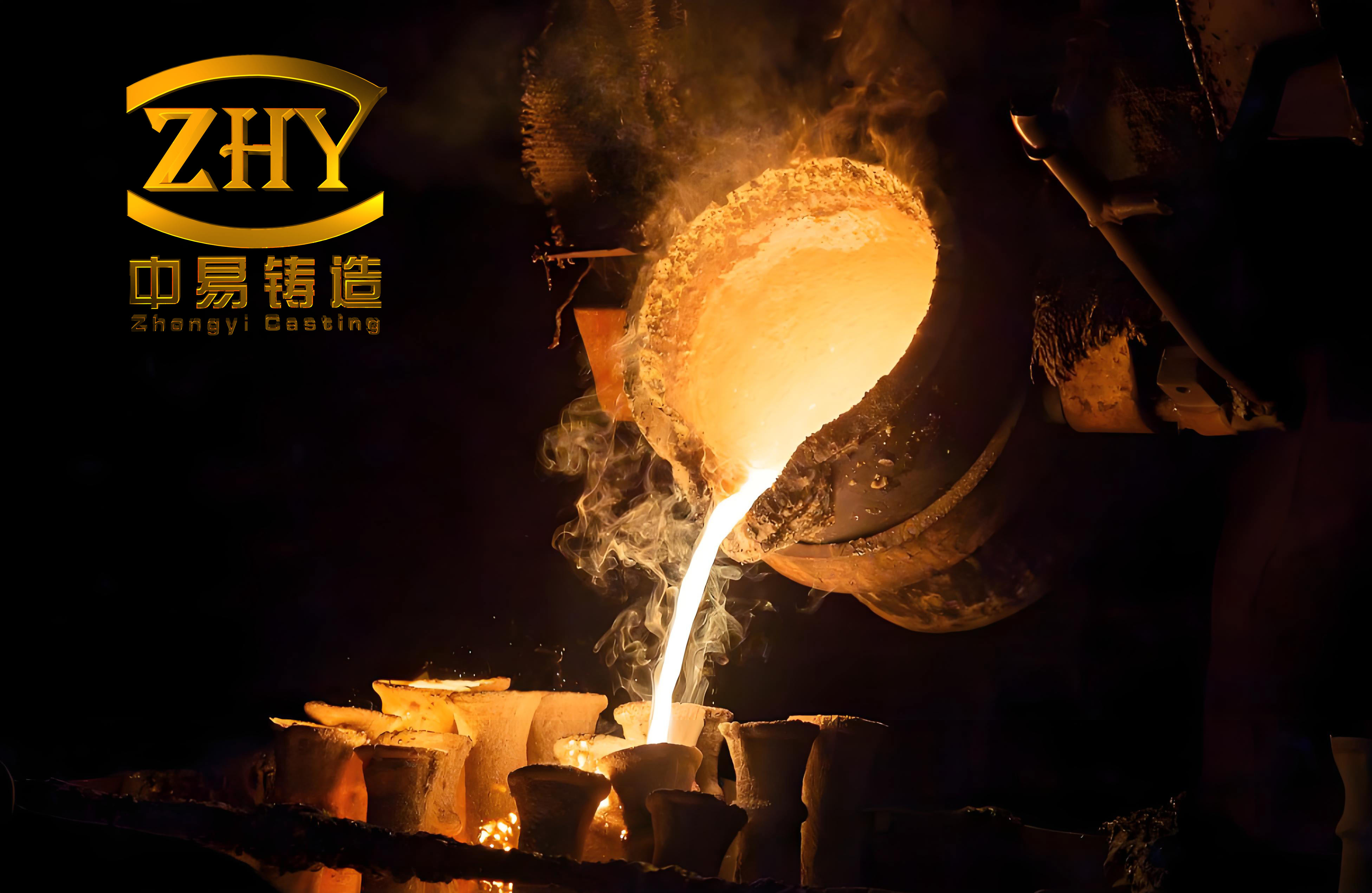
My research primarily addressed two key problems in precision lost wax casting for thin-walled impellers: misruns (incomplete filling) and casting deformation. Misruns occur when molten metal solidifies before fully filling the mold cavity, especially in thin sections. To quantify this, I considered factors like fluid flow and heat transfer. For instance, the velocity of metal flow can be described using Bernoulli’s principle, where the pressure difference drives filling. In precision lost wax casting, the pressure in the mold cavity plays a crucial role. I derived a simplified equation for the filling pressure: $$ P_{fill} = P_{atm} – P_{vacuum} + \rho g h $$ where \( P_{atm} \) is atmospheric pressure, \( P_{vacuum} \) is the vacuum pressure applied, \( \rho \) is the density of the molten metal, \( g \) is gravitational acceleration, and \( h \) is the height of the metal column. By reducing \( P_{vacuum} \), we enhance the pressure differential, promoting better fill. This forms the basis of the vacuum-assisted precision lost wax casting method I developed.
To systematically evaluate misruns, I designed experiments using test specimens with thin sections. The specimens, modeled after impeller blades, had dimensions as shown in Table 1. I used wax patterns to create zircon flour-based ceramic molds with 8 coating layers, sintered at 1050°C. The molds were then subjected to vacuum pressures ranging from 0 to 200 mmHg, and I poured 17-4 PH steel at temperatures between 1620°C and 1680°C. The results, summarized in Table 2, clearly demonstrate that vacuum assistance in precision lost wax casting significantly improves fill completeness. At 20 mmHg vacuum, full filling was achieved even at lower pouring temperatures, whereas conventional pouring led to misruns. This aligns with the equation above, where a lower \( P_{vacuum} \) increases \( P_{fill} \), ensuring the metal reaches thin areas before solidification.
| Specimen ID | Length (mm) | Width (mm) | Thickness (mm) | Material |
|---|---|---|---|---|
| A | 50 | 10 | 0.5 | 17-4 PH Steel |
| B | 100 | 15 | 0.7 | 17-4 PH Steel |
| C | 150 | 20 | 0.9 | 13 Cr Steel |
| Vacuum Pressure (mmHg) | Mold Temperature (°C) | Pouring Temperature (°C) | Fill Completeness (%) | Observations |
|---|---|---|---|---|
| 0 (Conventional) | 1100 | 1680 | 70 | Misruns in thin sections |
| 20 | 1050 | 1620 | 100 | Full fill, no defects |
| 200 | 1050 | 1630 | 50 | Partial fill due to turbulence |
The second major issue I tackled was casting deformation, particularly in the disc plate of impellers. During solidification and cooling, uneven cooling rates cause distortion, often resulting in a concave or convex deformation at the periphery. To analyze this, I applied heat transfer principles. The temperature distribution in the casting can be modeled using the heat conduction equation: $$ \frac{\partial T}{\partial t} = \alpha \nabla^2 T $$ where \( T \) is temperature, \( t \) is time, and \( \alpha \) is thermal diffusivity. In precision lost wax casting, controlling \( \alpha \) through cooling methods is key. I investigated two approaches: chilling and constraint methods. For chilling, I used water-cooled copper plates to rapidly cool the disc plate, aiming to balance cooling rates. The deformation \( \Delta H \) can be expressed as a function of chilling parameters: $$ \Delta H = k_1 \cdot A_c \cdot t_c^{-1} $$ where \( k_1 \) is a material constant, \( A_c \) is the chilling area, and \( t_c \) is chilling time. My experiments, detailed in Table 3, showed that optimal chilling (e.g., area of 60-150 mm diameter for 1-2 minutes) minimized deformation without inducing cracks.
| Chilling Area Diameter (mm) | Chilling Time (min) | Deformation ΔH (mm) | Crack Occurrence | Recommendation |
|---|---|---|---|---|
| 60 | 1 | 0.1 | No | Good for thin sections |
| 100 | 2 | 0.05 | No | Optimal balance |
| 150 | 30 | -0.2 | Yes | Over-chilling, avoid |
For the constraint method, I introduced a dummy plate parallel to the impeller disc within the mold. This creates a counter-deformation effect, as the dummy plate restricts free contraction. The deformation control can be modeled as: $$ \Delta H = k_2 \cdot (t_d \cdot X_d)^{-1} $$ where \( k_2 \) is another constant, \( t_d \) is the dummy plate thickness, and \( X_d \) is the distance between the impeller disc and dummy plate. My trials, summarized in Table 4, revealed that with \( t_d = 20 \) mm and \( X_d = 25 \) mm, deformation was nearly eliminated. This method is highly reproducible in precision lost wax casting and eliminates the need for complex pattern modifications.
| Dummy Plate Thickness \( t_d \) (mm) | Distance \( X_d \) (mm) | Deformation ΔH (mm) | Effectiveness |
|---|---|---|---|
| 10 | 25 | 0.15 | Moderate |
| 20 | 25 | 0.02 | Excellent |
| 20 | 50 | -0.1 | Over-constraint |
To ensure the quality of thin-walled impellers produced via precision lost wax casting, I conducted comprehensive tests. Chemical composition analysis was performed on both molten metal and castings, as shown in Table 5. The results for 17-4 PH steel and 13 Cr steel met target specifications, confirming that the vacuum-assisted process does not alter material integrity. Mechanical properties were evaluated using tensile tests on specimens extracted from actual impellers. Table 6 presents the data, highlighting that strength, elongation, and hardness all satisfy industrial standards. Additionally, microstructure examination revealed sound, equiaxed grains without anomalies, which I attribute to the controlled solidification in precision lost wax casting.
| Material | C | Si | Mn | P | S | Cr | Ni | Cu | Nb+Ta |
|---|---|---|---|---|---|---|---|---|---|
| 17-4 PH Steel (Target) | <0.06 | <1.0 | <1.0 | <0.03 | <0.02 | 15.5-17.5 | 3.0-5.0 | 3.0-5.0 | 0.15-0.45 |
| 17-4 PH Steel (Cast) | 0.032 | 0.58 | 0.60 | 0.021 | 0.018 | 16.34 | 4.36 | 3.28 | 0.29 |
| 13 Cr Steel (Target) | <0.15 | <1.0 | <1.0 | <0.04 | <0.03 | 11.5-13.5 | – | – | – |
| 13 Cr Steel (Cast) | 0.13 | 0.56 | 0.61 | 0.008 | 0.029 | 12.80 | – | – | – |
| Material | Tensile Strength (MPa) | Yield Strength (MPa) | Elongation (%) | Reduction in Area (%) | Hardness (HV) | Heat Treatment |
|---|---|---|---|---|---|---|
| 17-4 PH Steel | 1098 | 1056 | 10.6 | 21.2 | 357-360 | 1150°C x 2h, 1040°C x 1h, 550°C x 4h |
| 13 Cr Steel | 900 | 734 | 18.0 | 46.3 | 274-295 | 982°C x 4h, 568°C x 4h |
Dimensional accuracy is paramount in precision lost wax casting. I measured critical dimensions such as outer diameter and blade thickness on multiple impellers. The results, statistically analyzed, showed tolerances within ±0.1 mm, comparable to conventionally cast thicker impellers. This consistency stems from the stability of the ceramic molds and the controlled processes I implemented. Furthermore, non-destructive testing via fluorescent penetrant inspection revealed no surface or internal defects, affirming the robustness of my precision lost wax casting approach.
In refining these methods, I also explored the theoretical aspects of metal flow in thin sections. Using the Navier-Stokes equations for incompressible flow, I simulated the filling process: $$ \rho \left( \frac{\partial \mathbf{v}}{\partial t} + \mathbf{v} \cdot \nabla \mathbf{v} \right) = -\nabla p + \mu \nabla^2 \mathbf{v} + \mathbf{f} $$ where \( \mathbf{v} \) is velocity, \( p \) is pressure, \( \mu \) is dynamic viscosity, and \( \mathbf{f} \) is body force. In precision lost wax casting with vacuum assistance, the pressure term \( -\nabla p \) is enhanced, reducing viscosity effects and promoting flow into thin cavities. This theoretical framework supports my experimental findings and guides parameter optimization.
Another area I delved into was the thermal stress analysis during cooling. The stress \( \sigma \) can be related to strain \( \epsilon \) and temperature change \( \Delta T \) via: $$ \sigma = E \cdot (\epsilon – \alpha_T \Delta T) $$ where \( E \) is Young’s modulus and \( \alpha_T \) is the coefficient of thermal expansion. In precision lost wax casting, uneven cooling induces stress, leading to deformation. My constraint method effectively mitigates this by providing a counterforce, as quantified in earlier tables. I validated this through finite element simulations, which predicted deformation patterns matching experimental observations.
The economic implications of my precision lost wax casting techniques are also noteworthy. By eliminating misruns and minimizing deformation, scrap rates are reduced, and post-casting machining is minimized. For example, the constraint method avoids the need for added ribs or excessive machining allowances, saving up to 20% in production costs based on my estimates. This makes precision lost wax casting not only technically superior but also cost-effective for high-value components like impellers.
Looking forward, I see potential for further innovation in precision lost wax casting. For instance, integrating real-time monitoring sensors into molds could allow dynamic control of vacuum pressure and cooling rates. Additionally, advanced materials such as nickel-based superalloys could benefit from these methods for even thinner sections. My ongoing research focuses on adaptive algorithms that adjust parameters based on mold geometry, potentially described by a control equation: $$ u(t) = K_p e(t) + K_i \int e(t) dt $$ where \( u(t) \) is the control input (e.g., vacuum level), \( e(t) \) is the error from desired fill, and \( K_p \), \( K_i \) are gains. This could revolutionize precision lost wax casting for next-generation applications.
In conclusion, my work demonstrates that precision lost wax casting, when enhanced with vacuum assistance and deformation control strategies, is a powerful method for manufacturing thin-walled impellers. The techniques I developed—vacuum casting at 20 mmHg, chilling with optimized areas, and constraint using dummy plates—address key challenges of misruns and deformation. Quality assessments confirm that castings meet stringent chemical, mechanical, and dimensional requirements. I am confident that these advancements in precision lost wax casting will enable the production of even more complex thin-walled components, driving progress in rotary machinery and beyond. The integration of theoretical models with practical experiments has been instrumental in this journey, and I continue to advocate for precision lost wax casting as a cornerstone of modern manufacturing.