
In the realm of precision lost wax casting, gas porosity remains a persistent and costly defect that significantly impacts product quality and economic efficiency. Based on my extensive experience in foundry operations, I have observed that gas porosity defects in precision lost wax casting can lead to scrap rates fluctuating with seasonal changes, often peaking during humid summer months. This article delves into the multifaceted mechanisms behind gas porosity formation in precision lost wax casting and explores comprehensive mitigation strategies, emphasizing the critical role of process control and metallurgical treatments. Through detailed analysis, tables, and formulas, I aim to provide a holistic understanding that can enhance the reliability of precision lost wax casting processes.
The formation of gas porosity in precision lost wax casting is primarily driven by chemical reactions, material impurities, and processing inconsistencies. One of the most common issues stems from inadequate shell baking, where residual pattern material—carbon hydrogen compounds—leads to black spots on the shell surface. When molten alloy is poured into such shells, these spots undergo decomposition reactions, releasing gases that become trapped in the casting. For instance, the reaction of hydrocarbons can be represented as: $$C_{n}H_{2n+2} + O_2 \rightarrow nC + (n+1)H_2$$ This is followed by secondary reactions like: $$C + O_2 \rightarrow CO_2$$ and $$2CO + O_2 \rightarrow 2CO_2$$ These gases manifest as pinholes or irregular external pores, severely compromising the integrity of precision lost wax castings. To prevent this, it is essential to minimize residual wax during dewaxing and ensure proper shell baking at temperatures between 800°C and 850°C with sufficient holding time.
Another significant contributor to gas porosity in precision lost wax casting involves the shell manufacturing process itself. Impurities in refractory materials, such as calcium carbonate (CaCO₃), can decompose at high temperatures, releasing carbon dioxide. The decomposition reaction is: $$CaCO_3 \xrightarrow{\Delta} CaO + CO_2$$ This typically occurs above 900°C, and if the shell contains such impurities, gas evolution during pouring leads to porosity. Additionally, the type of binder used affects shell permeability. In precision lost wax casting, water glass-based binders often result in higher permeability due to microcracks formed during gelation, compared to ethyl silicate or silica sol binders. The table below summarizes the permeability characteristics of different binders in precision lost wax casting shells:
| Binder Type | Permeability (Relative Units) | Typical Application in Precision Lost Wax Casting |
|---|---|---|
| Water Glass | High | Common for cost-effective shells |
| Ethyl Silicate | Medium | Used for high-quality castings |
| Silica Sol | Low | Preferred for aerospace components |
Residual soluble cores, often made of urea, can also cause gas porosity in precision lost wax casting if not fully dissolved. Urea decomposes during baking and pouring, producing ammonia and other gases: $$2CO(NH_2)_2 \rightarrow NH_2-CO-NH-CO-NH_2 + NH_3$$ and $$NH_3 \rightarrow N + 3H$$ To avoid this, thorough washing of wax patterns in flowing water is crucial in precision lost wax casting processes. Furthermore, the use of iron wires for shell reinforcement can lead to oxidation during baking, forming iron oxides that react with molten steel to generate CO and CO₂ gases, resulting in large external pores. The reactions include: $$4Fe + 3O_2 \rightarrow 2Fe_2O_3$$ and $$Fe_2O_3 + CO \rightarrow 2Fe + CO_2$$ These issues highlight the need for careful material selection and process control in precision lost wax casting.
The phenomenon of “white hair” on shells—a mixture of sodium chloride (NaCl) and ammonium chloride (NH₄Cl)—is another source of gas porosity in precision lost wax casting. NaCl, with a boiling point of 1413°C, can vaporize during pouring, creating fine pinholes. NH₄Cl sublimates at around 350°C and has less impact. Controlling “white hair” formation involves managing hardening agent composition and reducing shell storage time after dewaxing. Moreover, residual saponified powders from reused pattern materials, such as stearates of iron or aluminum, can vaporize and cause surface pitting in precision lost wax castings. These low-melting compounds often accumulate in shell cavities, emphasizing the importance of proper wax recovery and shell baking practices.
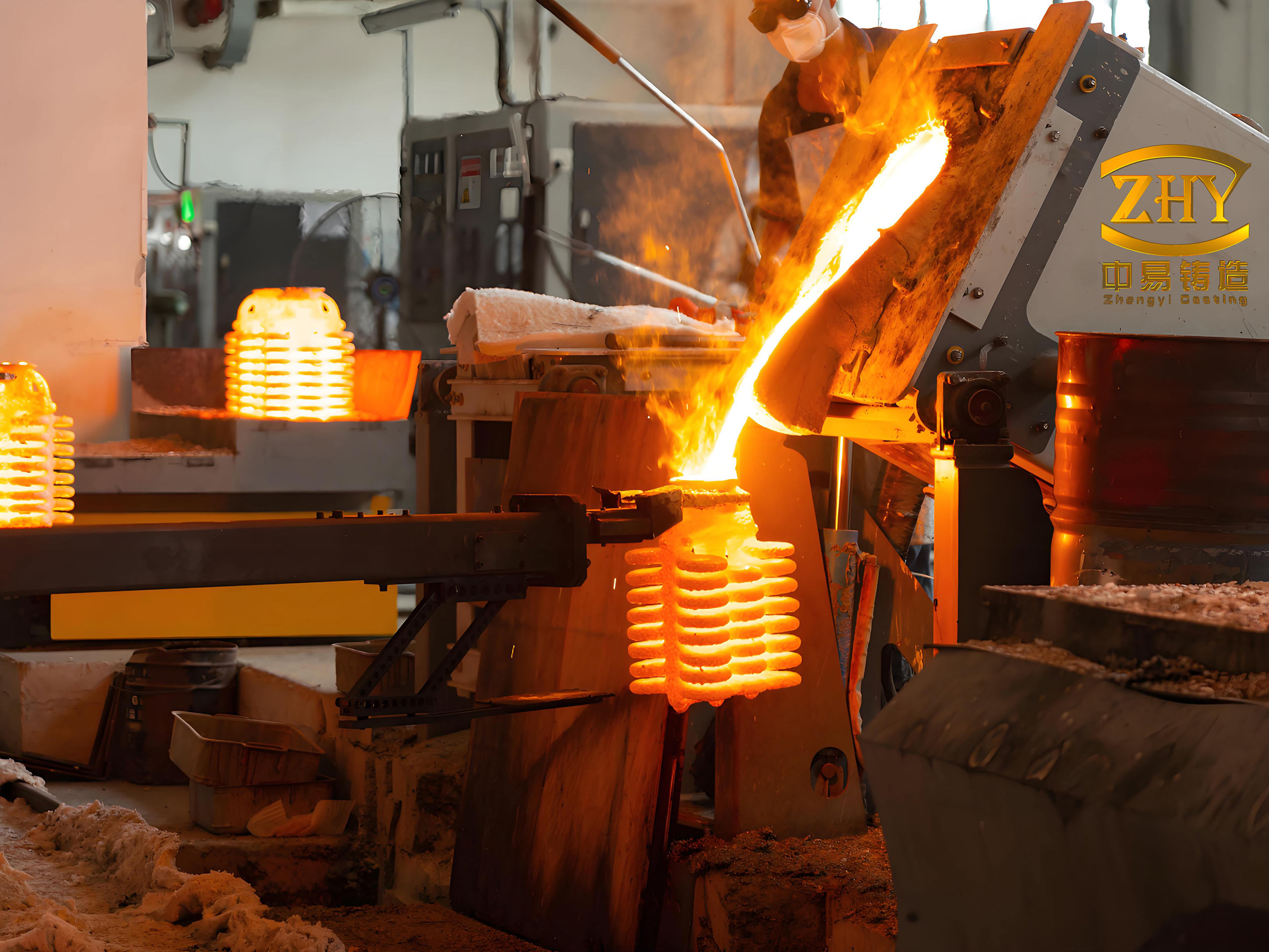
Gas entrapment in the molten alloy itself is a critical factor in precision lost wax casting. During non-vacuum melting, steels can absorb oxygen, hydrogen, and nitrogen, which precipitate as gases upon solidification. The solubility of gases in steel follows an inverse relationship with temperature, as described by Sieverts’ law: $$[G] = k \sqrt{P_G}$$ where [G] is the gas concentration, k is a constant, and P_G is the partial pressure. Carbon-oxygen reactions, such as $$[C] + [O] \rightarrow CO$$ can cause boiling in the melt, leading to “honeycomb” porosity in precision lost wax castings. Similarly, in the final solidification stages, high concentrations of carbon and hydrogen may form methane (CH₄), resulting in internal porosity. To quantify gas-related defects, the table below shows monthly scrap rates due to gas porosity in a typical precision lost wax casting operation, reflecting seasonal variations:
| Month | Gas Porosity Scrap Rate (%) | Environmental Conditions in Precision Lost Wax Casting |
|---|---|---|
| January | 8.2 | Cold, dry |
| April | 3.5 | Moderate humidity |
| August | 9.6 | High humidity, hot |
| December | 7.8 | Cold, variable |
To mitigate gas porosity in precision lost wax casting, effective melt purification is essential. Traditional deoxidation methods often fall short, but composite deoxidation—using elements with high affinity for oxygen—can significantly reduce gas content. Elements like rare earths, magnesium, and aluminum are superior deoxidizers. The standard free energy of formation for oxides, which indicates deoxidation power, can be expressed as: $$\Delta G^\circ = \Delta H^\circ – T\Delta S^\circ$$ where ΔG° is the standard Gibbs free energy change, ΔH° is the enthalpy change, T is temperature, and ΔS° is the entropy change. For rare earth oxides, ΔG° is more negative than that of iron oxide, making them highly effective in precision lost wax casting. The following table compares deoxidation capabilities of various elements used in precision lost wax casting:
| Deoxidizer | Typical Addition (%) | Effect on Oxygen Content (ppm) in Precision Lost Wax Casting |
|---|---|---|
| Mn-Fe | 0.25 | Reduction by 10-15 |
| Si-Fe | 0.15 | Reduction by 20-25 |
| Aluminum | 0.08 | Reduction by 30-40 |
| Rare Earth Alloy | 0.3 | Reduction by 40-50 |
| Si-Ca Alloy | 0.15 | Reduction by 50-60 |
In my practice, implementing composite deoxidation in precision lost wax casting has led to remarkable improvements. For example, in melting ZG45 steel, a sequence of Mn-Fe, Si-Fe, Al, rare earth alloy, and Si-Ca alloy additions reduced oxygen content to as low as 15.4 ppm, compared to over 40 ppm with conventional methods. This not only minimizes gas porosity but also enhances mechanical properties by modifying inclusion morphology. The reaction kinetics can be modeled using: $$\frac{d[O]}{dt} = -k[O][D]$$ where [O] is oxygen concentration, [D] is deoxidizer concentration, and k is the rate constant. The use of electromagnetic stirring in induction furnaces further accelerates inclusion removal, which is vital for high-integrity precision lost wax castings.
Economic analysis underscores the benefits of advanced deoxidation in precision lost wax casting. By adopting composite deoxidation, scrap rates due to gas porosity can be slashed from over 8% to around 6%, translating to substantial cost savings. The table below contrasts economic losses for a typical precision lost wax casting component—an axle housing—using different deoxidation methods:
| Deoxidation Method | Scrap Rate (%) | Annual Scrap Loss (Units) | Cost Savings in Precision Lost Wax Casting (USD) |
|---|---|---|---|
| Precipitation Deoxidation | 8.5 | 850 | Baseline |
| Composite Deoxidation | 6.0 | 600 | 18,000 |
This demonstrates that investing in melt purification technologies can yield high returns in precision lost wax casting operations, particularly for thick-section or fully machined components where internal quality is paramount. Additionally, process optimizations such as controlled shell baking, proper wax removal, and environmental management contribute to reducing gas porosity. For instance, maintaining shell temperatures above 700°C during pouring can alleviate thermal stresses and minimize gas entrapment in precision lost wax castings.
In conclusion, gas porosity in precision lost wax casting is a complex defect influenced by multiple factors, from shell chemistry to melt treatment. Through systematic analysis and the application of composite deoxidation, along with stringent process controls, it is possible to achieve significant reductions in porosity-related scrap. The integration of tables and formulas, as presented here, provides a framework for optimizing precision lost wax casting processes. As the industry advances, continued focus on material purity and reaction dynamics will further enhance the reliability and economic viability of precision lost wax casting, ensuring high-quality components for demanding applications.