
The continuous evolution of aerospace vehicle design demands components with increasingly complex geometries—featuring variable wall thicknesses, semi-enclosed or fully enclosed internal cavities, and asymmetric structures. This complexity elevates the requirements for materials, necessitating superior properties such as low density, high strength, excellent high-temperature resistance, and corrosion tolerance. In this context, the precision lost wax casting process has emerged as a predominant manufacturing route for producing critical, near-net-shape components like engine casings and structural airframe parts. This capability for integral forming of complex shapes offers significant advantages in reducing weight and assembly complexity.
My research focuses on addressing the significant challenge of manufacturing large, thin-walled, and intricate castings from advanced high-temperature titanium alloys. While conventional titanium alloys like Ti-6Al-4V (TC4) are widely used in precision casting due to their good fluidity and relatively low cracking tendency, their application is limited to service temperatures around 300-350°C. The development of next-generation aerospace systems requires materials capable of withstanding temperatures exceeding 550°C. Alloys from the Ti-Al-Sn-Zr-Mo-Si-Nb-Ta system, such as the ZTi55A alloy investigated here, meet this demand. However, their increased alloying content often leads to reduced casting fluidity and a pronounced susceptibility to hot tearing and cracking during solidification and cooling. Therefore, developing a tailored precision lost wax casting methodology, encompassing both the forming and post-processing stages, is crucial for the successful production of defect-free components from these advanced materials.
This article details a systematic study on the fabrication of a large-scale skeleton structure from ZTi55A alloy. The component, with maximum envelope dimensions of approximately 1600 mm x 800 mm and wall thicknesses generally under 3 mm, presents a classic challenge in casting large, complex, thin-walled parts. The research pathway involved two primary approaches: initial development via segmented casting followed by welding, and subsequent advancement towards a fully integral precision lost wax casting process. Each stage involved meticulous optimization of the entire process chain, from pattern creation to final post-treatment.
Material and Methodological Framework
The base material for this investigation is ZTi55A, a high-temperature titanium alloy with a nominal composition designed for service at elevated temperatures. The target chemical composition is provided in Table 1.
| Element | Al | Sn | Zr | Mo | Si | Nb | Ta | Ti |
|---|---|---|---|---|---|---|---|---|
| Content | 5.2-5.8 | 3.0-4.0 | 2.5-3.5 | 0.2-1.0 | 0.1-0.5 | 0.2-0.7 | 0.2-0.7 | Bal. |
The primary manufacturing technique employed is precision lost wax casting, also known as investment casting. The fundamental process sequence is: 1) Creation of a wax or polymer pattern of the component, 2) Assembly of patterns onto a central gating system to form a “tree”, 3) Building a ceramic shell around the pattern assembly through repeated dipping in slurry and stuccoing with refractory granules, 4) Removal of the pattern material (dewaxing), 5) High-temperature firing of the ceramic shell to develop strength, 6) Melting the alloy and pouring it into the preheated shell, and 7) Post-casting operations like shell removal, finishing, and heat treatment.
The critical challenge with ZTi55A is managing its solidification behavior to avoid defects. The total solidification time ($t_f$) for a section can be approximated by Chvorinov’s rule:
$$ t_f = C \left( \frac{V}{A} \right)^n $$
where $V$ is the volume, $A$ is the surface area, $C$ is a mold constant, and $n$ is an exponent (typically ~2). For thin-walled sections, $(V/A)$ is small, leading to rapid solidification and high thermal stresses ($\sigma_{therm}$), which can be estimated by:
$$ \sigma_{therm} \propto E \cdot \alpha \cdot \Delta T $$
where $E$ is Young’s modulus, $\alpha$ is the coefficient of thermal expansion, and $\Delta T$ is the temperature gradient. The high $\Delta T$ in thin sections increases stress, promoting hot tearing if the cohesive strength of the semi-solid material is exceeded.
Phase 1: Segmented Casting and Welding Development
Given the initial technical challenges associated with casting the entire large component integrally from the crack-prone ZTi55A, a segmented approach was first adopted. The skeleton was logically divided into three sections: Front, Middle, and Rear. This segmentation was designed to place weld joints in areas with more favorable geometry (reduced thickness variation) for subsequent electron beam welding.
Pattern and Gating Design for Segments
For the precision lost wax casting of each segment, patterns were fabricated using laser-based rapid prototyping (e.g., Stereolithography – SLA). This tool-less method allows for rapid iteration and direct creation of complex patterns from digital models. To combat warpage inherent in large, flat wax patterns, custom anti-deformation fixtures and inspection gauges were designed and employed. Each segment’s gating system was carefully engineered as a bottom-filling design. Bottom-gating promotes smoother, more turbulent-free filling of the mold cavity, reducing the entrainment of gases and erosion of the ceramic shell. It also favors directional solidification from the farthest point back towards the feeder heads (risers). Supplementary feeders were added at localized hot spots (areas with higher volumetric mass) to provide adequate molten metal feed to counteract shrinkage porosity. The overarching goal was to ensure sound, defect-free segments as the building blocks for the final assembly.
Shell Building and Firing Process
The ceramic shell is a critical element in precision lost wax casting, as it forms the mold cavity and must withstand the thermal shock of molten titanium (~1700°C) while maintaining dimensional stability and chemical inertness. A shell system based on a composite refractory material (a blend of Y$_2$O$_3$ and ZrO$_2$) and a specialized binder was used. The shell-building sequence is detailed in Table 2.
| Layer | Slurry Type | Stucco Material | Function | Drying Condition |
|---|---|---|---|---|
| Prime Coat | Refractory + Binder | Fine Zirconia (200 mesh) | Provides smooth surface finish | 22±2°C, 40-60% RH, 10-12h |
| 2nd Coat | Refractory + Binder | Alumina-Silicate (200 mesh) | Transition layer | 22±2°C, 40-60% RH, 10-12h |
| Coat 3-10 | Refractory + Binder | Alumina-Silicate (200 mesh) | Builds structural strength | 22±2°C, 40-60% RH, 10-12h |
| Final Seal Coat | Refractory + Binder | None | Seals surface, increases strength | 22±2°C, 40-60% RH, 10-12h |
After the final drying, the shell undergoes dewaxing (typically in an autoclave or flash fire) to remove the pattern material completely. This is followed by a high-temperature firing cycle, reaching temperatures above 1000°C. This firing process sinters the ceramic particles, burns out any residual organics, and develops the necessary high-temperature strength and permeability in the mold. A controlled firing curve with specific ramp and soak stages is essential to prevent shell cracking.
Melting, Pouring, and Initial Results
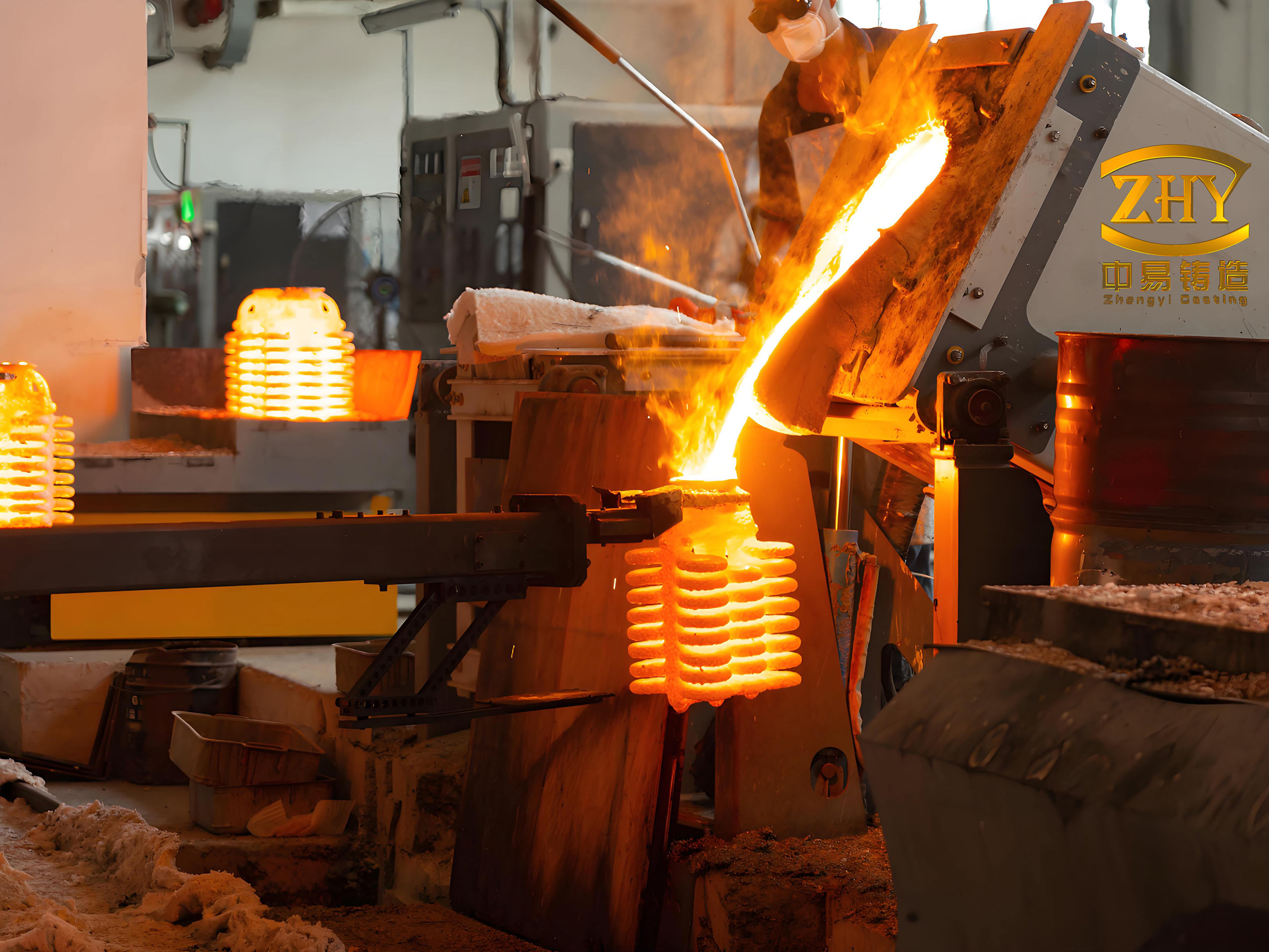
The melting of ZTi55A was conducted in a vacuum skull furnace (e.g., Vacuum Arc Remelting or Induction Skull Melting), which is standard for reactive alloys like titanium. To mitigate the high thermal stress and cracking tendency of this alloy, a “hot mold” pouring practice was implemented. The fired ceramic shells were preheated to 400-450°C before being quickly transferred to the furnace for pouring. This practice reduces the initial temperature gradient ($\Delta T$) between the molten metal and the mold, thereby slowing the cooling rate and reducing thermal stress, as suggested by the simplified stress relationship above. The melt was superheated by controlling the furnace current (in the range of 45-50 kA) to improve fluidity. After pouring, the entire mold assembly was insulated to further retard cooling. The resultant cast segments were found to be fully formed with a good metallic surface finish, free from visible cracks or major surface defects. Chemical analysis confirmed the composition of the segments was within the specified range for ZTi55A.
Phase 2: Integral Precision Lost Wax Casting
Building on the lessons learned from the segmented trials, the process was advanced to tackle the integral casting of the full-scale skeleton. The key challenges identified and addressed were: stress concentration at sharp section changes, potential for inclusions from small, hard-to-dry shell features, and inadequate feeding leading to shrinkage.
Design for Castability (DfC) Modifications
To facilitate a successful integral precision lost wax casting, several design modifications were incorporated into the casting pattern, which would later be machined away to achieve the final part geometry:
- Increased Fillet Radii: All sharp corners and junctions between thin and thick sections were given generously increased radii in the wax pattern. This reduces stress concentration factors, lowering the local stress well below the hot tear strength of the solidifying alloy. The final required part radius is achieved later via machining.
- Filling of Small Recesses: Very small, deep recesses or channels that pose a risk for inadequate shell drying and subsequent shell inclusion defects were simply filled in solid in the wax pattern. These features were then created accurately in the final part through CNC machining after casting.
- Enlarged Feeders (Risers): Feeder heads were significantly oversized compared to standard rules. The goal was to create a massive thermal mass that remains liquid longest, ensuring efficient feeding of shrinkage throughout the solidification process and definitively drawing any shrinkage porosity into the feeder body, away from the casting itself. These feeders are removed after Hot Isostatic Pressing (HIP).
- Strategic Reinforcement Ribs: Temporary reinforcing ribs and plates were added to the wax pattern across large, flat, or unstable areas. These “process ribs” greatly stiffen the wax pattern and the subsequent ceramic shell during handling and the early stages of casting cooling, minimizing overall distortion. They are removed after casting.
Gating System Design for Integral Casting
For the large, non-axisymmetric integral casting, a carefully designed bottom-gating system remained the cornerstone of the approach. The system was laid out to ensure a gradual, controlled fill from the bottom up, minimizing turbulence. Multiple in-gates were positioned to distribute the metal flow evenly to different sections of the part. The feeder heads were placed at the topographically highest points of the casting and connected to the heaviest sections to establish a strong temperature gradient for directional solidification. A robust central pouring cup and downsprue were designed, and the entire wax assembly was secured within a strong, dedicated steel framing fixture to prevent any distortion during the lengthy shell-building process.
Process Refinements and Outcome
The shell-making process followed the established parameters. Extreme care was taken to ensure shell cleanliness. After firing, the shells were meticulously inspected using high-resolution borescopes. Any loose debris was removed via careful cleaning and air blowing. The integral shell was then poured using the same optimized hot-mold practice developed earlier. The result was a fully formed, integral ZTi55A skeleton casting. Visual inspection showed complete filling with no evident mis-runs, cold shuts, or surface cracks. Chemical analysis again confirmed the alloy composition was within specification, as shown in a representative comparison in Table 3.
| Element | Spec. Min | Spec. Max | Cast Sample | Status |
|---|---|---|---|---|
| Al | 5.2 | 5.8 | 5.4 | OK |
| Sn | 3.0 | 4.0 | 3.6 | OK |
| O | – | 0.20 | 0.11 | OK |
Post-Casting Treatment and Critical Process Development
Successful solidification is only the first step. For titanium alloys, especially those used in critical applications, subsequent treatments are vital to achieve the required surface integrity, internal quality, and mechanical properties.
Alpha Case Removal via Chemical Pickling
All titanium castings react with the ceramic shell and atmospheric oxygen/nitrogen at high temperatures, forming a hard, brittle surface layer rich in alpha-stabilizing elements (oxygen, nitrogen). This “alpha case” must be completely removed as it severely reduces fatigue life and ductility. For ZTi55A, the thickness of this contaminated layer was first characterized on test blocks of different thicknesses (5, 10, 15, 20 mm). Metallographic examination revealed that the alpha case depth ($d_{\alpha}$) was not constant but showed a slight correlation with section thickness, likely due to varying local cooling rates affecting reaction kinetics. An average target removal depth of 0.4 mm was established.
The removal process is chemical pickling in an aqueous solution of Hydrofluoric (HF) and Nitric (HNO$_3$) acids. The rate of material removal (pickling rate, $R_p$) is a key parameter determined experimentally using witness coupons. The fundamental kinetic relationship can be expressed as:
$$ \frac{dm}{dt} = -k \cdot A \cdot C_{HF}^n $$
where $dm/dt$ is the mass loss rate, $k$ is a rate constant, $A$ is the surface area, $C_{HF}$ is the HF concentration, and $n$ is the reaction order. In practice, for a given acid concentration and temperature, a linear removal rate (mm/min) is often determined. In this study, the measured pickling rate ($R_p$) was 0.014 mm/min. Therefore, the required immersion time ($t_{pickle}$) to remove the target depth ($d_{target}$) is calculated as:
$$ t_{pickle} = \frac{d_{target}}{R_p} = \frac{0.4 \text{ mm}}{0.014 \text{ mm/min}} \approx 29 \text{ min} $$
A standard pickling time of 30 minutes was adopted to ensure complete alpha case removal. The pickling solution composition was maintained at a volumetric ratio close to HF:HNO$_3$:H$_2$O = 1:3:6.
Development of a Reliable Repair Welding Procedure
Despite best efforts, castings, especially of complex geometries in challenging alloys, may contain acceptable, repairable defects like small pores or inclusions. A qualified repair welding procedure is therefore an essential part of the manufacturing route. Initial attempts at repairing ZTi55A using standard parameters resulted in micro-cracking in the heat-affected zone (HAZ). A dedicated procedure was developed to manage the high restraint and residual stresses:
- Preheating: The entire casting was preheated to 350-400°C prior to welding. Immediately before welding in the vacuum chamber, the local repair area (within a radius >50 mm from the defect) was further preheated using the welding arc to 600-800°C.
- Low-Heat Input Welding: Welding was performed using a low current (50-100 A) and a slow travel speed (2-3 mm/s) to minimize the heat input and the size of the brittle HAZ.
- Post-Weld Thermal Management: After depositing the weld bead, the arc was slowly decayed while moving around the weld pool to provide a local “post-heat,” reducing the cooling rate and associated thermal stresses. The casting was then allowed to cool slowly under vacuum.
- Stress Relief: After cooling, the casting underwent ultrasonic vibration stress relief. Within 12 hours of welding, a full vacuum stress relief anneal was conducted.
- Cleanliness: Meticulous cleaning of the repair groove and the welding wire immediately prior to welding was mandatory to prevent contamination.
This comprehensive procedure successfully produced crack-free repairs on test specimens, validating the approach for production use. The key parameters are summarized in Table 4.
| Process Step | Parameter / Requirement | Purpose |
|---|---|---|
| Global Preheat | 350 – 400 °C | Reduce overall stress, lower $\Delta T$ |
| Local Preheat | 600 – 800 °C (R>50mm area) | Plasticize local area, reduce HAZ cooling rate |
| Welding Current | 50 – 100 A | Minimize heat input |
| Travel Speed | 2 – 3 mm/s | Control heat input and bead shape |
| Post-Weld Cycle | Slow arc decay with movement | Provide local post-heat, slow cooling |
| Stress Relief | Ultrasonic + Vacuum Anneal (<12h) | Reduce residual stresses below critical level |
Consolidated Process Summary and Conclusions
The successful manufacture of a large, complex ZTi55A titanium alloy skeleton casting was achieved through a methodical, two-phase development of the precision lost wax casting process and its associated post-treatments. The key outcomes and established process principles are:
- Process Route Flexibility: The research demonstrated the viability of both segmented-and-welded and fully integral manufacturing routes for large components, with the choice dependent on component geometry, alloy weldability, and ultimate performance requirements.
- Design for Manufacturability is Critical: Successful precision lost wax casting of challenging high-temperature alloys requires close collaboration between design and foundry engineering. Modifications such as increased fillet radii, the solid casting of tiny features for later machining, and the addition of temporary reinforcement ribs are essential strategies to mitigate casting defects and distortion.
- Gating and Solidification Control: A bottom-filling gating system coupled with strategically sized and placed feeder heads is fundamental for achieving sound, porosity-controlled castings in large, thin-walled geometries.
- Thermal Management During Casting: For crack-prone alloys like ZTi55A, reducing thermal stress is paramount. The combination of a “hot mold” pouring practice (shells preheated to ~400°C) and post-pouring insulation is an effective method to lower cooling rates and temperature gradients, thereby minimizing hot tear formation.
- Quantified Post-Casting Treatments:
- Alpha Case Removal: The depth of the alpha contaminated layer must be characterized for the specific alloy and casting geometry. The pickling process must be controlled based on a experimentally determined removal rate ($R_p$) to guarantee complete elimination without over-etching. The required time is $t = d_{target} / R_p$.
- Repair Welding: A successful welding procedure for high-temperature titanium castings must be a holistic thermal management protocol. It requires controlled preheating, low heat input deposition, and immediate post-weld stress relief operations to manage the high residual stresses that lead to HAZ cracking.
In conclusion, this systematic study outlines a comprehensive and robust framework for the precision lost wax casting of large, complex components from advanced high-temperature titanium alloys like ZTi55A. The integration of castability-driven design, optimized shell and pouring techniques, and rigorously controlled post-processing steps—each grounded in an understanding of the underlying metallurgical principles—enables the production of high-integrity castings that meet the stringent demands of next-generation aerospace applications. The methodologies developed, particularly the thermal stress management strategies during casting and the multi-stage repair welding procedure, provide a valuable reference for extending the capabilities of the precision lost wax casting process to other difficult-to-cast alloy systems.