
In the field of gas turbine manufacturing, the production of turbine blades poses significant challenges due to their complex aerodynamic profiles and the use of hard, brittle materials such as nickel-based superalloys. These alloys, enriched with reactive elements like aluminum and titanium, are prone to oxidation when melted in air, leading to defects that compromise performance. To address this, we have pioneered and refined precision lost wax casting under vacuum conditions—a technique that ensures high-quality, near-net-shape components. This article, based on our extensive research and development, delves into the evolution of vacuum investment casting for turbine blades, detailing the工艺 processes, material innovations, and critical solutions to冶金 and加工 issues. Throughout this discussion, we emphasize the advancements in precision lost wax casting that have revolutionized blade production.
The journey began with the recognition that conventional casting methods were inadequate for nickel-based superalloys. In atmospheric melting, a dense oxide film forms on the molten pool, which, when transferred into the mold, causes surface imperfections and internal porosity. Early attempts involved vacuum浇注 using single-chamber furnaces with water-glass molds and quartz sand solid molds. However, we observed severe reactions between the alloy and mold materials, resulting in gray-black, scaly surfaces and gas holes. This prompted the shift to precision lost wax casting in vacuum environments, where the alloy is protected from atmospheric contamination. The initial approach used a double-melting process:母合金 ingots were melted in large vacuum furnaces, followed by remelting and浇注 in smaller vacuum units to produce blades. This method, while effective, required mastering the intricacies of vacuum investment casting to eliminate defects.
One major breakthrough was the transition from wet sand solid molds to ceramic shell molds. In early vacuum浇注 with solid molds, we encountered sand inclusion defects due to pressure differentials during vacuum pumping. As illustrated by the theory of pressure imbalance, when the mold cavity is evacuated faster than the thick mold body, a pressure difference (P2 > P1) develops, drawing fine sand particles into the cavity through micro-cracks. This is represented by the equation: $$ \Delta P = P_2 – P_1 $$ where $\Delta P$ drives particle ingress. To mitigate this, we explored ceramic shell systems, focusing on three key challenges: enhancing thermal shock resistance, preventing shell cracking during dewaxing, and avoiding hot tearing of castings during浇注.
We replaced quartz with alumina (α-Al2O3) as the refractory material, which eliminated silica-metal reactions and improved thermal stability. The phase transformation of silica during heating, accompanied by volume changes, was a source of thermal stress. Alumina, with its stable crystal structure, reduced this risk. The thermal expansion coefficient mismatch between wax patterns and ceramics was another hurdle. Wax typically expands an order of magnitude more than ceramics, leading to shell fracture during heating. We adopted medium-temperature wax patterns and increased shell layers to boost strength. Additionally, rapid heating dewaxing techniques were developed, where the wax surface melts first, creating a gap to accommodate expansion. This was optimized using autoclave steam dewaxing at 5 atm pressure, equivalent to superheated steam at 150°C, which provided high latent heat for efficient wax removal. The success of this precision lost wax casting step was crucial for producing intact shells.
To maintain shell temperature prior to vacuum浇注 and prevent hot tearing, we implemented heating methods or dry filler techniques. Dry filler involves packing the shell with refractory granules to insulate it, slowing cooling rates. The cooling curves for bare shells versus dry-filled shells in vacuum are compared below, showing that dry filler maintains temperatures above 700°C, sufficient to avoid thermal cracks. The cooling rate can be modeled as: $$ \frac{dT}{dt} = -k (T – T_{\text{env}}) $$ where $T$ is shell temperature, $t$ is time, $k$ is the cooling constant, and $T_{\text{env}}$ is the environment temperature. Dry filler reduces $k$, thereby preserving heat.
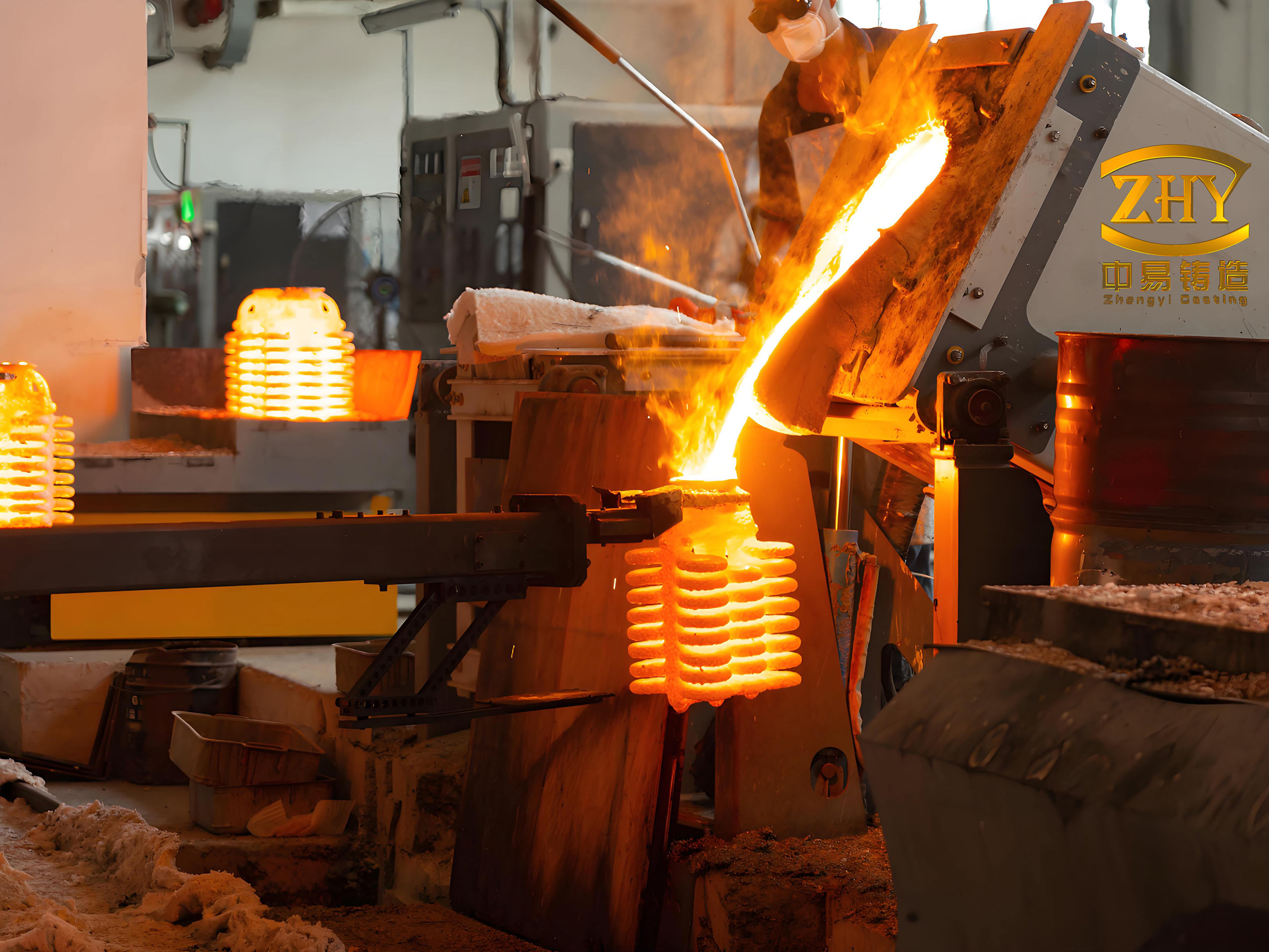
The rationalization of shell工艺 involved optimizing materials and processes. For wax patterns, we tested various rosin-based medium-temperature waxes. One successful composition, termed No. 3 wax, included: 70% rosin, 13% ceresin wax, 14% Sichuan wax, and 3% polyethylene. It was injected at 70–72°C, yielding smooth surfaces with minimal shrinkage. To prevent sticking, we used dimethyl silicone oil as a release agent. For shell materials, alumina was effective but costly. We developed a domestic alternative mimicking British Molochite, a calcined kaolin, with the composition: $$ \text{SiO}_2: 42-46\%,\quad \text{Al}_2\text{O}_3: 42-43\%,\quad \text{Fe}_2\text{O}_3: 0.7\%,\quad \text{TiO}_2: 0.05\%,\quad \text{CaO}: 0.1\%,\quad \text{MgO}: 0.1\%,\quad \text{K}_2\text{O}: 1.5-2.0\%,\quad \text{Na}_2\text{O}: 0.1\% $$ Our version used Suzhou kaolin (68%), Jilin clay (17%), and feldspar (3%), fired and ground into powders and grains. This material offered high strength, as shown in comparative strength tests. The table below summarizes key properties of refractory materials used in precision lost wax casting:
| Material | Composition Key | Thermal Shock Resistance | Cost Factor |
|---|---|---|---|
| Quartz | SiO₂ > 95% | Low (due to phase changes) | Low |
| Alumina | α-Al₂O₃ > 99% | High | High |
| Molochite (simulated) | Kaolin-based mix | Moderate to High | Moderate |
Shell-building工艺 evolved from multi-layer, air-dried methods to a rapid gelling process. Initially, we applied multiple coats with forced air drying, taking up to 3 hours per layer. This was streamlined by using ammonia drying, which reduced drying time to 20 minutes per layer and simplified the process. The technique involves dipping the pattern in a slurry, then exposing it to ammonia vapor to gel the binder—typically ethyl silicate. This accelerated the precision lost wax casting workflow, eliminating the need for controlled humidity and temperature environments. The shell thickness and strength are critical, governed by the number of layers and the refractory grain size distribution. We often use a face coat with finer particles (e.g., 10–20% cobalt aluminate in ethyl silicate) for surface finish, followed by backup coats with coarser grains for structural integrity.
Dewaxing remains a pivotal step. After testing water bath and steam methods, we standardized autoclave dewaxing at 5 atm for 5–10 minutes. The high-pressure steam rapidly melts the wax surface, preventing shell cracking. The wax recovery rate is high, making the process economical. For shell preheating, dry filler with quartz or alumina sand (3–5 mm grains) is common. The filler acts as insulation, maintaining shell temperature above 700°C during transfer to the vacuum furnace. This is essential for preventing hot tears, as the alloy solidifies rapidly under vacuum. The temperature profile can be expressed as: $$ T(t) = T_0 e^{-kt} + T_{\text{filler}} (1 – e^{-kt}) $$ where $T_0$ is initial shell temperature, and $T_{\text{filler}}$ is filler temperature.
Vacuum melting technology is integral to precision lost wax casting. We employ a double-melt approach:母合金 is induction-melted in a large vacuum furnace to ensure homogeneity and purity, followed by remelting in a smaller vacuum induction furnace for浇注. This minimizes oxidation and inclusion formation. The vacuum level typically ranges from $10^{-2}$ to $10^{-3}$ torr. During浇注, the shell is placed in the furnace, and the molten alloy is poured at controlled rates. The absence of air prevents alumina scale formation, yielding clean surfaces. We have also experimented with multi-chamber vacuum furnaces for batch production, enhancing efficiency. The冶金 aspects involve monitoring alloy composition, especially for reactive elements. For instance, the aluminum and titanium contents must be balanced to avoid excessive oxidation potential. The reaction kinetics can be described by: $$ \frac{d[O]}{dt} = -k [O][\text{Al}] $$ where $[O]$ is oxygen concentration, and $[\text{Al}]$ is aluminum concentration.
To illustrate the evolution of precision lost wax casting, we compare our early solid turbine blade process with the advanced斯贝 engine blade process. The table below highlights key differences in加工余量, pattern materials, shell systems, and浇注 methods. This comparison underscores how precision lost wax casting has progressed toward near-net-shape manufacturing.
| Aspect | Early Solid Turbine Blade Process | Advanced斯贝 Engine Blade Process | Implications for Precision Lost Wax Casting |
|---|---|---|---|
| Machining Allowance | 0.8 mm on airfoil, up to 1.2 mm locally | Near-net-shape, ±0.127 mm tolerance on airfoil | Reduced material waste and machining time |
| Pattern Material | No. 3 rosin-based wax (70% rosin, 13% ceresin, 14% Sichuan wax, 3% PE) | RRS medium-temperature wax (beeswax, microcrystalline wax, palm wax, hydrogenated ester, damar resin) | Improved pattern stability and recyclability |
| Shell Face Coat | Alumina-ethyl silicate with cobalt aluminate | Zircon flour-silica sol with cobalt aluminate | Better surface finish and reaction barrier |
| Dewaxing Method | Autoclave steam at 5 atm | Autoclave steam at similar parameters | Consistent shell integrity |
| 浇注 Setup | Top-side浇注, 4 blades per cluster | Top-side浇注, 16 blades per cluster | Higher productivity through cluster casting |
Furthermore, the positioning and定型 of blades during加工 require precise基准. In early designs, extra tabs were added for measurement, but modern precision lost wax casting enables direct use of the airfoil for定位. This reduces post-casting operations. The dimensional accuracy is achieved through careful control of shell expansion and alloy shrinkage. The linear shrinkage can be estimated as: $$ \Delta L = \alpha L_0 \Delta T $$ where $\alpha$ is the coefficient of thermal expansion, $L_0$ is initial length, and $\Delta T$ is temperature change. For nickel-based alloys, $\alpha$ ranges from $12 \times 10^{-6}$ to $16 \times 10^{-6}$ K$^{-1}$, necessitating compensation in pattern design.
In summary, the advancement of precision lost wax casting for turbine blades has been a multifaceted endeavor. From overcoming sand inclusions in wet molds to developing robust ceramic shells, each step has contributed to higher quality and efficiency. The integration of vacuum melting ensures冶金 purity, while process optimizations like rapid gelling and dry filler enhance productivity. Our work demonstrates that precision lost wax casting is not merely a casting method but a comprehensive technology encompassing material science, thermodynamics, and precision engineering. Future directions may involve additive manufacturing for patterns or advanced refractories for even better performance. As gas turbine demands grow, continued innovation in precision lost wax casting will remain vital for producing reliable, high-performance blades.
To quantify the improvements, we can analyze defect rates. Initially, oxidation defects affected over 30% of castings, but with vacuum precision lost wax casting, this dropped below 5%. Similarly, sand inclusions were rampant in solid molds but are now negligible with ceramic shells. The economic impact is significant, reducing scrap and rework costs. The公式 for cost savings can be expressed as: $$ \text{Savings} = (R_{\text{old}} – R_{\text{new}}) \times C_{\text{unit}} $$ where $R$ is rejection rate, and $C_{\text{unit}}$ is unit cost. For high-value turbine blades, this translates to substantial benefits.
In conclusion, our journey with precision lost wax casting has transformed turbine blade manufacturing. By addressing each challenge systematically—from mold materials to dewaxing techniques—we have established a reliable process that meets the stringent requirements of modern gas turbines. The repeated emphasis on precision lost wax casting throughout this article highlights its centrality to our achievements. As we look ahead, further refinements in automation and material consistency will push the boundaries of what is possible, ensuring that precision lost wax casting continues to be a cornerstone of aerospace and energy industries.