
In the pursuit of excellence within the heavy industry sector, particularly for critical transportation components, the limitations of traditional foundry methods become a significant bottleneck. My extensive experience in steel casting production has been marked by a constant battle against defects that compromise integrity, dimensional accuracy, and surface finish. For high-demand applications such as rail transit coupler buffer devices, where components like the installation seat bear immense structural loads, conventional processes often fall short. This narrative details the strategic shift from a problematic ester-hardened sodium silicate sand process to the implementation of an advanced coated sand shell molding technique, a transition that fundamentally transformed the quality and reliability of our steel castings.
The traditional method employed for years was the ester-hardened sodium silicate (water glass) sand process for both molds and cores. While common, this method presented inherent and persistent challenges for steel casting. The process was notoriously sensitive to environmental fluctuations, particularly humidity. Controlling the precise addition ratios of sodium silicate and organic ester was difficult, leading to inconsistencies. The sand molds exhibited a tendency to absorb moisture, causing creep deformation which directly translated into casting defects like gas holes and dimensional inaccuracies. Furthermore, the poor collapsibility of the cured sand resulted in high residual strength after pouring, making shakeout and cleaning an arduous, labor-intensive task. The most critical issues observed were:
- Hot Tears and Cracks: The low yield and high rigidity of the sand system provided inadequate compensation for the solidification shrinkage of the steel casting, leading to severe hot tearing within the cavity.
- Sand Inclusions, Burn-on, and Erosion: The surface of the mold was friable, leading to grains being dislodged by the molten metal flow. This resulted in pervasive sand inclusion defects and severe burn-on, which were difficult and costly to remove.
- Poor Surface Finish: The combined effect of surface sand grains and the need for extensive weld repair to fix defects resulted in a final surface roughness no better than Ra 100, far from the required Ra 50 specification.
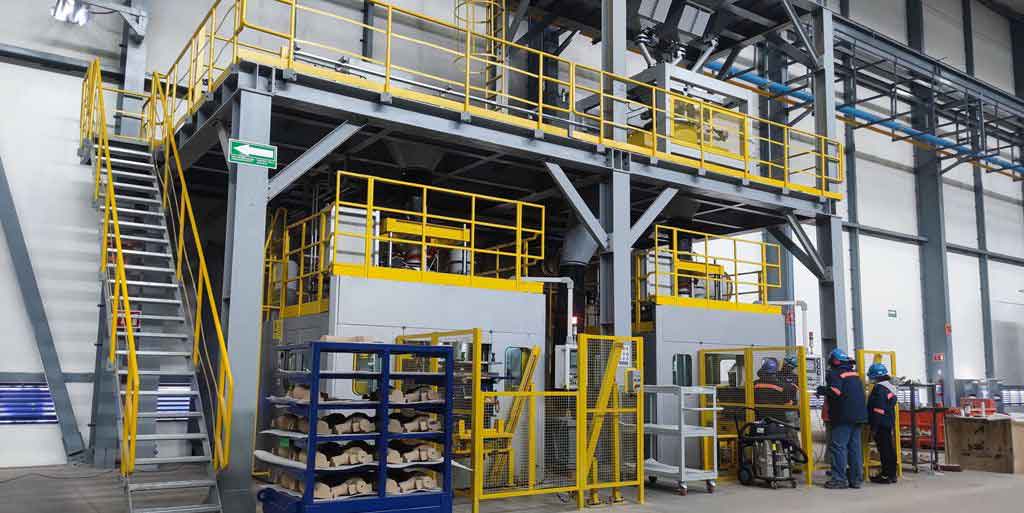
This image evokes the environment of traditional steel casting production, highlighting the need for more precise and controllable methods to achieve the required quality for high-performance components. The statistical reality was stark: a first-pass quality rate that was unacceptable, and a final product qualification rate hovering around 85%, with nearly half of all delivered steel castings requiring return and rework. The need for a technological leap was undeniable.
The core of our solution lay in adopting coated sand shell molding technology. Coated sand is produced by coating high-purity silica sand grains with a thermosetting phenolic resin. When heated, the resin melts, flows, and subsequently cures, bonding the sand grains into a solid, high-strength shell with precise contours. The fundamental advantages for steel casting are encapsulated in its superior high-temperature properties:
| Property | Value/Description | Benefit for Steel Casting |
|---|---|---|
| High-Temperature Strength | Thermal strength > 2.6 MPa | Resists metal static pressure & erosion, crucial for steel’s high pouring temperature. |
| Long Heat Resistance | Low resin degradation rate | Maintains integrity during longer solidification of steel castings. |
| Low Thermal Expansion | Controlled expansion coefficient | Minimizes dimensional change, reducing stress on the solidifying steel casting. |
| Low Gas Evolution | < 25 ml/g | Dramatically lowers the risk of gas porosity defects in the steel casting. |
| Excellent Collapsibility | Resin combusts post-pour | Allows easy shakeout, reducing cleaning cost for the steel casting. |
The initial trial involved a complete redesign of the tooling. The existing pattern plate was modified to function as a core assembly fixture. Both the external mold halves and the complex internal cores were produced as separate coated sand shells. These thin-walled (typically 6-12mm), hollow shells were then assembled to form the complete mold cavity. The gating system was also upgraded to pre-formed refractory tubes to minimize turbulence and sand erosion. However, this first iteration revealed a critical challenge: 100% occurrence of hot cracks at the ingate areas on the steel casting. This was a direct result of the localized heat concentration and constrained thermal contraction.
The solution required a fundamental rethink of the feeding and gating philosophy. The key breakthrough was transitioning from a bottom gating system to a top gating system integrated with the riser. The mathematical rationale relates to reducing thermal gradient-induced stress. The stress ($\sigma$) in a solidifying steel casting can be approximated by:
$$\sigma \propto E \cdot \alpha \cdot \Delta T$$
where $E$ is Young’s modulus, $\alpha$ is the coefficient of thermal expansion, and $\Delta T$ is the temperature gradient. By feeding through the riser, the temperature gradient from the feeding source (hottest) to the extremities is more linear, reducing $\Delta T$ at critical junctions and thus $\sigma$. Furthermore, two ingates were used to reduce fill time and velocity. Since the entire gating system was located in the top cope and removed during cutting, the crack-prone zone was completely eliminated from the final steel casting.
A second phase of optimization further enhanced the quality and yield of the steel casting. First, conventional insulating risers were replaced with exothermic risers. The efficiency of a riser can be modeled by its modulus (Volume/Surface Area). An exothermic liner reduces the effective surface area for heat loss, effectively increasing the riser modulus and its feeding range for the steel casting. The feed volume required $V_{feed}$ can be estimated by:
$$V_{feed} = V_{casting} \cdot \beta$$
where $\beta$ is the solidification shrinkage percentage of the steel alloy (approximately 3-4% for carbon steels). The exothermic riser ensured this volume was reliably delivered.
Second, the superior dimensional fidelity of the coated sand process allowed for a reduction in machining allowance on critical faces from 12mm to 8mm, directly improving the material yield for each steel casting. Third, strategic reinforcement ribs were added to the interior of large core segments. These ribs served a dual purpose: they increased the core’s handling strength and, more importantly, acted as internal chillers to regulate solidification and prevent distortion in open sections of the steel casting under the thermal load of the molten metal.
The success of this coated sand shell molding process for steel casting is intensely dependent on stringent process controls. Not all coated sands are suitable for the demanding thermal regime of steel casting. Through empirical testing, we established and enforced a strict specification for the coated sand material:
| Property | Target Specification | Test Method |
|---|---|---|
| Cold Bending Strength | 4.0 – 5.0 MPa | Ensures handling and assembly integrity of the shell. |
| Hot Bending Strength (at 250°C) | 2.6 – 3.6 MPa | Critical for resisting erosion during steel filling. |
| Loss on Ignition | ≤ 4.0 % | Indicates resin content; affects gas evolution. |
| Gas Evolution | < 25 ml/g | Directly correlates to porosity risk in the steel casting. |
| SiO2 Content | ≥ 94 % | High purity minimizes low-temperature fusion points causing burn-on. |
Equally critical was the application of refractory coating. Initial brushing of alcohol-based zirconite coatings led to runs, pools, and inconsistencies. We switched to a water-based coating applied via flow coating and dipping. This provided a uniform, smooth layer that dried to a strong ceramic veneer. This coating is essential to create a thermal barrier, preventing metal penetration and ensuring a clean surface on the final steel casting. The coating thickness ($t_c$) contributes to the overall interfacial heat transfer coefficient ($h_i$) between the metal and the mold, which influences the solidification time ($t_s$) according to Chvorinov’s Rule:
$$t_s = k \cdot \left( \frac{V}{A} \right)^n$$
where $k$ is the mold constant heavily influenced by $h_i$, and $V/A$ is the modulus of the steel casting section. A proper coating optimizes $h_i$ for sound solidification.
The quantifiable results of implementing the coated sand shell molding process for this critical steel casting were transformative. Over a three-month production period, nearly 730 installation seat castings were produced and delivered.
| Month | Quantity Delivered | First-Pass Acceptance Rate | Final Qualified Rate |
|---|---|---|---|
| Month 1 | 328 | 90.8% | 97.5% |
| Month 2 | 160 | 92.5% | 98.3% |
| Month 3 | 240 | 92.9% | 98.5% |
The defect spectrum changed dramatically. Incidences of sand inclusions, erosion, and gross surface defects were virtually eliminated. The occurrence of hot tears was reduced to negligible levels. The surface finish of the as-cast steel casting consistently met the Ra 50 requirement without extensive grinding. Non-destructive testing (magnetic particle and radiography) confirmed internal soundness. The improvement in first-pass quality from a previously unacceptable level to over 90%, and a final qualification rate exceeding 98%, represents not just a quality victory but a significant commercial one, drastically reducing scrap, rework, and inspection costs.
The economic impact extends beyond defect reduction. The formula for the total cost ($C_{total}$) of a steel casting can be simplified as:
$$C_{total} = C_{material} + C_{processing} + C_{rework} + C_{scrap}$$
While the raw material cost for coated sand is higher than for sodium silicate sand, the reductions in $C_{processing}$ (due to easier shakeout and cleaning), $C_{rework}$, and $C_{scrap}$ are profound. Furthermore, the improved yield from reduced machining allowance directly lowers $C_{material}$ per good piece. The overall cost per qualified steel casting was significantly reduced.
| Cost Factor | Traditional Process | Coated Sand Shell Process | Impact |
|---|---|---|---|
| Core/Mold Making | Lower | Higher | Negative |
| Shakeout & Cleaning | Very High | Low | Strong Positive |
| Weld Repair | Extensive | Minimal | Strong Positive |
| Scrap Loss | High (~15%) | Low (~2%) | Strong Positive |
| Material Yield | Standard | Improved | Positive |
| Total Cost per Good Casting | High | Lower | Net Positive |
In conclusion, the strategic adoption of coated sand shell molding technology represents a paradigm shift for producing high-integrity, complex steel castings. This case study on a critical rail component demonstrates that the move is not merely a material substitution but a holistic re-engineering of the casting process. It demands integrated optimization of gating and feeding design, rigorous control of sand properties and coating applications, and a deep understanding of the solidification dynamics of steel. The rewards, however, are substantial: dramatic reductions in classic steel casting defects like sand inclusions and hot tears, achievement of superior surface quality, significant improvements in dimensional consistency, and a overall more robust and economical manufacturing process. For industries where performance, safety, and reliability are non-negotiable, such as rail transportation, the coated sand shell molding process has proven to be an indispensable advanced manufacturing technology for steel casting.