
In the field of industrial manufacturing, steel casting plays a pivotal role, especially for large mechanical components subjected to harsh conditions such as mining and metallurgy. The demand for high-performance steel casting materials has escalated with the rapid development of modern industry, which emphasizes larger scale, higher efficiency, and more severe operational environments. Among various grades, 35Cr2Ni2Mo steel casting is renowned for its excellent strength, toughness, wear resistance, fatigue resistance, and machinability, making it a preferred choice for critical applications. However, to further enhance its comprehensive properties, alloying modifications are often employed. In previous work, we investigated the addition of magnesium (Mg) to 35Cr2Ni2Mo steel casting, which improved its microstructure and performance. Building on that, this study focuses on incorporating rare earth (RE) elements into Mg-modified 35Cr2Ni2Mo steel casting to explore their effects on inclusion refinement, mechanical properties, and wear resistance. The goal is to provide insights for developing advanced steel casting materials with superior stability and safety under恶劣 conditions.
Steel casting involves the solidification of molten steel into desired shapes, and the as-cast microstructure significantly influences the final properties. Fine-grained structures, achieved through effective grain refinement, can mitigate crack initiation and fatigue, thereby extending service life. In steel casting processes, the presence of heterogeneous nucleation sites during solidification promotes the formation of equiaxed crystals over columnar ones, leading to finer grains. Non-metallic inclusions, inherent in steel casting, often act as stress concentrators and crack origins when their size exceeds 5 μm, detrimentally affecting strength, toughness, and wear resistance. Therefore, controlling inclusion size and morphology is crucial for optimizing steel casting performance. Alloying with elements like RE has been shown to refine inclusions, purify the steel matrix, and enhance overall properties. In this context, we examine how RE addition modifies the Mg-treated 35Cr2Ni2Mo steel casting, leveraging techniques such as optical microscopy, scanning electron microscopy, tensile testing, and wear testing to provide a comprehensive analysis.
The steel casting materials used in this study were based on 35Cr2Ni2Mo, with one variant containing Mg (referred to as Steel A) and another containing both Mg and RE (referred to as Steel B). Their actual chemical compositions are summarized in Table 1. Both steels underwent identical heat treatment processes to ensure comparability. For microstructure examination, samples were sectioned into 10 mm × 10 mm × 10 mm cubes, ground with sandpapers from 200 to 2000 grit, polished mechanically, and etched with 3% nitric alcohol solution. We observed the微观组织 using an optical microscope (Nikon MA200) and a scanning electron microscope (TESCAN MIRA3). Inclusion analysis was performed by imaging multiple fields and measuring sizes with Image J software. Hardness was assessed using a microhardness tester (HV-1000) under a load of 0.1 kg for 15 s, with ten measurements averaged. Tensile properties were evaluated on a WDW-100G universal testing machine with specimens of φ10 × 80 mm at a speed of 2.00 mm/min. Wear resistance was tested on an MLG-130 dry sand rubber wheel abrasion tester, using 16–26 mesh quartz sand as abrasive, a frequency of 80 Hz, a load of 100 N, and a duration of 40 min. After wear, samples were ultrasonically cleaned to remove debris, and weight loss was measured to calculate wear rate. Relative wear resistance was determined by comparing weight losses between steels. Throughout these experiments, we maintained strict control over parameters to ensure reproducibility in steel casting evaluations.
| Element | Steel A (Mg-modified) | Steel B (Mg-RE-modified) |
|---|---|---|
| C | 0.32 | 0.32 |
| Mn | 1.09 | 1.06 |
| P | 0.003 | 0.003 |
| S | 0.005 | 0.004 |
| Si | 0.77 | 0.73 |
| Ni | 1.56 | 1.58 |
| Mg | 0.0032 | 0.0039 |
| Cr | 2.04 | 2.03 |
| Mo | 0.56 | 0.56 |
| RE | – | 0.0071 |
The microstructure of both steel casting materials after heat treatment primarily consisted of tempered sorbite with a lath-like morphology, as shown in our observations. In Steel A, the carbides were dispersed within the ferrite matrix, with spherical M23C6 and short rod-shaped M7C3 precipitates. The size of spherical carbides ranged from 20 to 45 nm, while rod-shaped ones measured between 50 and 200 nm. For Steel B, the carbide sizes were finer: spherical carbides from 10 to 45 nm and rod-shaped ones from 30 to 190 nm. This refinement indicates that RE addition promoted more uniform precipitation during steel casting solidification. The grain refinement effect can be described by the Hall-Petch relationship, which relates yield strength to grain size: $$ \sigma_y = \sigma_0 + k_y \cdot d^{-1/2} $$ where $\sigma_y$ is the yield strength, $\sigma_0$ is the friction stress, $k_y$ is the strengthening coefficient, and $d$ is the average grain diameter. Although we did not measure grain size directly, the carbide refinement suggests enhanced nucleation sites, potentially leading to finer grains in steel casting.
Non-metallic inclusions are critical defects in steel casting that influence mechanical integrity. We analyzed inclusion morphology and distribution in both steels. Typical inclusions included spherical, short rod-shaped, elongated, and triangular types, with spherical ones being the most numerous. The size distribution and counts are summarized in Table 2. For Steel A, inclusions smaller than 1 μm accounted for 69.33% of the total, while those between 1 and 3 μm represented 27.03%. Inclusions larger than 5 μm were rare, with an average size of 1.78 μm and 98.55% of inclusions being ≤5 μm. In Steel B, inclusions smaller than 1 μm comprised 66.99%, those between 1 and 3 μm were 31.88%, and the average size decreased to 1.47 μm, with 99.94% of inclusions ≤5 μm. This significant refinement in Steel B demonstrates RE’s efficacy in modifying inclusion characteristics during steel casting. The reduction in inclusion size can be attributed to RE elements reacting with impurities like sulfur and oxygen, forming finer and more dispersed compounds. This effect is crucial for steel casting quality, as larger inclusions often initiate cracks under stress. We also categorized inclusion types, as shown in Table 3, which include oxides, sulfides, and complex variants. RE addition likely altered the composition and morphology of these inclusions, contributing to improved steel casting performance.
| Size Range (μm) | Steel A Count | Steel B Count |
|---|---|---|
| <1 | 1,473 | 1,627 |
| 1–3 | 574 | 988 |
| 3–5 | 47 | 33 |
| 5–10 | 13 | 1 |
| >10 | 18 | 1 |
| Inclusion Type | Steel A Count | Steel B Count |
|---|---|---|
| MnS | 603 | 628 |
| MnS-Oxide | 2 | 45 |
| TiAl-MnS | 96 | 92 |
| Oxides | 262 | 248 |
| TiN-Nb | 568 | 583 |
| TiS-MnS | 75 | 39 |
| Ti-MnS | 18 | 25 |
| TiN-Nb-Al | 1 | 14 |
| Al-Mg | 2 | 1 |
The mechanical properties of steel casting are paramount for its application in demanding environments. We conducted tensile tests and hardness measurements on both steels, with results presented in Table 4. Steel A exhibited a tensile strength (Rm) of 1,254 MPa, yield strength (Rel) of 940 MPa, elongation of 5.76%, and hardness of 48.67 HRC. In contrast, Steel B showed improved strength properties: Rm increased to 1,274 MPa, Rel surged to 1,198 MPa, and hardness rose to 52.90 HRC. However, elongation decreased to 4.97%, indicating a trade-off between strength and ductility. The enhancement in strength can be linked to the refined microstructure and inclusions, as described by the Orowan strengthening mechanism for dispersoids: $$ \Delta \tau = \frac{Gb}{L} $$ where $\Delta \tau$ is the increase in shear stress, $G$ is the shear modulus, $b$ is the Burgers vector, and $L$ is the inter-particle spacing. Finer inclusions and carbides in Steel B likely reduced $L$, thereby increasing strength. This aligns with the goals of advanced steel casting, where high strength and wear resistance are prioritized. The fracture surfaces of tensile specimens revealed a mixed ductile-brittle mode, with cleavage facets, dimples, and tear ridges observed in both steels, suggesting that inclusion refinement did not drastically alter the fracture mechanism but improved resistance to crack propagation.
| Property | Steel A | Steel B |
|---|---|---|
| Tensile Strength (MPa) | 1,254 | 1,274 |
| Yield Strength (MPa) | 940 | 1,198 |
| Elongation (%) | 5.76 | 4.97 |
| Hardness (HRC) | 48.67 | 52.90 |
Wear resistance is a critical attribute for steel casting used in abrasive conditions. Our wear tests under a 100 N load for 40 min showed that Steel A had a weight loss of 2.5793 g, while Steel B lost 2.5032 g. The wear rate, defined as weight loss per unit time, decreased from 0.0645 g/min for Steel A to 0.0626 g/min for Steel B, representing a 2.95% improvement in wear resistance. The cumulative weight loss over time is detailed in Table 5. We attribute this enhancement to the refined inclusions and harder matrix in Steel B, which reduce abrasive penetration and material removal. The wear mechanism involved micro-cutting, plowing, and minor fatigue damage, as evidenced by the worn surface morphology. For Steel A, deeper grooves and more embedded abrasives were observed, whereas Steel B exhibited shallower grooves and fewer pits. This aligns with the Archard wear equation: $$ V = k \frac{FN}{H} $$ where $V$ is the wear volume, $k$ is the wear coefficient, $F$ is the load, $N$ is the sliding distance, and $H$ is the hardness. The increased hardness of Steel B likely reduced $V$, improving wear resistance. In steel casting applications, such improvements can significantly extend component life in mining and冶金 equipment.
| Time (min) | Steel A Weight Loss (g) | Steel B Weight Loss (g) |
|---|---|---|
| 10 | 0.4748 | 0.4558 |
| 20 | 1.0284 | 0.9801 |
| 30 | 1.8084 | 1.7418 |
| 40 | 2.5793 | 2.5032 |
The role of RE in steel casting modification can be further elucidated through thermodynamic considerations. RE elements have high affinity for oxygen, sulfur, and other impurities, forming stable compounds that act as nucleation sites during solidification. This promotes heterogeneous nucleation, refining the as-cast structure. The effectiveness of RE can be modeled using the constitutional supercooling theory, where the growth restriction factor $Q$ influences grain size: $$ d = a + b \cdot Q^{-1} $$ with $a$ and $b$ as constants, and $Q$ depending on alloy composition. RE addition increases $Q$, leading to finer grains. Moreover, RE-modified inclusions are less likely to coarsen during steel casting processes, preserving their beneficial effects. In our study, the refined inclusions in Steel B contributed to higher strength and wear resistance, albeit with slight ductility reduction. This trade-off is common in steel casting optimization, where tailoring composition for specific applications is key. We also note that the processing parameters, such as cooling rate and heat treatment, play vital roles in steel casting performance, and RE addition should be integrated with these factors for optimal results.
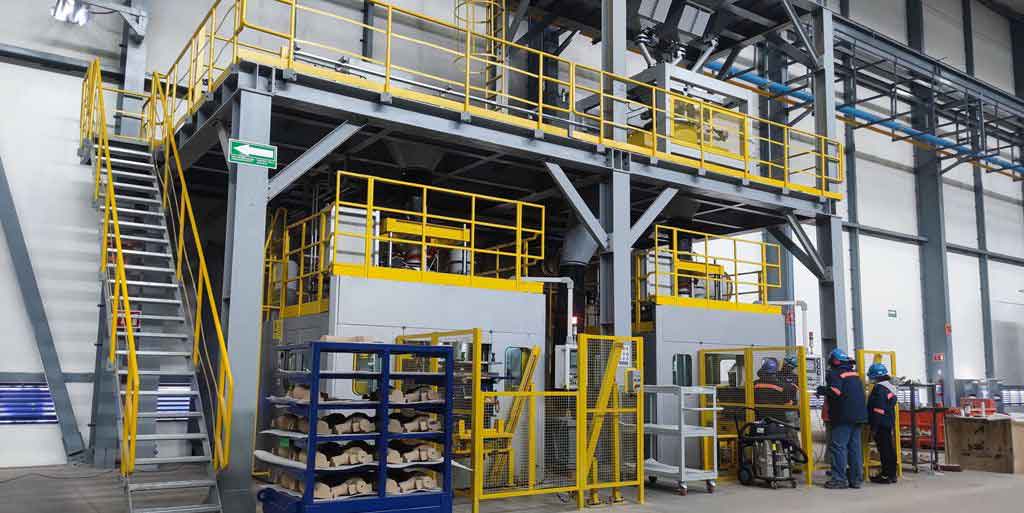
In practical steel casting operations, equipment like that shown in the image above is used to melt, pour, and solidify steel. The addition of RE elements can be seamlessly incorporated into existing steel casting workflows, often by adding RE-containing master alloys during ladle treatment. This makes it a viable strategy for enhancing steel casting quality without major process overhauls. Our findings demonstrate that RE modification of Mg-treated 35Cr2Ni2Mo steel casting leads to significant improvements in inclusion refinement, mechanical strength, and wear resistance. These advancements are crucial for meeting the escalating demands of industries that rely on durable steel casting components. Future work could explore the synergistic effects of RE with other microalloying elements, or investigate the impact of varying RE content on steel casting properties under different heat treatment regimes. Additionally, computational modeling of inclusion evolution during steel casting solidification could provide deeper insights for process optimization.
In conclusion, our investigation into RE-modified Mg-treated 35Cr2Ni2Mo steel casting reveals substantial benefits. The addition of RE refined non-metallic inclusions, reducing their average size from 1.78 μm to 1.47 μm and increasing the proportion of inclusions ≤5 μm to 99.94%. This refinement translated into enhanced mechanical properties: tensile strength increased to 1,274 MPa, yield strength to 1,198 MPa, and hardness to 52.9 HRC, though elongation decreased slightly to 4.97%. Wear resistance improved by 2.95%, with Steel B exhibiting lower weight loss under abrasive conditions. These results underscore the potential of RE alloying to advance steel casting materials for severe service environments. By leveraging RE’s ability to purify and refine microstructures, steel casting manufacturers can produce components with superior performance, longevity, and reliability. As industries continue to push the boundaries of efficiency and durability, such material innovations will be integral to the evolution of steel casting technology.