
The application of robotic automation in foundry finishing, particularly for steel castings, presents a significant leap forward in manufacturing efficiency and worker safety. Unlike delicate polishing or edge deburring, grinding steel castings involves the removal of substantial material from rough surfaces like gates and risers, demanding robust processes. For a given steel casting material and operational environment, two paramount parameters define the process: grinding efficiency and the resulting grinding force. Grinding efficiency, ultimately dictating throughput, is intrinsically linked to the volume of material removed per unit time. The grinding force, conversely, influences system stability, tool wear, and the required robotic payload. This study delves into establishing the optimal grinding parameters for maximum efficiency on steel castings and develops an empirical model to predict grinding forces, providing critical data for robotic control and tool design.
The foundational theory for material removal in abrasive processes posits that the volumetric removal rate, $V_m$, is a direct function of three primary machining parameters:
$$ V_m = v_f \cdot a_p \cdot b $$
where $v_f$ is the feed speed of the grinding tool (mm/s), $a_p$ is the grinding depth (mm), and $b$ is the fixed width of the grinding wheel (mm). However, the achievable $v_f$ and a practical $a_p$ are strongly constrained by another independent variable: the grinding wheel’s peripheral speed, $v_s$ (m/s). An excessively high $v_s$ can induce thermal damage, while a low $v_s$ reduces cutting efficiency. Therefore, the core challenge in optimizing the grinding of steel castings is solving the multivariate function:
$$ V_m = f(v_f, a_p, v_s) $$
to find the parameter combination that maximizes $V_m$ without exceeding the system’s mechanical limits, primarily the permissible grinding force and motor torque.
The grinding force itself is a critical response variable. In a simplified 2D model for surface grinding, the force exerted on the steel casting by the wheel can be resolved into tangential ($F_t$) and normal ($F_n$) components. Established theoretical models describe these forces with complex relationships involving material constants and wheel topography. For a specific steel casting grade and a stable grinding environment, these models simplify, showing dependence on the same three operational parameters:
$$ F_n, F_t = \phi(a_p, v_s, v_f) $$
A generalized power-law model often effectively captures these relationships for practical prediction:
$$ F_n = \lambda_n \cdot a_p^{\mu_1} \cdot v_s^{\mu_2} \cdot v_f^{\mu_3} $$
$$ F_t = \lambda_t \cdot a_p^{\sigma_1} \cdot v_s^{\sigma_2} \cdot v_f^{\sigma_3} $$
where $\lambda_n, \lambda_t$ are comprehensive influence coefficients, and $\mu_i, \sigma_i$ are exponents to be determined experimentally for the steel casting material.
Experimental Methodology and Platform
To investigate these relationships empirically, a dedicated robotic grinding system was established. The core of the system was a high-payload industrial robot (ABB IRB 6700-150) chosen for its stiffness and reach, essential for the forceful grinding of steel castings. The end-effector was a custom-designed grinding tool equipped with a 300 mm diameter, 25 mm wide vitrified alumina (brown corundum) wheel, selected for its durability on steel castings. The wheel was driven by a servo motor via a synchronous belt transmission. The control architecture allowed for independent setting and data acquisition from both the robot’s joint motors and the grinding tool’s spindle motor.
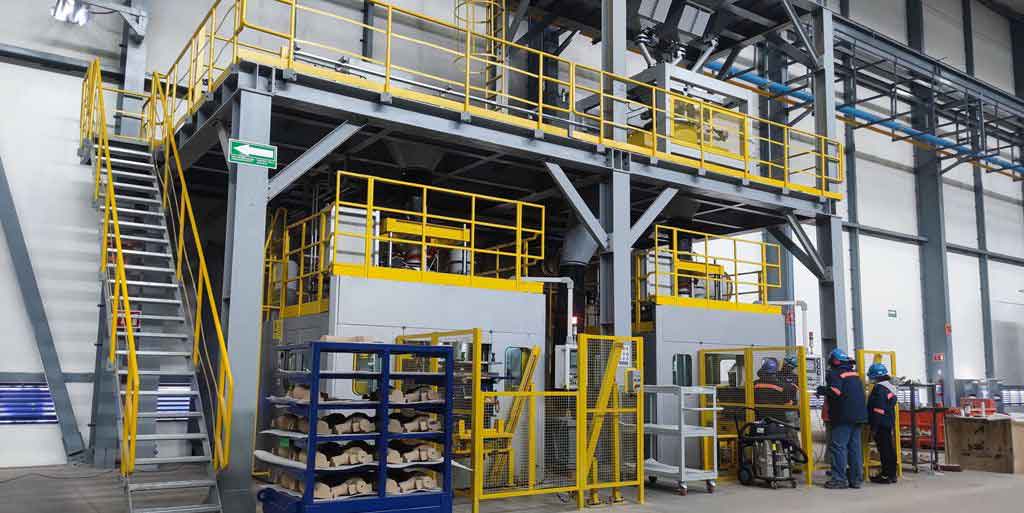
The experimental setup involved fixing a large steel casting sample with a flat, horizontal surface. The robot was programmed to maintain a specific orientation where its wrist axis was perpendicular to the work surface. This configuration ensured that the reaction grinding forces from the steel casting were primarily reacted by the robot’s second and third joints (J2 & J3), simplifying force calculation. Real-time torque data ($T_{J2}$, $T_{J3}$) from these joints and the spindle motor torque ($T_s$) were recorded during each grinding test. The grinding forces were then calculated using static force analysis and known kinematic parameters (link lengths, joint angles, gear ratios). The normal force $F_n$ was derived from the vector sum of forces from J2 and J3, while the tangential force $F_t$ was calculated from the spindle torque and wheel radius $r_s$:
$$ F_t = \frac{T_s \cdot i_{belt}}{r_s} $$
where $i_{belt}$ is the belt drive ratio.
Orthogonal Experiment for Maximizing Grinding Efficiency on Steel Castings
The goal of the first experiment was to identify the parameter set that maximizes the volumetric removal rate $V_m$ for the steel casting, subject to the constraint that the spindle motor torque remained below 80% of its rated capacity to ensure safety and longevity. A four-factor, three-level orthogonal experimental design $L_9(3^4)$ was employed. The three controlled factors and their chosen levels, based on preliminary tests with the steel casting, were:
- Grinding Depth ($a_p$): 0.4 mm (Level I), 0.8 mm (Level II), 1.2 mm (Level III). Levels were chosen to avoid tool overloading at high depths and ineffective skimming at very low depths on the rough steel casting surface.
- Wheel Speed ($v_s$): 40.0 m/s (Level I), 42.4 m/s (Level II), 44.7 m/s (Level III). These levels were within the wheel’s safe operating range and provided meaningful variation.
- Feed Speed ($v_f$): For each combination of $a_p$ and $v_s$, the maximum $v_f$ that kept $T_s$ at 80% of rating was determined experimentally. This measured $v_f$ and the corresponding $V_m$ became the response variables.
The orthogonal array and the averaged results from the tests on the steel casting are presented in Table 1.
| Test No. | Grinding Depth $a_p$ (mm) | Wheel Speed $v_s$ (m/s) | Feed Speed $v_f$ (mm/s) | Vol. Removal Rate $V_m$ (mm³/s) | J2 Torque $T_{J2}$ (Nm) | J3 Torque $T_{J3}$ (Nm) | Spindle Torque $T_s$ (Nm) |
|---|---|---|---|---|---|---|---|
| 1 | 0.4 (I) | 40.0 (I) | 35 | 350 | 5.98 | 7.09 | 13.48 |
| 2 | 0.4 (I) | 42.4 (II) | 39 | 390 | 6.80 | 8.71 | 12.72 |
| 3 | 0.4 (I) | 44.7 (III) | 42 | 420 | 7.53 | 9.88 | 12.06 |
| 4 | 0.8 (II) | 40.0 (I) | 11 | 220 | 8.06 | 10.36 | 13.48 |
| 5 | 0.8 (II) | 42.4 (II) | 12 | 240 | 8.69 | 11.52 | 12.72 |
| 6 | 0.8 (II) | 44.7 (III) | 20 | 400 | 9.21 | 12.68 | 12.06 |
| 7 | 1.2 (III) | 40.0 (I) | 2 | 60 | 10.04 | 14.97 | 13.48 |
| 8 | 1.2 (III) | 42.4 (II) | 4 | 120 | 10.72 | 15.29 | 12.72 |
| 9 | 1.2 (III) | 44.7 (III) | 5 | 150 | 11.29 | 16.04 | 12.06 |
A range analysis was performed on the results for $v_f$ and $V_m$ to determine the influence weight of each factor. The results are summarized in Table 2.
| Factor | Level | Avg. Feed Speed $v_f$ (mm/s) | Avg. Vol. Removal $V_m$ (mm³/s) |
|---|---|---|---|
| Grinding Depth ($a_p$) | I (0.4 mm) | 38.67 | 386.7 |
| II (0.8 mm) | 14.33 | 286.7 | |
| III (1.2 mm) | 3.67 | 110.0 | |
| Range (Δ) | – | 35.00 | 276.7 |
| Wheel Speed ($v_s$) | I (40.0 m/s) | 16.00 | 210.0 |
| II (42.4 m/s) | 18.33 | 250.0 | |
| III (44.7 m/s) | 22.33 | 323.3 | |
| Range (Δ) | – | 6.33 | 113.3 |
The analysis yields clear, critical insights for grinding steel castings:
- Dominance of Grinding Depth: The range value for $a_p$ is significantly larger than for $v_s$ for both $v_f$ and $V_m$. This indicates that $a_p$ is the most sensitive factor affecting the achievable feed rate and consequently the material removal rate when grinding steel castings. A smaller $a_p$ allows for a dramatically higher $v_f$.
- Optimal Parameter Set: The highest $V_m$ (420 mm³/s) was achieved in Test 3 with the parameter combination: $a_p$ = 0.4 mm, $v_s$ = 44.7 m/s, $v_f$ = 42 mm/s. This confirms that a strategy of “light depth, high speed, and fast feed” is most efficient for removing material from steel castings under the given system constraints.
- Effect on Robot Joint Torques: The data in Table 1 also shows that both $T_{J2}$ and $T_{J3}$ increase with $a_p$ and $v_s$. The increase with $a_p$ is more pronounced, and $T_{J3}$ is consistently higher than $T_{J2}$, informing robot selection and mechanical design for steel casting grinding cells.
Grinding Force Modeling for Steel Castings
Using the data collected from the orthogonal tests and additional single-factor validations, the grinding forces for each test condition were calculated using the method described earlier. A sample calculation for the optimal efficiency condition (Test 3) is shown:
Given: $T_s = 12.06$ Nm, $i_{belt}=1.5$, $r_s=0.15$ m, $T_{J2}=7.53$ Nm, $T_{J3}=9.88$ Nm, gear ratios $i_{J2}=0.22$, $i_{J3}=0.28$, link lengths $l_2=1.280$ m, $l_3=1.5925$ m.
Tangential force: $$ F_t = \frac{T_s \cdot i_{belt}}{r_s} = \frac{12.06 \times 1.5}{0.15} = 120.6 \ \text{N} $$
Forces from joints: $$ F’_{2} = \frac{T_{J2} \cdot i_{J2}}{l_2} = \frac{7.53 \times 0.22}{1.280} \approx 1.29 \ \text{N} $$ $$ F’_{3} = \frac{T_{J3} \cdot i_{J3}}{l_3} = \frac{9.88 \times 0.28}{1.5925} \approx 1.74 \ \text{N} $$
With a calculated angle $\alpha$ between forces, the normal force is: $$ F_n = \sqrt{F’_{2}^2 + F’_{3}^2 + 2 F’_{2}F’_{3}\cos(\alpha)} \approx 34.0 \ \text{N} $$
The calculated $F_n$ and $F_t$ for all test conditions form the dataset for model regression. Applying a logarithmic transformation to the proposed power-law models linearizes them:
$$ \ln(F_n) = \ln(\lambda_n) + \mu_1 \ln(a_p) + \mu_2 \ln(v_s) + \mu_3 \ln(v_f) $$
$$ \ln(F_t) = \ln(\lambda_t) + \sigma_1 \ln(a_p) + \sigma_2 \ln(v_s) + \sigma_3 \ln(v_f) $$
Multiple linear regression analysis was performed on this transformed data. The resulting empirical models, specifically calibrated for the tested steel casting material, are:
$$ F_n = 1.0265 \cdot a_p^{2.527} \cdot v_s^{-0.02043} \cdot v_f^{\ 1.5775} $$
$$ F_t = 31.1057 \cdot a_p^{1.28814} \cdot v_s^{-0.060798} \cdot v_f^{\ 0.53616} $$
The models provide profound insight into the sensitivity of grinding force to each parameter during the processing of steel castings:
- Grinding Depth ($a_p$): Has the highest positive exponent for both forces (2.527 for $F_n$, 1.288 for $F_t$), confirming it as the most dominant factor influencing grinding force. A small increase in $a_p$ causes a large increase in force.
- Feed Speed ($v_f$): Also shows a significant positive influence, especially on the normal force $F_n$ (exponent 1.578). This underscores why increasing $v_f$ to improve efficiency quickly drives up the normal load on the robot and tool.
- Wheel Speed ($v_s$): Has a slight negative exponent, indicating that increasing wheel speed marginally reduces grinding force for this steel casting, likely due to a change in the chip formation mechanism. However, its effect is an order of magnitude less than that of $a_p$ or $v_f$.
To visualize the relative impact, a sensitivity coefficient can be derived from the model exponents. A normalized sensitivity analysis is presented in Table 3.
| Parameter | Sensitivity Coefficient for $F_n$ | Sensitivity Coefficient for $F_t$ | Relative Influence Rank |
|---|---|---|---|
| Grinding Depth ($a_p$) | 2.527 | 1.288 | 1 (Highest) |
| Feed Speed ($v_f$) | 1.578 | 0.536 | 2 |
| Wheel Speed ($v_s$) | -0.020 | -0.061 | 3 (Lowest) |
Synthesis and Conclusion
This investigation into the robotic grinding of steel castings successfully bridges theoretical modeling with practical, data-driven optimization. The orthogonal experiment conclusively demonstrated that for high-efficiency material removal from steel castings, the optimal strategy is to employ a modest grinding depth coupled with high wheel speed and the maximum possible feed speed that the spindle torque allows. The specific optimum found was $a_p=0.4$ mm, $v_s=44.7$ m/s, $v_f=42$ mm/s, yielding a removal rate of 420 mm³/s. This finding challenges the intuitive approach of using deep cuts for fast removal and provides a clear guideline for process engineers working with steel castings.
Furthermore, the study developed empirical power-law models that effectively predict the tangential and normal grinding forces generated during the machining of steel castings as a function of the key process parameters. The models reveal that grinding depth is the paramount factor affecting force, followed by feed speed, while wheel speed has a minimal, slightly mitigating effect. The force model for the normal component is:
$$ F_n \approx 1.03 \cdot a_p^{2.53} \cdot v_f^{\ 1.58} $$
and for the tangential component:
$$ F_t \approx 31.1 \cdot a_p^{1.29} \cdot v_f^{\ 0.54} $$
(ignoring the very weak $v_s$ dependence for clarity).
The implications of this research are direct and valuable for industrial automation. First, it provides a tested parameter set for programming robotic grinding cells dedicated to steel castings to achieve peak productivity. Second, the grinding force models allow for:
- Informed Robotic Cell Design: The predicted forces, especially the high sensitivity to $a_p$, inform the selection of robots with adequate payload and rigidity for steel casting applications. The finding that joint J3 experiences higher torque is crucial for mechanical analysis.
- Adaptive Control Strategies: The models can be embedded into control algorithms to predict and preemptively compensate for force variations, enabling more stable grinding of steel castings and protecting the tool and robot from overload.
- Tooling Optimization: Understanding the force magnitudes and their drivers aids in the lightweight and strength-optimized design of future grinding end-effectors for steel castings.
In summary, this work establishes a foundational methodology and delivers concrete results for optimizing the robotic grinding process for steel castings, moving it from a trial-and-error operation towards a precisely engineered and controlled manufacturing step.