
In the realm of modern manufacturing, steel castings stand as a pivotal metal material with extensive application value across industries such as automotive, aerospace, construction, and machinery. The production of steel castings inherently relies on heat treatment technologies, which are indispensable processes that enhance the mechanical properties, microstructure, and overall performance of these components. Heat treatment involves controlled heating and cooling operations designed to alter the physical and sometimes chemical properties of steel castings, ensuring they meet stringent service requirements. From my perspective as an engineer deeply involved in metallurgical processes, understanding and optimizing heat treatment for steel castings is crucial for achieving desired outcomes like increased strength, improved toughness, and better wear resistance. This article delves into a comprehensive analysis of heat treatment technologies for steel castings, exploring common processes, their effects on properties, and practical applications, all while emphasizing the centrality of steel castings in industrial contexts.
The significance of heat treatment for steel castings cannot be overstated. Without proper thermal processing, steel castings might exhibit defects like residual stresses, coarse grains, or inadequate hardness, leading to premature failure in service. Thus, mastering heat treatment techniques is essential for manufacturers aiming to produce high-quality steel castings. In this discussion, I will cover various heat treatment methods, including annealing, normalizing, quenching, tempering, and more, highlighting their specific roles in modifying the microstructure of steel castings. Additionally, I will incorporate mathematical models and tables to summarize key parameters and outcomes, ensuring a thorough understanding. The keyword ‘steel casting’ will be frequently reiterated to underscore its importance throughout this analysis. Let us begin by examining the common heat treatment processes applied to steel castings.
Common Heat Treatment Processes for Steel Castings
Heat treatment processes for steel castings are categorized based on heating conditions, cooling rates, and intended microstructural changes. Each process serves distinct purposes, from relieving internal stresses to enhancing mechanical properties. Below, I detail the primary heat treatment techniques used for steel castings, supported by tables and formulas for clarity.
Annealing
Annealing is a fundamental heat treatment process for steel castings, involving heating the component to a temperature above the Ac3 transformation point by 20–30°C, holding it at that temperature for a specified duration to ensure uniform heating, and then slowly cooling it, typically in a furnace. The primary goal of annealing is to refine the grain structure, eliminate chemical segregation, and reduce internal stresses, thereby improving the machinability and mechanical properties of steel castings. The process can be described using the Arrhenius equation to model diffusion-controlled grain growth:
$$ d = d_0 + k \cdot \exp\left(-\frac{Q}{RT}\right) \cdot t^n $$
where \(d\) is the final grain size, \(d_0\) is the initial grain size, \(k\) is a constant, \(Q\) is the activation energy for grain growth, \(R\) is the universal gas constant, \(T\) is the absolute temperature, \(t\) is time, and \(n\) is a time exponent. For steel castings, annealing parameters vary based on composition; Table 1 summarizes typical conditions.
| Steel Casting Type | Annealing Temperature (°C) | Holding Time (hours) | Cooling Rate (°C/h) | Key Outcomes |
|---|---|---|---|---|
| Low-Carbon Steel Casting | 880–920 | 2–4 | 50–100 | Refined grains, stress relief |
| Medium-Carbon Steel Casting | 850–900 | 3–5 | 30–80 | Improved ductility, hardness reduction |
| Alloy Steel Casting | 900–950 | 4–6 | 20–60 | Homogenized microstructure |
Annealing is often the first step in heat treating steel castings, preparing them for subsequent operations like machining or further thermal processing. By reducing hardness, it enhances the workability of steel castings, making them easier to cut and shape.
Normalizing
Normalizing involves heating steel castings to a temperature 30–50°C above the Ac3 point, holding for austenitization, and then cooling in still air. This process results in a finer pearlitic structure compared to annealing, leading to improved strength and toughness in steel castings. The faster cooling rate in normalizing, as opposed to annealing, promotes the formation of finer ferrite and pearlite phases. The cooling rate can be approximated by Newton’s law of cooling:
$$ \frac{dT}{dt} = -h (T – T_{\text{env}}) $$
where \(T\) is the temperature of the steel casting, \(t\) is time, \(h\) is the heat transfer coefficient, and \(T_{\text{env}}\) is the ambient temperature. Table 2 outlines normalizing parameters for various steel castings.
| Steel Casting Grade | Normalizing Temperature (°C) | Austenitizing Time (min/mm thickness) | Typical Hardness After Normalizing (HRB) |
|---|---|---|---|
| ASTM A216 WCB | 900–950 | 1–2 | 70–85 |
| ASTM A352 LCC | 870–920 | 1.5–2.5 | 65–80 |
| Low-Alloy Steel Casting | 880–930 | 2–3 | 75–90 |
Normalizing is particularly beneficial for steel castings that require enhanced mechanical properties without the excessive softness from annealing. It serves as a preparatory step for quenching or as a final treatment for some applications.
Quenching
Quenching is a rapid cooling process applied to steel castings after austenitization, aimed at producing martensitic or bainitic structures that impart high hardness and strength. The steel casting is heated to a temperature above the Ac3 point, held to achieve full austenitization, and then cooled quickly using mediums like water, oil, or air. The severity of quenching is governed by the heat transfer coefficient of the medium, which affects the hardness profile. The hardness after quenching can be estimated using the following empirical formula for steel castings:
$$ H = H_0 + k_q \cdot \sqrt{C_{\%}} \cdot \log(t_q) $$
where \(H\) is the hardness in HRC, \(H_0\) is the base hardness, \(k_q\) is a quenching constant, \(C_{\%}\) is the carbon content in weight percent, and \(t_q\) is the quenching time in seconds. Table 3 compares different quenching media for steel castings.
| Quenching Medium | Heat Transfer Coefficient (W/m²·K) | Typical Cooling Rate (°C/s) | Suitable Steel Casting Types | Risk of Distortion/Cracking |
|---|---|---|---|---|
| Water | 2000–5000 | 100–300 | Carbon steel castings | High |
| Oil | 500–1500 | 20–80 | Alloy steel castings | Medium |
| Air | 50–200 | 5–20 | High-alloy steel castings | Low |
Quenching must be followed promptly by tempering to relieve internal stresses and prevent brittleness in steel castings. The selection of quenching parameters depends on the composition and geometry of the steel casting to minimize distortion.
Tempering
Tempering is performed after quenching or normalizing to reduce brittleness and improve toughness in steel castings. The process involves reheating the steel casting to a temperature below the Ac1 point, holding for a specific time, and then cooling. Tempering temperature and time influence the final properties; higher temperatures generally increase ductility at the expense of hardness. The tempering effect on hardness can be modeled using the Hollomon-Jaffe equation:
$$ H = H_{\text{max}} – k_t \cdot T \cdot \log(t) $$
where \(H\) is the hardness after tempering, \(H_{\text{max}}\) is the maximum hardness after quenching, \(k_t\) is a tempering constant, \(T\) is the tempering temperature in Kelvin, and \(t\) is the tempering time in hours. Table 4 categorizes tempering processes for steel castings.
| Tempering Type | Temperature Range (°C) | Holding Time (hours) | Application for Steel Castings | Resulting Properties |
|---|---|---|---|---|
| Low-Temperature Tempering | 150–250 | 1–3 | Surface-hardened steel castings | High hardness, good wear resistance |
| Medium-Temperature Tempering | 350–500 | 2–4 | Spring steel castings | Balanced strength and toughness |
| High-Temperature Tempering | 500–650 | 2–5 | Structural steel castings | High toughness, reduced strength |
Tempering is critical for achieving a balance between strength and ductility in steel castings, ensuring they can withstand dynamic loads without failure. For instance, a quenched and tempered steel casting often exhibits superior performance in demanding applications.
Other Heat Treatment Processes
Beyond the core processes, several specialized heat treatments are employed for steel castings, including:
- Solution Treatment: Used for austenitic stainless steel castings, involving heating to 1050–1150°C to dissolve carbides, followed by rapid cooling to retain a homogeneous solid solution.
- Precipitation Hardening: Applied to maraging or PH stainless steel castings, where aging at 480–620°C precipitates intermetallic compounds, enhancing strength.
- Stress Relieving: Heating steel castings to 550–650°C to reduce residual stresses from casting or welding, improving dimensional stability.
- Hydrogen Removal: Conducted at 200–300°C for extended periods to eliminate hydrogen embrittlement in low-alloy steel castings, enhancing ductility.
Each of these processes tailors the microstructure of steel castings to specific service conditions. For example, solution treatment is vital for corrosion-resistant steel castings in chemical plants. The kinetics of precipitation hardening can be expressed as:
$$ \Delta \sigma = A \cdot \exp\left(-\frac{B}{T}\right) \cdot t^{m} $$
where \(\Delta \sigma\) is the increase in yield strength, \(A\) and \(B\) are constants, \(T\) is the aging temperature, \(t\) is time, and \(m\) is an exponent. These advanced treatments underscore the versatility of heat treatment in optimizing steel castings.
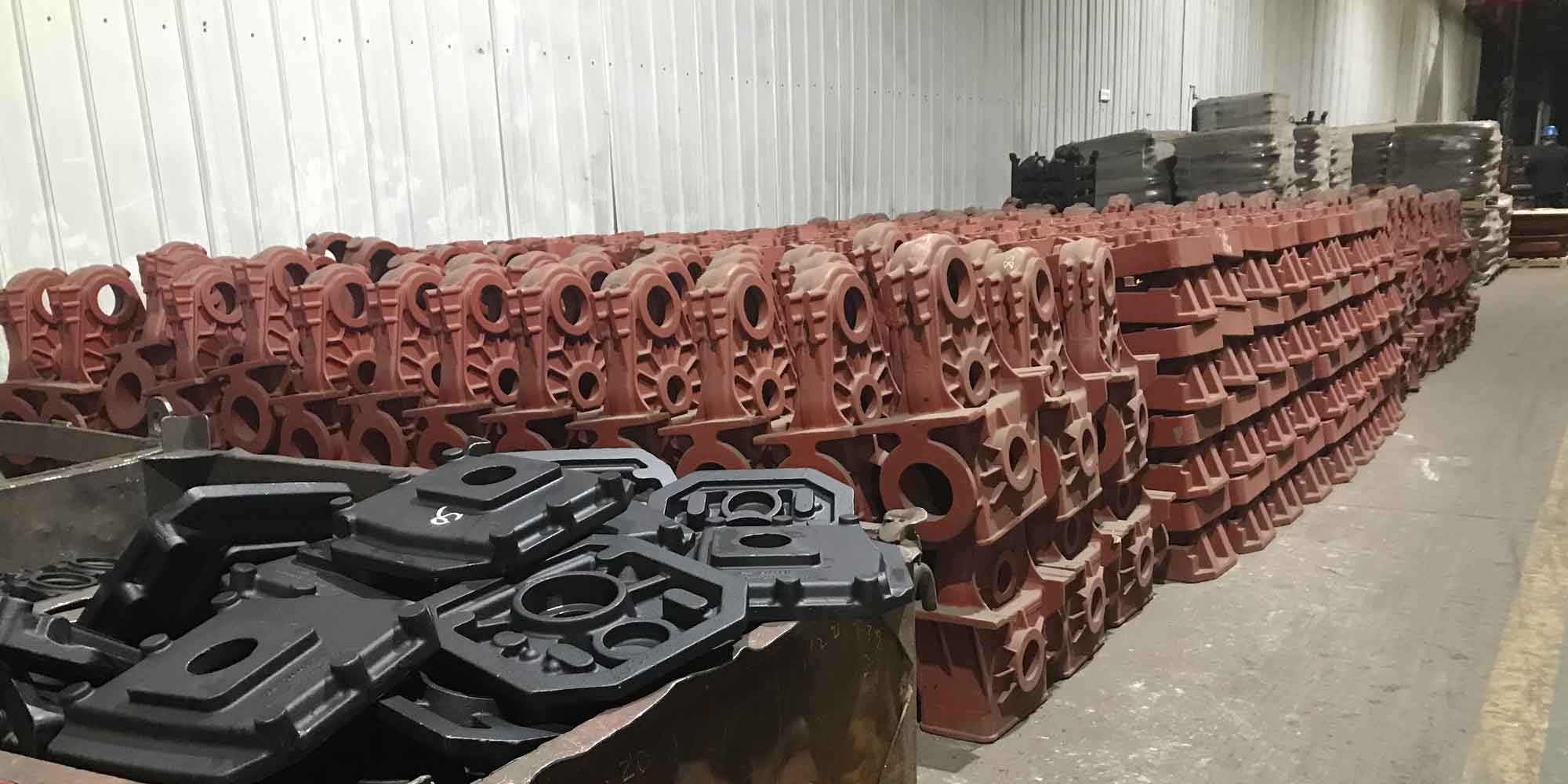
The image above illustrates a typical steel casting manufacturer facility, where heat treatment furnaces and quality control processes are integral to producing reliable steel castings. Such environments highlight the practical application of the technologies discussed, ensuring that steel castings meet industry standards.
Effects of Heat Treatment on Properties of Steel Castings
Heat treatment profoundly influences the mechanical and physical properties of steel castings, enabling customization for diverse applications. From my experience, understanding these effects is key to selecting the right process for a given steel casting. Below, I analyze how heat treatment impacts strength, elongation, impact toughness, and other attributes, using data and formulas to quantify relationships.
Strength Enhancement
The strength of steel castings, particularly yield and tensile strength, is primarily determined by microstructure, which heat treatment modifies. For instance, quenching and tempering can significantly increase the strength of low-alloy steel castings. The yield strength \(\sigma_y\) can be correlated with microstructural features via the Hall-Petch equation:
$$ \sigma_y = \sigma_0 + k_y \cdot d^{-1/2} $$
where \(\sigma_0\) is the friction stress, \(k_y\) is the strengthening coefficient, and \(d\) is the grain diameter. Heat treatments like normalizing refine grain size, thereby boosting strength. Table 5 shows strength variations for a low-alloy steel casting under different heat treatments.
| Heat Treatment Process | Yield Strength (MPa) | Tensile Strength (MPa) | Microstructure |
|---|---|---|---|
| As-Cast Steel Casting | 250–350 | 400–500 | Coarse ferrite-pearlite |
| Annealed Steel Casting | 300–400 | 450–550 | Refined ferrite-pearlite |
| Normalized Steel Casting | 350–450 | 500–600 | Fine pearlite |
| Quenched & Tempered Steel Casting | 600–800 | 800–1000 | Tempered martensite |
This table demonstrates that quenched and tempered steel castings achieve the highest strength, making them suitable for high-stress components like gears or shafts. The enhancement is due to the formation of martensite, a hard phase, followed by tempering to relieve stresses.
Improvement in Elongation and Ductility
Ductility, measured by elongation and reduction in area, is crucial for steel castings that undergo deformation or impact loads. Heat treatments like annealing and tempering improve ductility by reducing dislocation density and promoting softer phases. The elongation \(\epsilon\) can be modeled as a function of tempering temperature for quenched steel castings:
$$ \epsilon = \epsilon_0 + \alpha \cdot T_t – \beta \cdot \exp(-\gamma \cdot T_t) $$
where \(\epsilon_0\) is the base elongation, \(\alpha, \beta, \gamma\) are constants, and \(T_t\) is the tempering temperature in °C. For example, a carburized and quenched low-alloy steel casting subjected to tempering at 200°C might exhibit an elongation increase from 10% to 15%. This improvement is vital for applications like automotive brake discs, where steel castings must absorb energy without fracturing.
Impact Toughness and Fracture Resistance
Impact toughness, often assessed via Charpy tests, indicates the ability of steel castings to resist brittle fracture. Heat treatment plays a pivotal role by controlling the matrix structure and minimizing impurities. The impact energy \(E\) can be related to the microstructure through an empirical equation:
$$ E = E_0 – k_i \cdot V_f + k_m \cdot M_s $$
where \(E_0\) is the base energy, \(k_i\) is a constant for impurity volume fraction \(V_f\), and \(k_m\) is a constant for martensite start temperature \(M_s\). Processes like normalizing and quenching with high tempering temperatures enhance toughness by producing fine-grained structures or tempered martensite. Table 6 compares impact toughness for a medium-carbon steel casting under different heat treatments.
| Heat Treatment | Charpy Impact Energy at 20°C (J) | Fracture Appearance | Remarks for Steel Castings |
|---|---|---|---|
| As-Cast | 15–25 | Brittle cleavage | Poor toughness due to coarse grains |
| Normalized | 30–40 | Mixed ductile-brittle | Improved toughness from grain refinement |
| Quenched & Tempered at 200°C | 25–35 | Mostly brittle | High hardness but lower toughness |
| Quenched & Tempered at 600°C | 50–70 | Fully ductile | Optimal balance for structural steel castings |
This data shows that high-temperature tempering significantly boosts impact toughness in steel castings, making them ideal for dynamic environments such as railway components. The elimination of internal stresses and the formation of stable carbides contribute to this enhancement.
Hardness and Wear Resistance
Hardness is a key property for steel castings subjected to abrasive or adhesive wear, like in mining equipment. Heat treatments like quenching increase hardness, but tempering adjusts it to desired levels. The Rockwell hardness \(HRC\) can be approximated for steel castings with varying carbon content:
$$ HRC = a \cdot C_{\%} + b \cdot \log(t_q) – c \cdot T_t $$
where \(a, b, c\) are material constants. For instance, a high-carbon steel casting quenched in oil might reach HRC 60, but tempering at 300°C reduces it to HRC 50 while improving toughness. Wear resistance often correlates with hardness, as described by the Archard wear equation:
$$ W = k_w \cdot \frac{F \cdot L}{H} $$
where \(W\) is wear volume, \(k_w\) is a wear coefficient, \(F\) is load, \(L\) is sliding distance, and \(H\) is hardness. Thus, heat treatment allows tailoring hardness in steel castings to maximize service life.
Residual Stress and Dimensional Stability
Residual stresses in steel castings arise from uneven cooling during casting or quenching, leading to distortion or cracking. Stress relieving heat treatments mitigate this by heating to 550–650°C and slow cooling. The reduction in residual stress \(\sigma_r\) can be modeled as:
$$ \sigma_r = \sigma_{r0} \cdot \exp\left(-\frac{t}{\tau}\right) $$
where \(\sigma_{r0}\) is the initial stress, \(t\) is time, and \(\tau\) is a relaxation time constant dependent on temperature. For large steel castings, stress relieving is essential to ensure dimensional accuracy and prevent in-service failure.
Application of Heat Treatment in Steel Casting Production
To illustrate the practical relevance of heat treatment, let’s consider a case study involving steel castings for urban rail transit brake discs. Brake discs are critical safety components that require high strength, good thermal fatigue resistance, and consistent performance. Typically, low-alloy steel castings like 18CrMnTi are used, and heat treatment involves carburizing, quenching, and tempering. From my involvement in such projects, I’ve seen that optimizing heat treatment parameters is key to meeting specifications.
The process for a typical steel casting brake disc includes:
- Carburizing: Conducted at 920–950°C in a carbon-rich atmosphere to enrich the surface layer with carbon, enhancing wear resistance. The carbon diffusion depth \(x\) can be estimated using Fick’s second law:
$$ x = \sqrt{D \cdot t} $$
where \(D\) is the diffusion coefficient and \(t\) is time. For steel castings, carburizing times range from 4 to 10 hours depending on desired case depth.
- Quenching: After carburizing, the steel casting is oil-quenched from 850–870°C to form a hard martensitic case. Quenching must be uniform to avoid warping, especially for thin-section steel castings.
- Tempering: Performed at 180–200°C to relieve quenching stresses and improve toughness without significantly reducing hardness. The final surface hardness targets HRC 58–67, with core hardness HRC 30–45.
Table 7 summarizes the heat treatment cycle for such a steel casting brake disc.
| Process Step | Temperature (°C) | Time (hours) | Cooling Method | Objective for Steel Casting |
|---|---|---|---|---|
| Carburizing | 920–950 | 6–8 | Furnace atmosphere | Surface carbon enrichment |
| Quenching | 850–870 | 0.5–1 | Oil bath | Martensite formation |
| Tempering | 180–200 | 2–3 | Air cooling | Stress relief and toughness |
Post-heat treatment, steel castings undergo cleaning to remove scale and inspections for hardness and dimensional tolerance. For brake discs, flatness must be within 0.5 mm to ensure proper function. This example underscores how heat treatment transforms a raw steel casting into a high-performance component, highlighting the interdependence of processes.
Moreover, challenges like distortion during heat treatment require careful control. Finite element analysis (FEA) can simulate temperature and stress distributions in steel castings during quenching, helping optimize parameters. The governing heat conduction equation is:
$$ \rho c_p \frac{\partial T}{\partial t} = \nabla \cdot (k \nabla T) + Q $$
where \(\rho\) is density, \(c_p\) is specific heat, \(k\) is thermal conductivity, and \(Q\) is heat generation rate. Such simulations aid in designing fixtures and cooling strategies for complex steel castings.
Advanced Considerations and Future Trends
Beyond conventional heat treatment, emerging technologies are enhancing the capabilities of steel castings. For instance, induction heating allows localized heat treatment of steel castings, reducing energy consumption and distortion. Laser heat treatment can modify surface properties of steel castings with precision, improving wear resistance in specific areas. Additionally, computational thermodynamics tools like CALPHAD help predict phase transformations in steel castings during heat treatment, optimizing recipes.
The integration of Industry 4.0 concepts, such as IoT sensors in furnaces, enables real-time monitoring of heat treatment cycles for steel castings, ensuring consistency and quality. Predictive maintenance of heat treatment equipment also minimizes downtime in steel casting production. As materials evolve, heat treatment processes for advanced steel castings, such as those with nano-additives or gradient structures, will require further research.
In summary, heat treatment is a cornerstone of steel casting manufacturing, enabling the attainment of desired properties through precise thermal control. From annealing to tempering, each process contributes to the performance and reliability of steel castings. By leveraging mathematical models, empirical data, and innovative techniques, manufacturers can continually improve heat treatment outcomes for steel castings, meeting the ever-growing demands of modern engineering applications.
I hope this detailed exploration provides valuable insights into the science and art of heat treating steel castings, underscoring their vital role in industry. The continuous advancement in this field promises even better steel casting products in the future, driven by a deep understanding of metallurgical principles and process optimization.