
In the realm of nuclear power generation, the integrity of critical components is paramount. As a practitioner in non-destructive testing (NDT), I have witnessed the increasing localization of nuclear power equipment manufacturing, particularly for key steel castings used in high-pressure and intermediate-pressure casings. These steel castings, often made from low-alloy steels like ZG17CrMo9-10, are enhanced with austenitic stainless steel cladding layers in areas such as gate档 surfaces and bearing seats to improve wear resistance, corrosion resistance, and high-temperature performance. The ultrasonic inspection of these cladding layers presents unique challenges due to the anisotropic nature of austenitic structures and the interface with the base steel casting. This article delves into my practical experiences and applications of ultrasonic testing for austenitic cladding on nuclear steel castings, aiming to provide a comprehensive guide for quality control.
The use of steel castings in nuclear components is widespread due to their ability to form complex geometries and withstand harsh operational conditions. However, the addition of austenitic stainless steel cladding via welding introduces a heterogeneous interface and coarse columnar grains, which complicate ultrasonic wave propagation. In my work, I have found that conventional ultrasonic methods, designed for homogeneous materials like the base steel casting, often fall short when applied to cladding layers. The primary requirements for inspection include detecting defects as small as 1.5 mm in diameter, with acceptance criteria limiting defect lengths to 5 mm. This necessitates a tailored approach, combining theoretical analysis with hands-on experimentation.
One of the fundamental challenges in inspecting austenitic cladding on steel castings is the significant ultrasonic attenuation and scattering caused by coarse grains. The attenuation coefficient, which quantifies energy loss per unit distance, can be expressed as:
$$ \alpha = \frac{1}{d} \ln\left(\frac{I_0}{I}\right) $$
where \( \alpha \) is the attenuation coefficient (in dB/mm), \( d \) is the thickness of the cladding layer (in mm), \( I_0 \) is the initial sound intensity, and \( I \) is the intensity after passing through the material. For austenitic stainless steel cladding on steel castings, \( \alpha \) can be substantially higher than for the base steel casting, leading to reduced penetration and increased noise. Additionally, the anisotropic grain structure causes beam skewing, which alters the sound path and complicates defect localization. The interface between the cladding and the steel casting base material also reflects and refracts ultrasonic waves, producing interface echoes that can mask genuine defects.
To address these issues, I have developed a systematic methodology centered on the design and use of reference blocks. These blocks mimic the actual steel casting components in terms of material composition and manufacturing processes. The reference block consists of a base layer made from the same low-alloy steel casting material as the nuclear casing, and a cladding layer applied using identical welding parameters (e.g., 309L austenitic stainless steel with controlled preheat, interpass temperatures, and post-weld heat treatment). The block is designed to cover a range of cladding thicknesses encountered in practice, typically from 10 mm to 40 mm, with the base thickness at least twice the cladding thickness to minimize edge effects. Key features include flat-bottom holes (FBH) and side-drilled holes (SDH) at various depths, including at the fusion line, to calibrate sensitivity and assess detectability.
| Parameter | Specification |
|---|---|
| Base Material | ZG17CrMo9-10 Low-Alloy Steel Casting |
| Cladding Material | 309L Austenitic Stainless Steel |
| Cladding Thickness Range | 10–40 mm |
| Base Thickness | >= 2 × Cladding Thickness |
| Defect Simulators | 6 × φ3 mm FBH, 6 × φ1.5 mm × 40 mm SDH |
| Block Width | ≥ 50 mm (to reduce sidewall interference) |
| Additional Features | Step wedge for linearity calibration, arc for angle beam calibration |
The detectability of defects within the cladding layer is a critical first step. I evaluate this by measuring the signal-to-noise ratio (SNR) on representative sections of the steel casting or on the reference block. If the echo from the smallest reference defect (e.g., φ1.5 mm SDH) does not exceed the background noise by at least 6 dB, the cladding is deemed unsuitable for ultrasonic inspection. In my tests, I have observed that for cladding thicknesses exceeding 40 mm on steel castings, attenuation often renders the inspection impractical due to the lack of clear back-wall echoes. This can be quantified using the decibel drop per millimeter, which for austenitic cladding on steel castings, can be approximated by:
$$ \text{Attenuation (dB/mm)} = \frac{\text{Initial Amplitude (dB)} – \text{Final Amplitude (dB)}}{\text{Thickness (mm)}} $$
For instance, with a 4 MHz longitudinal wave probe, the attenuation in 309L cladding on steel casting might range from 0.1 to 0.3 dB/mm, depending on grain size and welding parameters.
Probe selection is paramount for successful inspection. Given the high attenuation in austenitic cladding, longitudinal waves are preferred over shear waves due to their longer wavelength and lower scattering. I typically use dual-crystal longitudinal straight-beam probes (e.g., 4 MHz) for thin cladding layers (around 15 mm) to enhance near-surface resolution, and single-crystal longitudinal probes (2 MHz or 4 MHz) for thicker sections to balance penetration and sensitivity. For detecting defects at the fusion line between the cladding and the steel casting base, I employ dual-crystal longitudinal angle-beam probes (e.g., VSY60°-4) to direct energy perpendicular to the interface. The choice of frequency involves a trade-off: higher frequencies (e.g., 4 MHz) offer better resolution but suffer more attenuation, as described by the relationship:
$$ \alpha \propto f^n $$
where \( f \) is the frequency and \( n \) is an exponent typically between 1 and 2 for polycrystalline materials like steel castings with cladding. In practice, I use the following guidelines, summarized in Table 2.
| Cladding Thickness | Probe Type | Frequency | Primary Application |
|---|---|---|---|
| < 20 mm | Dual-crystal Longitudinal Straight-beam | 4 MHz | High-resolution detection of small defects |
| 20–40 mm | Single-crystal Longitudinal Straight-beam | 2–4 MHz | Balanced penetration and sensitivity |
| Any thickness (fusion line focus) | Dual-crystal Longitudinal Angle-beam (60°) | 4 MHz | Defects at cladding-base interface |
Calibration of the ultrasonic system is another area where standard practices must be adapted for steel casting cladding. The time base (scan speed) adjustment cannot rely solely on conventional steel blocks due to velocity differences between the austenitic cladding and the base steel casting. The sound velocity in austenitic stainless steel is approximately 5800 m/s for longitudinal waves, compared to 5900–6000 m/s in low-alloy steel castings. I use the reference block with known thickness steps to calibrate the time base, ensuring accurate depth measurements. The distance-amplitude correction (DAC) curve is then established using the SDH or FBH reflectors in the reference block. The DAC curve accounts for material attenuation and beam spread, and I set the recording level at -6 dB below the reference curve to ensure defect detectability. Mathematically, the DAC curve can be modeled as:
$$ A(d) = A_0 \cdot e^{-2\alpha d} \cdot \frac{D}{d} $$
where \( A(d) \) is the amplitude at distance \( d \), \( A_0 \) is the initial amplitude, \( \alpha \) is the attenuation coefficient, and \( D \) is the probe element diameter. This equation highlights how attenuation in steel casting cladding impacts signal strength over depth.
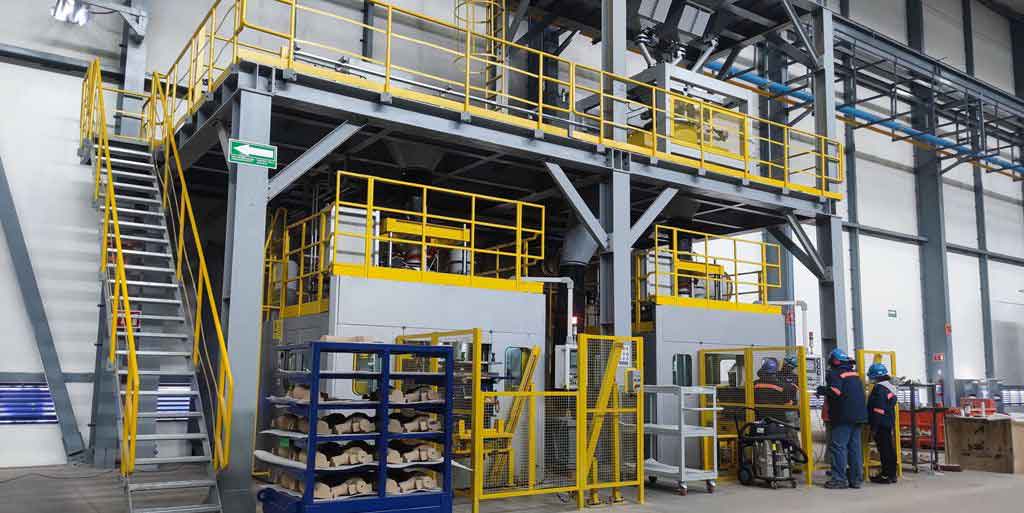
In practical applications on nuclear steel castings, I follow a stepwise procedure. First, I assess the cladding region for accessibility and surface condition—rough surfaces on steel castings can cause coupling losses, which I compensate for if exceeding 2 dB. Using the selected probe and calibrated equipment, I perform a raster scan over the cladding area, maintaining a scan sensitivity based on the DAC curve. When a defect indication is observed, I switch to a quantitative probe to re-evaluate its size, location, and orientation. Defect length is measured using the 6 dB drop method, and its amplitude is compared against the DAC curve for acceptance. For ambiguous indications, especially near the fusion line of the steel casting, I corroborate ultrasonic findings with alternative NDT methods like radiography to reduce false calls.
Throughout my work, I have encountered numerous cases where the anisotropic nature of austenitic cladding on steel castings led to complex echo patterns. For example, grain boundary reflections can produce “grass” noise that mimics defect signals. To mitigate this, I employ signal processing techniques such as time-corrected gain (TCG) and filtering, but these must be applied judiciously to avoid masking real defects. Additionally, the geometry of steel casting components—often with curved surfaces and varying thicknesses—requires careful probe manipulation and sometimes custom wedges to ensure proper beam entry.
To summarize the key points of my practice, I have compiled the following insights in Table 3, which emphasizes the integration of steel casting considerations throughout the inspection process.
| Aspect | Practice Point | Rationale |
|---|---|---|
| Detectability Assessment | Test on reference blocks with same steel casting and cladding工艺; limit inspection to cladding thickness < 40 mm if SNR < 6 dB. | Austenitic cladding exhibits high attenuation; thick layers may be ultrasonically opaque. |
| Probe Frequency Choice | Use higher frequencies (4 MHz) for thin steel casting cladding; lower frequencies (2 MHz) for thicker sections. | Trade-off between resolution and penetration in coarse-grained cladding on steel castings. |
| Inspection Direction | Prioritize beam perpendicular to fusion line of steel casting; supplement with angle beams for multi-dimensional coverage. | Enhances detection of interface defects critical for steel casting integrity. |
| Calibration | Use dedicated reference blocks matching steel casting cladding工艺 for time base and DAC. | Accounts for velocity differences and attenuation in heterogeneous steel casting systems. |
| Defect Evaluation | Combine amplitude-based sizing with length measurement; use supplementary NDT for verification. | Reduces risk of misinterpreting grain noise or interface echoes in steel casting cladding. |
In conclusion, the ultrasonic inspection of austenitic stainless steel cladding on nuclear steel castings is a nuanced discipline that demands a deep understanding of material properties and wave mechanics. My experiences have shown that success hinges on customizing every step—from reference block design to probe selection and calibration—to the specific characteristics of the steel casting and its cladding. By adhering to the practices outlined here, including rigorous detectability tests and multi-probe strategies, inspectors can reliably assess cladding quality and ensure the safety of nuclear components. Future advancements may involve phased array ultrasonic testing (PAUT) for better beam steering and imaging, but the fundamentals of addressing anisotropy and attenuation in steel casting cladding will remain essential. Ultimately, the goal is to achieve a balance between sensitivity and reliability, safeguarding the performance of these critical steel castings in nuclear power plants.