
As a core component of a double-roll crusher, the roller teeth work under extremely demanding conditions. Mounted in pairs and rotating in opposite directions, their intermeshing teeth are responsible for fracturing various materials with inconsistent composition and hardness. Unlike replaceable wear parts like liners or jaw plates, the working surfaces of these roller teeth are integral to the casting and cannot be exchanged. This harsh operational environment imposes stringent requirements: the steel casting must possess exceptional internal soundness and very high hardness to ensure service life, while the tooth profile must be complete and maintain high geometric accuracy for perfect meshing during operation.
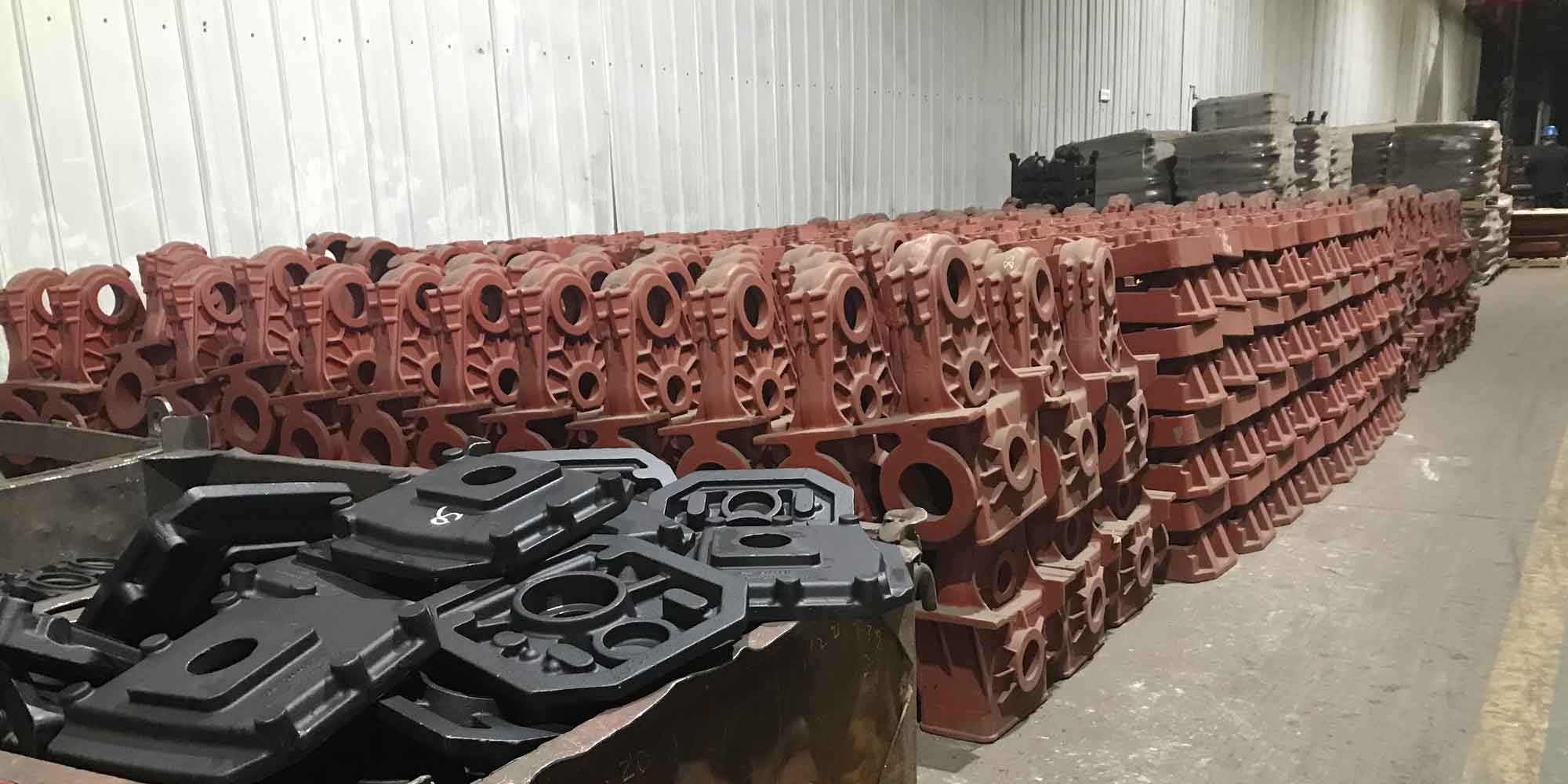
This project involved the custom development of such a component for an international client. Prior to collaborating with our team, the client had engaged another domestic foundry, where three consecutive trial productions failed due to issues like core shift and molten metal leakage during pouring. Our technical team succeeded in a single trial through meticulous technical and quality planning. This article shares our experience in process design optimization, achieving high hardness, and ensuring control over tooth profile accuracy, dimensional precision, and prevention of mold dilation and leakage during the production of this complex steel casting.
Technical Requirements for the Roller Teeth Steel Casting
Product Specifications and Key Requirements
The roller teeth steel casting has a rough weight of 2,500 kg, with overall dimensions of ϕ700 mm in diameter and 2,550 mm in height. The main wall thickness is 55 mm, and the circumference features 864 individual teeth. The material specification, designated internally as MCL400 based on client-provided data, has the chemical composition requirements shown in Table 1.
| Element | C | Mn | Si | P | S | Cr | Ni | Mo |
|---|---|---|---|---|---|---|---|---|
| Requirement | 0.25-0.29 | 1.00-1.20 | 0.20-0.40 | ≤ 0.025 | ≤ 0.015 | 1.25-2.00 | 3.20-4.00 | 0.25-0.50 |
The primary technical requirements were as follows:
- Quality Assurance: Due to the inability to perform ultrasonic testing on the roller body, the client required validation of the casting process through CAE simulation to ensure internal soundness. Additionally, magnetic particle inspection was required over the entire casting surface, to be accepted according to Grade 2 of GB/T 9444-2019.
- Mechanical Properties: A minimum hardness of 400 HBW was required on the casting body.
- Dimensional Accuracy: Dimensional tolerances were to comply with CT12 grade per GB/T 6414-2017. A critical requirement was that all 864 teeth must pass inspection in one go using a master gauge template provided by the client.
Technical Challenges
The development of this steel casting presented several significant challenges:
- Complex Geometry and Feeding Difficulty: The part’s intricate structure, featuring numerous dispersed hot spots at the tooth roots and junctions, made effective feeding and shrinkage elimination exceptionally difficult.
- High Hardness Requirement: Achieving a consistent bulk hardness ≥400 HBW in such a large, complex casting demanded precise control over both chemical composition and the heat treatment cycle.
- Dimensional and Process Control: The part’s high aspect ratio (height/diameter), stringent dimensional tolerances, and the need to assemble cores in a confined space created major challenges. These factors increased the risk of incomplete tooth filling, mold dilation, and run-out during pouring of the steel casting.
Casting Process Design and Optimization
Addressing Solidification Shrinkage
The fundamental strategy was to achieve a controlled, near-simultaneous solidification pattern to minimize isolated liquid pools and shrinkage porosity. The following measures were implemented in the process design for this steel casting:
- Feeding System: Three exothermic feeding risers were placed at the top of the casting to provide adequate feed metal and thermal gradient.
- Gating System: A buffered step-gating system was employed. The runner consisted of five levels, with four variable-thickness slot gates per level. Chills were strategically placed at the junctions of the gates and the casting to accelerate cooling at these potential hot spots and prevent shrinkage.
- Yield and Feeding Practice: The total poured weight was 3,200 kg for a casting weight of 2,500 kg, resulting in a casting yield of 78.1%. After pouring, 2.5 kg of exothermic topping compound was added evenly to each riser.
The design was rigorously analyzed and optimized using ProCAST simulation software. The solidification simulation confirmed the absence of large, isolated liquid regions, indicating a successful simultaneous solidification approach. The shrinkage porosity analysis predicted only minor, isolated shrinkage with an equivalent diameter not exceeding 5 mm, which was deemed acceptable for this application. The successful simulation gave confidence in the steel casting process design.
Ensuring High Hardness in the Steel Casting
Achieving the specified high hardness required a dual approach: precise chemical composition control and a tailored heat treatment process.
Chemical Composition Control Strategy
Within the ranges specified by the client, the composition was controlled toward the upper-middle limits to enhance hardenability, strength, and final hardness of the steel casting. The targeted ranges and the metallurgical rationale are summarized below:
| Element | Target Range (wt.%) | Metallurgical Role in Hardness |
|---|---|---|
| Chromium (Cr) | 1.6 – 2.0 | Increases strength, hardness, wear resistance, and hardenability by forming carbides and slowing transformation kinetics. |
| Nickel (Ni) | 3.6 – 4.0 | Improves strength and toughness, enhances hardenability, particularly in thick sections of the steel casting. |
| Molybdenum (Mo) | 0.4 – 0.5 | Increases strength and hardenability, reduces temper embrittlement susceptibility. |
| Manganese (Mn) | 1.1 – 1.2 | A potent hardenability agent, increases strength and hardness. |
| Silicon (Si) | 0.3 – 0.4 | Contributes to solid solution strengthening and improves hardenability. |
The combined effect of these elements can be approximated by calculating the Ideal Critical Diameter (DI), a measure of hardenability. While exact multiplicative factors are complex, a simplified expression highlights the influence:
$$ D_I \propto f(C) \cdot [1 + k_{Mn}(Mn) + k_{Cr}(Cr) + k_{Ni}(Ni) + k_{Mo}(Mo) ] $$
Where kX are potency coefficients for each alloying element. Controlling these elements toward the upper limit effectively maximizes DI for this steel casting composition, ensuring sufficient depth of hardening.
Heat Treatment Process Design
Conventional normalizing and tempering were insufficient to reach 400 HBW. Quenching and tempering (quench & temper) posed a high risk of distortion and cracking for this complex geometry. An alternative approach was developed: a modified normalizing cycle with accelerated cooling. The thermal profile is illustrated below.
The steel casting was first austenitized at 890-910°C, followed by air cooling (normalizing). The key to achieving high hardness was the post-normalizing cooling rate. Immediately after being removed from the furnace, the casting was subjected to forced air cooling combined with water mist spray. This significantly increased the cooling rate compared to standard still-air normalizing, promoting the formation of a finer, harder microstructure (e.g., bainite or fine pearlite with ferrite) instead of the coarser structures typical of slow cooling.
The subsequent tempering was performed at 580-600°C. Tempering is crucial for relieving internal stresses induced by rapid cooling and for achieving a good balance of hardness and toughness. The final hardness (HBW) can be related to the tempering parameter (the Hollomon-Jaffe parameter, P) for a given steel:
$$ P = T \cdot (k + \log t) $$
Where T is the absolute temperature (K), t is the time (hours), and k is a constant (often ~20 for many steels). For this steel casting, the selected tempering temperature and time were designed to achieve the target hardness while ensuring adequate stress relief. The final process successfully met the ≥400 HBW requirement on the casting body.
Critical Process Controls for Manufacturing the Steel Casting
Successful production of this demanding steel casting relied on stringent control across all manufacturing stages.
Pattern and Core Box Fabrication
- Rigidity: Core boxes were constructed on sturdy iron frames to prevent deformation during core production.
- Tooth Profile Accuracy: The tooth profiles in the core boxes were machined with high precision. The patterns were strategically segmented with well-designed loose pieces to allow damage-free withdrawal from the mold without compromising the intricate tooth geometry of the steel casting.
- Dimensional Verification: All pattern equipment was rigorously inspected against the process drawings prior to release for production.
Molding and Coremaking Operations
- Molding Media: The molds and cores were made using a furan no-bake resin-bonded sand system with ceramic beads (a type of high-silica sand) for improved thermal stability and surface finish.
- Chill Placement: Formed external chills were placed exactly as specified in the工艺 (process) on the patterns and in core boxes.
- Gating Assembly: The ceramic gate bricks and filters were carefully positioned and secured.
- Core Assembly and Reinforcement: After assembling the two main semi-cylindrical cores, their internal steel reinforcement frames (core irons) were welded together to create a single rigid structure. This was a critical step in preventing core movement or mold wall deformation during pouring of the steel casting.
- Coating: Both molds and cores were coated with two layers of alcohol-based zirconia refractory coating. Special attention was paid to ensure even, non-dripping application on the complex tooth profiles.
- Mold Closing and Reinforcement: Before closing the mold, the core assembly was positioned and checked. Steel bars were then wedged between the core’s back and the mold’s reinforcing grid (box bars) to provide additional support against metallostatic pressure. The mold cavity was thoroughly cleaned of any loose sand or debris.
Pouring and Solidification Control
The pouring temperature was tightly controlled at 1560°C. The pouring sequence started at a moderate rate to allow for smooth filling of the thin teeth and flotation of inclusions, then slowed towards the end to prevent “false risering” (where the riser appears full but the casting is not). The exothermic topping compound was added immediately after the risers were filled.
Post-Casting Operations
After shakeout and cooling, the steel casting underwent thorough visual inspection, grinding, and dressing. The master gauge template was used to inspect all 864 teeth, confirming dimensional compliance. The casting was then subjected to the defined heat treatment cycle and final hardness testing.
Results and Conclusion
Through comprehensive preparation and strict adherence to the controlled process, the trial production of the high-hardness roller teeth steel casting was successful on the first attempt. Subsequently, over ten pieces have been produced consistently to the customer’s satisfaction, paving the way for the development of other similar components.
The successful development of this roller teeth steel casting represents a significant technical achievement and provides valuable experience for manufacturing complex, high-performance castings:
- Process Design Philosophy: The application of simultaneous solidification principles, validated and optimized through advanced CAE simulation (ProCAST), allowed for meeting stringent quality requirements without sacrificing casting yield for this intricate steel casting.
- Mechanical Property Control: High hardness was reliably achieved through a synergistic approach: precise control of hardenability-enhancing alloying elements (Cr, Ni, Mn, Mo) combined with an innovative heat treatment process featuring accelerated cooling after normalizing. The relationship between composition, cooling rate, and final microstructure is key to engineering properties in steel casting.
- Dimensional Accuracy Management: A holistic, full-process control methodology was established, addressing factors from pattern making to mold closing, which is essential for complex castings with tight tolerances.
- Quality Assurance System: The implementation of a detailed process control plan, with clear responsibilities, preventive measures, and real-time monitoring at each stage, proved effective in mitigating potential defects and ensuring consistent quality in the production of this demanding steel casting.
This project underscores that overcoming the challenges of complex, high-specification steel casting components requires an integrated approach combining scientific simulation, metallurgical expertise, and rigorous procedural control throughout the entire manufacturing chain.