
As a seasoned professional in the steel casting industry, I have witnessed a significant shift towards lightweighting in structural applications, driven by the need for efficiency and sustainability. While aluminum and magnesium offer notable lightweighting potential, steel castings remain indispensable due to their superior strength, cost-effectiveness, and compatibility in diverse environments. However, traditional gravity casting methods often fall short in achieving optimal weight reduction. In this context, low-pressure casting has emerged as a transformative process for steel castings, enabling thinner walls, reduced material usage, and enhanced performance. Through this article, I aim to elaborate on the multifaceted benefits of low-pressure casting for steel castings, supported by comparative data, formulas, and practical insights.
The steel casting industry is continuously evolving to meet demands for lighter components without compromising integrity. In many applications, such as automotive or industrial machinery, weight reduction directly correlates with energy savings and improved functionality. Gravity casting, while prevalent, involves substantial gating and riser systems, leading to high recycled material weight and inefficiencies. Low-pressure casting, by contrast, utilizes a controlled pressure differential to fill molds with minimal turbulence, thereby optimizing the steel casting process. This method not only enhances material yield but also reduces defects, making it a cornerstone for advanced steel castings. My analysis will delve into the technical nuances that make low-pressure casting a superior choice for lightweight steel castings.
To understand the core advantages, let’s compare key parameters between gravity casting and low-pressure casting for steel castings. The table below summarizes critical aspects based on industry data and my own observations in steel casting operations.
| Parameter | Gravity Casting | Low-Pressure Casting |
|---|---|---|
| Yield | 20% to 50% | Increases by 1.5 to 2 times |
| Reject Rate (geometry-dependent) | Up to 25% | Reduced by 5% to 10% |
| Layout (parts per mold) | Continuous cluster of castings, requiring separation | Separate parts, no need for separation |
| Required Rework | Extensive due to large risers and gating systems | Minimal, with near-net-shape finishing |
| Filter Usage | Necessary to trap inclusions | Often unnecessary due to low-turbulence filling |
| Melting Temperature | 1,700°C to 1,750°C | Approximately 1,640°C |
| Energy Consumption | High, with short lining life | Low, with extended lining life |
| Process Control | Uncontrolled metal flow velocity, temperature fluctuations | Controlled low-turbulence curve, adjustable temperature |
| Wall Thickness Feasibility | Limited, not economical for thin walls | As low as < 2 mm, locally < 1 mm |
This comparison underscores how low-pressure casting revolutionizes steel casting by improving yield and reducing waste. The yield improvement can be quantified using the formula for material efficiency in steel casting: $$ Yield_{LP} = Yield_{G} \times \alpha $$ where \( Yield_{LP} \) is the yield in low-pressure casting, \( Yield_{G} \) is the yield in gravity casting (typically 0.2 to 0.5), and \( \alpha \) is the enhancement factor ranging from 1.5 to 2. For instance, if a gravity steel casting process yields 40%, low-pressure casting can elevate it to 60% to 80%, significantly cutting raw material costs. This is pivotal for lightweight steel castings, where every kilogram saved translates to broader economic and environmental benefits.
Another critical aspect is the reduction in gating and riser systems, which directly impacts recycled material weight. In gravity casting, the gating system can account for over 50% of the total metal poured, whereas low-pressure casting minimizes this to below 20%. The savings in recycled material weight, \( W_{savings} \), can be expressed as: $$ W_{savings} = W_{G} – W_{LP} $$ where \( W_{G} \) and \( W_{LP} \) are the gating system weights in gravity and low-pressure casting, respectively. For a typical steel casting weighing 10 kg, \( W_{G} \) might be 5 kg, while \( W_{LP} \) could be as low as 1 kg, leading to \( W_{savings} = 4 \) kg per casting. Over large production runs, this accumulates to substantial material and energy conservation.
Environmental considerations are integral to modern steel casting practices. Low-pressure casting reduces energy consumption per kilogram of sound casting by up to 50%, as evidenced by lower melting temperatures and decreased material handling. The energy savings, \( E_{savings} \), can be modeled as: $$ E_{savings} = \frac{E_{G} – E_{LP}}{E_{G}} \times 100\% $$ where \( E_{G} \) and \( E_{LP} \) represent energy inputs for gravity and low-pressure steel casting. Assuming \( E_{G} = 100 \) kWh per ton and \( E_{LP} = 50 \) kWh per ton, \( E_{savings} = 50\% \). This aligns with global sustainability goals, making low-pressure casting a greener alternative for steel castings. Additionally, the process minimizes slag and oxide formation, further reducing waste and enhancing the lifecycle of steel castings.
The principles of low-pressure casting involve a sealed furnace where molten steel is forced into the mold by applied pressure, typically using inert gases like argon. This controlled environment mitigates hydrogen pickup and inclusion formation, which are common defects in steel castings. The pressure curve, \( P(t) \), during filling can be precisely adjusted to match mold geometry, ensuring laminar flow. A simplified model is: $$ P(t) = P_0 + \beta \cdot t $$ where \( P_0 \) is the initial pressure, \( \beta \) is the pressure ramp rate, and \( t \) is time. By optimizing \( \beta \), we can achieve complete mold filling in seconds without turbulence, a key advantage for complex steel castings. This level of control is unattainable in gravity casting, where flow dynamics are erratic.
In my experience, the adoption of advanced furnace systems has been instrumental in scaling low-pressure casting for steel castings. These systems feature modular designs that allow quick component replacement, maximizing uptime. For instance, the integration of a teapot-like ladle system ensures slag-free pouring, eliminating the risk of freeze-offs and improving steel casting quality. Such innovations underscore the technological maturity of low-pressure casting in the steel casting domain.
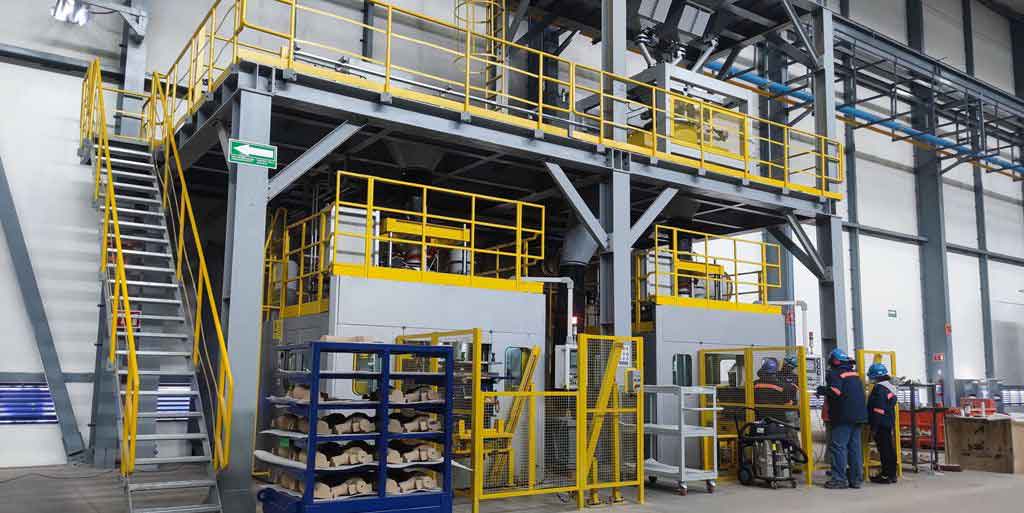
The image above illustrates typical equipment used in low-pressure casting for steel castings, highlighting the compact furnace and mold setup. This visual reinforces how the process minimizes footprint while enhancing precision. In practice, these systems enable the production of thin-walled steel castings with wall thicknesses below 2 mm, a feat that gravity casting cannot accomplish economically. This capability is crucial for lightweight steel castings in sectors like aerospace and automotive, where weight reduction is paramount.
Quality and reproducibility are hallmarks of low-pressure casting for steel castings. The process allows for automated pressure and temperature control, with data logging for continuous improvement. Key parameters such as pressure accuracy (within ±1 mbar), argon consumption, and mold contact pressure are archived to refine each steel casting cycle. The defect rate reduction, \( D_{reduction} \), can be estimated using statistical process control: $$ D_{reduction} = D_{G} \cdot (1 – \gamma) $$ where \( D_{G} \) is the defect rate in gravity casting (e.g., 0.25) and \( \gamma \) is the improvement factor (0.05 to 0.10). Thus, \( D_{reduction} \) ranges from 5% to 10%, translating to fewer rejects and lower costs in steel casting operations.
Furthermore, the lower pouring temperature in low-pressure casting (around 1,640°C) extends refractory life and reduces thermal stress on molds. The relationship between temperature and lining wear, \( L_{wear} \), can be approximated as: $$ L_{wear} \propto T^3 $$ where \( T \) is the operating temperature. By lowering \( T \) from 1,750°C to 1,640°C, we reduce \( L_{wear} \) by approximately 15%, leading to longer equipment lifespan and lower maintenance costs for steel casting facilities. This thermodynamic advantage complements the material savings discussed earlier.
Looking ahead, the integration of low-pressure casting with digital technologies promises further advancements in steel casting. Real-time monitoring and adaptive pressure curves can optimize each pour for diverse steel casting geometries. For example, machine learning algorithms can analyze historical data to predict ideal filling parameters, minimizing trial and error. This synergy positions low-pressure casting as a future-proof solution for lightweight steel castings, aligning with Industry 4.0 trends.
In conclusion, low-pressure casting offers a paradigm shift for producing lightweight steel castings, with demonstrable benefits in yield, energy efficiency, and quality. As the steel casting industry embraces sustainability, this process stands out for its ability to reduce carbon footprint while maintaining mechanical performance. My advocacy for low-pressure casting stems from its proven results in enhancing steel casting outcomes across applications. By leveraging tables, formulas, and empirical evidence, I have outlined why this method is indispensable for modern steel casting endeavors. The ongoing evolution of furnace systems and process controls will undoubtedly solidify its role in shaping the future of steel castings.