
Steel castings are fundamental components in hydro turbine generators, where they must endure extreme mechanical stresses and corrosive environments. The production of high-performance steel castings, such as those used in major hydropower projects like the Baihetan Station, relies heavily on precise smelting and heat treatment processes. This article delves into the intricate details of optimizing these processes for ultra-low carbon stainless steel grades, emphasizing the critical role of chemical composition control and thermal processing in achieving superior mechanical properties. Through extensive research and experimentation, we have developed methodologies that ensure steel castings meet stringent standards, particularly for applications requiring high strength, ductility, and impact resistance. The focus here is on the ZG04Cr13Ni5Mo steel grade, a material chosen for its excellent balance of properties, but the principles discussed apply broadly to advanced steel casting manufacturing.
The manufacturing of steel castings begins with the smelting phase, where the foundation for material performance is laid. Controlling the chemical composition is paramount, as even minor deviations can lead to significant changes in microstructure and properties. For steel castings used in critical applications, elements like carbon, chromium, and nickel must be maintained within narrow ranges. Carbon, for instance, influences hardness and strength; in ultra-low carbon stainless steel castings, it is typically kept below 0.04% to enhance weldability and toughness. Chromium provides corrosion resistance, while nickel improves ductility and stabilizes austenite. Beyond these, interstitial elements such as nitrogen, hydrogen, and oxygen must be minimized to prevent defects like embrittlement and inclusion formation. The smelting process often involves advanced techniques like vacuum oxygen decarburization (VOD) and vacuum degassing (VD) to achieve low gas contents. For example, in producing steel castings for hydro turbines, targets include nitrogen below 150 ppm, hydrogen below 3 ppm, and oxygen below 80 ppm. These controls are essential for ensuring the integrity and longevity of steel castings in service.
| Element | Target Range (wt%) or ppm | Role in Steel Castings | Impact on Properties |
|---|---|---|---|
| C | 0.025–0.035 | Primary strengthener | Affects hardness and tensile strength; low carbon improves toughness |
| Si | ≤0.60 | Deoxidizer | Enhances fluidity but can reduce toughness if excessive |
| Mn | ≤1.00 | Desulfurizer and austenite stabilizer | Improves hardenability and strength |
| P | ≤0.028 | Impurity | Causes embrittlement; must be minimized |
| S | ≤0.008 | Impurity | Forms inclusions that reduce ductility |
| Cr | 12.70–13.20 | Corrosion resistance | Forms passive oxide layer; enhances high-temperature strength |
| Ni | 4.80–5.20 | Austenite stabilizer | Increases toughness and impact resistance |
| Mo | 0.40–1.00 | Solid solution strengthener | Improves creep resistance and hardenability |
| N | ≤150 ppm | Interstitial element | Can increase strength but may cause embrittlement |
| H | ≤3 ppm | Interstitial element | Leads to hydrogen-induced cracking; critical to control |
| O | ≤80 ppm | Interstitial element | Forms oxide inclusions that act as stress concentrators |
In addition to elemental control, the microstructure of steel castings must be managed to avoid detrimental phases. One key aspect is the suppression of high-temperature delta-ferrite (δ-Fe), which can form during solidification if the nickel and chromium equivalents are not balanced. Delta-ferrite, being a soft phase, can reduce the toughness and ductility of steel castings when present in significant amounts. Research indicates that maintaining a nickel-to-chromium equivalent ratio above a critical threshold ensures δ-Fe content remains below 5%, which is generally acceptable for mechanical performance. The nickel equivalent (Nieq) and chromium equivalent (Creq) can be calculated using empirical formulas, though for ZG04Cr13Ni5Mo steel castings, a simplified approach is often used. The condition is expressed as:
$$ \text{Nieq/Creq} \geq 0.42 $$
where Nieq and Creq are derived from the composition. For practical purposes, aiming for Nieq/Creq ≥ 0.43 provides a safety margin, ensuring δ-Fe content is minimal and welding properties are improved. This balance is crucial in the smelting of steel castings to achieve a homogeneous microstructure that responds well to subsequent heat treatment.
The heat treatment of steel castings is equally vital, as it transforms the as-cast structure into one with optimized mechanical properties. For martensitic stainless steel castings like ZG04Cr13Ni5Mo, the typical sequence involves annealing, normalizing, and tempering. Annealing at around 630°C relieves internal stresses from casting, while normalizing at 1040°C refines the austenite grains and promotes a fully martensitic structure upon air cooling. However, the key to enhancing ductility and impact resistance lies in the tempering process, where reversed austenite forms. This phase, stable at room temperature, significantly improves toughness without compromising strength. Our studies on steel castings involved comparing single and double tempering cycles to determine the optimal parameters. The results showed that a two-step tempering process, with specific temperature ranges, maximizes the volume fraction of reversed austenite.
| Heat Treatment Stage | Temperature Range (°C) | Time (hours) | Cooling Method | Microstructural Outcome |
|---|---|---|---|---|
| Annealing | 630 | Variable based on section size | Furnace cooling | Stress relief and carbide spheroidization |
| Normalizing | 1040 | 1–2 per inch of thickness | Air cooling | Fine martensitic lath structure |
| First Tempering | 600–630 | 8 | Air cooling | Forms martensite-austenite interfaces |
| Second Tempering | 580–600 | 8 | Air cooling | Increases reversed austenite to ~10.1% |
The mechanism behind this improvement can be described using kinetic models. The formation of reversed austenite during tempering is influenced by the diffusion of alloying elements, particularly nickel and manganese, which stabilize austenite. The volume fraction of reversed austenite (\(V_\gamma\)) can be approximated as a function of tempering temperature (\(T\)) and time (\(t\)):
$$ V_\gamma = A \cdot \exp\left(-\frac{Q}{RT}\right) \cdot t^n $$
where \(A\) is a pre-exponential factor, \(Q\) is the activation energy for diffusion, \(R\) is the gas constant, and \(n\) is a time exponent. For steel castings subjected to double tempering, the first tempering at higher temperatures (600–630°C) creates numerous nucleation sites for austenite at martensite lath boundaries, while the second tempering at slightly lower temperatures (580–600°C) allows for growth and stabilization of these austenite islands. This process is critical for achieving the desired balance of properties in steel castings.
To quantify the effects, we conducted mechanical testing on steel casting samples after various heat treatment regimens. The results, summarized in the table below, demonstrate that the optimized double tempering process yields superior performance compared to single tempering or alternative cycles. Notably, the elongation and impact energy increase significantly with the presence of reversed austenite, meeting the rigorous standards required for hydro turbine applications.
| Property | Standard Requirement | Single Tempering (610°C) | Double Tempering (600°C + 580°C) | Improvement (%) |
|---|---|---|---|---|
| Yield Strength (Rp0.2, MPa) | ≥580 | 658 | 801 | 21.7 |
| Tensile Strength (Rm, MPa) | ≥780 | 848 | 858 | 1.2 |
| Elongation (A, %) | ≥20 | 17.0 | 23.0 | 35.3 |
| Reduction of Area (Z, %) | ≥55 | 70 | 74 | 5.7 |
| Impact Energy (KV at 0°C, J) | ≥100 | 162 | 183 | 13.0 |
| Hardness (HB) | 220–285 | 272 | 275 | 1.1 |
The relationship between heat treatment parameters and mechanical properties can be further analyzed using empirical equations. For instance, the yield strength (\(\sigma_y\)) of steel castings after tempering can be modeled as:
$$ \sigma_y = \sigma_0 + k_y \cdot d^{-1/2} + \sigma_{ss} + \sigma_{ppt} $$
where \(\sigma_0\) is the lattice friction stress, \(k_y\) is the Hall-Petch coefficient, \(d\) is the grain size, \(\sigma_{ss}\) is solid solution strengthening, and \(\sigma_{ppt}\) is precipitation strengthening. In the case of ZG04Cr13Ni5Mo steel castings, the refined martensitic lath structure and reversed austenite contribute to a lower \(d\) and enhanced \(\sigma_{ss}\), leading to high strength and ductility. Additionally, the impact energy (\(CVN\)) correlates with the volume fraction of reversed austenite (\(V_\gamma\)):
$$ CVN = B \cdot V_\gamma + C $$
where \(B\) and \(C\) are material constants. Our data suggests that for every 1% increase in \(V_\gamma\), impact energy rises by approximately 5–10 J in these steel castings.
The microstructure evolution in steel castings during heat treatment is a complex process that involves phase transformations. In the as-cast state, ZG04Cr13Ni5Mo steel castings may contain some delta-ferrite and coarse martensite, but normalizing at 1040°C homogenizes the structure, resulting in fine lath martensite. Upon tempering, carbide precipitation occurs, and reversed austenite forms along lath boundaries. The amount of reversed austenite is critical; too little can lead to brittleness, while too much may reduce strength. Through metallographic analysis, we determined that an optimal content of around 10% reversed austenite provides the best combination of properties for steel castings. This microstructure is characterized by a matrix of tempered martensite with dispersed austenite islands, which impede crack propagation and enhance toughness.
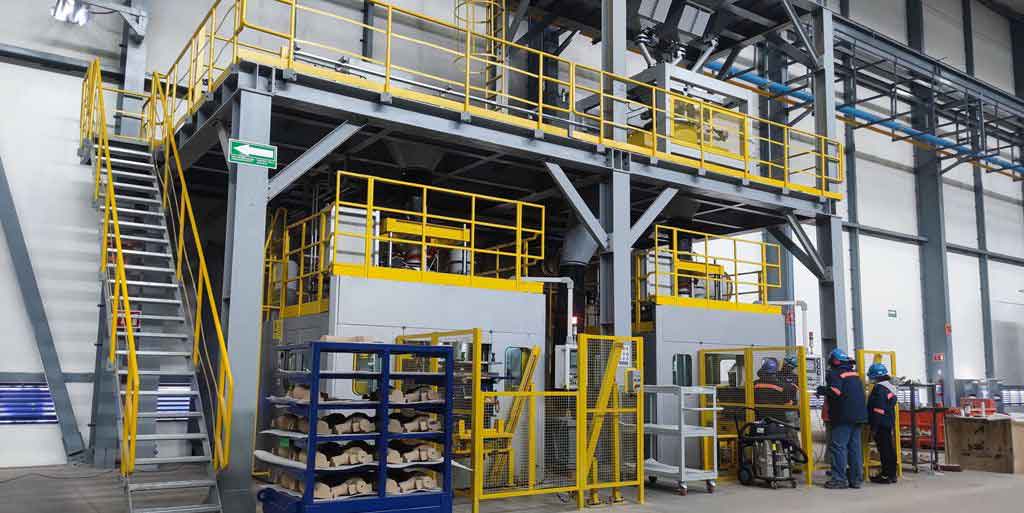
In the context of industrial production, the smelting and heat treatment of steel castings require sophisticated equipment to ensure consistency and quality. Advanced furnaces, vacuum degassing units, and precise temperature control systems are employed. For example, during the smelting of steel castings for hydro turbines, VOD and VD processes are used to achieve low gas contents, while protective argon atmospheres during pouring prevent re-oxidation. The image below illustrates typical equipment involved in the manufacturing of steel castings, highlighting the scale and complexity of these operations.
The heat treatment of large steel castings, such as those for turbine runners, poses additional challenges due to section thickness variations. To address this, computational modeling is often used to predict temperature distributions and phase transformations. The heat transfer during normalizing and tempering can be described by the Fourier equation:
$$ \frac{\partial T}{\partial t} = \alpha \nabla^2 T $$
where \(T\) is temperature, \(t\) is time, and \(\alpha\) is thermal diffusivity. By simulating these processes, manufacturers can optimize heating and cooling rates to minimize residual stresses and ensure uniform microstructure in steel castings. Furthermore, the kinetics of austenite formation during tempering can be modeled using the Johnson-Mehl-Avrami-Kolmogorov (JMAK) equation:
$$ V_\gamma = 1 – \exp(-k t^n) $$
where \(k\) is a rate constant dependent on temperature, and \(n\) is the Avrami exponent. These models aid in designing heat treatment cycles that achieve the desired reversed austenite content in steel castings.
Beyond the technical aspects, the economic and environmental implications of producing high-quality steel castings are significant. Efficient smelting reduces energy consumption and material waste, while optimized heat treatment enhances the service life of components, leading to lower lifecycle costs. For hydroelectric power plants, where steel castings are subject to cyclic loading and wet environments, durability is paramount. The advancements discussed here contribute to more reliable and sustainable energy generation. In summary, the production of steel castings for hydro turbine generators involves a meticulous interplay of smelting and heat treatment. By controlling chemical composition, minimizing impurities, and applying tailored thermal cycles, manufacturers can achieve steel castings with exceptional mechanical properties. The ZG04Cr13Ni5Mo grade serves as a prime example, where a Nieq/Creq ratio above 0.42 and a double tempering process yield a microstructure with ample reversed austenite, ensuring high strength, elongation, and impact resistance. These principles are applicable to a wide range of steel castings used in demanding applications, underscoring the importance of continuous research and innovation in this field.
To further elaborate, the role of each alloying element in steel castings can be quantified using strengthening mechanisms. For instance, the contribution of carbon to yield strength (\(\sigma_C\)) is given by:
$$ \sigma_C = k_C \cdot [C]^{1/2} $$
where \(k_C\) is a constant and [C] is the carbon concentration in weight percent. Similarly, chromium and nickel contribute via solid solution strengthening, with coefficients derived from experimental data. In ultra-low carbon stainless steel castings, the low carbon content reduces the risk of carbide precipitation at grain boundaries, which can cause sensitization and intergranular corrosion. Instead, the alloy relies on elements like molybdenum for secondary hardening during tempering. The precipitation of fine carbides, such as M23C6 or MX-type carbonitrides, adds strength without compromising toughness. The Orowan looping mechanism describes this strengthening effect:
$$ \sigma_{ppt} = \frac{Gb}{L} $$
where \(G\) is the shear modulus, \(b\) is the Burgers vector, and \(L\) is the inter-particle spacing. In steel castings subjected to double tempering, the careful control of temperature allows for optimal precipitate size and distribution.
The impact of heat treatment on toughness is particularly crucial for steel castings operating at low temperatures, such as in hydro turbines where water temperatures can approach freezing. The ductile-to-brittle transition temperature (DBTT) is lowered by refining the microstructure and introducing reversed austenite. Empirical correlations show that for every 10% increase in reversed austenite, the DBTT drops by approximately 20°C in these steel castings. This is vital for preventing catastrophic failure under impact loading. Moreover, the fatigue resistance of steel castings, a key consideration in rotating machinery, is enhanced by a homogeneous microstructure free of inclusions and brittle phases. The fatigue limit (\(\sigma_f\)) can be estimated using the Basquin equation:
$$ \sigma_f = \sigma_f’ \cdot (2N_f)^b $$
where \(\sigma_f’\) is the fatigue strength coefficient, \(N_f\) is the number of cycles to failure, and \(b\) is the fatigue exponent. Improvements in cleanliness and microstructure from optimized smelting and heat treatment directly boost \(\sigma_f’\), extending the service life of steel castings.
In practice, the production of steel castings involves continuous monitoring and quality control. Spectroscopic analysis ensures composition accuracy, while ultrasonic testing detects internal defects. During heat treatment, thermocouples and data loggers track temperature profiles to guarantee consistency across large batches. Statistical process control (SPC) methods are employed to analyze variations and refine parameters. For example, regression analysis can relate tempering temperature to mechanical properties, enabling predictive adjustments. A simplified model for yield strength as a function of first tempering temperature (\(T_1\)) and second tempering temperature (\(T_2\)) might look like:
$$ \sigma_y = \beta_0 + \beta_1 T_1 + \beta_2 T_2 + \beta_3 T_1 T_2 $$
where \(\beta\) coefficients are determined from experimental data on steel castings. Such models facilitate the optimization of heat treatment cycles for different steel casting geometries and applications.
Looking ahead, trends in steel casting technology include the adoption of additive manufacturing for complex shapes and the integration of artificial intelligence for process optimization. However, traditional smelting and heat treatment remain foundational. Research continues into new alloy designs that offer better performance with lower cost, such as reduced nickel content while maintaining Nieq/Creq ratios. Additionally, environmental regulations drive the development of greener processes, like using recycled scrap in smelting and implementing energy-efficient heat treatment furnaces. These advancements promise to further enhance the sustainability and performance of steel castings in hydro turbine generators and beyond.
In conclusion, the smelting and heat treatment of steel castings are complex but essential processes that determine the success of critical infrastructure projects like hydroelectric power plants. Through precise control of chemistry and thermal cycles, manufacturers can produce steel castings that meet extreme demands for strength, ductility, and toughness. The case of ZG04Cr13Ni5Mo steel castings illustrates how a combination of low carbon, balanced alloying, and double tempering leads to a microstructure rich in reversed austenite, delivering superior mechanical properties. As the industry evolves, ongoing innovation in these areas will ensure that steel castings continue to play a vital role in global energy systems, providing reliable and durable components for generations to come.