
In the realm of automotive engineering, the evolution of engine technology has pushed operational temperatures to unprecedented levels, often exceeding 950°C and even reaching 1000°C. This demanding environment renders traditional cast iron materials inadequate for components like exhaust manifolds, which are subjected to severe thermal cycling and mechanical stress. Consequently, austenitic heat-resistant steel casting has emerged as a critical solution, offering superior high-temperature strength and thermal fatigue resistance. However, the adoption of austenitic steels in steel casting presents significant challenges, including poor fluidity, high solidification shrinkage, and a pronounced tendency for defects such as hot tearing, shrinkage porosity, and non-metallic inclusions. These issues are exacerbated by the complex geometry of exhaust manifolds, which feature uneven wall thickness and irregular shapes, making the steel casting process particularly intricate. In this article, I will delve into a comprehensive failure analysis of a heat-resistant steel casting exhaust manifold that cracked during bench testing, explore the root causes linked to non-metallic inclusions, and detail the optimized steel casting processes that successfully mitigated these failures.
The exhaust manifold in question was designed for use in a turbocharged engine, connecting the engine block to the turbocharger. Its structure, typical of many steel casting components, includes flanges, pipes, and bosses with varying thicknesses—ranging from 6 mm in the pipe walls to 15 mm in the flange areas. The material specified was SCH23 austenitic heat-resistant cast steel (per JIS G5122-2003), with a chemical composition and mechanical properties as outlined below. This steel casting is characterized by a single austenite matrix, which theoretically provides excellent creep resistance and oxidation stability at elevated temperatures. However, during a thermal shock bench test—simulating extreme engine conditions with cycles of high-speed operation (720–730°C) followed by forced air cooling (200–300°C)—the manifold cracked after only 1,200 cycles, failing to meet the 1,500-cycle requirement. This premature failure prompted an in-depth investigation to identify the underlying causes and improve the steel casting methodology.
| Element | Required Range (wt%) | Actual Measured (wt%) |
|---|---|---|
| C | 0.2–0.6 | 0.36 |
| Si | ≤2.0 | 1.46 |
| Mn | ≤2.0 | 1.08 |
| P | ≤0.04 | 0.018 |
| S | ≤0.04 | 0.02 |
| Cr | 28–32 | 28.41 |
| Ni | 18–22 | 18.87 |
| Nb | 0.8–1.6 | 0.898 |
| Property | Required (SCH23 Standard) | Initial Casting (Before Optimization) | Optimized Casting (After Improvement) |
|---|---|---|---|
| Tensile Strength (MPa) | ≥450 | 548 | 560 |
| Yield Strength (MPa) | ≥245 | 344 | 350 |
| Elongation (%) | ≥8 | 11 | 12 |
The initial step in the failure analysis involved a visual inspection of the cracked manifold. The crack originated near the outlet flange, extending along the pipe wall and penetrating through the thickness. This location is a known stress concentration zone due to thermal gradients during operation. X-ray radiography, conducted according to ASTM E446 standards, revealed no significant shrinkage porosity or slag inclusions at the crack site, suggesting that the failure was not due to gross casting defects but rather to microstructural anomalies. Chemical analysis via optical emission spectroscopy confirmed that the composition adhered to SCH23 specifications, as shown in Table 1, ruling out material deviation as a direct cause. Similarly, mechanical tests on samples from the production batch met the required properties (Table 2), indicating that the bulk material performance was adequate.
Macroscopic examination of the fracture surface revealed a dull, oxidized appearance with yellowish rust deposits, indicative of high-temperature exposure and gradual crack propagation. Notably, radial patterns and darkened regions suggested potential crack initiation sites. At higher magnification (100×), black patches were observed within the matrix, hinting at the presence of non-metallic inclusions. To investigate further, scanning electron microscopy (SEM) was employed, revealing that the austenitic matrix contained dispersed carbides without extensive microcracking. However, numerous black patches were evident at grain boundaries and within grains. Energy-dispersive X-ray spectroscopy (EDS) analysis identified these inclusions as complex oxides, manganese sulfides (MnS), and calcium aluminates. The composition data are summarized below, highlighting the diverse nature of these defects in steel casting.
| Inclusion Type | Location | Major Elements Detected (wt%) | Inferred Composition |
|---|---|---|---|
| Complex Oxides | Within Grains | O (34.08), P (21.73), Ti (18.02), Al (17.33), Ca (1.72), Mg (1.57) | Oxides and calcium aluminate |
| MnS Inclusions | Grain Boundaries | Mn (45.25), S (34.84), Cr (19.91) | Manganese sulfide with chromium |
The presence of these non-metallic inclusions is a critical factor in the failure mechanism. In steel casting, inclusions arise primarily from deoxidation reactions and impurity elements during melting and solidification. For instance, during deoxidation, elements like aluminum, silicon, and calcium react with oxygen to form oxides, while sulfur combines with manganese to precipitate MnS. The total oxygen content in the melt, often denoted as [O]total, is directly proportional to the volume fraction of oxide inclusions. This relationship can be expressed as:
$$ V_f = k \cdot [O]_{total} $$
where \( V_f \) is the volume fraction of inclusions and \( k \) is a proportionality constant dependent on process parameters. Additionally, the solubility product of MnS in austenitic steel governs its precipitation during cooling:
$$ [Mn] \cdot [S] = K_{sp}(T) $$
where \( K_{sp}(T) \) is the temperature-dependent solubility product. At lower temperatures, exceeding this product leads to MnS formation. These inclusions, being brittle and non-deformable, act as stress concentrators under thermal cycling. The mismatch in thermal expansion coefficients between the austenitic matrix and inclusions generates localized stresses. During high-temperature operation, creep deformation occurs, and the strain incompatibility can initiate microvoids at the inclusion-matrix interface. Over repeated cycles, these microvoids coalesce into cracks, propagating along grain boundaries and ultimately causing macroscopic fracture. The stress intensity factor \( K \) at an inclusion site can be modeled as:
$$ K = \sigma \sqrt{\pi a} \cdot f\left(\frac{a}{W}\right) $$
where \( \sigma \) is the applied stress, \( a \) is the inclusion size, and \( f(a/W) \) is a geometric correction factor. Larger inclusions significantly reduce fatigue life, emphasizing the importance of inclusion control in steel casting.
In this case, the original steel casting process involved melting in a 1-ton medium-frequency induction furnace without a protective cover, exposing the molten steel to atmospheric oxygen. The charge consisted of pig iron, scrap steel, ferrochromium, nickel plates, and other alloys, which introduced impurities like sulfur. The deoxidation sequence used manganese and silicon for pre-deoxidation, followed by final deoxidation with aluminum and silicon calcium in the ladle. While effective in reducing oxygen, this approach tended to form clustered alumina inclusions. Moreover, the lack of inert gas shielding allowed re-oxidation, increasing the total oxygen content and inclusion population. To address these issues, a comprehensive optimization of the steel casting process was implemented, focusing on melt purification and inclusion minimization.
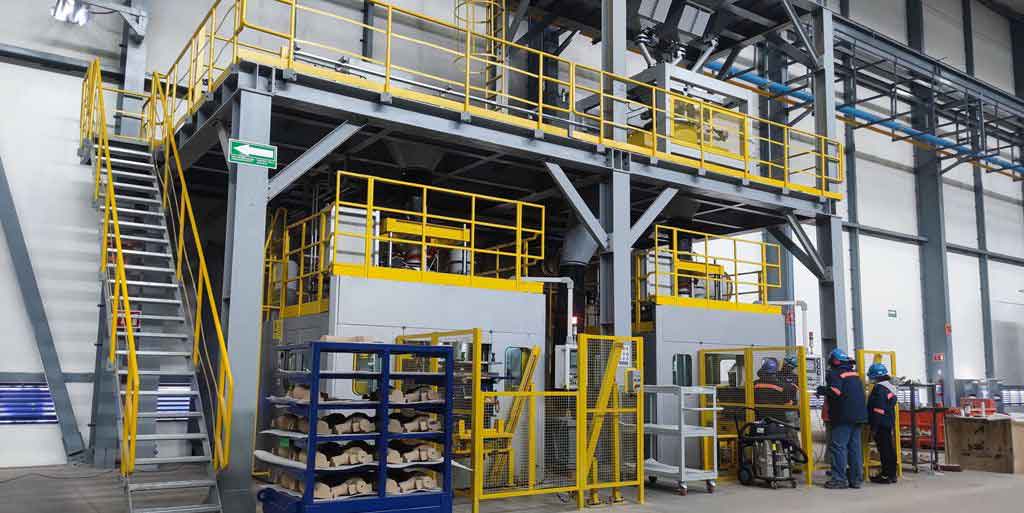
The revised steel casting strategy encompassed several key modifications. First, the charge materials were altered: pig iron was eliminated to reduce sulfur input, and instead, a blend of scrap steel, returns, and low-carbon ferrochromium was used. All materials were pre-treated—shot blasted to remove rust and crushed to ensure dense packing in the furnace, preventing “bridging” and promoting efficient melting. The furnace was equipped with a cover to minimize air exposure, and inert gas (argon) was injected through the bottom to protect the melt and enhance inclusion flotation. The gas bubbling also facilitates the removal of fine inclusions via the principle of Stokes’ law, where the rise velocity \( v \) of an inclusion is given by:
$$ v = \frac{2 g (\rho_m – \rho_i) r^2}{9 \eta} $$
Here, \( g \) is gravitational acceleration, \( \rho_m \) and \( \rho_i \) are densities of the melt and inclusion, \( r \) is the inclusion radius, and \( \eta \) is the dynamic viscosity of the steel. Larger bubbles can capture inclusions, further purifying the steel casting.
Deoxidation was overhauled using a compound method. At temperatures above 1600°C, a combination of low-carbon ferromanganese, ferrosilicon, and 1.0 wt% silicon calcium (or aluminum) alloy was added for precipitation deoxidation, accompanied by vigorous stirring to ensure homogeneity. Subsequently, diffusion deoxidation was performed by sprinkling 0.15–0.20 wt% silicon calcium powder on the slag surface. During tapping, the ladle was pre-lined with rare earth elements (0.15–0.20 wt%), SiSrZr (0.2 wt%), and ferroniobium (0.3 wt%) for final deoxidation and modification. This multi-stage approach reduces the activity of oxygen and sulfur, as described by the equilibrium constants:
$$ K_{Al} = \frac{[Al]^2 \cdot [O]^3}{a_{Al_2O_3}} \quad \text{and} \quad K_{S} = \frac{[Mn] \cdot [S]}{a_{MnS}} $$
where \( a \) denotes activity. By lowering [O] and [S], inclusion formation is suppressed. Additionally, rare earth elements modify inclusion morphology, transforming harmful angular oxides into globular, less detrimental forms, thereby improving the toughness of the steel casting.
To validate the efficacy of these optimizations, new exhaust manifolds were produced using the refined steel casting process. Samples from critical regions were subjected to the same battery of tests. Chemical and mechanical analyses confirmed compliance with SCH23 standards, with slight improvements in tensile and yield strengths (Table 2). Microstructural evaluation via SEM revealed a clean austenitic matrix with finely dispersed carbides and an absence of large, continuous inclusions. EDS spot analyses on grain boundaries and interiors showed primarily chromium carbides and the base alloy elements, as summarized below, indicating successful inclusion reduction.
| Location | Major Elements Detected (wt%) | Inferred Phase |
|---|---|---|
| Grain Boundary | Cr (42.47), Ce (22.51), Pt (16.28), O (9.43), Fe (5.96), Al (3.35) | Chromium carbides with rare earth modifiers |
| Within Grain | Fe (50.61), Cr (28.11), Ni (18.80), Si (2.48) | Austenitic matrix |
The thermal shock bench test on the optimized steel casting components demonstrated remarkable durability, with all units surpassing 1,500 cycles without failure. This outcome underscores the critical role of melt cleanliness in enhancing the performance of heat-resistant steel castings. The reduction in non-metallic inclusions not only mitigates crack initiation but also improves overall ductility and fatigue resistance. In steel casting, especially for high-temperature applications, controlling inclusion size and distribution is paramount. Statistical models can relate inclusion characteristics to fatigue life, such as the Pareto distribution of inclusion sizes:
$$ P(d > x) = \left(\frac{x_0}{x}\right)^m $$
where \( d \) is inclusion diameter, \( x_0 \) is a scale parameter, and \( m \) is the shape parameter. By optimizing the steel casting process, we shift this distribution toward smaller sizes, extending component life.
In conclusion, the failure of the heat-resistant steel casting exhaust manifold was primarily attributable to non-metallic inclusions—complex oxides, MnS, and calcium aluminates—that acted as stress concentrators and crack initiation sites under thermal cycling. Through a systematic redesign of the steel casting process, including charge material selection, inert gas shielding, and compound deoxidation, these inclusions were significantly reduced. The optimized steel casting methodology not only resolved the cracking issue but also enhanced the mechanical properties and reliability of the manifolds. This case study highlights the importance of meticulous process control in steel casting, particularly for demanding applications like exhaust systems. Future work could explore advanced simulation techniques to predict inclusion behavior and further refine steel casting parameters, ensuring even greater performance in next-generation engines. As steel casting continues to evolve, such insights will be invaluable for pushing the boundaries of material capability and automotive innovation.