
The production of critical structural components, especially large-scale steel castings, demands meticulous planning and precise execution to meet stringent mechanical and dimensional specifications. This discussion details the comprehensive manufacturing methodology employed for a significant steel casting component: a large anchor block designed for use in anchor box girders. The component under consideration possesses overall dimensions of approximately 3000mm in length, 3000mm in width, and 700mm in height, with a final weight exceeding 16 metric tons. The material specification for this steel casting is ZG270-480H, a grade of cast steel known for its balanced strength and toughness, making it suitable for demanding structural applications.
The performance requirements for this steel casting anchor block were exceptionally rigorous. Internal soundness was paramount, with the final machined surfaces required to be completely free from defects such as shrinkage cavities, porosity, cold shuts, gas holes, and cracks. Dimensional tolerances and weight had to be controlled within ±5% of the drawing specifications. Furthermore, the finished steel casting underwent 100% non-destructive testing (NDT) on specified surfaces. The chemical composition and mechanical properties of the final product were mandated to conform strictly to the standards outlined for the material grade, ensuring reliability under operational loads.
The successful manufacture of such a steel casting hinges on the integration and stringent control of several key technological processes. The overarching production sequence can be summarized as follows: Patternmaking and Molding → Melting and Pouring → Shakeout → Heat Treatment (Normalizing & Tempering) → Fettling and Cleaning → Inspection → Machining (Base and Holes) → Non-Destructive Testing → Surface Preparation (Blasting) → Coating/Painting → Final Inspection → Assembly/Pairing.
To guarantee the quality of the final steel casting, specific and targeted measures were implemented at each critical stage of the process, from initial design to final validation.
Foundry and Melting Process Design
The geometry of the anchor block steel casting dictated a strategic approach to pattern and mold design. Given the component’s height and geometry, a two-part molding process was adopted with the parting line established at the 700mm height. The wooden pattern was consequently constructed in two segments. A high-quality silica sand mix was utilized for molding. Draft angles were applied at 1:8 to facilitate pattern withdrawal, and a linear shrinkage allowance of 1.2% was incorporated to achieve final net dimensions. Machining allowances were assigned in accordance with international casting tolerance standards, with 9mm added to the bottom and side surfaces, and 5-6mm reserved for subsequent hole boring operations.
The gating and feeding system is the heart of any successful steel casting process. For this large, relatively flat steel casting, a top-running multi-ingate system was designed to ensure a controlled and rapid fill of the mold cavity, minimizing temperature gradients and potential cold shuts. More critically, multiple generously sized feeder heads (risers) were strategically placed to provide a reservoir of molten metal to compensate for solidification shrinkage, thereby preventing internal shrinkage defects in the main body of the steel casting. The design of these feeders often follows principles related to the modulus (Volume/Surface Area ratio) of the casting sections they are intended to feed. A simplified check can be expressed as ensuring the feeder’s solidification time exceeds that of the casting section:
$$ t_f > t_c $$
where \( t_f \) is the solidification time of the feeder and \( t_c \) is the solidification time of the critical casting section, often estimated by Chvorinov’s Rule: \( t = k (V/A)^2 \), where \( V \) is volume, \( A \) is cooling surface area, and \( k \) is a mold constant.
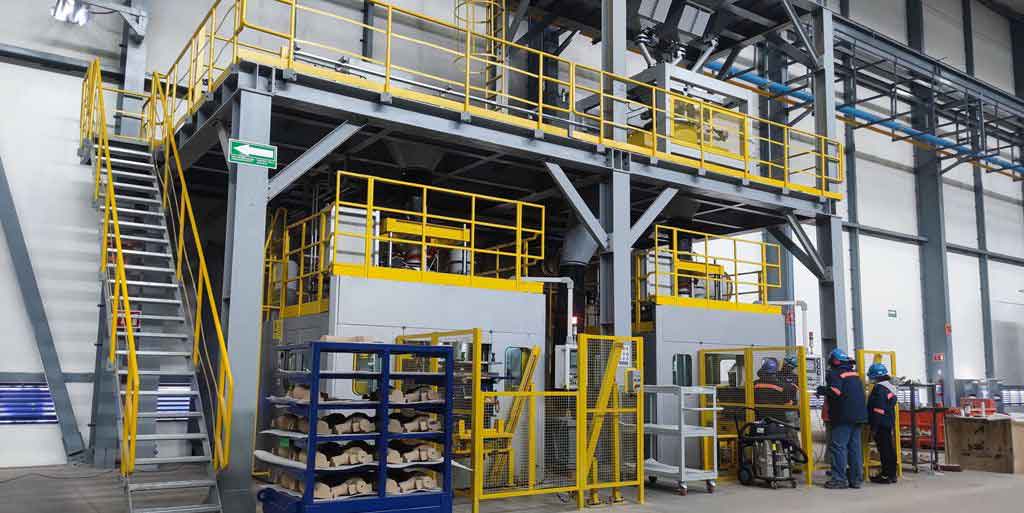
The melting operation was conducted in a coreless induction furnace with a capacity sufficient for the heat. Charge materials were meticulously weighed and inspected prior to charging to control the baseline chemistry of the steel casting. Throughout the melt, a spectrometer was used for real-time chemical analysis, allowing for precise adjustments to achieve the target composition for the ZG270-480H grade. The molten steel was subjected to purification treatments, such as slag control and possible argon rinsing, to enhance cleanliness by reducing oxide and sulfide inclusions. Pouring temperature was continuously monitored using digital infrared pyrometers, and the pour was executed at a controlled rate to maintain thermal stability and minimize turbulence, which can lead to reoxidation and slag entrainment in the final steel casting. Mechanical vibration was employed for shakeout to efficiently separate the solidified steel casting from the sand mold without imparting excessive mechanical stress.
Heat Treatment Process Design
Heat treatment is indispensable for developing the required mechanical properties in a steel casting. The as-cast microstructure is often coarse and may contain undesirable phases or segregation, leading to suboptimal strength and toughness. For this anchor block steel casting, a normalizing and tempering cycle was specified. Normalizing involves heating the steel casting to a temperature above its upper critical transformation temperature (Ac3), holding to achieve a uniform austenitic structure throughout the section, followed by cooling in still air. This process refines the grain structure, improves homogeneity, and enhances mechanical properties. Tempering is subsequently performed to relieve internal stresses induced by the normalizing cool-down and to improve toughness by adjusting the hardness.
The precise thermal cycle is critical. A stepped heating rate was employed to prevent thermal shock and distortion in the large steel casting. The component was heated to a normalizing temperature of 920°C, held for a duration calculated based on its maximum section thickness (typically 2.5 hours for this configuration), and then air-cooled. The tempering was conducted at 580°C for 3 hours, followed by air cooling. Furnace temperature uniformity was maintained within ±10°C to ensure consistent treatment across the entire steel casting. The transformation during heat treatment can be conceptually related to the time-temperature-transformation (TTT) diagram for the specific steel chemistry, ensuring the cooling rates achieve the desired microstructure (e.g., fine pearlite/ferrite or bainite). The cooling rate \( \dot{T} \) influences the resulting hardness and strength, often correlated empirically for similar steel castings:
$$ HV = A + B \cdot \log(\dot{T}) $$
where \( HV \) is Vickers hardness, and \( A \) and \( B \) are material-dependent constants.
Machining and Finishing Processes
After heat treatment and initial cleaning, the steel casting proceeds to machining to achieve final dimensional accuracy and surface finish. For this large anchor block, key surfaces included the entire bottom mounting plane (the 3000mm x 3000mm face) and the precision-bored holes. These operations were performed on large, modern CNC milling and boring machines to guarantee parallelism, flatness, and positional accuracy of the holes as per the engineering drawings. The specified surface roughness for these machined areas was between 12.5 and 25 micrometers (Ra). The use of数控 machining for this steel casting ensured repeatability and adherence to tight geometric tolerances, which is crucial for its function in the final assembled structure.
Quality Assurance and Non-Destructive Testing
Quality verification permeated the entire manufacturing sequence for this steel casting. Post-machining, a comprehensive battery of NDT methods was applied. Magnetic Particle Testing (MT) was used at 100% frequency on all fillet radii (e.g., R60mm transitions) and on both sides of the vertical walls to detect surface and near-surface discontinuities. Ultrasonic Testing (UT) was employed at 100% frequency on the large machined bottom surface to assess internal soundness, looking for any subsurface flaws like shrinkage or inclusions. Liquid Penetrant Testing (PT) was also conducted on all vertical surfaces and ribs to complement the MT, providing high sensitivity for fine surface-breaking defects. Any defects identified were evaluated against acceptance standards (typically Level II for MT and UT, Level I for PT). The stringent NDT protocol for this steel casting provided a high level of confidence in its structural integrity.
In cases where minor, acceptable defects required repair, a controlled repair welding procedure was established. This involved preheating the local area of the steel casting to a minimum of 180°C, using welding consumables with strength matching or exceeding the base metal, and executing the weld per qualified procedures. For major repairs, a subsequent stress relief heat treatment was mandated. Strict limits were placed on the total weight of deposited weld metal relative to the total weight of the steel casting to prevent distortion or adverse effects on bulk properties.
Production Results and Validation
The implementation of the described process yielded steel casting anchor blocks that successfully met all design requirements. The validation data from the production of multiple units is summarized below.
Chemical Composition Analysis: Samples for chemical analysis were taken during the pouring of each heat. The results for four separate steel casting units are shown in Table 1, confirming full compliance with the ZG270-480H specification limits, particularly noting the very low levels of residual elements Phosphorus (P) and Sulfur (S), which contribute to improved toughness.
| Casting Unit | Carbon (C) | Manganese (Mn) | Silicon (Si) | Phosphorus (P) | Sulfur (S) |
|---|---|---|---|---|---|
| 1 | 0.20 | 0.91 | 0.33 | ≤0.012 | ≤0.012 |
| 2 | 0.23 | 0.87 | 0.33 | ≤0.010 | ≤0.010 |
| 3 | 0.21 | 1.00 | 0.49 | ≤0.016 | ≤0.016 |
| 4 | 0.23 | 0.87 | 0.33 | ≤0.010 | ≤0.010 |
| Spec. (ZG270-480H) | 0.10-0.25 | 0.80-1.20 | ≤0.60 | ≤0.025 | ≤0.025 |
Mechanical Properties Testing: Separate test coupons (keel blocks) were cast from the same heat as each steel casting and underwent identical heat treatment. Tensile and impact specimens were machined from these blocks. The results, detailed in Table 2, demonstrate that all units comfortably exceeded the minimum specified requirements for yield strength (ReH), tensile strength (Rm), elongation (A), and impact energy (KV). The high impact energy values are particularly noteworthy, indicating excellent toughness in the finished steel casting.
| Casting Unit | Yield Strength, ReH (MPa) | Tensile Strength, Rm (MPa) | Elongation, A (%) | Impact Energy, KV (J) [Triplet] |
|---|---|---|---|---|
| 1 | 305 | 507 | 34 | 104, 91, 82 |
| 2 | 306 | 508 | 33 | 105, 91, 82 |
| 3 | 309 | 505 | 34 | 102, 91, 82 |
| 4 | 307 | 507 | 33 | 104, 92, 83 |
| Spec. Requirement | ≥270 | ≥480 | ≥20 | ≥40 |
Non-Destructive Testing & Dimensional Inspection: As reported, all NDT inspections (MT, UT, PT) were passed satisfactorily, with no rejectable defects found on the critical areas of the steel castings. Final dimensional checks using tape measures, calipers, and visual inspection confirmed that the geometry, size, and surface quality of all anchor block steel castings conformed to the drawing specifications. The weight of each casting was also verified to be within the stipulated ±5% tolerance.
Summary of Key Process Parameters
The following table consolidates the central parameters that defined the manufacturing route for this large steel casting, providing a concise overview of the controlled process window.
| Process Stage | Key Parameter | Value / Specification |
|---|---|---|
| Pattern & Mold | Parting Line | At 700mm height |
| Shrinkage Allowance | 1.2% Linear | |
| Machining Allowance (Bottom/Sides) | 9 mm | |
| Machining Allowance (Holes) | 5-6 mm | |
| Melting & Pouring | Material Grade | ZG270-480H (Cast Steel) |
| Melt Control | Spectrometer Analysis, Slag Control | |
| Pouring Temperature | Controlled per thermal analysis (Typically ~1580-1600°C for such steel casting) | |
| Heat Treatment | Normalizing Temperature | 920°C |
| Normalizing Soak Time | 2.5 hours | |
| Tempering Temperature | 580°C | |
| Tempering Soak Time | 3 hours | |
| Quality Control | NDT Methods | 100% MT on critical fillets, 100% UT on bottom face, 100% PT on vertical surfaces |
In conclusion, the methodology outlined for the production of this large anchor block demonstrates a viable and robust technical pathway for manufacturing high-integrity steel castings for critical structural applications. The synergistic integration of careful pattern design, controlled melting and feeding, precise heat treatment, accurate machining, and rigorous non-destructive validation resulted in a steel casting product whose chemical, mechanical, and dimensional properties comprehensively satisfied the demanding client specifications. The process underscores the capability of modern steel casting technology to deliver large, complex components with guaranteed performance characteristics, essential for infrastructure and heavy engineering projects.