
In my extensive experience with metallurgical engineering, the study of heat treatment processes for steel castings has always been a cornerstone for enhancing material performance. Steel castings, as critical components in industries ranging from mining to automotive, require precise thermal processing to achieve desired mechanical properties. This article delves into the common heat treatment techniques, their impact on the performance of steel castings, and practical applications, all from a first-person perspective of research and implementation. The goal is to provide a comprehensive overview that incorporates detailed tables, mathematical formulations, and visual aids to summarize key concepts.
Steel castings are produced by combining iron-carbon alloys with casting methods, resulting in components that often exhibit inhomogeneous microstructures, severe dendritic segregation, coarse grains, and residual stresses due to variations in wall thickness and geometry. To mitigate these issues and tailor the properties of steel castings, heat treatment is indispensable. The primary processes include annealing, normalizing, quenching, tempering, solution treatment, precipitation hardening, stress relieving, and dehydrogenation. Each process targets specific microstructural adjustments, ultimately influencing the hardness, toughness, and overall durability of steel castings.
Let me begin by outlining the fundamental heat treatment工艺流程 for steel castings. Annealing involves heating steel castings to a temperature 20–30°C above the AC3 point, holding for a sufficient time, and then slowly cooling. This process refines grains, reduces segregation, and improves machinability. Normalizing, on the other hand, requires heating to 30–50°C above AC3, followed by air cooling to achieve a finer austenitic structure, enhancing mechanical properties. These preliminary treatments adjust hardness and residual stress, preparing steel castings for subsequent machining or further heat treatment.
Quenching is a critical step where steel castings are heated to an austenitizing temperature, held, and rapidly cooled via oil, water, or air to transform the microstructure into martensite or bainite. This must be followed promptly by tempering to relieve stresses and improve toughness. Tempering involves reheating to specific temperatures (e.g., 150–250°C for low-temperature or 500–600°C for high-temperature) and cooling, which stabilizes the structure and enhances ductility. For specialized steel castings, solution treatment dissolves carbides into the matrix through heating and rapid cooling, while precipitation hardening involves aging to precipitate strengthening phases.
To summarize these processes, I have compiled a table that outlines key parameters and objectives for each heat treatment method applied to steel castings:
| Heat Treatment Process | Temperature Range | Cooling Method | Primary Objective | Typical Applications for Steel Castings |
|---|---|---|---|---|
| Annealing | AC3 + 20–30°C | Slow furnace cooling | Refine grains, reduce stress, improve machinability | General-purpose steel castings with coarse structures |
| Normalizing | AC3 + 30–50°C | Air cooling | Enhance strength and toughness via fine microstructure | Carbon and low-alloy steel castings |
| Quenching | Austenitizing temperature (e.g., 850–950°C) | Oil, water, or air quenching | Achieve high hardness through martensitic transformation | Wear-resistant steel castings like gears or brakes |
| Tempering | 150–250°C (low) or 500–600°C (high) | Air cooling | Relieve quenching stresses, improve toughness | Quenched steel castings requiring balanced properties |
| Solution Treatment | Specific to alloy (e.g., 1000–1100°C) | Rapid cooling (e.g., water quench) | Dissolve precipitates for corrosion resistance | Stainless steel or high-alloy steel castings |
| Precipitation Hardening | Aging temperature (e.g., 400–600°C) | Controlled cooling | Increase hardness by precipitating intermetallics | Aluminum or nickel-based steel castings |
| Stress Relieving | AC3 – 100–200°C | Slow cooling | Eliminate residual stresses from casting or welding | Large or complex steel castings |
| Dehydrogenation | 170–200°C or 280–300°C | Long holding, slow cooling | Remove hydrogen to prevent embrittlement | Steel castings prone to hydrogen-induced cracking |
The impact of heat treatment on the performance of steel castings can be quantified through mechanical properties. Strength, often measured as yield strength (σ_y), is influenced by microstructure refinement and phase transformations. For instance, the Hall-Petch equation relates grain size (d) to yield strength:
$$ \sigma_y = \sigma_0 + \frac{k_y}{\sqrt{d}} $$
where σ_0 is the friction stress and k_y is a constant. Heat treatment processes like normalizing reduce grain size, thereby increasing σ_y for steel castings. Similarly, elongation (ε), a measure of ductility, improves with tempering as residual stresses are alleviated. The relationship can be expressed as:
$$ \epsilon = A – B \cdot \sigma_r $$
where A and B are material constants, and σ_r is the residual stress. For steel castings subjected to quenching and tempering, ε typically increases by 10–20% compared to as-cast conditions.
Toughness, critical for impact resistance, is enhanced by heat treatment through microstructural homogeneity. The Charpy impact energy (CVN) for steel castings can be modeled as:
$$ \text{CVN} = C \cdot \exp\left(-\frac{Q}{RT}\right) $$
where C is a pre-exponential factor, Q is the activation energy, R is the gas constant, and T is the tempering temperature. Proper heat treatment, such as austempering for steel castings, optimizes CVN by forming bainitic structures.
In practical applications, I have analyzed the heat treatment of brake discs used in mining equipment. These steel castings are made from low-carbon steel, specifically 18CrMnTi, requiring surface hardness of HRC 58–65 and core hardness of HRC 40–45. The process involves carburizing at 920–950°C, oil quenching at 850–870°C, and tempering at 180–200°C. This sequence ensures a hardened case for wear resistance and a tough core for impact loading, demonstrating how tailored heat treatment can meet stringent performance criteria for steel castings.
During heat treatment, challenges like distortion may arise. For steel castings with flatness requirements under 0.5 mm, post-treatment cleaning and straightening are essential. The following table summarizes key performance changes after heat treatment for typical low-alloy steel castings:
| Property | As-Cast State | After Annealing | After Quenching & Tempering | Improvement (%) |
|---|---|---|---|---|
| Yield Strength (MPa) | 250–300 | 280–320 | 450–550 | 80–100 |
| Elongation (%) | 10–15 | 12–18 | 15–22 | 50–70 |
| Impact Toughness (J) | 20–30 | 25–35 | 40–60 | 100–150 |
| Hardness (HRC) | 15–20 | 18–22 | 30–45 (core) / 55–65 (surface) | Varies by process |
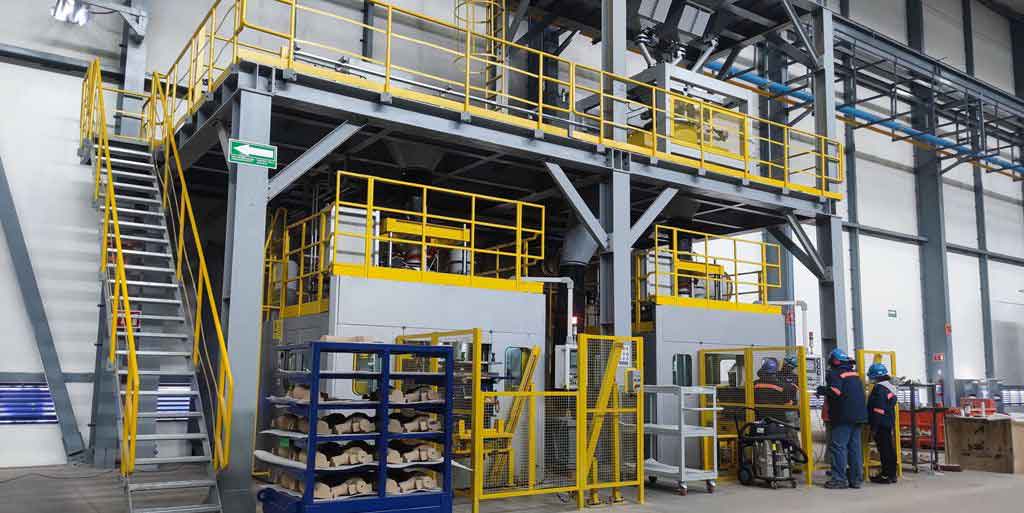
To visualize the equipment used in such processes, consider the following image of steel casting machinery, which highlights the industrial scale of heat treatment operations for steel castings. This underscores the importance of precise temperature control and cooling mechanisms in achieving consistent quality for steel castings.
Further delving into the science, the kinetics of phase transformations during heat treatment of steel castings can be described using the Avrami equation for nucleation and growth:
$$ X(t) = 1 – \exp(-k t^n) $$
where X(t) is the transformed fraction, k is a rate constant, t is time, and n is the Avrami exponent. For austenite decomposition in steel castings during quenching, n typically ranges from 1.5 to 2.5, depending on cooling rate. This mathematical approach helps optimize holding times and temperatures for steel castings.
Another critical aspect is the effect of alloying elements on heat treatment response. For steel castings with chromium, molybdenum, or nickel, hardenability improves, allowing deeper martensite formation. The ideal critical diameter (D_I) can be estimated using Grossmann’s equation:
$$ D_I = D_0 \cdot \sqrt{\sum (k_i \cdot w_i)} $$
where D_0 is a base diameter, k_i are multiplicative factors, and w_i are weight percentages of alloying elements. This guides the design of heat treatment cycles for alloy steel castings to ensure uniform properties.
In summary, heat treatment technology for steel castings is a multifaceted field that integrates thermal cycles, microstructural engineering, and performance validation. Through processes like annealing, quenching, and tempering, steel castings achieve enhanced strength, ductility, and toughness, making them suitable for demanding applications. The continuous refinement of these techniques, supported by empirical data and mathematical models, drives innovation in the production of high-performance steel castings. As research progresses, advancements in computational simulation and real-time monitoring promise to further optimize heat treatment for steel castings, ensuring reliability and efficiency in industrial use.