
In the field of heavy machinery, steel castings serve as critical load-bearing components, often subjected to substantial stresses and impacts. Ensuring the quality of these steel castings is paramount, as defects like shrinkage porosity, cracks, or inclusions can severely compromise mechanical performance. Traditional casting process design relies heavily on empirical knowledge, which can be time-consuming and costly. With advancements in computational tools, numerical simulation has become an indispensable method for optimizing casting processes, reducing trial-and-error cycles, and enhancing efficiency. In this study, I focused on designing and optimizing the casting process for a bracket steel casting made of ZG270-500 steel. Through three-dimensional modeling and simulation, I explored various gating and feeding systems to achieve a robust, cost-effective, and high-quality process. The goal was to eliminate defects such as shrinkage cavities and porosity, which are common challenges in steel castings due to their high melting point and poor fluidity compared to other materials like cast iron.
The bracket steel casting in question has complex geometry, with dimensions of 2500 mm × 2410 mm × 2150 mm, a volume of 3.2 m³, and a weight of approximately 25 tons. The wall thickness varies from 130 mm to 300 mm, making it susceptible to thermal gradients during solidification. Steel castings, particularly those made of carbon steels like ZG270-500, exhibit high shrinkage rates and lower fluidity, leading to risks of misruns and shrinkage defects. Therefore, a meticulous design of the pouring and feeding systems is essential. I utilized CAD software for 3D modeling and ADSTEFAN casting simulation software to analyze mold filling, solidification, and defect formation. The simulation allowed me to visualize temperature fields, solidification sequences, and potential defect locations, guiding iterative improvements.
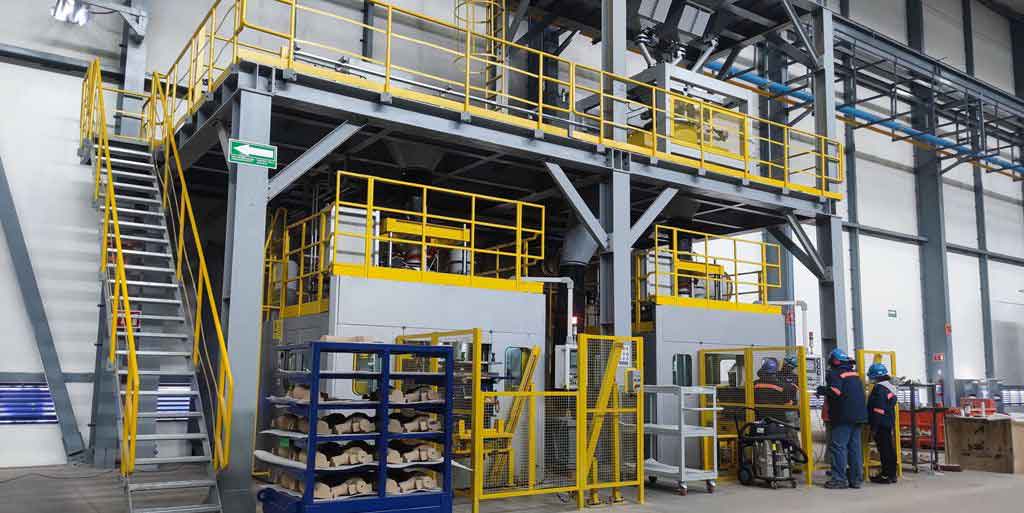
The initial step involved determining the optimal pouring position. For steel castings, the pouring orientation affects the flow of molten metal and the subsequent solidification pattern. I considered two primary schemes: upright (normal) placement and inverted placement. In the upright scheme, the larger planar surfaces are positioned at the bottom, which aligns with casting principles to minimize turbulence. In the inverted scheme, the thicker sections are placed uppermost, potentially favoring directional solidification. To evaluate these, I created 3D models for both orientations and combined them with different gating systems: bottom gating and step gating. Bottom gating involves introducing molten metal from the base of the mold, ensuring smooth filling with minimal oxidation, but it may result in a “hot bottom, cold top” scenario that hinders sequential solidification. Step gating, where metal enters at multiple levels, promotes a “hot top, cold bottom” temperature gradient, which is beneficial for feeding shrinkage in steel castings.
I designed four preliminary gating system schemes, as summarized in Table 1. Each scheme was modeled and simulated for mold filling to assess fluid flow, temperature distribution, and potential issues like air entrapment or cold shuts.
| Scheme | Pouring Orientation | Gating System Type | Main Characteristics |
|---|---|---|---|
| Scheme 1 | Inverted | Bottom Gating (Open) | Metal enters from bottom; smooth filling but unfavorable temperature gradient. |
| Scheme 2 | Inverted | Step Gating | Metal enters at multiple levels; promotes hot top, cold bottom gradient. |
| Scheme 3 | Upright | Bottom Gating (Open) | Metal enters from bottom; economical but may lead to defects in upper regions. |
| Scheme 4 | Upright | Step Gating | Metal enters at multiple levels; moderate improvement in temperature distribution. |
The pouring time was calculated using empirical formulas to ensure adequate filling without excessive turbulence. For steel castings, the pouring time $\tau$ (in seconds) is given by:
$$ \tau = C \sqrt{m} $$
where $m$ is the pouring mass in kg, and $C$ is an empirical coefficient dependent on the casting’s relative density $K_V$. The relative density is defined as:
$$ K_V = m / V $$
with $V$ being the volume of the casting’s bounding box in dm³. For this bracket steel casting, $m = 35,000$ kg, $V = 25 \times 21.5 \times 24.1$ dm³, yielding $K_V \approx 2.7$ kg/dm³. From standard casting handbooks, $C = 1.0$ for such steel castings. Thus,
$$ \tau = 1.0 \times \sqrt{35,000} \approx 187 \text{ seconds}. $$
This pouring time was used in all simulations to maintain consistency. The gating system’s choke area was determined using Bernoulli’s principle and the Osborne formula. For an open gating system, the choke area $A_{\text{choke}}$ (in cm²) is calculated as:
$$ A_{\text{choke}} = \frac{m}{\rho \mu \tau \sqrt{2g H_P}} $$
where $\rho = 7840$ kg/m³ is the density of steel, $\mu = 0.25$ is the flow coefficient, $g = 9.81$ m/s² is gravitational acceleration, and $H_P = 2$ m is the effective metallostatic head. Plugging in the values:
$$ A_{\text{choke}} = \frac{35,000}{7840 \times 0.25 \times 187 \times \sqrt{2 \times 9.81 \times 2}} \approx 152.5 \text{ cm}^2. $$
This area corresponds to the sprue’s cross-section. I selected ceramic pipes with an inner diameter of 140 mm for the sprue, ensuring sufficient flow. The gating ratios were set according to open system principles: for bottom gating, $\sum A_{\text{sprue}} : \sum A_{\text{runner}} : \sum A_{\text{ingate}} = 1 : 2.3 : 2.3$; for step gating, additional secondary sprues and ingates were incorporated.
The mold filling simulations for all four schemes revealed distinct behaviors. In Scheme 1 (inverted bottom gating), the filling was smooth without splashing, but the temperature field showed hotter metal at the bottom and cooler at the top, which could impede directional solidification. Scheme 2 (inverted step gating) demonstrated a more desirable temperature gradient, with the upper regions remaining hotter due to delayed metal entry. This is advantageous for steel castings, as it encourages sequential solidification from the bottom upward, facilitating riser feeding. Scheme 3 (upright bottom gating) also exhibited stable filling, but the temperature distribution was similar to Scheme 1, with potential defect formation in the top sections. Scheme 4 (upright step gating) showed some improvement, but the effect was less pronounced due to the geometry of the bracket steel casting. Based on these filling simulations, I shortlisted Scheme 2 and Scheme 3 for further solidification analysis.
Solidification simulations were conducted to predict shrinkage porosity and cavity formation. The solidification sequence was visualized through fractional solid plots. In Scheme 2, isolated liquid pockets formed at the bottom of the casting, which would be difficult to feed with risers. In contrast, Scheme 3 showed isolated liquid regions at the top, making them accessible for riser placement. This key insight led me to select Scheme 3 (upright bottom gating) as the base design for subsequent optimization. The solidification time for the steel casting was approximately 28,969 seconds, highlighting the need for effective feeding to compensate for volumetric shrinkage.
To address shrinkage defects, I designed a feeding system comprising risers and chills. For steel castings, risers must provide sufficient molten metal to feed shrinkage until the casting solidifies. I initially placed top risers on the upper surface of the bracket, targeting the potential defect zones. The risers were cylindrical blind risers with necks for easy removal. Their dimensions were optimized using modulus methods, but for brevity, the iterative design process is summarized in Table 2. Additionally, insulating sleeves (80 mm thick) were applied to the risers to slow down cooling and enhance feeding efficiency.
| Riser ID | Diameter (mm) | Height (mm) | Location | Purpose |
|---|---|---|---|---|
| R1, R2 | 500 | 600 | Top left and right | Feed upper plate defects |
| R3, R4 | 500 | 600 | Top near sprue | Feed central top regions |
| R5 | 400 | 500 | Side interior | Feed lower rib junctions |
Chills were employed to accelerate cooling in thick sections and promote directional solidification. External chills were preferred over internal ones to avoid introducing stress concentrators. The initial chill layout included flat chills placed at strategic locations, such as the junctions between ribs and plates. However, the first simulation with this feeding system showed that while defects on the top surface were reduced, some late-solidifying areas in the lower regions still exhibited shrinkage porosity. This indicated the need for secondary optimization.
In the secondary optimization, I increased the size of the top risers (R1-R4) to 600 mm in diameter and thickened the insulating sleeve on the riser near the sprue to 100 mm. A side riser (R5) was added inside the lower part of the casting, also insulated, to feed the problematic junctions. Moreover, the chill design was refined: concave chills were placed between the top risers to enhance cooling uniformity, and trapezoidal chills were installed near the sprue side to enforce directional solidification. The trapezoidal shape helps in creating a graded thermal gradient, which is crucial for steel castings. The updated chill configurations are summarized in Table 3.
| Chill Type | Dimensions (mm) | Location | Function |
|---|---|---|---|
| Concave Chill | 200 × 150 × 50 | Between top risers | Localize cooling for top plate |
| Trapezoidal Chill | Base: 300, Top: 200, Height: 100 | Near sprue side | Promote directional solidification |
| Flat Chill | 250 × 200 × 40 | Rib-plate junctions | Accelerate cooling in thick zones |
The final simulation of the optimized process confirmed significant improvements. The mold filling remained steady, completing in about 187 seconds with minimal turbulence. The temperature field at the end of filling showed a more uniform distribution, reducing thermal stresses. The solidification analysis indicated that the last areas to solidify were now within the risers, effectively eliminating macroscopic shrinkage cavities. The predicted shrinkage porosity, visualized through defect maps, was confined to negligible levels, with no major defects in the casting body. This outcome underscores the effectiveness of combining risers and chills for steel castings, especially when guided by numerical simulation.
The success of this optimization hinges on several factors. First, the choice of upright pouring with bottom gating proved economical and practical for this steel casting, as it allowed easy placement of risers on the top surface. Second, the iterative use of simulation enabled precise tuning of riser and chill parameters without physical trials. For instance, the modulus method for riser sizing can be expressed as:
$$ M_{\text{riser}} = k \cdot M_{\text{casting}} $$
where $M$ denotes the modulus (volume-to-surface area ratio), and $k$ is a safety factor typically between 1.1 and 1.2 for steel castings. In my design, I used $k = 1.15$ to ensure adequate feeding. The riser volume $V_{\text{riser}}$ was then calculated to meet the shrinkage demand $\varepsilon$ of the steel, which is around 4-6% for ZG270-500. The required riser volume can be estimated as:
$$ V_{\text{riser}} = \frac{\varepsilon \cdot V_{\text{casting}}}{\eta} $$
where $\eta$ is the feeding efficiency, often taken as 0.14 for insulated risers. For this bracket steel casting, $V_{\text{casting}} = 3.2$ m³, $\varepsilon = 0.05$, so:
$$ V_{\text{riser}} \approx \frac{0.05 \times 3.2}{0.14} \approx 1.14 \text{ m}^3. $$
This volume was distributed among the risers, with adjustments based on simulation feedback.
Furthermore, the cooling effect of chills can be quantified using the chill modulus $M_{\text{chill}}$, defined similarly, but with material properties considered. For steel castings, the chill’s ability to extract heat is critical. The heat transfer equation can be simplified as:
$$ Q = h \cdot A \cdot (T_{\text{metal}} – T_{\text{chill}}) \cdot t $$
where $Q$ is heat extracted, $h$ is the heat transfer coefficient, $A$ is the contact area, $T$ are temperatures, and $t$ is time. In practice, I selected chill sizes to ensure rapid solidification of hot spots, as identified in simulations.
In conclusion, this study demonstrates a comprehensive approach to designing and optimizing casting processes for steel castings. Through numerical simulation, I evaluated multiple gating schemes, selected an upright bottom gating system for its balance of economy and feasibility, and refined the feeding system with risers and chills to eradicate shrinkage defects. The final process ensures high-quality steel castings with minimal porosity, meeting the stringent requirements of heavy machinery applications. The integration of CAD modeling and simulation tools not only saves time and cost but also enhances the reliability of steel casting production. Future work could explore advanced materials for riser insulation or multi-physics simulations for stress analysis, further pushing the boundaries of steel casting technology.
The entire process underscores the importance of a methodical design strategy for steel castings. From initial pouring orientation to detailed riser and chill optimization, each step was validated through simulation, reducing uncertainties. Steel castings will continue to be vital in industrial sectors, and such optimized processes contribute to their durability and performance. By leveraging computational aids, foundries can achieve higher yields and better quality, reinforcing the role of steel castings in modern engineering.