
Cable clamp joints are pivotal connecting elements within modern tensile structures, with their performance being fundamentally critical to the overall structural reliability and safety of the system. These nodes function by utilizing the pre-tension force applied by high-strength bolts to create a synergistic clamping action between the clamp body and pressure plates. This action grips the cable body and generates frictional resistance, thereby inhibiting the slippage of the clamp along the cable. The integrity of this connection is paramount. Should slippage occur, the internal force state of the node is altered, leading to unintended deformations and significant losses in the designed pre-stress. This cascade effect ultimately compromises the load-bearing capacity and stability of the entire structural system. Furthermore, the friction during the slippage process can damage the protective layer of the cable, accelerating corrosion and drastically shortening the cable’s service life. Real-world project histories, such as incidents during the construction of major stadiums, have necessitated work stoppages and costly rework due to slippage issues in cable clamps, underscoring the severe practical consequences of such failures.
Saddle-shaped cable-net structures, characterized by their orthogonal cable layout, frequently employ orthogonal steel castings as the connecting nodes between intersecting cables. The geometric and load-transfer mechanisms of these orthogonal clamps differ significantly from conventional radial clamps. Therefore, to ensure engineering safety, conducting targeted anti-sliding performance tests is not just advisable but essential for validating their slip resistance, which directly correlates to the safety and reliability of the entire project application.
In general, the anti-sliding performance of a cable clamp node is predominantly governed by the frictional effect at the interface between the steel castings of the clamp and the cable body. This frictional behavior is influenced by a multitude of factors, with key parameters including the material properties of the contact surfaces, the geometric morphology of the cable channel, the type of surface coating, and the magnitude of the bolt preload. Purely theoretical analysis of the anti-sliding performance for complex steel castings is often insufficient, as it struggles to comprehensively account for all interacting variables and surface conditions present in real applications. Consequently, experimental research and analysis become indispensable tools for achieving a more precise and reliable performance assessment, providing the empirical data necessary for robust design validation.
Project Context and Structural System
The research is grounded in the context of a major international football center project. The stadium’s roof structure integrates both rigid and flexible components. The flexible inner ring features a self-anchored, fully enclosed cable-net system. A key element of this system is a double-layer, bidirectional orthogonal cable-net, which is prestressed to form a stable, pre-tensioned state in conjunction with outer compression rings and inner tension rings. The outer boundary of this cable net describes a saddle-shaped surface with significant height variation. The cables utilized are sealed wire ropes with a Zn95Al5 metallic coating. The critical connection points—the orthogonal nodes where upper and lower layer cables cross—are fabricated from G20Mn5QT grade steel castings, with their cable channels receiving a thermal-sprayed zinc treatment for corrosion protection. The performance of these bespoke steel castings is central to the structural integrity of the innovative roof.
Experimental Program: Objectives and Setup
The experimental study was designed to investigate the anti-sliding performance and the associated bolt preload relaxation characteristics of the orthogonal steel castings. Full-scale cable-clamp assemblies, identical to those specified for the project, were subjected to testing. The primary objectives were twofold:
- To install the clamps on unstressed cables, apply the specified bolt pre-torque, and then tension the cable to a designated service stress. Throughout this process and during sustained loading, the attenuation of the high-strength bolt clamping force was monitored in real-time.
- Upon stabilization of the bolt force decay, to conduct a thrust loading test on the clamp. This involved applying a controlled lateral force to the clamp body while simultaneously recording the applied load and the corresponding slip displacement, thereby determining the ultimate anti-sliding capacity and deriving the effective friction coefficient.
The test specimens are detailed in the following tables:
| Designation | Quantity | Material / Coating | Minimum Breaking Force (kN) |
|---|---|---|---|
| D90 Test Cable | 1 | Zn95Al5 Sealed Wire Rope | 8090 |
| D65 Test Cable | 1 | Zn95Al5 Sealed Wire Rope | 4220 |
| Clamp Type | Component Type | Material | Channel Treatment | Quantity (sets) |
|---|---|---|---|---|
| W-A (for 90/90 cables) | Orthogonal Steel Casting | G20Mn5QT | Thermal-Sprayed Zn | 3 |
| W-A (for 65/65 cables) | Orthogonal Steel Casting | G20Mn5QT | Thermal-Sprayed Zn | 3 |
| W-B (for 65/65 cables) | Orthogonal Steel Casting | G20Mn5QT | Thermal-Sprayed Zn | 3 |
The testing regimen meticulously simulated the actual site installation and loading sequence:
- The clamp assembly (body, pressure plates, bolts) was installed on the unstressed test cable. High-strength bolts were fitted with load cells to measure clamping force, and the data acquisition system was initialized.
- Using a calibrated torque wrench, the bolts were tightened to their specified installation torque (e.g., 500 N·m for M20 8.8-grade bolts on W-A clamps, 1000 N·m for M27 10.9-grade bolts on W-B clamps).
- The test cable was tensioned using hydraulic jacks until the cable stress reached the target service level of 660 MPa (corresponding to ~3670 kN for D90 cable and ~1968 kN for D65 cable).
- The cable load was maintained, and the decay of the bolt clamping forces was continuously monitored until a stable state was observed.
- A thrust loading frame, equipped with a load cell and long-travel displacement transducers, was assembled against the clamp body.
- A controlled lateral force was applied to the clamp via a hydraulic jack. Load and displacement data were synchronously recorded at a 1 Hz sampling rate until a clear plateau or drop in the load-displacement curve indicated sustained slip.
- The process was repeated for multiple positions on the same clamp and for all clamp specimens.
Experimental Results and Analysis
Stress Relaxation in High-Strength Bolts
The real-time monitoring of bolt clamping force from initial tightening through cable tensioning and sustained load holding revealed significant stress relaxation. This phenomenon is critical as the effective normal force, and hence the frictional capacity, is directly proportional to the bolt preload. The data is summarized below:
| Clamp Type & Bolt | Avg. Initial Preload (kN) | Avg. Final Preload (kN) | Average Attenuation Rate | Range of Attenuation Rates |
|---|---|---|---|---|
| W-A (90/90) – M20 8.8 | 106.07 | 63.32 | 40.30% | 33.19% – 48.84% |
| W-A (65/65) – M20 8.8 | 110.08 | 67.55 | 38.63% | 32.84% – 44.32% |
| W-B (65/65) – M27 10.9 | 262.10 | 182.85 | 30.24% | 23.55% – 40.22% |
The results clearly demonstrate that the act of tensioning the cable induces a substantial and rapid initial decay in bolt preload, attributed to the settling and plastic deformation of surface asperities at the multiple interfaces within the steel castings assembly (bolt head/washer, washer/clamp, plate/cable, cable/clamp body). The higher-grade, larger-diameter M27 bolts on the W-B clamps exhibited a relatively lower average attenuation, likely due to their higher initial preload and different stiffness characteristics. This significant relaxation underscores a vital practical recommendation: to restore the design clamping force and ensure optimal anti-sliding safety margins, a secondary tightening of the bolts after the primary cable tensioning phase is essential in construction practice.
Slip Behavior and Ultimate Anti-Sliding Capacity
The load-displacement curves obtained from the thrust tests exhibited consistent behavioral patterns. Initially, during the application of lateral force, minimal displacement was recorded, indicating the mobilization of static friction. As the load increased, a point was reached where the clamp body began to slide relative to the cable. In most tests, the pressure plate slid concurrently with the body from the onset. In a few instances, the body displaced a small amount before the plate engaged and slid with it. The lateral force at which consistent, sustained slippage of the pressure plate occurred was defined as the ultimate anti-sliding capacity, $F_k$, of the clamp assembly.
Post-test inspection of the disassembled steel castings provided crucial forensic evidence. The primary slip interface was consistently identified between the base metal of the cable wires and the thermally-sprayed zinc coating on the clamp channel. The zinc layer exhibited clear, permanent indentations corresponding to the wire pattern, confirming that plastic deformation and wear of the coating occurred during the test, and that the frictional resistance was primarily generated at this specific material interface.
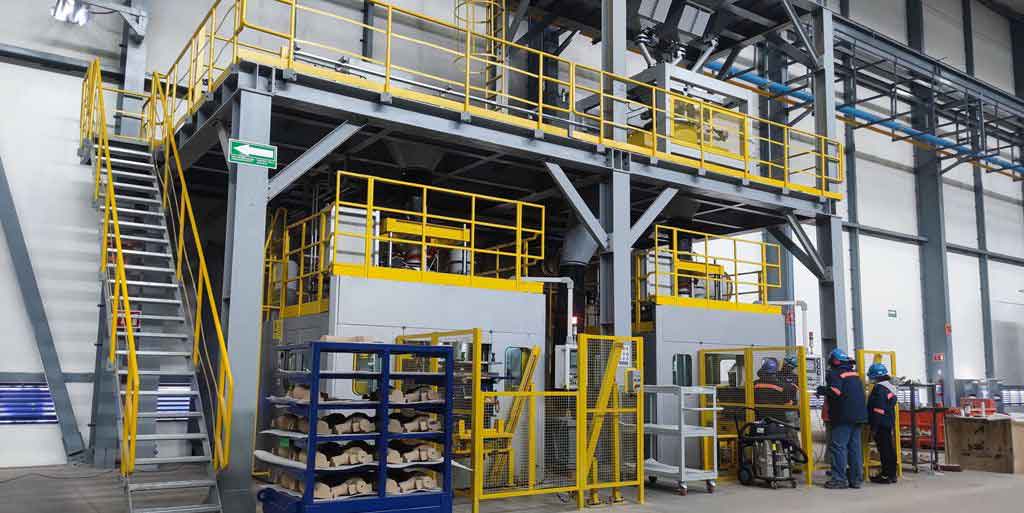
The quality and consistency of the zinc coating, and indeed the surface finish of the steel castings channel itself, are therefore paramount. Advanced steel casting equipment and controlled post-casting processes (like precise machining and consistent thermal spraying) are vital for achieving the uniform surface properties necessary for predictable and reliable frictional performance in these critical structural nodes.
Determination of the Comprehensive Friction Coefficient
The anti-sliding capacity is fundamentally related to the total effective clamping force provided by the bolts and the friction at the interfaces. For a clamp assembly with two primary friction surfaces (cable-to-body and cable-to-pressure-plate), the comprehensive friction coefficient, $\mu$, can be derived using the following equilibrium relation at the point of slip:
$$ F_k = \mu \cdot m \cdot \sum_{i=1}^{n} P_{e}^{(i)} $$
where:
$F_k$ is the experimentally measured anti-sliding capacity (kN).
$\mu$ is the comprehensive friction coefficient.
$m$ is the number of effective friction surfaces ($m=2$ for this clamp design).
$n$ is the number of clamping bolts.
$P_{e}^{(i)}$ is the effective clamping force in the i-th bolt at the moment of clamp slippage (kN).
Rearranging to solve for the friction coefficient:
$$ \mu = \frac{F_k}{ m \cdot \sum_{i=1}^{n} P_{e}^{(i)} } $$
Applying this formula to the test data for each clamp specimen yields the following results:
| Tested Clamp Specimen | Total Effective Bolt Force at Slip, $\sum P_e$ (kN) | Anti-Sliding Capacity, $F_k$ (kN) | Comprehensive Friction Coefficient, $\mu$ | Average $\mu$ for Clamp Type |
|---|---|---|---|---|
| W-A (90/90) – I | 271.58 | 145.72 | 0.268 | 0.264 |
| W-A (90/90) – II | 239.30 | 119.92 | 0.251 | |
| W-A (90/90) – III | 240.42 | 130.89 | 0.272 | |
| W-A (65/65) – I | 294.13 | 130.49 | 0.222 | 0.215 |
| W-A (65/65) – II | 276.19 | 114.29 | 0.207 | |
| W-A (65/65) – III | 240.33 | 103.60 | 0.216 | |
| W-B (65/65) – I | 874.99 | 405.71 | 0.232 | 0.236 |
| W-B (65/65) – II | 753.94 | 369.69 | 0.245 | |
| W-B (65/65) – III | 565.31 | 259.91 | 0.230 |
The comprehensive friction coefficient for the tested steel castings with thermal-sprayed zinc channels against Zn95Al5-coated cables falls within a range of approximately 0.215 to 0.272. These values are critical design parameters. The W-B clamps, utilizing higher-capacity bolts, achieved a higher total clamping force, resulting in a significantly greater absolute anti-sliding capacity ($F_k$) despite a similar range of $\mu$ values.
Engineering Application and Design Implications
The experimental findings have direct and significant implications for the design, verification, and construction of structures employing similar orthogonal steel castings.
1. Design Verification and Safety Margin: The derived friction coefficients provide empirical data far more reliable than theoretical estimates for verifying the anti-sliding design check, typically governed by:
$$ F_{sd} \le F_{s,Rd} $$
where $F_{sd}$ is the design shear force on the clamp (from structural analysis) and $F_{s,Rd}$ is the design slip resistance, calculated as $F_{s,Rd} = \mu_{test} / \gamma_{m} \cdot m \cdot \sum P_{d}$. Here, $\mu_{test}$ is the characteristic value derived from test statistics, $\gamma_{m}$ is a partial safety factor, and $P_d$ is the design bolt preload after accounting for relaxation. The test results confirmed that the developed steel castings possessed adequate anti-sliding capacity for the intended project, validating the nodal design.
2. Construction Protocol – Secondary Tightening: The pronounced relaxation of bolt preload (25-40%) during cable tensioning is a major operational finding. It mandates a specific construction sequence: initial bolt tightening → primary cable tensioning/stressing → secondary re-tightening of all clamp bolts to the specified torque. This procedure is non-negotiable for ensuring the design clamping force is active during the structure’s service life.
3. Manufacturing and Quality Focus: The identified primary slip interface (cable wire to zinc coating) highlights that the performance of the steel castings node is not solely a function of the base casting material strength. The quality, adhesion, uniformity, and hardness of the applied coating are equally critical. Furthermore, the geometric precision of the cast and machined cable channel in the steel castings directly influences the pressure distribution on the cable. Improved machining tolerances can enhance contact uniformity, potentially leading to more consistent friction coefficients and higher overall reliability.
4. Analysis for Bidirectional Loading: The tests simulated a primary loading condition with tension in only one of the two orthogonal cables. In the actual structure, both cable directions are stressed. A conservative assessment of the clamp’s capacity under biaxial tension can be performed. The reduction in effective bolt preload ($\Delta P$) due to the tensioning of the “second” cable can be estimated from the relaxation data. The corresponding reduction in slip resistance for the “first” cable direction can be approximated as $\Delta F_k \approx \mu \cdot m \cdot \Delta P$. This allows engineers to conservatively verify that even under full bidirectional loading, the net anti-sliding capacity remains above the required design shear forces.
Conclusion
This comprehensive experimental study on full-scale orthogonal steel castings for cable nets has yielded critical quantitative data regarding their in-service behavior. The investigation successfully characterized two intertwined phenomena: the significant time-dependent relaxation of high-strength bolt preloads following cable tensioning, and the ultimate anti-sliding capacity governed by a comprehensive friction coefficient. For the specific material pairing of G20Mn5QT steel castings with thermal-sprayed zinc channels against Zn95Al5-coated sealed wire ropes, the friction coefficient was determined to be in the range of 0.215 to 0.264. These steel castings demonstrated sufficient anti-sliding resistance to meet the demanding requirements of a large-span saddle-shaped cable-net roof.
The key practical outcome is the unequivocal necessity for a secondary tightening procedure of all clamp bolts after the initial cable stressing phase is complete, to compensate for the measured preload losses. Furthermore, the research directs attention to the importance of manufacturing quality control, particularly in the surface preparation and coating of the cable channels within the steel castings, as this interface dictates the frictional performance. The methodology and results provide a validated framework for the performance assessment, design verification, and construction quality assurance of similar complex steel castings nodes in tensile structures, contributing to enhanced safety and reliability in modern architectural engineering.