
In the field of industrial equipment, steel castings play a critical role in ensuring durability and performance under high-pressure conditions. As a casting engineer, I have extensively researched the manufacturing challenges associated with horizontal multistage pump casings, which are complex steel castings used in applications requiring high head and corrosion resistance. These steel castings are characterized by intricate geometries, significant wall thickness variations, and stringent quality requirements, making their production a demanding task. In this article, I will delve into the casting process for multistage pump steel castings, addressing common defects, design strategies, and practical implementations. The goal is to provide a comprehensive guide that emphasizes the importance of precision in steel castings, utilizing tables and formulas to summarize key points and enhance understanding. Throughout, the term “steel castings” will be repeatedly highlighted to underscore their significance in this context.
Multistage pump steel castings are typically produced from duplex stainless steels, such as ASTM A995Gr1B, due to their excellent strength and corrosion resistance. The chemical composition of this material is crucial for achieving desired properties, and I have summarized it in Table 1. This table illustrates the alloying elements that contribute to the performance of steel castings in aggressive environments.
| Element | Content (wt.%) |
|---|---|
| C | ≤ 0.04 |
| Mn | ≤ 1.0 |
| Si | ≤ 1.0 |
| P | ≤ 0.04 |
| S | ≤ 0.04 |
| Cr | 24.5–26.5 |
| Ni | 4.7–6.0 |
| Mo | 1.7–2.3 |
| Cu | 2.7–3.3 |
| N | 0.10–0.25 |
The geometry of multistage pump steel castings involves multiple volute chambers and interstage channels, with wall thicknesses ranging from 28 mm to 150 mm. This variation poses significant challenges in achieving dimensional accuracy and internal soundness. For instance, the overall dimensions can exceed 2000 mm in length, with weight up to 2100 kg for the pump body. The tolerance requirements are strict, often conforming to CT11 per ISO standards, and non-destructive testing methods like PT1 and RT2 are mandated. Such steel castings must also pass hydrostatic tests at 6 MPa for 30 minutes without leakage, underscoring the need for defect-free production.
During my analysis, I identified several common issues in manufacturing these steel castings. Dimensional inaccuracies arise from core assembly errors and thermal distortions, while surface defects like slag inclusions and cracks result from turbulent filling and improper solidification. Internal shrinkage porosity and hot tearing are prevalent in thick sections and junctions, leading to potential leakage. To quantify these challenges, I often refer to casting formulas. For example, the solidification time for steel castings can be estimated using Chvorinov’s rule:
$$ t = k \left( \frac{V}{A} \right)^2 $$
Here, \( t \) is the solidification time, \( V \) is the volume of the casting section, \( A \) is its surface area, and \( k \) is a constant dependent on the mold material and casting conditions. For multistage pump steel castings, the large \( V/A \) ratio in thick sections prolongs solidification, increasing shrinkage risk. Similarly, the feeding distance for effective riser action can be modeled as:
$$ L_f = M \cdot \sqrt{T} $$
Where \( L_f \) is the feeding distance, \( M \) is the modulus of the section, and \( T \) is a temperature factor. This formula helps in designing risers to prevent shrinkage defects in steel castings.
To address these issues, I have developed a detailed casting process design. First, the parting line orientation is critical. I compared two methods: Method 1 with the split face downward and Method 2 with it upward. Table 2 summarizes the pros and cons, based on my experience with steel castings.
| Aspect | Method 1 (Split Face Downward) | Method 2 (Split Face Upward) |
|---|---|---|
| Feeding Efficiency | Lower due to side risers; higher riser volume needed. | Higher with top risers; better sequential solidification. |
| Filling Behavior | Slower filling of thick sections; more slag inclusion risk in thin walls. | Faster filling of thin walls; slag floats to top for removal. |
| Operational Complexity | Simpler core setting in bottom mold. | More complex core fixing in top mold; requires precise controls. |
| Yield Rate | Lower yield due to larger risers. | Higher yield with optimized riser design. |
From this analysis, I prefer Method 2 for steel castings, as it enhances feeding and reduces defects, albeit with stricter operational controls. This choice aligns with the goal of producing high-quality steel castings efficiently.
Dimensional control in steel castings relies on integrated core designs. For multistage pump casings, I use a monolithic core for the volute chambers to ensure accurate relative positions. The interstage channel cores are assembled with precision, and I employ gauging plates for verification. The core assembly process involves minimizing clearances and adding support points, such as process holes in long bridge cores. To mathematically express the positional tolerance, I use:
$$ \Delta P = \sqrt{ \sum_{i=1}^{n} (\delta x_i^2 + \delta y_i^2) } $$
Where \( \Delta P \) is the total positional error, and \( \delta x_i \) and \( \delta y_i \) are deviations in individual core placements. By keeping \( \Delta P \) within CT11 limits, I ensure that steel castings meet the required accuracy.
The feeding system for steel castings must eliminate shrinkage in critical areas like the split face flanges and long bridge sections. I design top risers using modulus calculations. The modulus \( M \) is defined as:
$$ M = \frac{V}{A} $$
For a riser to effectively feed a section, its modulus should exceed that of the casting by a factor, often 1.2. In practice, I place risers over hot spots, such as flange junctions, and use insulating sleeves to improve efficiency. For long bridge areas, side blind risers are essential to prevent shrinkage porosity and cracks. The riser volume \( V_r \) can be estimated based on the shrinkage porosity risk:
$$ V_r = \beta \cdot V_c \cdot \varepsilon $$
Here, \( V_c \) is the casting volume, \( \varepsilon \) is the solidification shrinkage (typically 4-6% for steel castings), and \( \beta \) is a safety factor (usually 1.5-2.0). This ensures adequate metal supply for sound steel castings.
Gating design focuses on minimizing turbulence. I implement a bottom-gating system with pouring ditches to achieve a steady upward fill. The filling velocity \( v \) is controlled to reduce oxidation:
$$ v = \frac{Q}{A_c} $$
Where \( Q \) is the flow rate and \( A_c \) is the cross-sectional area of the gate. For thin walls, I maintain \( v \) between 30-60 mm/s, and for thick flanges, 10-20 mm/s. This reduces slag formation, a common issue in steel castings. The pouring ditch also acts as a thermal buffer, aiding in feeding and reducing thermal stress.
Crack prevention in steel castings involves strategic use of chills and ribs. At wall junctions, I place conformal chills to accelerate cooling and balance stresses. The chill effect can be modeled using Fourier’s law of heat conduction:
$$ q = -k \frac{dT}{dx} $$
Where \( q \) is the heat flux, \( k \) is the thermal conductivity, and \( \frac{dT}{dx} \) is the temperature gradient. By increasing \( q \) at hot spots, chills prevent hot tearing. Additionally, ribs are added between thick and thin sections to distribute stresses, which is crucial for complex steel castings.
In practical production, I have applied these techniques to manufacture various multistage pump steel castings. The results show dimensional accuracies within CT10-CT11, excellent surface quality, and no leakage during hydrostatic tests. The internal soundness is verified through radiographic testing, confirming the effectiveness of the riser and gating designs. Below is an image showcasing a produced steel casting, illustrating the intricate geometry and quality achieved.
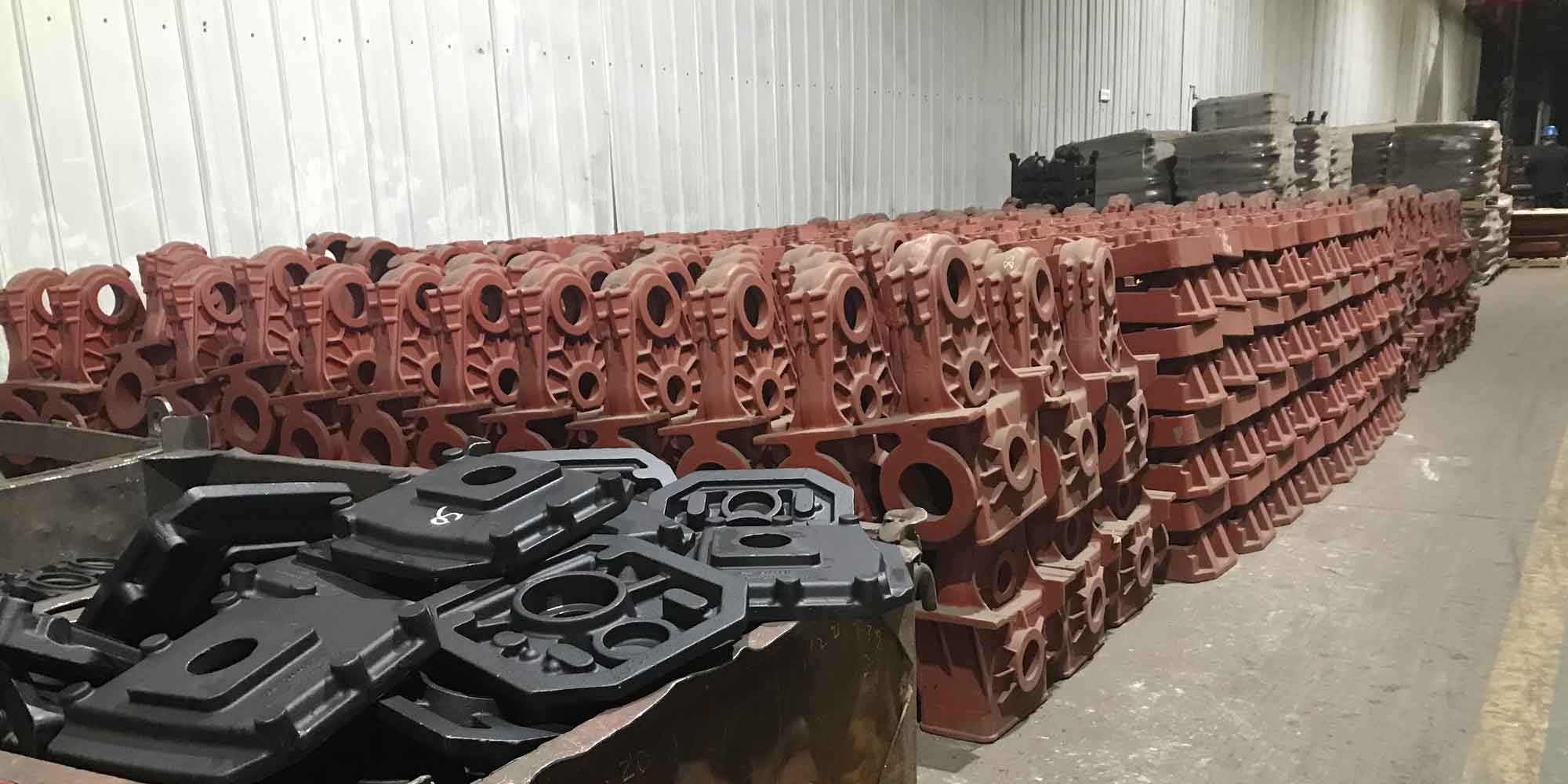
To further optimize the process, I have conducted simulations using software like MAGMA or ProCAST, which predict flow and solidification patterns. These tools help refine riser placements and reduce trial runs, ultimately lowering costs for steel castings. For instance, simulation outputs can validate the feeding distance formula and suggest adjustments for better yield.
In conclusion, the casting of multistage pump steel castings requires a holistic approach. Key takeaways include using an upward split face for better feeding and defect control, monolithic cores for dimensional accuracy, and calculated riser designs to eliminate shrinkage. The integration of pouring ditches and chills further enhances quality. Through these methods, I have consistently produced reliable steel castings that meet stringent industrial standards. Future work may explore advanced alloys or additive manufacturing for cores, but the principles outlined here remain foundational for high-performance steel castings.
Throughout this discussion, I have emphasized the term “steel castings” to highlight their centrality in this manufacturing domain. By leveraging formulas and tables, I aim to provide a resource that bridges theory and practice, ensuring that engineers can tackle the complexities of producing such critical components. The continuous improvement in steel castings technology will undoubtedly drive advancements in pump and other heavy equipment industries.