
In the realm of clean energy, hydropower stands out as a sustainable and renewable source, playing a pivotal role in economic development. As part of my involvement in manufacturing critical components for hydropower equipment, I focused on the production of a complex ball valve steel casting. This steel casting, with intricate geometry and significant production challenges, required meticulous process design to ensure high quality. In this study, I employed SolidWorks software for three-dimensional modeling and utilized Huazhu CAE casting simulation software to optimize the casting process through iterative analysis. The primary material is WCB, equivalent to the domestic steel casting grade ZG230-450, which is widely used for its mechanical properties and weldability. Throughout this research, the term ‘steel castings’ is emphasized to highlight the focus on this category of components, which are essential in heavy industrial applications.
The ball valve steel casting has an approximate envelope dimension of 2000 mm × 1700 mm × 1500 mm and weighs about 5 tons. Its structure features varying wall thicknesses, with thicker sections at the top and thinner ones at the bottom, posing challenges for solidification control. The chemical composition of the WCB steel casting is critical for performance, and I summarize it in Table 1 to provide clarity.
| Element | Content (ω) |
|---|---|
| Carbon (C) | ≤ 0.30% |
| Silicon (Si) | ≤ 0.60% |
| Manganese (Mn) | ≤ 1.00% |
| Phosphorus (P) | ≤ 0.0040% |
| Sulfur (S) | ≤ 0.0045% |
My first step involved creating a detailed 3D model using SolidWorks software. This model allowed me to visualize the steel casting’s geometry, identify potential hot spots, and analyze regions prone to defects like shrinkage porosity. The 3D modeling process facilitated a data-driven approach to casting process design, moving beyond traditional empirical methods. By examining the digital model, I could pinpoint areas such as the shaft hole locations and the transition zones between thick and thin sections, which are critical for determining riser placement and cooling strategies. The accuracy of this model served as the foundation for subsequent simulation and optimization steps, ensuring that the design of steel castings is both efficient and reliable.
Based on the 3D model, I proceeded with the casting process design. Adhering to the principle of directional solidification, I positioned risers at thicker and flatter sections to facilitate mold-making and post-casting operations. The riser design was calculated using empirical formulas and modulus methods to ensure adequate feed metal volume. I summarize the initial riser configurations in Table 2, which includes dimensions and locations. Additionally, to enhance solidification control, I incorporated external chills in areas where risers could not provide sufficient cooling, such as the lower shaft hole regions and the junctions between the spherical crown and the main body. These chills, made of steel, were sized at 160 mm × 140 mm × 90 mm to accelerate local cooling and promote sequential solidification.
| Riser Location | Type | Dimensions (mm) | Quantity |
|---|---|---|---|
| Bottom of Ball Valve | Blind Riser | 230 × 340 × 300 | 1 |
| Shaft Hole Ends | Blind Riser | ϕ290 × 350 | 2 |
| Spherical Crown Circumference | Open Riser | 360 × 660 × 600 | 2 |
| Spherical Crown Circumference | Blind Riser | 290 × 430 × 370 | 2 |
| Center of Spherical Crown | Blind Riser | 210 × 310 × 270 | 2 |
To validate and refine this design, I used Huazhu CAE casting simulation software. The 3D model was converted to STL format and imported into the simulation environment. After meshing with 12,532,212 elements, I set the material properties for the steel casting: liquidus temperature at 1512°C, solidus at 1469°C, pouring temperature at 1580°C, shrinkage rate of 5%, and initial mold and chill temperatures at 25°C. The simulation parameters are summarized in Table 3. The governing equations for solidification in the simulation include the heat transfer equation, which can be expressed as:
$$ \rho c_p \frac{\partial T}{\partial t} = \nabla \cdot (k \nabla T) + Q $$
where \( \rho \) is density, \( c_p \) is specific heat, \( T \) is temperature, \( t \) is time, \( k \) is thermal conductivity, and \( Q \) represents latent heat release during phase change. For steel castings, this equation is crucial for predicting thermal gradients and solidification fronts.
| Parameter | Value |
|---|---|
| Liquidus Temperature | 1512°C |
| Solidus Temperature | 1469°C |
| Pouring Temperature | 1580°C |
| Shrinkage Rate | 5% |
| Initial Mold Temperature | 25°C |
| Number of Mesh Elements | 12,532,212 |
The simulation results revealed critical defects in the steel casting. At a solidification time of t = 3700 s, isolated liquid pools formed between the shaft hole areas and the bottom riser, indicating insufficient feeding. By t = 11000 s, similar issues appeared at the upper corners of the shaft holes. These isolated regions eventually led to shrinkage porosity, as predicted by the simulation. The root causes were identified as: (1) undersized risers at the shaft hole ends, (2) disrupted feeding channels due to the through-hole structure at the shaft holes, and (3) excessive distance between the shaft holes and the bottom riser, exceeding the effective feeding range. In casting theory, the feeding distance \( L_f \) for steel castings can be estimated using:
$$ L_f = k \cdot \sqrt{V} $$
where \( k \) is a material constant and \( V \) is the volume of the section. For this steel casting, the calculated \( L_f \) was less than the actual distance, necessitating design changes.
Based on these insights, I optimized the casting process. First, I enlarged the shaft hole risers from ϕ290 mm × 350 mm blind risers to 290 mm × 430 mm × 370 mm blind risers to increase feed metal volume. Second, I modified the through-hole geometry to enhance feeding channels, ensuring continuous metal flow during solidification. Third, I added external chills between the shaft holes and the bottom riser to create artificial cooling ends, thereby extending the feeding distance. The chill placement was adjusted from the lower shaft hole area to the sides to avoid interference with the new feeding channels. These optimizations are summarized in Table 4, along with their intended effects on the steel casting quality.
| Measure | Description | Expected Impact |
|---|---|---|
| Riser Enlargement | Increase shaft hole riser dimensions | Improve feeding capacity |
| Channel Modification | Redesign through-hole for better flow | Enhance feeding continuity |
| Chill Addition | Place external chills at key junctions | Promote directional solidification |
| Chill Relocation | Move chills to sides of shaft holes | Prevent blockage of feeding channels |
After implementing these changes, I reran the simulation. The results showed significant improvement: at t = 1900 s, the added chills effectively acted as cooling ends, extending the feeding range; by t = 4100 s, the enhanced feeding channels prevented isolated liquid formation between the shaft holes and bottom riser; and at t = 11900 s, the enlarged risers provided ample feed metal to the upper shaft hole corners, eliminating shrinkage porosity. The final solidification pattern indicated a sound steel casting with no major defects. The success of this optimization underscores the importance of simulation in refining processes for complex steel castings.
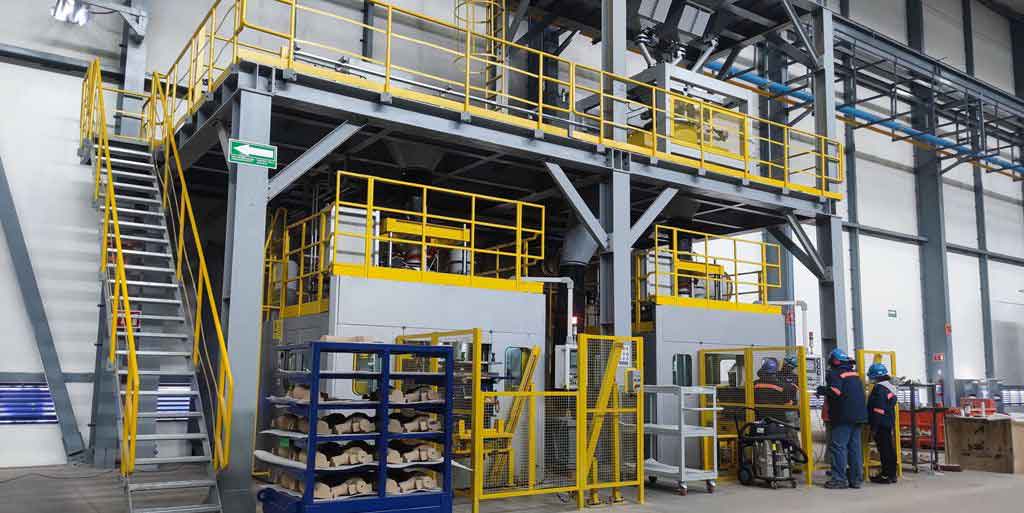
With the optimized process, I oversaw the actual production of the ball valve steel casting. The manufacturing workflow included steps such as pattern making, mold preparation, melting, pouring, cooling, shakeout, heat treatment, and finishing. Each stage was controlled using detailed operation guidelines to ensure adherence to the design. After rough machining, the steel casting underwent ultrasonic testing (UT) according to GB/T 7233.1-2009 standards. The results showed a Grade 2 qualification, with no超标 defects detected over the entire casting surface, confirming the internal soundness of the steel casting. This outcome validated the simulation predictions and demonstrated the effectiveness of the optimized process in producing high-quality steel castings for hydropower applications.
In conclusion, this study highlights the integration of 3D modeling and CAE simulation in advancing casting technology for steel castings. The optimized process, involving riser size adjustments, feeding channel enhancements, and strategic chill placement, successfully mitigated shrinkage porosity in the ball valve steel casting. The practical production results aligned with simulation forecasts, yielding a dense and defect-free component that met client specifications. This approach not only improves the reliability of steel castings but also reduces reliance on trial-and-error methods, fostering innovation in the casting industry. Future work could explore advanced materials or real-time monitoring systems to further enhance the quality of steel castings in critical infrastructure projects.
To summarize the key parameters and outcomes, I present Table 5, which compares the initial and optimized processes for the steel casting. This comprehensive analysis reinforces the value of simulation-driven design in manufacturing complex steel castings.
| Aspect | Initial Process | Optimized Process | Improvement |
|---|---|---|---|
| Shaft Hole Riser Size | ϕ290 mm × 350 mm | 290 mm × 430 mm × 370 mm | Increased feeding volume |
| Feeding Channels | Disrupted by through-holes | Enhanced for continuity | Better metal flow |
| External Chills | Placed only at lower shaft hole | Added between shaft holes and bottom riser | Extended feeding distance |
| Simulation Defects | Shrinkage porosity at multiple sites | No major defects predicted | Eliminated shrinkage |
| Production Outcome | Not executed | UT Grade 2, defect-free | High-quality steel casting |
Throughout this research, the focus on steel castings has been paramount, as these components are integral to hydropower systems and other heavy industries. By leveraging modern tools like SolidWorks and Huazhu CAE, I demonstrated how traditional casting methods can be enhanced to produce superior steel castings. The mathematical models and empirical data used in this study, such as the solidification equations and feeding distance calculations, provide a framework for future projects involving steel castings. As the demand for clean energy grows, optimizing the manufacturing of steel castings will remain a critical endeavor, ensuring reliability and efficiency in global infrastructure.