
In the production of steel castings, the use of reclaimed sand is a critical strategy for reducing costs and promoting sustainable foundry practices. As a foundry engineer specializing in steel castings, I have extensive experience with ester-hardened sodium silicate sand processes, where reclaimed sand constitutes approximately 80% of our total sand consumption. This article delves into the application of reclaimed sand in steel castings, focusing on quality control measures to minimize defects and ensure efficient recycling. The integration of reclaimed sand not only cuts down on raw material usage but also aligns with green manufacturing principles by reducing waste emissions. Through detailed analysis of the regeneration system, sand properties, process parameters, and common production challenges, I will share insights and solutions that have proven effective in maintaining high-quality steel castings.
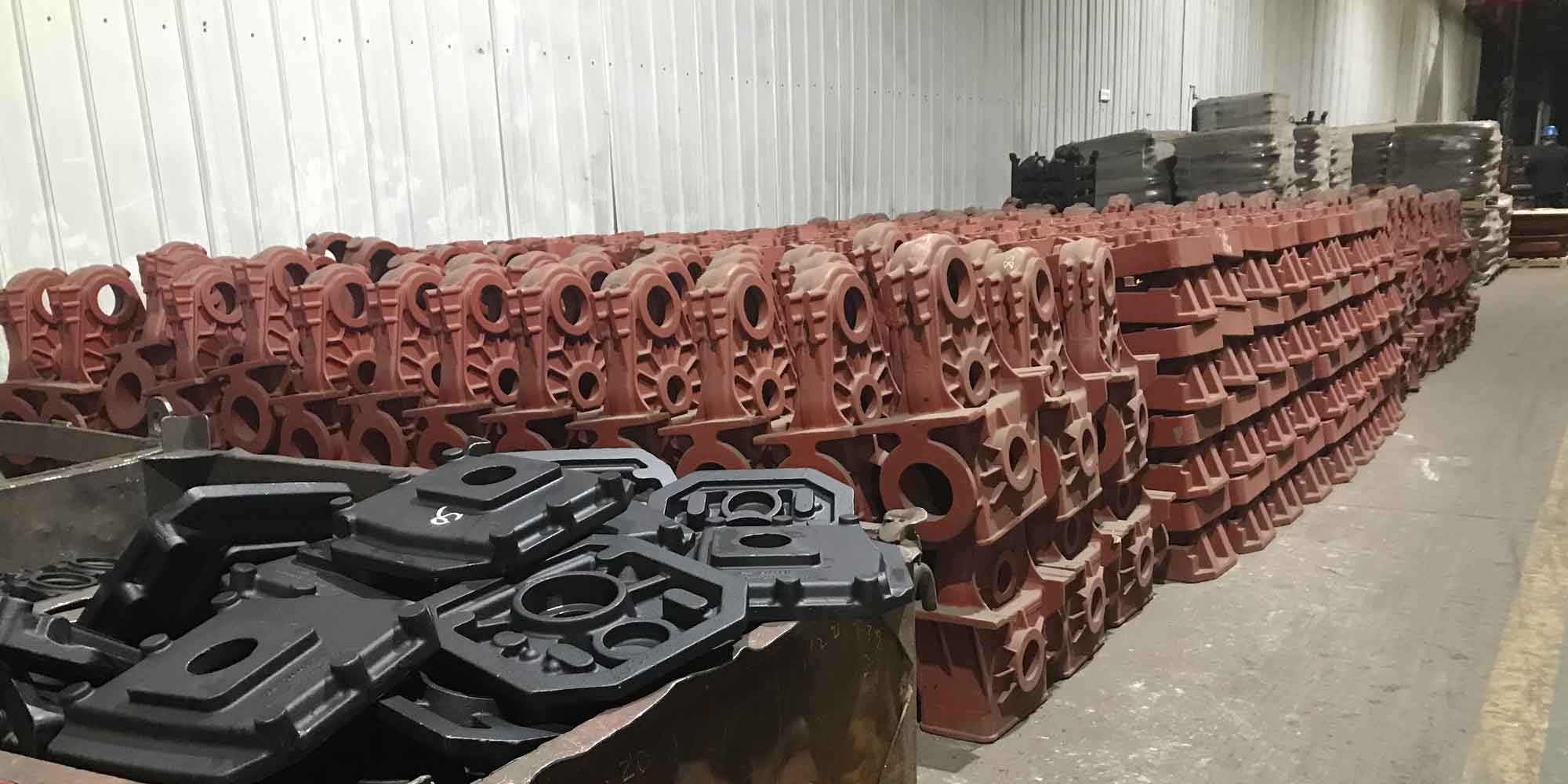
The foundation of effective reclaimed sand usage lies in the regeneration system. Our facility employs a hot-dry combined regeneration system, which is particularly suited for steel castings production due to its ability to handle large volumes of used sand efficiently. The process begins with magnetic separation to remove metallic impurities, followed by crushing to break down agglomerates. The sand is then fed into a vertical calcining furnace, where it is heated to temperatures between 300°C and 400°C. This thermal treatment degrades the residual sodium silicate film on the sand grains. Subsequently, the sand undergoes mechanical regeneration in a centrifugal regenerator, where friction removes the weakened coatings. Finally, cooling and air classification yield reclaimed sand with consistent properties. The theoretical recycling rate can reach 80–90%, making it a viable option for sustainable steel castings manufacturing. The workflow is summarized below:
| Parameter | Specification | Importance for Steel Castings |
|---|---|---|
| SiO₂ Content (%) | ≥97 | Ensures high refractoriness for steel castings |
| Na₂O Content (%) | ≤0.5 | Critical for controlling sand expansivity and defects |
| Concentration (%) | ≥85 | Indicates consistent grain size distribution |
| Clay Content (%) | ≤0.5 | Reduces gas generation in steel castings |
| Sieve Mesh | 30/50 | Optimizes surface finish of steel castings |
| Moisture Content (%) | ≤0.2 | Prevents gas porosity in steel castings |
| Angularity Factor | ≤0.5 | Affects mold strength and permeability |
The quality of reclaimed sand is paramount for producing defect-free steel castings. We use spherical quartz sand as the base raw material, with each batch inspected upon arrival. Daily tests are conducted on the reclaimed sand from two production lines (A and B) to ensure compliance with the standards in Table 1. Key performance metrics include Na₂O content, which accumulates with repeated recycling and must be tightly controlled to avoid issues like poor collapsibility and expansion during pouring. The relationship between Na₂O accumulation and recycling cycles can be expressed as:
$$ C_{Na_2O} = C_0 + \sum_{i=1}^{n} k \cdot R_i $$
where \( C_{Na_2O} \) is the cumulative Na₂O content, \( C_0 \) is the initial content, \( n \) is the number of cycles, \( k \) is a constant dependent on binder addition, and \( R_i \) is the regeneration efficiency per cycle. For steel castings, maintaining \( C_{Na_2O} \leq 0.5\% \) is essential to prevent sand-related defects.
In terms of process application, ester-hardened sodium silicate sand is widely used for molding and coring in steel castings production. Our mixing formulations are designed to balance workability, strength, and cost-effectiveness. We employ a continuous mixer and use modified sodium silicate (HS101) along with four types of organic esters (HS01, HS02, HS04, HS07) that vary in hardening speed. The selection depends on ambient temperature, casting size, and complexity. Below is a summary of our standard mixing recipes:
| Formulation | Sand Composition | Modified Sodium Silicate (% by sand mass) | Organic Ester (% by silicate mass) | Application in Steel Castings |
|---|---|---|---|---|
| Formula 1 | 30% new sand + 70% reclaimed sand | 2.3 | 18 | Small to medium castings molding and coring |
| Formula 2 | 100% reclaimed sand | 2.3 | 20 | Large castings molding and coring |
| Formula 3 | 50% new sand + 50% reclaimed sand | 2.4 | 18 | Adjustment sand for various steel castings |
The technological properties of ester-hardened sodium silicate sand are crucial for achieving high-quality steel castings. Workability time, which ranges from 5 to 25 minutes depending on casting size, is controlled by the ester type and ambient conditions. Gas evolution is relatively low compared to other sand systems, reducing the risk of gas porosity in steel castings. The tensile strength, measured using standard “8” specimens, typically falls between 0.4 and 0.8 MPa, sufficient for handling and pouring steel castings. However, collapsibility and yieldability are areas of concern; reclaimed sand tends to have poor collapsibility due to Na₂O buildup, which can hinder shakeout and increase cleaning time for steel castings. The yieldability is limited, with a linear contraction of 1–1.5% for medium-sized steel castings, necessitating design adjustments such as预留空腔 (reserved cavities) in cores to accommodate shrinkage. The relationship between binder addition and strength can be approximated by:
$$ \sigma_t = A \cdot B^{0.5} – C \cdot S $$
where \( \sigma_t \) is the tensile strength, \( A \) and \( C \) are material constants, \( B \) is the binder content, and \( S \) is the Na₂O content. For steel castings, optimizing \( B \) while minimizing \( S \) is key to balancing strength and collapsibility.
During production, several challenges arise with reclaimed sand in steel castings manufacturing. Environmental fluctuations significantly impact sand performance. In summer, high temperatures accelerate sand hardening, reducing workability time and potentially causing mold layer separation or collapse. To mitigate this, we increase the proportion of new sand to lower the sand temperature, ensuring it remains below 40°C. In winter, low temperatures increase the viscosity of sodium silicate, affecting mixing quality. We implement heating systems for binder storage when ambient temperatures drop below 10°C. Additionally, ester formulations are adjusted seasonally; for instance, faster-hardening esters like HS01 are used in cooler conditions to maintain adequate hardening rates for steel castings. Humidity control is also vital, as reclaimed sand’s hygroscopic nature can lead to moisture absorption, causing gas defects in steel castings. When humidity exceeds 70%, we reduce reclaimed sand usage and enhance mold drying prior to pouring.
Quality issues stemming from reclaimed sand properties require proactive measures. Na₂O content must be monitored closely; as it approaches 0.5%, we increase new sand addition to 50% or more to dilute accumulation. This helps maintain a stable equilibrium for steel castings production. The thermal expansion of quartz sand poses another challenge: during pouring, the phase transformation from α-quartz to β-quartz causes volume expansion, which can induce cracks or dimensional inaccuracies in steel castings. Reclaimed sand exhibits reduced thermal expansion due to prior heating cycles, so using higher proportions in cores can minimize this effect. The expansion coefficient \( \alpha \) for reclaimed sand versus new sand can be modeled as:
$$ \alpha_{reclaimed} = \alpha_{new} \cdot e^{-\lambda n} $$
where \( \lambda \) is a decay constant and \( n \) is the number of regeneration cycles. For steel castings, this means reclaimed sand cores are less prone to expansion-related defects. Collapsibility remains a concern, especially for large cores in steel castings; we address this by maximizing cavity sizes in hollow cores and limiting new sand to 50% in mixes. Fine content in reclaimed sand, specified as ≤0.6%, is controlled by adjusting air classification settings and ensuring dust removal systems operate efficiently.
Equipment monitoring is integral to quality control. Daily inspections of regeneration system outputs, such as ash content and grain distribution, help detect anomalies. For instance, if fine content exceeds limits, we check dust collectors and adjust airflow rates. In summer, managing sand throughput is essential to prevent overheating; we maintain a sand inventory sufficient for two days to allow cooling. When Na₂O levels near 0.5%, we not only adjust sand mixes but also increase calcining temperatures and air classification intensity to enhance regeneration efficiency. Regular maintenance of components like filter bags ensures consistent performance, supporting the reliable production of steel castings.
In conclusion, the effective use of reclaimed sand in steel castings hinges on a balanced approach to recycling and quality management. By optimizing the blend of new and reclaimed sand, we achieve a steady-state recycling rate around 80%, which sustains both economic and environmental benefits. Key control parameters, particularly Na₂O content, must be kept below 0.5% to ensure sand performance and minimize defects in steel castings. Through tailored process adjustments, vigilant monitoring, and proactive problem-solving, reclaimed sand can be a reliable resource for high-quality steel castings. As the industry moves toward greener practices, mastering these techniques will be increasingly important for the future of steel castings manufacturing.
To further illustrate the impact of reclaimed sand on steel castings, consider the overall material balance in a foundry. The mass flow of sand can be represented as:
$$ M_{total} = M_{new} + M_{reclaimed} – M_{waste} $$
where \( M_{total} \) is the sand used for steel castings, \( M_{new} \) is fresh sand input, \( M_{reclaimed} \) is recycled sand, and \( M_{waste} \) is discarded material. For sustainable steel castings production, maximizing \( M_{reclaimed} \) while minimizing \( M_{waste} \) is the goal. Empirical data from our operations show that with strict quality controls, reclaimed sand can maintain performance comparable to new sand for most steel castings applications, underscoring its value in modern foundries.