
The global foundry industry stands as a cornerstone of modern manufacturing. Within this sector, the production of steel castings represents a critical segment, supplying complex, high-strength components for demanding applications across energy, transportation, and heavy machinery. However, the post-casting phase—specifically the cleaning and finishing of these components—has historically been a significant bottleneck. This process, essential for removing gates, risers, flash, burrs, and surface imperfections, has long relied on manual or semi-mechanized methods. These traditional approaches are characterized by low efficiency, inconsistent quality, severe environmental pollution, and high labor intensity, posing substantial challenges to the industry’s advancement towards lean, safe, and sustainable production. This article, from my perspective as an engineer engaged in this field, delves into the complexities of automating the cleaning process for steel castings, analyzing prevailing challenges, exploring a spectrum of technological solutions, and proposing integrated strategies for implementation.
The imperative for automation in finishing steel castings is driven by a confluence of factors. Manually intensive processes not only limit throughput and increase production costs but also expose operators to hazardous conditions including noise, dust (often containing silica), and vibration. Furthermore, the subjective nature of manual grinding leads to quality inconsistencies, potential damage to the casting’s integrity, and difficulties in traceability. The industry’s evolution demands solutions that enhance precision, repeatability, and worker safety while simultaneously boosting productivity. The development and integration of automated cleaning and grinding technologies are, therefore, not merely an operational upgrade but a strategic necessity for foundries aiming to remain competitive, particularly those specializing in high-value steel castings.
The Limitations of Traditional Processing Methods
Conventional methods for cleaning steel castings primarily involve manual hammering, chiseling, and the use of hand-held pneumatic or electric grinders. While flexible, this paradigm is fraught with systemic issues.
- Low Efficiency and Productivity: The process is entirely dependent on operator skill and stamina, leading to unpredictable and often slow cycle times. It becomes a critical path constraint in high-volume production.
- Inconsistent Quality: Surface finish quality, edge consistency, and dimensional accuracy vary significantly from one operator to another and even from one part to another handled by the same operator. This inconsistency can lead to downstream assembly issues or part rejection.
- High Labor Intensity and Ergonomic Hazards: Operators are subjected to prolonged periods of noisy, dusty, and physically demanding work, leading to health issues like hearing loss, respiratory problems (silicosis), and musculoskeletal disorders.
- Environmental Pollution: Dry grinding generates substantial amounts of airborne particulate matter, requiring extensive local exhaust ventilation and creating waste disposal challenges.
- Material Damage Risk: Excessive or incorrectly applied manual force can cause micro-cracks, alter critical dimensions, or weaken thin sections of the steel casting.
The shortcomings of these methods can be summarized in the following table, contrasting them with the ideal outcomes of automation:
| Aspect | Traditional Manual Methods | Targets for Automated Solutions |
|---|---|---|
| Efficiency | Low, unpredictable cycle time | High, consistent, and optimized cycle time |
| Quality Consistency | Highly variable | High repeatability and precision |
| Labor Dependency | Very high | Minimized, reallocated to supervision/maintenance |
| Work Environment | Hazardous (dust, noise, vibration) | Contained, clean, and safe |
| Process Control | Subjective, skill-based | Objective, program-based, and data-driven |
| Scalability | Poor | Excellent, easily integrated into flow lines |
Challenges in Automating the Cleaning Process for Steel Castings
The path to widespread automation is not straightforward and is impeded by several key challenges that must be acknowledged and addressed.
1. High Capital Cost and Technological Dependence
A primary barrier has been the high cost of advanced automated grinding systems. Core technologies, especially for complex path planning and adaptive force control, were historically concentrated with a few international equipment suppliers. This quasi-monopolistic situation often led to prohibitively expensive solutions for many foundries, particularly small and medium-sized enterprises specializing in steel castings. The return on investment was difficult to justify for bespoke, low-mix production. The solution lies in fostering domestic R&D to develop more cost-effective, modular systems tailored to the specific needs and economic realities of the local foundry industry, thereby breaking the dependency and reducing the entry threshold for automation.
2. The “Island of Automation” Problem
Many early automated solutions were single-function, stand-alone machines (e.g., a dedicated grinding station). While they automated a specific task, they failed to address the holistic workflow. These “islands of automation” created new bottlenecks—manual loading/unloading, part transfer between stations—limiting the overall productivity gain. The true potential of automation is only unlocked when equipment is conceived as part of an integrated system. This requires careful planning of the entire material flow, from the shakeout area through all finishing steps to final inspection.
3. Complexity and Variability of Steel Castings
Steel castings are inherently variable. Dimensional tolerances from the casting process, differing parting lines, core shifts, and the unpredictable nature of flash and burr formation present a significant challenge for rigid automation. A robot or CNC machine programmed for a nominal part geometry may fail if the real part deviates beyond a certain limit. Therefore, key technological hurdles include:
- Part Identification and Localization: The system must accurately locate the casting and its features in space.
- Adaptive Path Planning: The tool path must adapt to the actual part condition, not just the CAD model. This can involve 3D scanning, force/torque sensing, or machine vision.
- Compliant Force Control: Maintaining an optimal, constant contact force between the tool (grinding wheel, brush) and the workpiece is critical to avoid tool damage, part damage, and ensure consistent material removal. A simple position-controlled robot will fail at this task. The contact force $F_n$ is often regulated using an impedance or admittance control model:
$$ F_n = K_p \cdot e + K_d \cdot \dot{e} $$
where $e$ is the error between the desired and actual position (or force), and $K_p$ and $K_d$ are control gains. More advanced models account for tool wear and surface curvature.
A Holistic Solution Philosophy: The Full-Sequence Approach
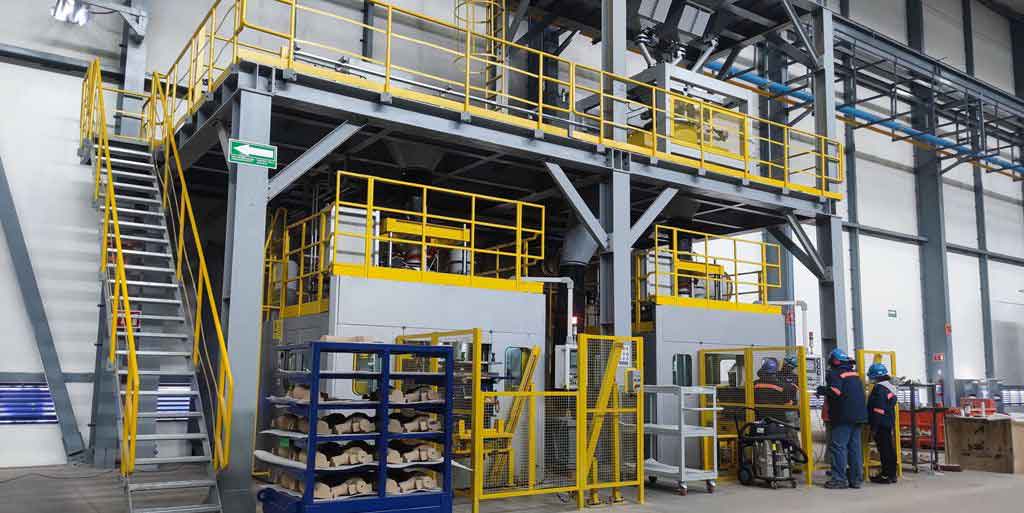
Moving beyond single machines, the most effective strategy is a “full-sequence” philosophy. This involves designing a customized, integrated cleaning cell or line that matches the specific part mix, volume, and quality requirements of a foundry. The goal is to achieve the maximum result with the minimum necessary investment by strategically combining different technologies. The solution set can be viewed as a toolkit, where the appropriate tools (machines) are selected and sequenced to build an optimal process flow for a given family of steel castings.
Technology Toolkit for Automated Steel Casting Finishing
The following sections detail the primary technologies available, their principles, advantages, and ideal applications.
1. Multi-Axis CNC Grinding Machines
These are the workhorses for precision finishing of medium-to-high complexity steel castings. Built on a robust machine tool platform, they offer high rigidity and stability.
- Principle: The casting is fixtured on a table, and a high-speed grinding spindle, mounted on 3-5 programmable axes, moves relative to the part to follow a pre-defined CNC toolpath. They often integrate automatic tool changers for different grinding or milling heads.
- Advantages: Excellent for achieving tight tolerances on datum surfaces, machining seal grooves, or performing precise edge-breaking. They are highly repeatable and can handle a wide range of part sizes and geometries with appropriate fixturing. Integrated dust extraction is standard.
- Mathematical Basis: The toolpath is generated from the part’s CAD model, offset by the tool radius. For complex surfaces, the path involves calculating a series of closely spaced contact points $(x_i, y_i, z_i)$ and tool orientations $(u_i, v_i, w_i)$ that satisfy the surface equation $S(x,y,z)=0$ and maintain a constant scallop height $h_s$. The material removal rate (MRR) can be approximated for milling-type operations as:
$$ MRR \approx f \cdot d \cdot w $$
where $f$ is the feed rate, $d$ is the depth of cut, and $w$ is the width of cut.
2. Robotic Grinding Cells
Industrial robots provide extreme flexibility for finishing complex, free-form surfaces on steel castings.
- Principle: A 6-axis articulated robot arm holds either the grinding tool (tool-in-hand) or the casting (part-in-hand). The “part-in-hand” configuration is common for smaller castings, while “tool-in-hand” is used for larger, heavier parts. The robot executes a programmed path, often guided by offline programming (OLP) software.
- Advantages: Unmatched flexibility to access intricate geometries and internal passages. Modern cells integrate force/torque sensors at the robot wrist, allowing for adaptive grinding that compensates for part variability and tool wear. The process can be easily reprogrammed for new parts.
- Control Challenge: The robot’s serial-link structure is less rigid than a CNC machine. This compliance must be actively managed. Hybrid position/force control is essential. A common model is:
$$ \tau = J^T(K_p (x_d – x) + K_f (F_d – F)) + D(\dot{q}) $$
where $\tau$ is the joint torque vector, $J$ is the Jacobian matrix, $x_d$ and $x$ are desired and actual end-effector positions, $F_d$ and $F$ are desired and actual forces, $K_p$ and $K_f$ are gain matrices, and $D(\dot{q})$ represents damping terms.
3. Specialized Non-Standard Equipment
For high-volume production of specific part families, dedicated non-standard machines offer the highest productivity and best economics.
a) Punch-Trimming Presses: Used for removing flash from the parting line of ductile iron or aluminum castings. A hydraulic press drives a shaped punch through the flash, shearing it off cleanly. It is extremely fast (cycle times < 10 seconds) and clean. Note: This method is generally not suitable for most steel castings due to their higher strength and toughness, which can damage the punch or leave a poor edge finish.
b) Through-Feed Grinding Machines: Designed for finishing large, flat surfaces on parts like cylinder blocks or heads. The casting is conveyed on a belt or roller bed under high-power grinding heads. It excels at achieving consistent surface flatness and parallelism but is limited to primarily planar surfaces.
c) Rotary-Table and Dedicated Machines: For high-volume disc-shaped steel castings like brake discs, flywheels, or clutch plates. Parts are loaded onto a rotary index table. As the table indexes, the parts pass under stationary grinding or milling heads that finish the front face, back face, and outer diameter in a single, continuous flow. Productivity is extremely high.
- Production Rate Calculation: For an $N$-station rotary index machine with a cycle time $T_c$ per index, the production rate $P$ is:
$$ P = \frac{3600}{T_c} \quad \text{parts/hour} $$
If processing occurs at $M$ of the $N$ stations simultaneously, it is highly efficient.
d) Copy/Form Grinding Machines: Employ a profiled grinding wheel that matches the desired final contour of the part (e.g., a camshaft lobe). The part rotates, and the form wheel is fed in to finish the entire profile in one pass. It is the fastest method for finishing large batches of identical profiled components.
- Material Removal Model: In form grinding, the material removal is primarily a function of the wheel’s profile and the infeeding velocity $v_f$. The cross-sectional area of material removed $A$ is constant per revolution for a given part, so the volumetric removal rate is:
$$ MRR = A \cdot v_f $$
4. Conventional Grinding with Advanced Tooling
Manual grinding stations will likely persist for prototyping, low-volume jobs, or touch-up operations. Their environmental and efficiency impact can be mitigated by using advanced abrasive technologies. Cubic Boron Nitride (CBN) or Diamond-impregnated grinding wheels/wire brushes last significantly longer than conventional alumina wheels, generate less heat and dust, and provide a more consistent finish. While the initial tool cost is higher, the total cost per part finished on a steel casting can be lower due to reduced changeover time and waste.
5. Automated Material Handling & Auxiliary Systems
This is the glue that transforms individual machines into a coherent production line. A full-sequence solution is incomplete without it.
- Components: Includes conveyors (belt, roller, slat), rotary tables, gantry robots, AGVs/AMRs, and pallet transfer systems.
- Function: Automates the loading/unloading of machines, transfers parts between different finishing stages, manages buffer storage, and presents parts in the correct orientation. This eliminates manual handling, reduces work-in-progress (WIP), and ensures a smooth, predictable production flow.
- System Integration: A central PLC or Manufacturing Execution System (MES) coordinates the timing and logic of all equipment. The key performance metric becomes the overall line cycle time $T_{line}$, which is dictated by the slowest station (the bottleneck):
$$ T_{line} = \max(T_1, T_2, …, T_n) $$
where $T_i$ is the cycle time of station $i$. The goal of line balancing is to minimize $T_{line}$.
| Technology | Key Principle | Best For | Key Performance Metric |
|---|---|---|---|
| Multi-Axis CNC Grinder | Pre-programmed, rigid toolpath machining | Precision surfaces, batch production, dimensional accuracy | Surface finish (Ra), Dimensional Tolerance (±mm) |
| Robotic Grinding Cell | Flexible, adaptive path with force control | Complex 3D geometries, high-mix production | Cycle Time Adaptability, Path Repeatability (mm) |
| Punch Trimming Press | Shearing/breaking of flash | High-volume ductile iron/aluminum | Parts per Hour (PPH) |
| Through-Feed Grinder | Continuous processing of flat surfaces | Large planar surfaces (blocks, heads) | Surface Flatness, Throughput (sq. m/hour) |
| Rotary-Table Machine | Simultaneous multi-station processing | High-volume disc/rotor-type parts | Overall Equipment Effectiveness (OEE %) |
| Form/Copy Grinder | Contour replication with profiled wheel | Mass production of identical profiled parts | Profile Accuracy, Tool Life (parts/wheel) |
Implementing an Automated Cleaning Line: A Conceptual Case
Consider a foundry producing medium-sized, high-value alloy steel castings for the energy sector. The parts have complex internal passages and require precise finishing on mating flanges and ports.
Proposed Full-Sequence Line:
- Stage 1 – De-gating & Rough Clean: Castings arrive from shakeout on a conveyor. A vision-guided robot picks a casting and places it into a CNC-controlled abrasive waterjet station to remove large gates and risers. Waterjet is cold-working, avoiding heat-affected zones critical for steel castings.
- Stage 2 – Primary Finishing: The part is transferred via an AGV to a multi-axis CNC grinding machine. Here, the datum surfaces, bolt holes, and critical seal faces are precisely machined to drawing specifications.
- Stage 3 – Secondary/Complex Finishing: The part is then loaded into a robotic grinding cell. The robot, equipped with a force-controlled spindle and a suite of tools (grinding wheels, rotary files, brushes), deburrs internal passages, blends edges, and finishes complex contoured surfaces based on a scan-to-path program that adapts to each individual casting.
- Stage 4 – Washing & Inspection: The finished casting is conveyed through a wash station to remove residual grit and debris. It then passes through an automated inspection booth (3D scan + vision) for final quality verification before packaging.
System Benefits: This integrated line minimizes manual handling, ensures consistent quality critical for steel castings in demanding service, captures all grinding dust at source, and provides real-time production data. The initial investment is offset by reduced labor costs, lower scrap/rework rates, higher throughput, and improved worker safety.
Future Directions and Conclusion
The automation of cleaning and finishing for steel castings is on a rapid evolutionary path. Key future trends include:
- Enhanced Perception and AI: Integration of high-resolution 3D scanning and machine learning algorithms to automatically generate and optimize grinding paths from a as-cast scan, dramatically reducing programming time for new parts.
- Digital Twins and Process Simulation: Creating a virtual model of the entire finishing line to simulate cycle times, optimize robot paths, and perform collision checking before physical implementation.
- Advanced Tooling and Coolant Systems: Development of smarter, longer-lasting abrasive tools and the wider adoption of MQL (Minimum Quantity Lubrication) or cryogenic cooling to further improve surface integrity and environmental performance.
- Collaborative Robotics (Cobots): Using force-limited cobots for simpler finishing tasks or for assisting human workers in handling heavy steel castings, blending the benefits of automation with human flexibility.
In conclusion, the transition from manual to automated finishing is imperative for the modern foundry producing steel castings. The challenges are significant but surmountable through a strategic, full-sequence approach that thoughtfully combines CNC machining, robotic flexibility, specialized high-volume equipment, and seamless automation. The payoff is substantial: dramatic gains in productivity and quality, the creation of a safer and more attractive workplace, and the enhanced competitiveness of foundries in a global market. By continuing to develop and integrate these technologies, the industry can effectively fill the historical “blank space” of efficient, clean, and intelligent post-casting processing, securing its future as a high-tech manufacturing sector.
| Technical Challenge | Current Mitigation Strategy | Future/Advanced Solution |
|---|---|---|
| Part Variability | Fixture with locators, teach-and-playback for robots | Real-time 3D scan-to-path generation with AI-based feature recognition |
| Force Control | Wrist-mounted F/T sensors, impedance control | Direct joint torque sensing, advanced hybrid force/position controllers with dynamic model compensation |
| Tool Wear | Scheduled tool changes, manual inspection | In-process tool wear monitoring via power consumption, acoustic emission, or integrated sensors; predictive tool life models |
| Process Planning | Offline Programming (OLP) software | Cloud-based digital twin simulations with automated cycle time and path optimization algorithms |
| Dust/Fume Control | Local exhaust ventilation (LEV) at source | Integrated dry filtration systems with automated filter cleaning and air recirculation; widespread adoption of wet or MQL grinding |