
Since the inception of our company in 1999, we have embarked on a journey of continuous evolution, initially focusing on castings for mining machinery before transitioning to petroleum, chemical, and boiler valve castings in 2004. By 2006, we entered the high-end market of power generation equipment steel castings, producing components for high-temperature and high-pressure steam turbines in ultra-supercritical power plants. This progression led us to manufacture heavy-duty gas-steam combined cycle turbine castings in 2014 and valves for nuclear projects like Hongyanhe in 2016. Committed to becoming a leader in premium steel castings, we embraced green, intelligent, and environmental-friendly principles, investing significantly in 2017 to establish a new facility characterized as “environmentally friendly and resource-efficient.” This foundation drives our exploration of green and advanced process理念 in steel castings, aiming to enhance quality, reduce waste, and promote sustainability.
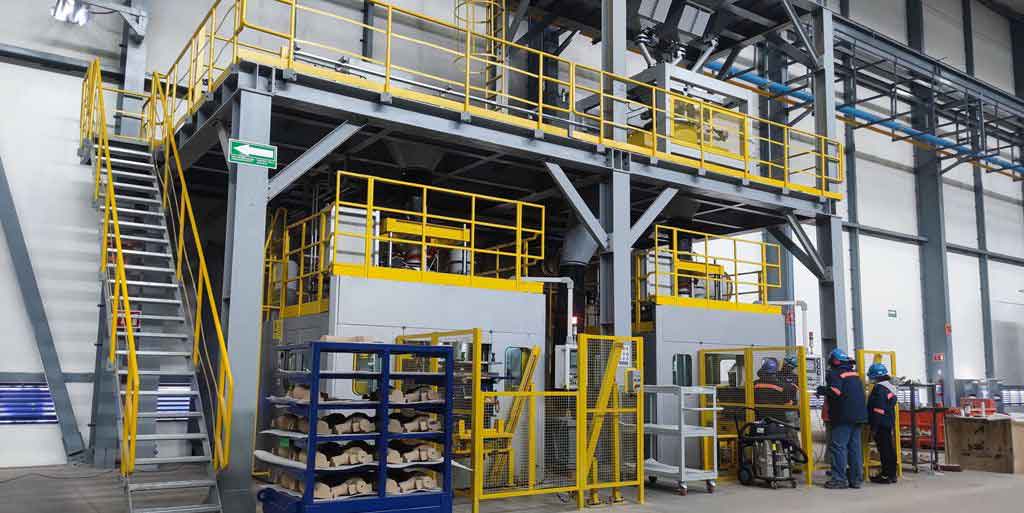
In the realm of steel castings, the adoption of green manufacturing practices is paramount. We prioritize advanced process equipment and methodologies that minimize environmental impact while maximizing efficiency. One key aspect is the use of water glass sand molding, widely recognized as a promising green casting solution. This process offers high strength, low cost, excellent dimensional accuracy, simplicity in production, and superior casting properties. Notably, water glass sand is colorless, odorless, and non-toxic, generating no刺激性气体 or harmful emissions during mixing, molding, pouring, and shakeout, thus posing no health risks. Compared to resin sand, it excels in cost-effectiveness, efficiency, and environmental benefits, while delivering comparable quality in steel castings. Our implementation involves ester-hardened modified water glass sand, with旧砂 regeneration achieving a 92% recovery rate and residual sodium controlled below 0.30%. However, due to inherent characteristics like moisture absorption, poor hardenability, creep tendency, and reduced collapsibility after multiple regeneration cycles—especially in humid regions like Sichuan—strict process controls are essential. We daily monitor sand flow, liquid flow, and strength from each mixer, along with residual sodium levels in regenerated sand. Small to medium molds must be poured within 12 hours, and large ones within 24 hours, with pre-pouring hot-air drying for over 3 hours to ensure mold temperatures above 60°C. These measures have eliminated defects such as冲砂,掉砂, and气孔, achieving dimensional accuracy of CT12级 per GB/T6414, and maintaining good collapsibility even after repeated regeneration cycles.
To further optimize steel castings production, we employ advanced melting and refining equipment. After comparing medium-frequency induction furnaces and electric arc furnaces, we opted for a配置 that leverages the strengths of both. Medium-frequency furnaces excel in melting various steel grades—including carbon steels, low-alloy steels, and high-alloy steels—with high efficiency, stable element yield, precise temperature control, and advantages in烟尘治理, composition control, and operational flexibility. However, their limited metallurgical反应, lack of refining capability, and minimal脱磷,脱硫,脱氧 functions necessitate high-quality raw materials. To address this, our melting department features an innovative setup with 3t, 6t, and 10t medium-frequency induction furnaces, complemented by 25t LF refining furnaces and 25t VOD/VD refining furnaces, enabling maximum molten steel capacity of 50t and single-piece steel castings up to 25t. Our melting processes are tailored for diverse steel castings requirements:
| Process Sequence | Key Functions | Applications in Steel Castings |
|---|---|---|
| Medium-frequency furnace + slag washing +喂硅钙丝 + bottom argon blowing | Initial melting,预脱氧, alloying; final脱氧, degassing, inclusion removal/modification | General steel castings |
| Medium-frequency furnace + slag washing + VD refining | Vacuum degassing for further gas and inclusion removal | High-demand steel castings |
| Medium-frequency furnace + LF furnace duplex | Melting and alloying in medium-frequency; composition微调,脱硫,脱氧, degassing in LF | Low-alloy steel castings |
| Medium-frequency furnace + VOD furnace duplex | Melting in medium-frequency;吹氧脱碳, vacuum degassing, reduction in VOD | Special steel castings |
| Medium-frequency furnace + LF furnace + VOD triple | Melting and alloying;微调,脱硫,脱氧;脱碳, degassing, reduction | High-end low-carbon steel castings |
| Medium-frequency furnace + LF furnace + VD triple | Melting and alloying;微调,脱硫,脱氧; vacuum degassing | High-quality low-alloy steel castings |
This versatility allows us to produce over 60 material grades for steel castings, including high-temperature-resistant materials like WC9 and ZG11Cr10Mo1NiWVNbN (up to 620°C), low-temperature-resistant materials like LCB and ZG08Crl8Ni9Ti (down to -196°C), corrosion-resistant materials such as CF8M and 00Cr25Ni7Mo4N, and high-strength engineering materials like 25CrNi2Mo with tensile strength exceeding 1,100 MPa.
The integration of virtual design technologies has revolutionized our approach to process design for steel castings. We utilize CAD software for initial casting layout—determining pouring positions, machining allowances,工艺补正, and non-cored holes—followed by simulation with MAGMA-SOFT and Anycasting to calculate hot spots and模数. Based on design rules, we develop risers, feeders, chills, and gating systems, iteratively refining parameters through simulation until defect-free results are achieved. This virtual验证 minimizes trial-and-error, reducing lead times and costs. For instance, numerical simulation helps predict potential defects in steel castings, allowing optimization before physical production. The transition from 2D to 3D virtual models enhances design accuracy and competitiveness.
In material science for steel castings, we leverage JMatPro software for性能 and热物性参数 calculations. This tool, grounded in thermodynamic models, enables rapid and accurate predictions of material properties, aiding in alloy design, processing, heat treatment, and welding. Applications include providing data for CAE software like Procast, predicting high-temperature性能, and guiding research. For example, phase diagram calculations for steady and metastable states inform solidification behavior in steel castings, while phase transformation simulations optimize heat treatment schedules. The software’s reliability reduces experimental costs and accelerates development for premium steel castings.
A critical advancement in steel castings production is the application of advanced gating system理念, inspired by John Campbell’s work on双层氧化膜 as a root cause of defects like porosity, shrinkage, and hot tears. To prevent oxide film entrainment, we adhere to ten principles for quality steel castings, emphasizing smooth, controlled filling. Our gating design for steel castings focuses on reducing Weber and Reynolds numbers to ensure平稳,慢流速,快速上升. The key principles are:
- High Flow Rate: Ensures rapid mold filling with a minimum rise velocity of 14 mm/s, reducing oxide film thickness at the molten front.
- Low Velocity: Limits gate exit velocity to 0.5 m/s, maintaining laminar flow and minimizing turbulence.
- Smooth and Air-Gap-Free: Avoids sharp bends and air entrapment in gating channels to prevent oxide inclusion. Curved sections are designed with radii to reduce紊流.
- Reverse Gravity: Uses bottom-gated or near-bottom内浇道 (within 90 mm of the lowest point) to promote counter-gravity filling.
These principles are encapsulated in design formulas. For instance, the Reynolds number (Re) for flow in steel castings gating systems should be kept low to ensure laminar conditions:
$$Re = \frac{\rho v D}{\mu}$$
where $\rho$ is density, $v$ is velocity, $D$ is hydraulic diameter, and $\mu$ is dynamic viscosity. Similarly, the Weber number (We) relates to surface tension effects:
$$We = \frac{\rho v^2 L}{\sigma}$$
where $L$ is characteristic length and $\sigma$ is surface tension. By targeting Re < 2000 and We < 1, we minimize turbulence and oxide entrainment in steel castings. A典型浇注系统布置 incorporates these elements, with large cross-sectional areas for high flow, tapered runners for velocity control, and curved transitions to maintain smooth flow.
To quantify benefits, our process innovations have significantly improved steel castings quality. Rejection rates for steel castings have fallen below 1%, weld repair rates are under 1%, and molten steel utilization exceeds 52%. The table below summarizes key performance metrics for steel castings production:
| Metric | Before Advanced Processes | After Implementation | Improvement |
|---|---|---|---|
| Rejection Rate | ~5% | <1% | >80% reduction |
| Weld Repair Rate | ~3% | <1% | >67% reduction |
| Molten Steel Utilization | ~45% | >52% | >15% increase |
| Dimensional Accuracy (CT level) | CT14 | CT12 | 2-level improvement |
| Energy Consumption per Ton | High | Reduced by 20% | Significant savings |
The economic and environmental impacts are profound. Green processes in steel castings reduce waste and energy use, aligning with global sustainability goals. For example, water glass sand regeneration cuts raw material consumption by over 90%, while advanced melting reduces emissions. Virtual design slashes development time for new steel castings by 30-40%, and optimized gating systems improve yield, directly lowering costs per unit of steel castings.
Looking ahead, we continue to innovate in steel castings technology. Emerging trends like artificial intelligence for process control, additive manufacturing for complex cores, and real-time monitoring with IoT devices promise further gains. Our commitment to “innovation-driven, pursuit of excellence” ensures that steel castings remain at the forefront of clean energy, chemical, engineering machinery, rail transit, and shipbuilding industries. By integrating green principles with advanced engineering, we set a benchmark for high-performance steel castings that meet rigorous global standards.
In conclusion, the application of green and advanced process理念 in steel castings has transformed our production paradigm. Through state-of-the-art equipment, virtual design, and科学的浇注系统, we achieve unparalleled quality and efficiency. The journey from traditional methods to a resource-smart approach underscores the potential for steel castings to drive industrial progress while minimizing environmental footprint. As we refine these technologies, the future of steel castings looks brighter than ever, poised to meet the demands of next-generation infrastructure and sustainable development.