
In my investigation into the performance of steel castings under severe service conditions, I focus on brake discs used in rail vehicles. These components are critical for safety, and their integrity depends heavily on the material’s response to repeated thermal cycles during braking. Steel castings, particularly those made from low-alloy steels, are favored for their balance of strength and toughness. However, the localized heating from friction can induce microstructural transformations that compromise mechanical properties. This study explores how simulated braking heat cycles affect the microstructure and mechanical behavior of steel castings, emphasizing the role of phase changes and strain localization. Through experimental simulations and advanced measurement techniques, I aim to provide insights that enhance the reliability of steel castings in high-temperature applications.
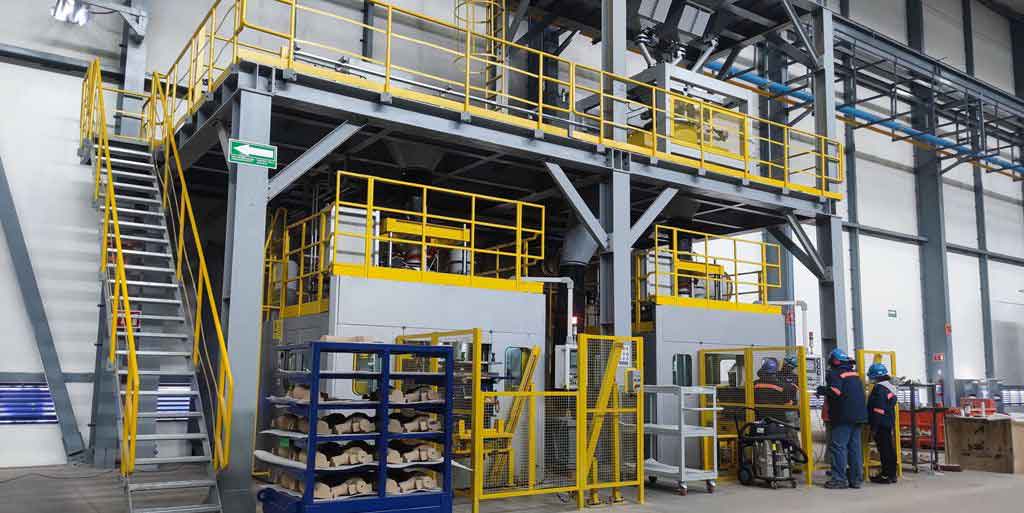
The manufacturing of steel castings involves precise control of composition and heat treatment to achieve desired properties. For brake discs, common grades include Cr-Ni-Mo-V steels, which are cast and then tempered to form a tempered sorbite structure. This initial microstructure provides good ductility and strength, but under braking, temperatures can exceed critical points, triggering transformations. I simulate these conditions using a Gleeble thermal cycle simulator, where specimens are subjected to controlled heating and cooling profiles. The goal is to replicate the thermal history of brake disc surfaces, especially in hotspots where temperatures spike. By analyzing the aftermath, I assess how steel castings degrade over time, informing better design and maintenance practices.
My experimental approach involves multiple steps. First, I prepare specimens from new steel castings for brake discs, ensuring they represent the as-cast material. The thermal cycles are designed based on real braking scenarios: one set mimics harsh braking with peak temperatures reaching 900°C, and another adds subsequent cycles at 600°C to simulate extended service. The parameters are summarized in Table 1, which outlines the heating, holding, cooling, and idle times for each cycle. This systematic variation allows me to isolate the effects of different thermal histories on steel castings.
| Specimen ID | Temperature Cycle | Heating Time (s) | Holding Time (s) | Cooling Time (s) | Post-Cooling Hold (s) |
|---|---|---|---|---|---|
| A | 900°C × 3 cycles | 30 | 10 | 120 | 90 |
| B | 900°C × 3 cycles + 600°C × 9 cycles | 30 (for 900°C), 20 (for 600°C) | 10 | 120 (for 900°C), 80 (for 600°C) | 90 (for 900°C), 60 (for 600°C) |
After thermal cycling, I examine the microstructural changes in the steel castings using metallography. The initial tempered sorbite structure, characterized by ferrite and cementite, serves as a baseline. For specimen A, exposed to 900°C cycles, the heated zone undergoes martensitic transformation due to rapid cooling, leading to refined grains. This can be described by the phase transformation kinetics, where the cooling rate exceeds the critical value for martensite formation. The hardness in this region increases significantly, which I quantify using Vickers hardness tests. The relationship between hardness and grain size can be approximated by the Hall-Petch equation:
$$ H = H_0 + k \cdot d^{-1/2} $$
where \( H \) is the hardness, \( H_0 \) is the base hardness, \( k \) is a material constant, and \( d \) is the grain diameter. For steel castings, finer grains from martensite contribute to higher hardness. In contrast, specimen B, with additional 600°C cycles, shows carbide dispersion within the matrix, resulting in a more uniform and finer microstructure. The boundary between heated and unheated zones exhibits a mix of original sorbite and refined grains, creating a softened region. This microstructural gradient is critical for understanding mechanical performance.
To quantify these changes, I measure hardness profiles across the specimens. Table 2 summarizes the average hardness values in different zones: the heated zone, boundary zone, and unheated zone. The data reveal that steel castings after harsh thermal cycles experience significant hardening in the heated area, but the boundary zone softens due to microstructural heterogeneity. This softening acts as a weak point under mechanical loading.
| Zone | Specimen A Hardness (HV) | Specimen B Hardness (HV) | Unheated Zone Hardness (HV) |
|---|---|---|---|
| Heated Zone | Approx. 350 | Approx. 310 | 250 |
| Boundary Zone | Approx. 278 | Approx. 288 | 250 |
| Unheated Zone | 250 | 250 | 250 |
The mechanical properties of steel castings are further evaluated through tensile testing. I prepare tensile specimens from both thermally cycled and pristine materials, using a standard geometry for consistency. During testing, I employ Digital Image Correlation (DIC) to capture full-field strain distributions. This technique reveals how localized thermal cycles alter strain responses. For untreated steel castings, the strain distribution is relatively uniform until necking, following a typical stress-strain curve. The elastic region can be modeled by Hooke’s law:
$$ \sigma = E \epsilon $$
where \( \sigma \) is stress, \( E \) is Young’s modulus, and \( \epsilon \) is strain. However, for thermally cycled specimens, the strain localizes in the boundary zone from the onset of yielding. The DIC data show a bimodal strain distribution, with peaks at the softened boundaries and minimal deformation in the hardened heated zone. This strain localization correlates with fracture locations, indicating that the boundary zone becomes the preferred site for crack initiation.
My tensile test results are summarized in Table 3, which compares key mechanical parameters: yield strength, tensile strength, and elongation. The data demonstrate that thermal cycling degrades the performance of steel castings. Specimen A shows the most significant reduction, while specimen B partially recovers due to tempering effects from the 600°C cycles. However, both fall short of the pristine material’s properties, highlighting the detrimental impact of repeated heating and cooling on steel castings.
| Specimen Condition | Yield Strength (MPa) | Tensile Strength (MPa) | Elongation (%) |
|---|---|---|---|
| Pristine Steel Castings | 550 | 700 | 15 |
| Specimen A (900°C cycles) | 450 | 600 | 8 |
| Specimen B (900°C + 600°C cycles) | 480 | 620 | 10 |
Fracture surface analysis supports these findings. For pristine steel castings, the fracture surface exhibits deep dimples, indicative of ductile failure. In contrast, specimen A shows a lack of dimples and the presence of microvoids, suggesting brittle tendencies. Specimen B displays shallow dimples, reflecting some recovery of ductility. This evolution underscores how thermal cycles alter the failure mode of steel castings, moving from ductile to brittle behavior in severely cycled regions.
To delve deeper, I consider the thermal stress generated during braking. The temperature gradient in steel castings can be modeled using Fourier’s heat conduction equation:
$$ \frac{\partial T}{\partial t} = \alpha \nabla^2 T $$
where \( T \) is temperature, \( t \) is time, and \( \alpha \) is thermal diffusivity. For brake discs, the surface heats rapidly during braking, while the interior remains cooler, creating stresses that promote microstructural changes. The resultant thermal strain can be expressed as:
$$ \epsilon_{th} = \beta \Delta T $$
with \( \beta \) as the coefficient of thermal expansion and \( \Delta T \) as the temperature difference. This strain, combined with mechanical loads, accelerates damage in steel castings.
Moreover, the fatigue life of steel castings under thermal cycles can be estimated using Coffin-Manson relation for low-cycle fatigue:
$$ \Delta \epsilon_p \cdot N_f^c = C $$
where \( \Delta \epsilon_p \) is the plastic strain range, \( N_f \) is the number of cycles to failure, and \( c \) and \( C \) are material constants. For steel castings in brake discs, the plastic strain accumulates in the boundary zones, reducing fatigue resistance. My simulations show that after multiple cycles, cracks initiate in these softened areas, leading to premature failure.
The implications for steel castings in service are significant. Hotspots on brake discs, where temperatures exceed critical points, become sites of microstructural transformation. The hardened zones are more prone to cracking under thermal stress, while the softened boundaries act as stress concentrators. To mitigate this, optimizing the composition and heat treatment of steel castings is essential. For instance, adding alloying elements that stabilize the microstructure or implementing post-casting treatments can enhance thermal stability. My research suggests that for steel castings subjected to repeated braking, regular inspection for hotspots and microstructural changes is crucial to prevent catastrophic failures.
In summary, my study demonstrates that braking heat cycles profoundly affect steel castings used in brake discs. The microstructural evolution—from martensite formation to carbide dispersion—alters hardness and mechanical properties. Strain localization in boundary zones, captured by DIC, explains the reduction in tensile performance. These findings underscore the need for improved materials and monitoring strategies for steel castings in high-temperature applications. Future work could explore advanced steel castings with enhanced thermal fatigue resistance, potentially through nanostructuring or composite approaches. By continuing to investigate steel castings, we can develop safer and more durable components for critical infrastructure.
To further illustrate the thermal behavior, I derive a simplified model for temperature evolution during braking. Assuming one-dimensional heat flow, the temperature rise at the surface of steel castings can be approximated by:
$$ T(x,t) = T_0 + \frac{q}{\sqrt{\pi \kappa \rho c t}} \exp\left(-\frac{x^2}{4\alpha t}\right) $$
where \( T_0 \) is initial temperature, \( q \) is heat flux, \( \kappa \) is thermal conductivity, \( \rho \) is density, \( c \) is specific heat, \( x \) is depth, and \( \alpha \) is thermal diffusivity. This equation highlights how rapid heating leads to steep gradients in steel castings, driving the observed transformations.
Additionally, the effect of cooling rate on phase transformation in steel castings can be described using continuous cooling transformation (CCT) diagrams. For the steel used here, cooling rates above a critical value result in martensite, while slower rates permit pearlite or bainite formation. My thermal cycles simulate fast cooling, akin to quenching, which explains the martensitic structures. The kinetics can be modeled by the Avrami equation:
$$ f = 1 – \exp(-k t^n) $$
where \( f \) is the transformed fraction, \( k \) is a rate constant, and \( n \) is an exponent. For steel castings, this helps predict microstructural outcomes under varying thermal histories.
In practice, the design of steel castings for brake discs must account for these thermal effects. Finite element analysis (FEA) can simulate temperature and stress distributions, but my experimental data provide validation. For example, the hardness gradient measured in Table 2 can inform FEA models by linking microstructure to material properties. By integrating such data, engineers can optimize the geometry and material selection for steel castings, ensuring they withstand operational demands.
Lastly, I emphasize the importance of non-destructive testing (NDT) for monitoring steel castings in service. Techniques like ultrasonic testing or thermography can detect hotspots and microstructural changes before failure. My research provides a basis for developing NDT criteria, such as hardness thresholds or strain patterns, specific to steel castings. Overall, advancing the understanding of steel castings under thermal cycles is key to enhancing safety and longevity in transportation systems.