
The relentless drive for higher performance, safety, and sustainability across industries such as automotive, construction, and heavy machinery places ever-increasing demands on the quality of steel. At the heart of steel quality lies its cleanliness, which is predominantly dictated by the population of non-metallic inclusions within the final product. As a foundry engineer deeply involved in the production of high-integrity steel castings, I have witnessed firsthand the detrimental effects of uncontrolled inclusions and the transformative impact of advanced process control. This article delves into the complex journey of inclusion genesis and evolution through the integrated steelmaking route of primary steelmaking, secondary refining, and continuous casting, with a particular focus on implications for the production of premium steel castings. We will systematically analyze inclusion sources, characteristics, and state-of-the-art control strategies, utilizing formulas and tables to consolidate this critical knowledge.
1. The Imperative for Clean Steel and High-Quality Steel Castings
The term “clean steel” lacks a universally rigid definition but is functionally understood as steel with exceptionally low levels of impurity elements (S, P, H, N, O) and, more importantly, a minimized population of deleterious non-metallic inclusions. For critical applications like bearing rings, large turbine steel castings, or high-strength automotive components, cleanliness is not a luxury but a prerequisite. Inclusions act as stress concentrators, initiating fatigue cracks, reducing toughness, impairing machinability, and compromising corrosion resistance. The pursuit of cleaner steel is intrinsically linked to the advancement of steel castings capable of withstanding extreme operational environments. The control window for total oxygen (T.O) in high-grade bearing steel, for example, is often below 10 ppm, a testament to the precision required.
2. Inclusion Taxonomy: Origins, Characteristics, and Impact on Steel Castings
Inclusions in steel are generally classified as endogenous or exogenous. Endogenous inclusions form within the molten steel due to chemical reactions during steelmaking and solidification. Exogenous inclusions are introduced from external sources like refractory erosion, slag entrapment, or reoxidation.
2.1 Major Inclusion Types and Their Deleterious Effects
The nature of an inclusion determines its impact on the properties of rolled products and, more critically for our focus, on steel castings where the as-cast structure is directly in service.
| Inclusion Type | Typical Composition | Morphology & Properties | Primary Detrimental Effects on Steel Castings |
|---|---|---|---|
| Alumina (Al2O3) | Al2O3, Al2O3-MgO spinel | Clusters of small, hard, angular particles; brittle and non-deformable. | Severe stress concentrators. Dramatically reduce fatigue life and impact toughness in cast components. Can lead to premature failure under cyclic loading. |
| Silicates | xFeO·yMnO·zSiO2 | Glassy or crystalline phases; deformable at hot-working temps but brittle in cast state. | Impair machinability, reduce ductility and toughness. In large steel castings, they can create planes of weakness. |
| Sulfides (MnS, CaS) | MnS, (Mn,Ca)S, CaS | Plastic at rolling temperatures, forming elongated stringers. In castings, they appear as isolated globules or grain boundary films. | Reduce transverse ductility and toughness. Can promote anisotropy. In free-machining steels for cast parts, they are beneficial. |
| Oxide-Sulfide Complexes | Al2O3-CaS, CaO-Al2O3-CaS | Core-shell or irregular composite structures. | Behavior depends on the core (brittle oxide) and shell (sulfide). Can be equally detrimental to fatigue properties. |
2.2 The Genesis and Evolution of Inclusions
The life cycle of an endogenous inclusion can be described by several fundamental metallurgical phenomena:
Nucleation: Following deoxidation, oxide particles nucleate when the solubility product of the oxide is exceeded. The nucleation rate $J$ can be expressed as a function of supersaturation and interfacial energy:
$$ J = A \exp\left(-\frac{\Delta G^*}{kT}\right) $$
where $\Delta G^*$ is the critical Gibbs free energy for nucleation, $k$ is Boltzmann’s constant, and $T$ is temperature. A high supersaturation from strong deoxidants like Al leads to a high nucleation rate, resulting in numerous fine Al2O3 particles.
Growth and Coalescence: Nucleated particles grow by diffusion and collide due to turbulent fluid flow, forming clusters (e.g., Al2O3 clusters) or larger aggregates. The collision rate in a stirred ladle is key to inclusion removal.
Flotation and Removal: The primary mechanism for inclusion removal is buoyant flotation to the top slag. Stokes’ law governs the terminal rising velocity $v_t$ of a spherical inclusion:
$$ v_t = \frac{2 (\rho_m – \rho_i) g r^2}{9 \eta} $$
where $\rho_m$ and $\rho_i$ are the densities of molten steel and inclusion, $g$ is gravity, $r$ is the inclusion radius, and $\eta$ is the steel viscosity. This highlights the critical importance of inclusion size ($r^2$) and the benefit of forming liquid inclusions (lower $\rho_i$ and potential for coalescence).
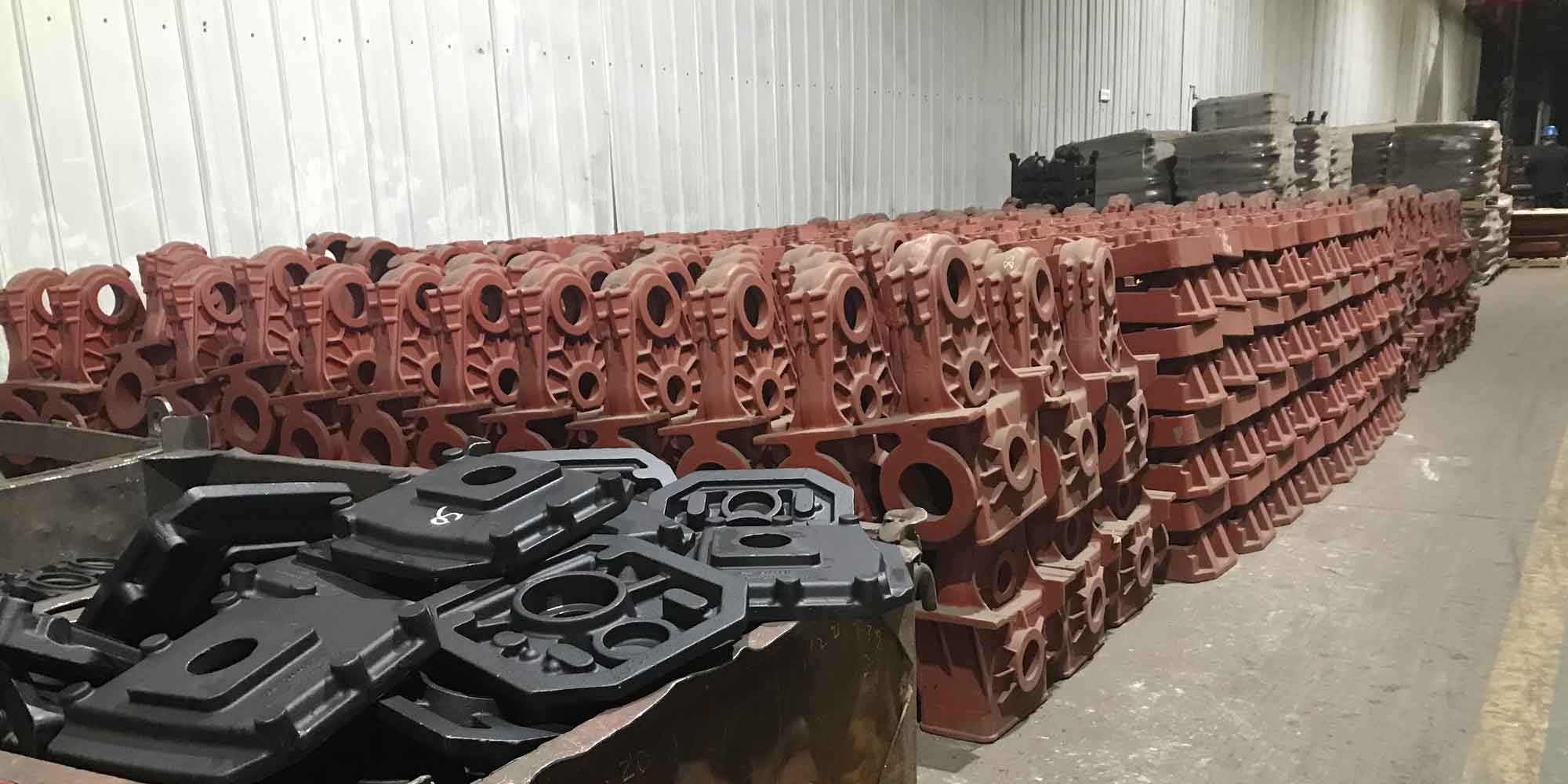
As seen in the image of a modern foundry producing large steel castings, the scale and complexity of the process underscore the necessity for meticulous control at every stage to ensure the internal soundness of such massive components.
3. The Integrated Control Strategy: From Converter to Caster
Effective inclusion control is not a single operation but a holistic strategy applied across the entire production route.
3.1 Primary Steelmaking and Hot Metal Pretreatment
The battle for cleanliness begins before the steelmaking furnace. Efficient desulfurization and dephosphorization of hot metal reduce the load of these elements, minimizing the formation of subsequent sulfide and phosphate inclusions. The reaction for ladle desulfurization can be simplified as:
$$ [S] + (CaO) \rightarrow (CaS) + [O] $$
A low initial oxygen activity is crucial for this reaction to proceed efficiently, often achieved through “slag skimming” to remove oxidizing converter slag before tapping.
3.2 Secondary Metallurgy: The Heart of Inclusion Control
The ladle furnace (LF), Ruhrstahl-Heraeus (RH) degasser, and other secondary refining units are where precise inclusion chemistry and morphology control is achieved.
A. Deoxidation Strategy: The choice of deoxidant dictates the initial inclusion population. Aluminum is powerful but generates solid Al2O3. A more advanced approach is complex deoxidation, using combinations like Si-Mn-Al or Ca-Si-Al. The goal is to form liquid or low-melting point oxides (e.g., calcium aluminates) that easily coalesce and float out. The stability diagram for the CaO-Al2O3 system is essential here, targeting the liquid window (e.g., 12CaO·7Al2O3).
| Deoxidation Practice | Typical Inclusion Products | Melting Point Range | Advantages for Steel Castings |
|---|---|---|---|
| Aluminum Only | Solid Al2O3 clusters | ~2050°C | Strong deoxidation, low cost. |
| Silicon-Manganese | Liquid MnO-SiO2 silicates | ~1200-1300°C | Form globular, less harmful inclusions. |
| Calcium Treatment | Liquid Calcium Aluminates (e.g., CaO·Al2O3) | ~1400-1600°C | Modifies Al2O3 to liquid globules, prevents nozzle clogging, improves machinability of castings. |
B. Inclusion Modification and Removal:
– Gas Stirring: Argon bubbling through porous plugs creates a plume, promoting inclusion collision and transport to the slag. The mixing time $ \theta $ can be related to gas flow rate $Q$:
$$ \theta \propto Q^{-1/3} $$
Optimal stirring is crucial: too weak and inclusions don’t remove; too strong leads to slag entrapment and reoxidation.
– Slag Engineering: A synthetic “white slag” with high basicity (CaO/SiO2 > 3), low FeO+MnO content, and appropriate viscosity is maintained. This slag acts as a chemical sink, absorbing inclusions that float to the surface. The capacity of slag to absorb Al2O3 is governed by its composition and the equilibrium:
$$ (Al_2O_3)_{inclusion} \rightleftharpoons (Al_2O_3)_{slag} $$
– Vacuum Degassing (RH/VD): Dramatically reduces hydrogen and nitrogen content, preventing gas-based inclusions (blowholes) during the solidification of large steel castings. It also promotes carbon deoxidation under low pressure: [C] + [O] → CO(g), further lowering oxygen content.
C. Wire Feeding: A precise method for final inclusion shape control, particularly calcium treatment. Cored wire containing CaSi or other alloys is injected deep into the ladle. The reaction to modify alumina is critical:
$$ 3[Ca] + Al_2O_3_{(s)} \rightarrow 3CaO_{(in slag/liquid)} + 2[Al] $$
The success of this treatment is measured by the Calcium-to-Aluminum ratio ([Ca]/[Al]) in the steel, aiming for a range that ensures liquid calcium aluminate formation.
3.3 The Critical Tundish and Continuous Casting Stage
This is the last line of defense before solidification. The tundish is not just a reservoir; it is a reactor for final inclusion flotation.
– Flow Control: Weirs, dams, and baffles are designed to optimize flow patterns, maximize residence time, and promote a piston-like flow to allow inclusions to float to the tundish slag cover. Computational Fluid Dynamics (CFD) is indispensable for designing these systems.
– Protection from Reoxidation: This is paramount. Any contact between the steel stream and air generates new oxide inclusions (“reoxidation products”). Complete shrouding with argon is used from ladle to tundish and from tundish to mold. A stable, liquid mold flux that uniformly melts and absorbs inclusions from the solidifying shell is essential.
– Solidification and Macro-Inclusion Formation: In the final stage, the interplay between solidification rate and inclusion mobility determines final distribution. The critical radius $r_c$ for an inclusion to be pushed by the solidification front versus engulfed is given by:
$$ r_c \propto \sqrt{\frac{\sigma_{sl}}{\Delta \rho \cdot G \cdot R}} $$
where $\sigma_{sl}$ is solid-liquid interfacial energy, $\Delta \rho$ is density difference, $G$ is temperature gradient, and $R$ is solidification rate. Fast casting speeds (high R) can lead to the engulfment of smaller inclusions, highlighting the need for their prior removal. For large, slowly-solidifying steel castings, this phenomenon is even more critical as the long solidification time can allow for significant segregation and inclusion agglomeration in the final liquid pools.
4. Advanced Monitoring and Future Trends for Premium Steel Castings
The future of inclusion control lies in advanced sensors, process models, and big data analytics to move from reactive to predictive control.
4.1 Real-Time Monitoring: Systems like the LiMCA (Liquid Metal Cleanliness Analyzer) provide real-time measurement of inclusion concentration and size distribution in the melt, allowing for immediate corrective actions before casting crucial steel castings for nuclear or aerospace applications.
4.2 Inclusion Engineering: Beyond mere removal, there is active research into tailoring inclusions to enhance properties. For example, intentionally introducing nano-sized, thermally stable inclusions (e.g., TiN, rare earth oxides) can pin austenite grain boundaries during heat treatment of castings, refining the final microstructure and improving toughness.
4.3 Thermodynamic and Kinetic Modeling: Sophisticated software (e.g., FactSage, Thermo-Calc coupled with kinetic modules) allows for the prediction of inclusion evolution along the entire process route. This enables virtual process optimization before actual trials, reducing cost and time for developing new grades of clean steel for demanding steel castings.
5. Conclusion
The control of non-metallic inclusions in steel is a complex, multi-stage challenge that sits at the intersection of thermodynamics, kinetics, and fluid dynamics. For producers of high-performance steel castings, where the integrity of the as-cast component is non-negotiable, mastering this chain from primary refining through to solidification is essential. A successful strategy hinges on a deep understanding of inclusion genesis, rigorous process control at every step—especially in secondary metallurgy and casting protection—and the increasing adoption of digital tools for process optimization. The goal is not just to remove inclusions, but to intelligently manage their composition, morphology, and distribution to consistently produce steel of exceptional cleanliness, thereby unlocking new frontiers in the performance and reliability of engineered steel castings.