
In the realm of steel castings manufacturing, the quest for efficient, environmentally friendly, and cost-effective binding materials for mold and core sands is perpetual. As a researcher deeply involved in foundry technology, I have observed the widespread use of sodium silicate (water glass) binders due to their low cost and minimal environmental impact. However, their inherent drawbacks—such as high gas evolution, poor collapsibility, and the need for high addition percentages—often lead to defects like gas porosity and inclusions in critical steel castings, such as railway wheels. This study presents my comprehensive investigation into a novel inorganic binder system, evaluating its performance against traditional water glass in the production of steel castings, with a focus on wheel manufacturing. The goal is to reduce binder usage, enhance mold strength, and minimize casting defects, thereby improving the overall quality and sustainability of steel castings production.
The foundational materials used in this study are critical for replicating industrial conditions. The base sand was sourced from Inner Mongolia, characterized by a granularity of 45/75 mesh and an average fineness AFS between 46 and 52, with a silica content exceeding 99.0%. The traditional binder was a conventional sodium silicate (water glass) with a SiO2/Na2O ratio of 2.4, a Baumé degree of 51, and a density of 1.5 g/cm³. The novel inorganic binder, also with a SiO2/Na2O ratio of 2.4, had a lower Baumé degree of 47 and a density of 1.5 g/cm³, but its composition was modified to include aluminosilicate structures with additions of potassium tetraborate (K2B4O7) and lithium tetraborate (Li2B4O7). A fly ash additive, comprising a mixture of mineral powders (CaO, Al2O3, SiO2, Fe2O3, C, etc.), was used as a hardening agent at 1% by mass of sand. The specifications are summarized in Table 1.
| Material Name | Specification Details |
|---|---|
| Inner Mongolia Sand | Grain size: 45/75 mesh, AFS: 46–52, ω(SiO2) ≥ 99.0% |
| Water Glass Binder | SiO2/Na2O = 2.4, Baumé: 51, Density: 1.5 g/cm³, primary component: silicate |
| Novel Inorganic Binder | SiO2/Na2O = 2.4, Baumé: 47, Density: 1.5 g/cm³, primary component: aluminosilicate with K2B4O7 and Li2B4O7 |
| Fly Ash Additive | Mixed mineral powder (CaO, Al2O3, SiO2, Fe2O3, C, etc.) |
The experimental methodology was designed to simulate actual foundry processes for steel castings. For each test, 1 kg of base sand was mixed in a laboratory sand mixer for 1 minute. Then, the binder was added at varying percentages by mass of sand—4%, 5%, and 6%—and mixed for another minute. Subsequently, 1% fly ash additive was incorporated and mixed for a final minute. The mixed sand was then shaped into standard “8”-shaped specimens using an MLRA1 specimen machine. The molds were hardened using CO2 gas at a pressure of 0.1 MPa for 15 seconds. Immediate tensile strength, referred to as instant strength, was measured right after hardening using a sand strength tester. To assess baked strength, specimens were placed in a drying oven at 150°C for 30 minutes, then cooled and tested for tensile strength. The strength measurements are crucial for evaluating mold handleability and durability during the casting of steel castings.
Gas evolution is a critical parameter in steel castings production, as excessive gases can lead to porosity defects. To measure this, residual sand samples from the tests were collected, ground, and dried at 110°C for 1 hour. Then, 1 g of dried sand was placed in a preheated porcelain boat at 850°C in a gas evolution determinator. The gas released was measured and recorded. The relationship between binder addition and gas evolution can be modeled empirically. For instance, the gas volume \( G \) (in mL/g) as a function of binder content \( C \) (in wt%) can be approximated by a linear equation for each binder type:
$$ G_{water} = a_w C + b_w $$
$$ G_{novel} = a_n C + b_n $$
where \( a_w, b_w, a_n, b_n \) are constants derived from experimental data. Lower gas evolution is desirable to reduce defects in steel castings.
The results from the gas evolution tests are presented in Table 2. As observed, gas evolution increases with binder content for both systems, but the novel binder consistently produces less gas across all addition levels. This reduction is significant for steel castings quality, as lower gas evolution minimizes the risk of porosity formation during solidification.
| Binder Type | Binder Addition (wt%) | Gas Evolution (mL/g) |
|---|---|---|
| Water Glass | 4 | 12.5 |
| 5 | 15.2 | |
| 6 | 18.0 | |
| Novel Inorganic Binder | 4 | 10.1 |
| 5 | 12.8 | |
| 6 | 15.5 |
The instant strength of the molds is vital for demolding without damage. My measurements showed that instant strength increases with binder content. Remarkably, sand with 4% novel binder exhibited higher instant strength than sand with 5% water glass. This suggests that the novel binder provides better immediate bonding, which is advantageous for productivity in steel castings foundries. The baked strength, indicating the final mold strength after drying, followed a similar trend, with the novel binder outperforming water glass at equivalent or lower addition levels. These strength relationships can be expressed as:
$$ \sigma_i = k_i C + d_i $$
$$ \sigma_b = k_b C + d_b $$
where \( \sigma_i \) is instant strength, \( \sigma_b \) is baked strength, \( C \) is binder content, and \( k_i, d_i, k_b, d_b \) are constants specific to each binder. The data are summarized in Table 3.
| Binder Type | Binder Addition (wt%) | Instant Strength (MPa) | Baked Strength (MPa) |
|---|---|---|---|
| Water Glass | 4 | 0.45 | 1.20 |
| 5 | 0.60 | 1.50 | |
| 6 | 0.75 | 1.80 | |
| Novel Inorganic Binder | 4 | 0.70 | 1.65 |
| 5 | 0.85 | 1.95 | |
| 6 | 1.00 | 2.25 |
To understand the superior performance of the novel binder, I conducted microstructural analysis using scanning electron microscopy (SEM). Sand specimens with 5% water glass and 4% novel binder were examined after hardening. The sand with water glass showed larger inter-particle voids and a lower density of bonding bridges. Numerous pores and cracks were observed at the bonding bridges, weakening the structure. In contrast, the sand with the novel binder exhibited a uniform binder film coating the sand grains, with dense bonding bridges free of pores and cracks. This microstructure contributes to higher strength and lower gas evolution, which are critical for high-integrity steel castings.
The enhanced properties of the novel binder can be attributed to its chemical composition. Energy-dispersive spectroscopy (EDS) revealed the presence of Al, Si, Li, K, Na, and O, indicating an aluminosilicate matrix with dissolved K2B4O7 and Li2B4O7. These borates reduce the viscosity of the binder, improve its fluidity, and enhance wettability on sand grains. The improved wetting leads to more uniform coverage and denser bonding bridges upon hardening. The bond strength \( S \) can be related to the binder’s viscosity \( \eta \) and surface tension \( \gamma \) through a modified adhesion model:
$$ S \propto \frac{\gamma \cos \theta}{\eta} $$
where \( \theta \) is the contact angle. Lower \( \eta \) and optimized \( \gamma \) in the novel binder promote better adhesion, directly benefiting the mold strength for steel castings.
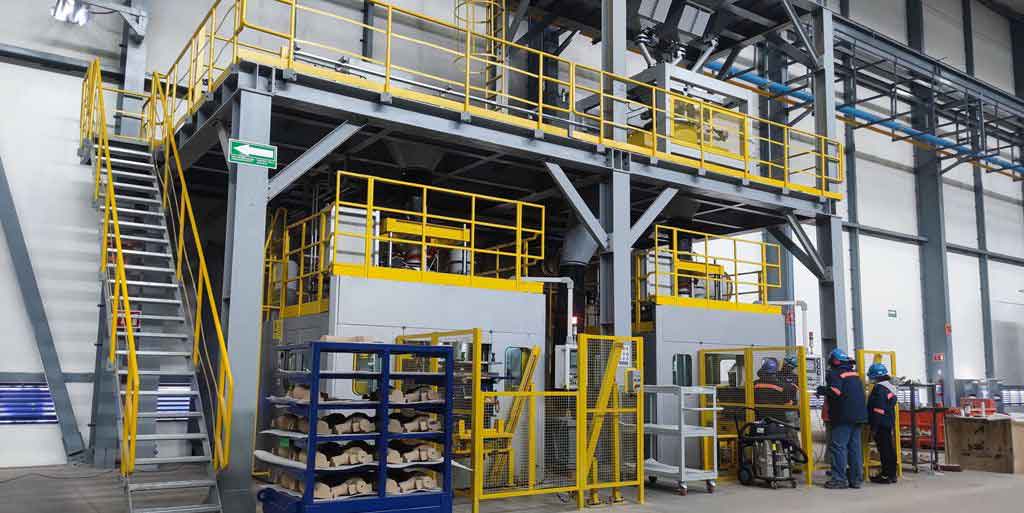
The application of the novel inorganic binder was tested in an actual production line for steel castings, specifically for railway wheels. The binder was added at 4% by mass of sand, with 1% fly ash additive. The molding process involved shooting the sand into molds, followed by CO2 hardening at 0.2 MPa for 20–30 seconds. The demolded sand molds exhibited excellent surface quality with no loose sand, and the instant strength was sufficient for demolding. After molding, the cores and molds were assembled, poured with molten steel, and subjected to heat treatment. The resulting steel castings—railway wheels—showed minimal sand adhesion and good surface finish after cleaning, indicating high final mold strength and good collapsibility.
To quantify the benefits, a batch of 2,000 wheels produced with the novel binder was compared with a concurrent batch using traditional water glass binder. The wheels underwent rigorous inspection, including dimensional checks, ultrasonic testing, and magnetic particle inspection. The defect rates are summarized in Table 4. The wheels made with the novel binder showed significant reductions in inclusion-related and gas porosity-related defects, underscoring its effectiveness for high-quality steel castings production.
| Binder Type | Inclusion Defects (%) | Gas Porosity Defects (%) | Total Defect Rate (%) |
|---|---|---|---|
| Water Glass (5% addition) | 3.15 | 3.22 | 6.37 |
| Novel Inorganic Binder (4% addition) | 1.43 | 1.42 | 2.85 |
The reduction in defects can be correlated with the lower gas evolution and higher strength of the novel binder system. For steel castings, where internal soundness is paramount, such improvements directly enhance product reliability and reduce scrap rates. The economic implications are substantial, as lower binder usage (4% vs. 5% or more for water glass) translates to cost savings in raw materials, while the improved quality reduces rework and waste in steel castings manufacturing.
Further analysis involves the kinetic aspects of gas evolution during pouring. The gas evolution rate \( \dot{G} \) as a function of temperature \( T \) for the binders can be described by an Arrhenius-type equation:
$$ \dot{G} = A e^{-E_a / (RT)} $$
where \( A \) is the pre-exponential factor, \( E_a \) is the activation energy for gas release, \( R \) is the gas constant, and \( T \) is the absolute temperature. For the novel binder, \( E_a \) is higher due to its stable aluminosilicate structure, leading to slower gas release during the casting of steel castings, which allows gases to escape more easily without forming pores.
In terms of mold collapsibility, which is crucial for post-casting shakeout, the novel binder also offers advantages. The lower binder content and the presence of borates promote easier breakdown of the sand after solidification. The collapsibility index \( CI \) can be defined as the inverse of the residual strength after heating:
$$ CI = \frac{1}{\sigma_r} $$
where \( \sigma_r \) is the residual strength after exposure to casting temperatures. For the novel binder, \( \sigma_r \) is lower due to reduced binder burnout resistance, enhancing collapsibility for steel castings.
The integration of this novel binder into existing foundry operations for steel castings is straightforward. It requires no major changes to equipment or processes, as it utilizes standard CO2 hardening methods. The lower viscosity improves sand flowability during shooting, leading to more uniform mold compaction. This uniformity is essential for complex steel castings like wheels, where consistent mold density ensures dimensional accuracy and reduces casting stresses.
Environmental considerations are increasingly important in steel castings production. The novel binder, with its reduced addition levels and lower organic components (due to inorganic borates), generates fewer volatile organic compounds (VOCs) and less waste sand. The overall environmental footprint of the binding process is diminished, aligning with sustainable manufacturing practices for steel castings industries.
Looking forward, the optimization of this novel binder system can involve tailoring the borate ratios (K2B4O7 to Li2B4O7) for specific steel castings applications. For instance, heavy-section steel castings might benefit from higher lithium content for enhanced thermal stability, while thin-walled steel castings could use more potassium for faster hardening. The general formula for binder composition can be expressed as:
$$ Binder = [Al_2O_3 \cdot xSiO_2] + yK_2B_4O_7 + zLi_2B_4O_7 + other modifiers $$
where \( x, y, z \) are molar ratios optimized for performance. This flexibility allows for customization across a wide range of steel castings production scenarios.
In conclusion, my research demonstrates that the novel inorganic binder system, with additions of K2B4O7 and Li2B4O7, offers significant advantages over traditional water glass for steel castings manufacturing. At an addition level of 4%, it provides higher instant and baked strengths, lower gas evolution, and improved microstructural integrity compared to water glass at 5% or more. These properties translate to reduced defect rates in steel castings, such as railway wheels, and lower production costs. The binder’s lower viscosity enhances sand workability, while its inorganic nature supports environmental sustainability. This innovation holds great promise for advancing the quality and efficiency of steel castings production worldwide, paving the way for more reliable and economical manufacturing processes in the foundry industry.