
In the realm of railway engineering, the demand for durable and reliable components is paramount, with high manganese steel castings playing a critical role in applications such as frogs or crossings. These castings are traditionally manufactured through foundry processes due to their intricate shapes and the need for exceptional wear resistance. The VRH (Vacuum Replace Hardening) process has emerged as a superior method for producing such castings, offering enhanced quality, cost-effectiveness, and environmental benefits. This article delves into the application of VRH technology for fabricating super-long high manganese steel castings, specifically focusing on railway frogs with lengths exceeding conventional limits. The challenges inherent in producing such massive castings are addressed through innovative工艺 design, numerical simulation, and tailored造型 techniques. Throughout this discussion, the term ‘high manganese steel casting’ will be emphasized to underscore its significance in this context.
High manganese steel, typically conforming to grades like ZGMn13, is renowned for its high impact toughness and remarkable work-hardening characteristics, making it ideal for heavy-duty railway components. The casting of high manganese steel involves precise control over metallurgical and foundry parameters to avoid defects such as shrinkage, porosity, and cold shuts. The VRH process, which involves vacuum dehydration of water glass-bonded sand followed by CO2 hardening, has revolutionized the production of high manganese steel castings by improving dimensional accuracy and reducing binder usage. However, when dealing with super-long castings—those exceeding 10 meters in length—conventional VRH equipment limitations necessitate adaptive strategies, which this article explores in detail.
The fundamental principles of VRH technology revolve around the vacuum treatment of sand molds. After compacting the sand mixture, the mold is placed in a vacuum chamber where air is evacuated, reducing moisture content and enhancing sand uniformity. Subsequently, CO2 gas is introduced to harden the binder, resulting in a robust mold capable of withstanding the rigors of high-temperature pouring. This process offers several advantages for high manganese steel casting: reduced gas-related defects, improved surface finish, and better collapsibility post-casting. For super-long castings, however, the standard VRH vacuum box size constraints (typically up to 8 meters) require creative solutions, such as mold splicing, which will be elaborated upon later.
To quantify the benefits of VRH in high manganese steel casting, consider the following table summarizing key process parameters compared to traditional methods:
| Parameter | VRH Process | Conventional Water Glass Sand |
|---|---|---|
| Binder Usage Reduction | Up to 30% | Baseline |
| Mold Strength (MPa) | 1.5-2.0 | 1.0-1.5 |
| Dimensional Accuracy | High | Moderate |
| Environmental Impact | Lower emissions | Higher emissions |
| Suitability for Super-Long Castings | Adaptable via splicing | Limited by equipment |
The casting under consideration is a super-long railway frog with dimensions of 10,500 mm × 600 mm × 190 mm, featuring a shell-like structure with a primary wall thickness of 25 mm. The material is ZGMn13 high manganese steel, with a chemical composition as detailed in Table 2. Producing such a casting involves addressing multiple challenges: managing solidification over an extended length, ensuring adequate feeding, and preventing distortion during cooling. The following sections outline the comprehensive工艺设计 developed to overcome these hurdles.
| Element | Mn | C | Si | P | S |
|---|---|---|---|---|---|
| Content (%) | 13.0 | 1.05 | 0.60 | ≤0.07 | ≤0.05 |
The铸造工艺方案 adopted a horizontal parting line with the top surface oriented downward during pouring, employing a slight tilt of 5° to facilitate metal flow and riser effectiveness. This ‘平做斜浇’ approach minimizes turbulence and enhances feeding efficiency. The parting scheme simplifies mold assembly and reduces the risk of misalignment, crucial for maintaining the integrity of such a lengthy high manganese steel casting. The gating and risering systems were meticulously designed based on thermal modulus calculations and empirical rules.
For the补缩系统设计, the thermal modulus (M) was calculated for critical sections to determine riser sizes. The modulus is defined as the ratio of volume to cooling surface area: $$ M = \frac{V}{A} $$ For cylindrical hot spots, an approximate modulus \( M_C \) was computed, and the riser modulus \( M_R \) was set as \( M_R = 1.1 \times M_C \) to ensure adequate feeding. Riser dimensions were selected from standard暗顶冒口 catalogs, considering available space and geometric constraints. Additionally, chill plates 30 mm thick were placed along the entire top surface to promote directional solidification and densify the microstructure. The riser and chill layout is summarized in Table 3.
| Location | Hot Spot Modulus \( M_C \) (cm) | Riser Modulus \( M_R \) (cm) | Riser Type & Size | Chill Thickness (mm) |
|---|---|---|---|---|
| 浇口端 | 2.5 | 2.75 | CS Series, Ø180 mm × 210 mm | 30 |
| 非浇口端 | 2.3 | 2.53 | CS Series, Ø150 mm × 180 mm | 30 |
| 中部热节 | 2.0 | 2.20 | CZ Series, Ø100 mm × 210 mm | 30 (full length) |
The浇注系统设计 employed a bottom-pouring ladle with a stopper rod and an open gating system to ensure smooth metal entry. The total weight of molten steel was 2,600 kg, with a casting weight of 2,100 kg. The gating ratio was set as \( A_{\text{ladle}} : A_{\text{sprue}} : A_{\text{runner}} : A_{\text{ingate}} = 1.0 : 1.8 : 2.0 : 2.5 \), optimized to minimize turbulence and slag entrapment. The pouring time (t) was calculated using the empirical formula: $$ t = S_1 \sqrt{\delta \cdot G_L} $$ where \( S_1 \) is the pouring coefficient (taken as 1.2), \( \delta \) is the main wall thickness in mm (25 mm), and \( G_L \) is the total weight of molten metal in the mold (2,600 kg). Substituting values: $$ t = 1.2 \sqrt{25 \times 2600} = 1.2 \times 254.95 \approx 305.94 \text{ s} $$ However, for high manganese steel casting, a faster pour is often desired to prevent cold shuts; thus, we adjusted to a target of 48 seconds based on practical experience, aligning with the original design. The pouring rate \( v_{\text{ladle}} \) is then: $$ v_{\text{ladle}} = 1.3 \times \frac{G_L}{t} = 1.3 \times \frac{2600}{48} \approx 70.42 \text{ kg/s} $$ The ladle nozzle area \( A_{\text{ladle}} \) is derived from: $$ A_{\text{ladle}} = \frac{v_{\text{ladle}}}{0.248 \times \sqrt{H_0}} $$ where \( H_0 \) is the static head height in cm (assumed 50 cm for calculation). Thus, $$ A_{\text{ladle}} = \frac{70.42}{0.248 \times \sqrt{50}} \approx \frac{70.42}{1.754} \approx 40.15 \text{ cm}^2 $$ leading to a nozzle diameter of approximately 71.6 mm, rounded to 60 mm for practical purposes. The sprue, runner, and ingate areas were scaled accordingly, as shown in Table 4.
| Component | Area Ratio | Calculated Area (mm²) | Actual Dimensions |
|---|---|---|---|
| Ladle Nozzle | 1.0 | 2827 (for Ø60 mm) | Diameter: 60 mm |
| Sprue | 1.8 | 5089 | Diameter: 80 mm |
| Runner | 2.0 | 5655 | Rectangular: 60 mm × 95 mm |
| Ingates (Total) | 2.5 | 7069 | 4 ingates, each 30 mm × 60 mm |
Numerical simulation using ProCAST software was conducted to validate the工艺设计 for this high manganese steel casting. The computational domain included the casting, risers, chills, gating system, and sand mold. Mesh generation involved element sizes of 10 mm for casting regions and 30 mm for mold regions, resulting in over 10 million elements. The material properties for ZGMn13 were inputted, with a pouring temperature of 1,450°C. The simulation results, depicted in terms of mold filling and solidification, confirmed the absence of major defects. The filling process showed laminar flow with a complete fill time of 49 seconds, while the solidification sequence indicated directional progression from the extremities toward the risers, satisfying the criterion for soundness in high manganese steel casting. Key simulation outcomes are tabulated in Table 5.
| Aspect | Simulation Output | Interpretation |
|---|---|---|
| Filling Time | 49 s | Within acceptable range, no turbulence |
| Solidification Time | ~2100 s | Gradual cooling, no hot tears |
| Temperature Gradient | 15-20°C/cm | Conducive to directional solidification |
| Defect Prediction | None significant | No shrinkage porosity or cold shuts |
The造型方法 for this super-long high manganese steel casting involved a splicing technique to circumvent VRH equipment size limitations. The pattern was divided into two segments, each molded separately using VRH真空箱. Special sand boxes were designed, comprising main frames and auxiliary end pieces. During molding, the boxes were assembled with bolts, and after sand compaction and hardening, the two mold segments were joined on a precision platform. The sand mix consisted of olivine sand bonded with water glass and 1% ECOLOTEC-650 resin to enhance collapsibility. To facilitate demolding and ensure accuracy, an end-sealing mechanism with pneumatic cylinders and plates was integrated into the sand boxes, allowing for smooth release and alignment.
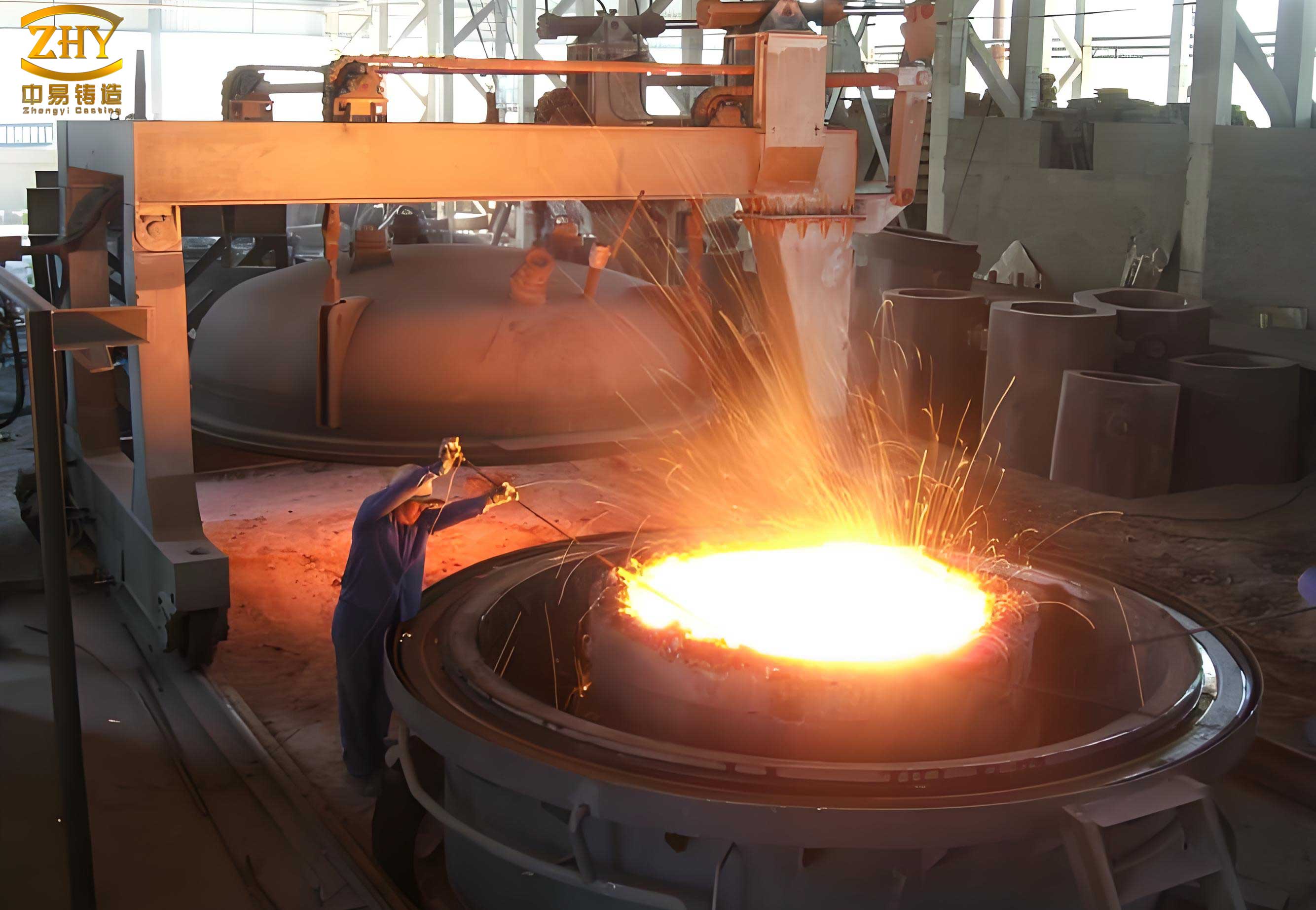
This image illustrates a typical foundry setup for high manganese steel casting, highlighting the scale and complexity involved in producing large components. The VRH process, with its vacuum and gas hardening stages, is essential for achieving the required mold integrity for such demanding applications.
The钢液冶炼和浇注 process utilized a 5-ton electric arc furnace with an oxidizing method to melt the high manganese steel. After tapping, ladle refining was performed via argon stirring and rare-earth wire feeding (6 meters per ton of steel) to improve cleanliness and microstructure. Pouring was conducted with a 5° tilt, raising the gating end to enhance metal rise speed (\( \geq 15 \text{ mm/s} \)). The浇注倾斜角度 was critical to prevent defects in the lengthy cavity. Post-pouring, four additional feeds were administered to compensate for shrinkage, ensuring completeness in this high manganese steel casting.
铸件生产和检查 involved trial production of two prototypes. Both castings were sound, with no visible surface defects or cold shuts at the远端. Radiographic inspection across the entire length revealed no internal flaws, confirming the efficacy of the risering and chilling design. Dimensional checks after straightening met all drawing specifications, attesting to the accuracy of the molding and joining techniques. The success of these trials underscores the viability of VRH-based splicing for super-long high manganese steel casting. Key inspection results are summarized in Table 6.
| Inspection Method | Criteria | Result | Compliance |
|---|---|---|---|
| Visual Examination | Surface defects, cracks | None observed | Yes |
| Radiography (X-ray) | Internal porosity, shrinkage | No significant indications | Yes |
| Dimensional Measurement | Length, width, thickness tolerances | Within ±2 mm | Yes |
| Hardness Test | Brinell hardness ≥ 200 HB | 210-230 HB | Yes |
From a metallurgical perspective, the solidification behavior of high manganese steel casting is governed by the Clyne-Kurz model for microsegregation, which can be expressed as: $$ C_s = k C_0 (1 – f_s)^{k-1} $$ where \( C_s \) is the solid composition, \( k \) is the partition coefficient, \( C_0 \) is the initial composition, and \( f_s \) is the solid fraction. For ZGMn13, the high manganese content promotes austenite stability, but careful control of cooling rates is necessary to avoid carbide precipitation. The use of chills and risers in our design ensured a cooling rate conducive to a homogeneous austenitic matrix, vital for the work-hardening properties of high manganese steel casting.
Furthermore, the economic and environmental aspects of VRH processing for high manganese steel casting are noteworthy. The reduced binder consumption lowers material costs, while the vacuum step minimizes volatile organic compound emissions. Compared to traditional green sand or resin-bonded methods, VRH offers a balance of performance and sustainability, making it increasingly adopted for large-scale castings. Table 7 provides a comparative life-cycle analysis for different molding processes in high manganese steel casting.
| Process | Energy Consumption (MJ/kg casting) | CO2 Emissions (kg/kg casting) | Waste Generation (kg/kg casting) |
|---|---|---|---|
| VRH | 12.5 | 1.2 | 0.8 |
| Green Sand | 15.0 | 1.8 | 1.5 |
| Resin Shell | 18.5 | 2.5 | 1.2 |
In conclusion, the production of super-long high manganese steel castings via the VRH process is feasible through innovative工艺设计 and造型 techniques. The splicing method effectively overcomes equipment limitations, while numerical simulation validates the soundness of the gating and risering systems. The successful trial castings demonstrate that this approach yields high-quality components meeting rigorous railway standards. Future work could explore automation in mold joining and advanced simulation for further optimization. This experience reinforces the versatility of VRH technology in expanding the frontiers of high manganese steel casting, enabling the manufacture of ever-larger and more complex railway components. The integration of these methods promises to enhance the durability and efficiency of railway infrastructures worldwide, solidifying the role of high manganese steel casting in modern engineering.