
In my extensive work with wear-resistant materials, the challenge of premature failure in high manganese steel casting components under severe impact and abrasion has been a persistent focus. Failures often originate from casting defects like hot tears, porosity, and unfavorable as-cast microstructures, which are later exacerbated in service, leading to catastrophic brittle fracture or spalling. My research and practical implementation have conclusively demonstrated that a controlled addition of rare earth (RE) elements serves as a powerful modifying treatment. This process fundamentally enhances the metallurgical quality and mechanical performance of high manganese steel casting, leading to a dramatic extension of its service life in demanding applications.
The conventional challenges in high manganese steel casting are well-known: the tendency to form continuous networks of brittle carbides along austenite grain boundaries in the as-cast state, the presence of deleterious non-metallic inclusions, and relatively poor melt fluidity which promotes casting defects. The RE modification process addresses these issues synergistically. The active RE elements act as potent deoxidizers and desulfurizers, effectively purifying the molten steel. Furthermore, they alter the morphology and distribution of both carbides and inclusions, refine the grain structure, and enhance the work-hardening capability of the austenitic matrix.
Comprehensive Performance Enhancement: Experimental Evidence
The efficacy of RE modification is not merely theoretical but is robustly supported by comparative experimental data. The following sections detail the tangible improvements observed across chemical composition, mechanical properties, casting quality, and final field performance.
1. Chemical Purification and Inclusion Control
The first notable effect is the cleansing of the steel melt. RE elements have a high affinity for oxygen, sulfur, and nitrogen. Their addition leads to the formation of high-melting-point, globular RE-oxysulfides and other complex compounds that either float to the slag or remain finely dispersed. This significantly reduces the gas and harmful inclusion content. The table below contrasts the chemical composition and gas levels of a standard ZGMn13-type high manganese steel casting with its RE-modified counterpart from two independent trial groups.
| Group | Condition | C | Mn | Si | S | P | [O] ppm | [N] ppm |
|---|---|---|---|---|---|---|---|---|
| 1 | Standard | 1.18 | 12.60 | 0.48 | 0.019 | 0.012 | 93 | 140 |
| RE-modified | 1.13 | 12.82 | 0.41 | 0.015 | 0.018 | 44 | 103 | |
| 2 | Standard | 1.13 | 13.00 | 0.45 | 0.017 | 0.012 | 97 | 134 |
| RE-modified | 1.12 | 12.08 | 0.32 | 0.014 | 0.023 | 38 | 126 |
The data clearly shows a consistent reduction in sulfur and oxygen content post-modification. The decrease in oxygen, in particular, is crucial for reducing oxide-based inclusions that act as stress concentrators.
2. Enhancement of As-Cast and Heat-Treated Mechanical Properties
The refinement of microstructure and inclusion morphology directly translates to superior mechanical properties, even in the brittle as-cast condition. This improvement provides a safer margin during handling and prior to heat treatment. The following table summarizes the key mechanical properties in the as-cast state.
| Group | Steel Type | Tensile Strength (MPa) | Elongation (%) | Impact Toughness (J/cm²) | Hardness (HB) |
|---|---|---|---|---|---|
| 1 | Standard ZGMn13 | 402 | 1.9 | 84 | ~220 |
| 1 | RE-modified ZGMn13 | 473 | 2.4 | 146 | ~215 |
| 2 | Standard ZGMn13 | 425 | 1.8 | 79 | ~218 |
| 2 | RE-modified ZGMn13 | 450 | 2.2 | 128 | ~216 |
The most striking improvement is in impact toughness, which increased by approximately 70-85%. This indicates a significant reduction in brittleness. After the standard water-quenching (solution treatment) heat treatment, which dissolves the carbides into the austenite matrix, the benefits of RE modification persist and are further amplified.
| Group | Steel Type | Yield Strength (MPa) | Tensile Strength (MPa) | Elongation (%) | Impact Toughness (J/cm²) |
|---|---|---|---|---|---|
| 1 | Standard ZGMn13 | 348 | 642 | 41.2 | 121 |
| 1 | RE-modified ZGMn13 | 388 | 788 | 48.1 | 148 |
| 2 | Standard ZGMn13 | 368 | 688 | 42.8 | 122 |
| 2 | RE-modified ZGMn13 | 380 | 804 | 46.4 | 158 |
The post-treatment data shows comprehensive gains: higher yield and tensile strength, greater ductility, and consistently superior impact toughness. This combination is ideal for components subjected to heavy impact.
3. Dramatic Improvement in Casting Quality and Field Performance
The practical foundry benefits are immediately apparent. The purer, more fluid melt leads to a drastic reduction in casting defects. This was quantified in a production run of jaw crusher plates, a classic application for high manganese steel casting.
| Steel Type | Sound Casting Rate | Rejection Rate Due to Defects (%) | |||
|---|---|---|---|---|---|
| Total Rejects | Porosity | Cracks | Other | ||
| Standard ZGMn13 | 83% | 17% | 9% | 8% | 0% |
| RE-modified ZGMn13 | 97% | 3% | 2% | 0% | 1% |
The near-elimination of cracking is particularly significant, as hot tears are a major source of failure in complex high manganese steel casting components. Ultimately, the true test is in-service performance. Field trials on jaw crusher plates under identical operating conditions yielded conclusive results.
| Test Site | Steel Type | Average Weight Loss (kg) | Service Life (hours) | Relative Life Ratio |
|---|---|---|---|---|
| A | Standard ZGMn13 | 3.65 | 1564 | 1.00 |
| A | RE-modified ZGMn13 | 2.57 | 2476 | 1.58 |
| B | Standard ZGMn13 | 3.54 | 1292 | 1.00 |
| B | RE-modified ZGMn13 | 2.42 | 2002 | 1.55 |
The RE-modified plates lasted approximately 1.55 to 1.58 times longer than the standard plates, a substantial improvement in durability and cost-effectiveness for the end-user. This performance leap is a direct consequence of the microstructural and property enhancements detailed earlier.
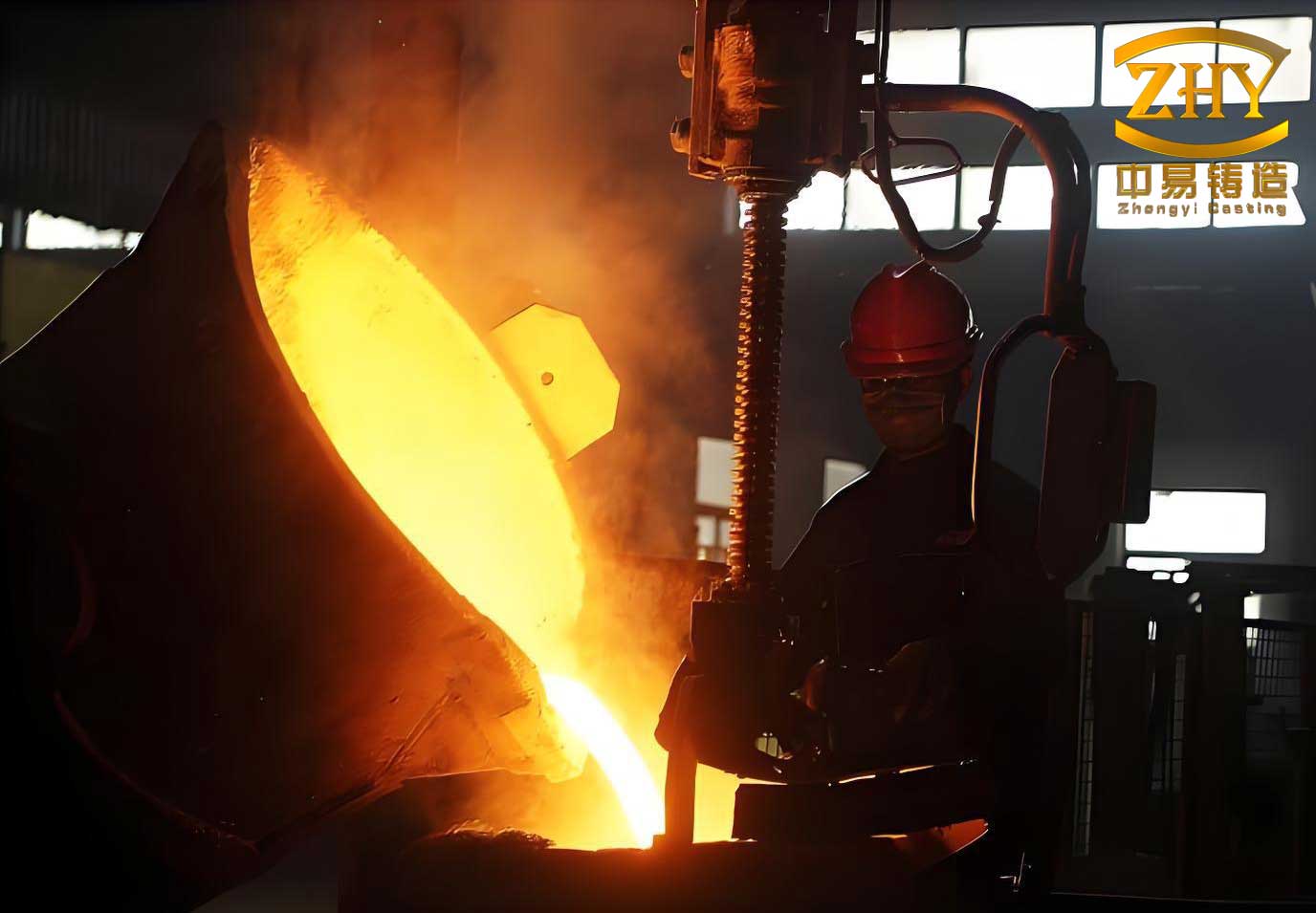
Mechanistic Analysis of Rare Earth Modification
The profound effects of RE on high manganese steel casting can be understood through several interconnected metallurgical mechanisms.
1. Grain Refinement and Carbide Modification
RE elements are potent surface-active agents in liquid steel. They adsorb at the solid-liquid interface during solidification, reducing the interfacial energy ($\gamma_{SL}$). This reduction lowers the critical energy barrier ($\Delta G^*$) for homogeneous nucleation, as described by the classical nucleation theory:
$$
\Delta G^* = \frac{16\pi \gamma_{SL}^3}{3(\Delta G_v)^2}
$$
where $\Delta G_v$ is the volume free energy change. A lower $\gamma_{SL}$ decreases $\Delta G^*$, leading to a higher nucleation rate ($I$), which refines the austenite grain size. Furthermore, RE adsorption on the growing faces of carbide phases (e.g., (Fe,Mn)$_3$C) inhibits their anisotropic growth. This prevents the formation of continuous brittle networks, promoting instead a discontinuous, refined, or even globular carbide morphology in the as-cast structure. This modified structure is far more resistant to crack initiation and propagation.
2. Purification and Inclusion Morphology Control
The strong chemical affinity of RE for O and S leads to the reactions:
$$
2[RE] + 3[O] \rightarrow (RE)_2O_3(s)
$$
$$
[RE] + [S] \rightarrow RES(s)
$$
The products are stable, high-melting-point compounds. They act as heterogeneous nucleation sites for other inclusions, promoting their growth and flotation (separation) from the melt—a process akin to Ostwald ripening but driven by RE addition. The inclusions that remain are finely dispersed and spheroidized, minimizing their stress-concentration effect. This purification directly enhances the ductility and toughness, as evidenced by the dramatic rise in impact energy.
3. Enhancement of Work-Hardening Behavior
The work-hardening capacity of high manganese steel is its defining service property. RE atoms in solid solution can strengthen the austenitic matrix through lattice strain interactions (solid solution strengthening). More importantly, the refined and purified microstructure allows for more uniform and rapid generation of dislocations under impact, leading to a higher work-hardening rate ($\theta = d\sigma/d\epsilon$). A simplified empirical relation can be considered:
$$
\sigma(\epsilon) = \sigma_0 + K \epsilon^n
$$
where $\sigma_0$ is the initial yield strength, $K$ is the strength coefficient, and $n$ is the work-hardening exponent. RE modification increases $\sigma_0$ (via solid solution and grain refinement) and potentially enhances $n$, leading to a faster rise in flow stress with strain. This results in a harder, more wear-resistant surface layer that is also more resistant to subsurface crack formation due to its refined and tougher underlying microstructure.
4. Beneficial Effects on Heat Treatment
The as-cast modified microstructure provides a more favorable starting condition for solution heat treatment. The fragmented carbide network presents a higher surface-area-to-volume ratio and shorter diffusion paths for carbon, facilitating their dissolution into the austenite matrix during high-temperature soaking. This promotes a more homogeneous final austenitic structure, free of undissolved carbide chains that could act as brittle failure paths.
Industrial Application and Process Considerations
Implementing RE modification in high manganese steel casting production requires careful control. The optimal addition range is typically between 0.1% and 0.3% by weight, often added in the form of mischmetal or specific RE silicide alloys during late stages of ladle treatment. Excessive additions can lead to the formation of large, clustered RE-containing inclusions, which are detrimental. The process must be integrated with proper deoxidation and desulfurization practices to maximize efficiency. Foundries adopting this technique report not only improved product performance but also reduced scrap rates and more consistent casting quality, validating it as a highly effective and economically viable technology for premium-grade high manganese steel casting components like crusher liners, railway frogs, and dredger buckets.
In conclusion, the application of rare earth modification transforms the intrinsic properties of high manganese steel casting. It acts through a multi-faceted mechanism encompassing melt purification, microstructure refinement, inclusion morphology control, and enhancement of work-hardening kinetics. The collective result is a material with superior toughness, strength, and castability, which directly and substantially extends the service life of components operating under the most severe impact-abrasion conditions. This treatment represents a significant advancement in the metallurgy of wear-resistant steels.