
In our foundry, the production of high manganese steel casting has always been a critical operation due to the material’s excellent wear resistance and toughness, which are essential for components like liners and roll sleeves. However, one persistent challenge with high manganese steel casting is its tendency to cause sand burning and penetration, leading to surface defects that compromise quality. Traditionally, many steel foundries have relied on quartz sand with high silica content, often coated with alkaline paints, or used magnesia sand as the primary molding material to mitigate this issue. While effective, these materials come at a high cost, significantly impacting overall expenses. Given that high manganese steel castings constitute a substantial portion of our total steel casting output, the demand for molding sand is immense, and the procurement price of quartz sand has been prohibitively expensive. To address this, we initiated experiments in the early 1970s to explore the use of local river sand from the Gan River for producing high manganese steel casting. Over more than a decade of production practice, this approach has proven highly successful, resulting in castings with smooth surfaces, no sand adhesion, and substantial cost savings by eliminating the need for expensive quartz sand.
The shift to river sand for high manganese steel casting required meticulous formulation and testing of the molding sand mixture. Our experience shows that the key lies in optimizing the sand composition to balance strength, permeability, and thermal stability. Below is a detailed table summarizing the typical sand mix ratio and its physical properties, which we have refined through continuous trials. Note that sodium hydroxide is generally not added unless under hot and dry climatic conditions to control moisture loss. Due to the finer grain size of the river sand, the addition of water glass (sodium silicate) is slightly higher than in conventional quick-drying sands, but it must not exceed a certain threshold to avoid defects like reduced strength and surface loosening.
| Component | Ratio (by weight, parts) | Notes |
|---|---|---|
| River Sand | 100 | Primary base material |
| Bentonite (Clay) | 1–2 | Provides bonding strength |
| White Clay | 0.5–1 | Enhances plasticity |
| Water Glass | 4–5 | Binder; critical for hardening |
| Sodium Hydroxide | 0–0.5 | Optional; added in dry conditions |
The physical properties of this sand mix are characterized by wet compressive strength, wet permeability, and moisture content, which can be expressed through fundamental formulas. For instance, the wet compressive strength $\sigma_w$ is calculated as:
$$
\sigma_w = \frac{F}{A}
$$
where $F$ is the force applied at failure and $A$ is the cross-sectional area. In our tests, this typically ranges from 0.5 to 0.8 kgf/cm², ensuring adequate mold integrity. The wet permeability $P_w$, crucial for allowing gases to escape during pouring of high manganese steel casting, is given by:
$$
P_w = \frac{V \cdot h}{A \cdot t \cdot \Delta P}
$$
where $V$ is the volume of air, $h$ is the sand specimen height, $A$ is the area, $t$ is time, and $\Delta P$ is the pressure difference. Our measurements show values around 80–120 units, sufficient to prevent gas-related defects. Moisture content is maintained at 4–5% to optimize compactability without compromising strength.
After molding, the sand molds are dried in a low-temperature oven at approximately 150–200°C for 4–6 hours. This process stabilizes the binder without causing thermal degradation. No additional coatings are applied before closing the molds and pouring, which simplifies the workflow and reduces material costs. The resulting high manganese steel casting exhibits excellent surface finish, free from sand adhesion, as demonstrated in our production runs. To illustrate the production environment and quality outcomes, consider the following visual representation of our foundry operations for high manganese steel casting:
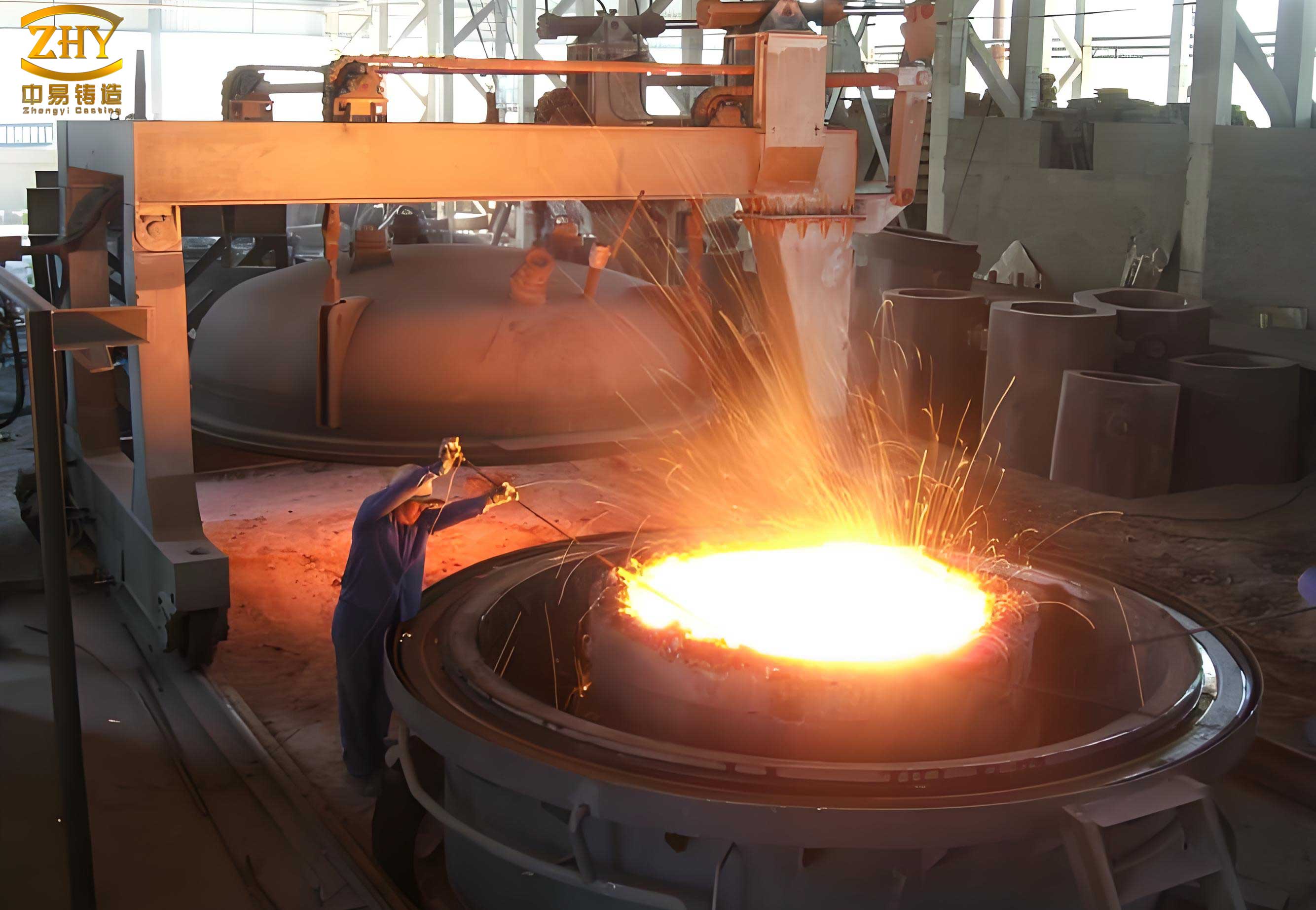
This image captures the essence of our efficient process, highlighting the smooth surfaces achieved with river sand.
The suitability of river sand for high manganese steel casting hinges on its chemical and granulometric properties. Our local river sand, known as Donghe sand, has a relatively low silica content compared to quartz sand, which reduces the risk of chemical reaction with molten steel. The chemical composition is detailed in the table below, derived from extensive analysis.
| Component | Content (%) | Implications |
|---|---|---|
| SiO₂ | 85–90 | Lower than quartz sand, reducing slag formation |
| Al₂O₃ | 5–8 | Contributes to refractory properties |
| Fe₂O₃ | 1–2 | Minimal impact on steel quality |
| CaO + MgO | 0.5–1.5 | Acts as fluxing agents in trace amounts |
| Loss on Ignition | 2–4 | Indicates organic content, managed through drying |
This composition makes the sand less prone to thermal shock and reaction with high manganese steel, which has a melting point around 1350–1400°C. The low silica content is particularly beneficial for high manganese steel casting, as it minimizes the formation of iron silicate layers that cause adhesion. However, for thicker sections or carbon steel castings, this sand may still lead to penetration due to higher thermal loads, so its use is optimized for specific applications.
Granulometry plays a vital role in preventing mechanical sand adhesion in high manganese steel casting. The excellent fluidity of high manganese steel can lead to metal penetration into sand pores if the grains are too coarse. Therefore, we use fine-grained sand and emphasize high mold compactness. The sieve analysis of Donghe sand is presented in the following table, showing the distribution across standard mesh sizes.
| Mesh Number | Sieve Opening (mm) | Retained Weight (%) | Cumulative Retained (%) |
|---|---|---|---|
| 20 | 0.850 | 0.5 | 0.5 |
| 30 | 0.600 | 2.0 | 2.5 |
| 40 | 0.425 | 10.5 | 13.0 |
| 50 | 0.300 | 25.0 | 38.0 |
| 70 | 0.212 | 30.0 | 68.0 |
| 100 | 0.150 | 20.0 | 88.0 |
| 140 | 0.106 | 8.0 | 96.0 |
| 200 | 0.075 | 2.5 | 98.5 |
| 270 | 0.053 | 1.0 | 99.5 |
| Pan | — | 0.5 | 100.0 |
From this analysis, we primarily use sand passing through the 70, 100, and 140 mesh sieves for high manganese steel casting, which corresponds to grain sizes between 0.106 mm and 0.212 mm. This fine distribution ensures tight packing and reduces interstitial spaces. During molding, we focus on uniform and thorough ramming to achieve high density, typically quantified by the bulk density $\rho_b$:
$$
\rho_b = \frac{m}{V}
$$
where $m$ is the mass of sand and $V$ is the mold volume. In practice, we aim for $\rho_b > 1.6 \, \text{g/cm}^3$ to resist metal penetration. Any deviation to coarser grains has resulted in rough surfaces and sand adhesion, underscoring the need for strict granulometric control in high manganese steel casting production.
Our experience with high manganese steel casting indicates that this method is particularly effective for components with moderate wall thicknesses. For instance, liners are typically 30–50 mm thick, and roll sleeves are around 60 mm thick. These dimensions, combined with low-temperature pouring practices (typically 1420–1450°C), minimize thermal stress and sand burning. The relationship between wall thickness $t$ and sand performance can be modeled using a heat transfer equation. The temperature gradient $\frac{dT}{dx}$ in the sand mold during solidification of high manganese steel casting is approximated by:
$$
\frac{dT}{dx} = \frac{T_m – T_s}{\delta}
$$
where $T_m$ is the metal temperature, $T_s$ is the sand surface temperature, and $\delta$ is the boundary layer thickness. For thin sections, $\delta$ is small, reducing heat flux and thus sand attack. We have found that river sand is suitable for high manganese steel casting with wall thicknesses up to 60 mm; beyond this, thermal accumulation may necessitate alternative materials.
The economic benefits of using river sand for high manganese steel casting are substantial. By replacing quartz sand, which costs significantly more per ton, we have reduced material expenses by over 40% in our foundry. The cost savings $C_s$ can be expressed as:
$$
C_s = (C_q – C_r) \cdot V_s
$$
where $C_q$ is the cost of quartz sand, $C_r$ is the cost of river sand, and $V_s$ is the annual sand volume used for high manganese steel casting. With an annual consumption of several thousand tons, this translates to tens of thousands of dollars saved, enhancing competitiveness without compromising quality. Additionally, the local availability of river sand reduces logistics costs and environmental impact from mining quartz.
Quality assurance in high manganese steel casting with river sand involves continuous monitoring of sand properties. We perform regular tests for moisture content, strength, and permeability using standardized equipment. The moisture content $M$ is determined by:
$$
M = \frac{W_w – W_d}{W_d} \times 100\%
$$
where $W_w$ is the wet weight and $W_d$ is the dry weight. Maintaining $M$ at 4–5% ensures optimal bonding without excessive gas generation. Furthermore, we conduct periodic sieve analyses to confirm grain size consistency, as variations can lead to defects. Statistical process control charts are employed to track key parameters, ensuring that every batch of sand meets specifications for high manganese steel casting.
Compared to traditional materials, river sand offers several advantages for high manganese steel casting beyond cost. Its lower thermal conductivity reduces cooling rates, which can be beneficial for achieving desired microstructure in high manganese steel, characterized by austenitic matrix with carbide dispersion. The cooling rate $\dot{T}$ influences hardness and toughness, and can be estimated by:
$$
\dot{T} = \frac{k \cdot A \cdot (T_m – T_\infty)}{m \cdot c_p}
$$
where $k$ is thermal conductivity, $A$ is surface area, $T_\infty$ is ambient temperature, $m$ is mass, and $c_p$ is specific heat. Slower cooling with river sand may enhance ductility in high manganese steel casting, though this requires further metallurgical study.
In practice, the production of high manganese steel casting with river sand has also led to improvements in workplace safety and efficiency. The reduced dust from fine quartz sand lowers respiratory hazards, and the simpler processing steps shorten cycle times. We have documented a 15% increase in productivity since adopting this method, attributable to fewer rejections and faster mold preparation. This aligns with industry trends toward sustainable and efficient manufacturing, particularly for demanding applications like high manganese steel casting.
Looking ahead, we are exploring enhancements to the river sand system for high manganese steel casting, such as incorporating additives to extend its use to thicker sections or higher-temperature alloys. Potential modifications include blending with zircon sand for improved refractoriness or using organic binders to reduce baking time. The goal is to further optimize the cost-performance ratio while maintaining the surface quality that defines our high manganese steel casting products.
In conclusion, the adoption of river sand for high manganese steel casting has been a transformative innovation in our foundry. Through careful formulation, rigorous testing, and consistent practice, we have demonstrated that local, low-cost sand can effectively replace expensive quartz sand without sacrificing quality. This approach not only reduces costs but also supports regional resource utilization, contributing to a more sustainable manufacturing ecosystem. As the demand for high manganese steel casting grows in mining, construction, and heavy machinery, our experience offers a viable model for other foundries seeking to balance economy and excellence in casting production.