
In the realm of cryogenic industrial applications, such as liquid hydrogen storage, liquefied natural gas (LNG) facilities, ethylene plants, and air separation units, the selection of materials for valves and piping systems is paramount. These environments subject components to extreme temperature fluctuations, often ranging from ambient to as low as -196°C, accompanied by pressure cycles that challenge material integrity. As a researcher and engineer engaged in the localization of cryogenic equipment, I have witnessed firsthand the limitations of conventional materials like 18Cr-8Ni austenitic stainless steels and 9% nickel steels. Their issues with low-temperature embrittlement, thermal contraction, and high cost have driven the pursuit of alternatives. This article details our extensive research and development efforts into a novel high manganese steel casting, specifically designed for cryogenic valve applications. Through systematic design of chemical composition, casting processes, heat treatment, and welding protocols, we have established a high manganese steel casting with superior mechanical properties, exceptional low-temperature toughness, and notable economic advantages. The term “high manganese steel casting” will be repeatedly emphasized, as it represents the core of our innovation—a material that leverages manganese’s austenite-stabilizing properties to replace expensive nickel, thereby reducing costs and environmental impact while maintaining performance in ultra-low temperature service.
The fundamental challenge in cryogenic valve design lies in material behavior under thermal and mechanical stress. Most metallic materials exhibit thermal expansion and contraction, but more critically, their impact toughness can plummet as temperatures decrease, leading to brittle fracture risks. Additionally, unstable austenitic phases in some steels can transform to martensite at low temperatures, causing dimensional changes and further embrittlement. For valves, which require precise sealing and moving part clearances, such material instabilities are unacceptable. Therefore, the ideal cryogenic material must possess: high strength and yield strength to resist deformation under load, excellent low-temperature impact toughness (typically measured at -196°C for ultra-low temperatures), good weldability for fabrication and repair, minimal dimensional change due to phase transformations, and economic viability. Our focus on high manganese steel casting arises from its potential to meet all these criteria, offering a cost-effective solution compared to nickel-heavy alloys.
To understand the context, let’s examine the two most common material families for cryogenic valves: austenitic stainless steels (e.g., ASTM A351 CF8, CF8M) and high-nickel steels (e.g., ASTM A352 LC9). These materials are often specified in standards like JB/T 7248 and ASTM A352, but they have inherent drawbacks. Austenitic stainless steels, while having good toughness and weldability, suffer from relatively low yield strength (around 205-265 MPa), making them prone to creep and relaxation under sustained loads, which can compromise valve sealing. Moreover, their austenite phase is metastable; below a certain temperature, known as the martensite start temperature (Ms), they undergo a phase transformation to martensite. This transformation not only reduces toughness but also induces volumetric changes, exacerbating “thermal contraction” effects and potentially causing leakage or seizing in valve mechanisms. The Ms temperature can be estimated using an empirical formula based on chemical composition. For common grades like CF8 and CF8M, using typical compositional limits, the Ms is calculated as follows:
$$ M_s = \left\{75 \times (14.6 – Cr) + 110 \times (8.9 – Ni) + 60 \times (1.33 – Mn) + 50 \times (0.47 – Si) + 3000 \times [0.068 – (C + N)] – 32\right\} \times \frac{5}{9} $$
Where Cr, Ni, Mn, Si, C, and N are weight percentages. For CF8, with compositions near lower limits (e.g., Cr=18%, Ni=8%, Mn=1%, Si=0.5%, C=0.04%, N=0.04%), the Ms is approximately -157°C, indicating that martensite formation can occur in LNG service (-163°C). This is a critical limitation for valves experiencing temperature cycles. In contrast, 9% nickel steel offers high strength (yield strength ≥515 MPa) and good toughness at -196°C, but its production is challenging due to strict compositional controls, high nickel content (making it expensive), and difficult welding requirements. Nickel is a scarce resource in many regions, and its extraction involves energy-intensive processes with significant carbon emissions, conflicting with global “carbon footprint” reduction goals. Thus, there is a strong impetus to develop alternative materials that are both technically proficient and economically and environmentally sustainable. This is where our work on high manganese steel casting becomes pivotal.
High manganese austenitic steels have been explored since the late 20th century for cryogenic applications, but earlier attempts were hampered by冶金技术 limitations. Recent advances, such as ASTM A1106 for plates and GB/T 713.5-2023 for pressure vessel sheets, have standardized their use in storage tanks. However, applications in valve castings remained unexplored. Our project aimed to fill this gap by developing a dedicated high manganese steel casting grade, designated here as ZG45Mn24Cr4CuDR (a cast steel with ~45 MPa tensile strength contribution from base, 24% Mn, 4% Cr, Cu, and designed for low temperature). The development process involved multiple iterations across chemistry, casting, heat treatment, and welding, each optimized through experimental trials.
The chemical design of high manganese steel casting centers on achieving a fully austenitic microstructure that remains stable down to -196°C, while providing adequate strength and toughness. Manganese is a potent austenite stabilizer, similar to nickel but cheaper and more abundant. Our base composition targets included high Mn (23-25%), moderate Cr (3-5%) for corrosion resistance, Cu (0.5-1.5%) to enhance strength and toughness, and careful balancing of C, Si, Al, and V. Carbon content is kept low (≤0.10%) to prevent carbide precipitation and embrittlement, while aluminum and vanadium are added in controlled amounts to refine grains and improve strength through precipitation hardening. The interplay of these elements can be summarized in a formula for estimating austenite stability, but our focus was on empirical optimization. For instance, we found that increasing Al to 0.1% and V to 0.15% could increase yield strength by approximately 30 MPa and improve -196°C impact energy by 20 J, due to grain refinement. However, excessive Al can coarsen grains, and high V may impair weldability, so balances were struck. A representative target composition for our high manganese steel casting is shown in Table 1.
| Element | C | Mn | Cr | Cu | Si | Al | V | P | S | Fe |
|---|---|---|---|---|---|---|---|---|---|---|
| Range | 0.05-0.10 | 23.0-25.0 | 3.5-4.5 | 0.8-1.2 | 0.3-0.6 | 0.08-0.12 | 0.10-0.15 | ≤0.020 | ≤0.015 | Bal. |
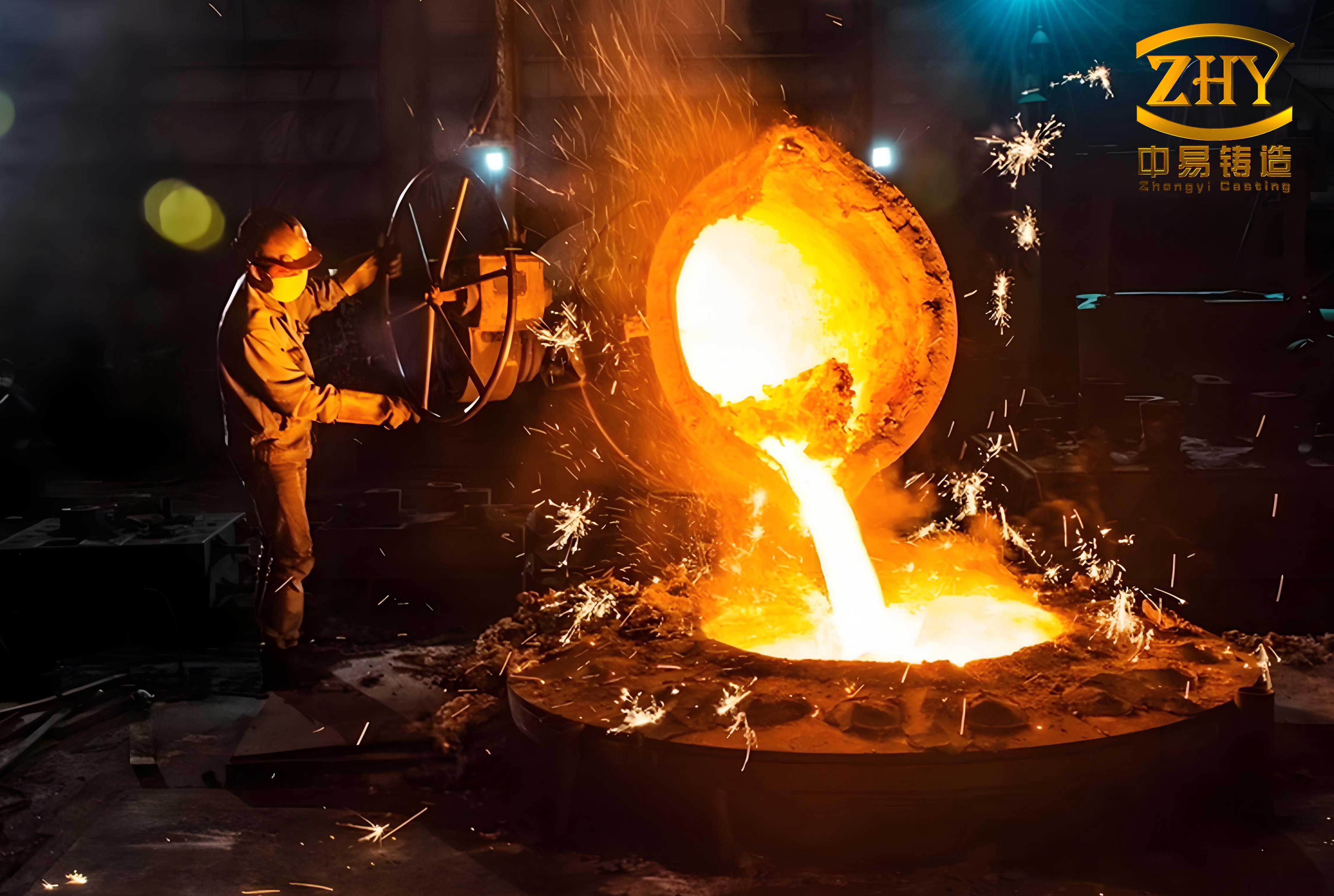
Casting high manganese steel presents unique challenges: high manganese content reduces fluidity, and the melt tends to oxidize and produce slag. To address this, we employed high-temperature pouring to improve fluidity, used deoxidizers and protective slag covers during tapping to minimize oxidation, and selected molding sands with high permeability and refractoriness to reduce surface burning and inclusion entrapment. These measures were critical to achieving sound castings with minimal defects. The as-cast microstructure of high manganese steel casting is typically coarse austenite with carbides, requiring heat treatment to refine grains and optimize properties.
Heat treatment is essential for enhancing the strength and toughness of high manganese steel casting. As-cast material has low yield strength, but grain refinement through recrystallization can significantly improve it. However, high manganese steels exhibit an “aging embrittlement” range between 500°C and 900°C, where low-temperature impact energy drops markedly. We conducted a series of solution treatments at temperatures from 980°C to 1100°C, followed by water quenching. Mechanical testing and impact tests at -196°C revealed that temperatures above 900°C restored toughness, with optimal results at 1050°C. This treatment produced a fine, fully austenitic structure with dispersed carbides, offering the best combination of strength and toughness. The relationship between solution temperature and properties can be expressed qualitatively: for a given high manganese steel casting composition, the impact energy E at -196°C as a function of solution temperature T (in °C) follows a curve with a minimum near 700°C and a plateau above 1000°C. We chose 1050°C for balance. The microstructure after 1050°C solution treatment shows complete austenite with minor carbide particles along grain boundaries, as confirmed by metallography.
Welding performance is crucial for valve fabrication and repair. We conducted welding procedure qualifications per ASME Section IX, including both similar-material joints (high manganese steel casting to high manganese steel casting) and dissimilar joints with ASTM A351 CF8M (F316L). Using appropriate filler metals and parameters, we achieved sound welds. Tests included tensile, side bend, Charpy V-notch impact at -196°C, hardness, and metallographic examination. All results met requirements: similar welds had tensile strengths matching the base metal, bend tests showed minimal cracks (max 0.6 mm), and impact energies in weld and heat-affected zones (HAZ) remained high. Dissimilar welds also performed well, with no cracking in bend tests. The weld microstructures were austenitic with minor carbides, indicating good compatibility. This demonstrates that high manganese steel casting can be reliably welded, facilitating its integration into existing cryogenic systems.
The mechanical properties of our developed high manganese steel casting are impressive. Table 2 compares typical measured values for ZG45Mn24Cr4CuDR with those of common cryogenic valve casting materials. The data clearly show that high manganese steel casting offers a unique combination: yield strength (340 MPa) significantly higher than austenitic stainless steels, though lower than 9% Ni steel; tensile strength (700 MPa) comparable to or better than both; elongation (70%) far exceeding others, indicating excellent ductility; and most notably, impact energy at -196°C (160 J average) vastly superior to all, with a lateral expansion of 1.9 mm, reflecting exceptional toughness. This high toughness is a key advantage for valve components subjected to thermal shocks and pressure transients.
| Material | Tensile Strength (MPa) | Yield Strength (MPa) | Elongation (%) | Impact Energy @ -196°C (J) | Lateral Expansion @ -196°C (mm) |
|---|---|---|---|---|---|
| Developed High Manganese Steel Casting (ZG45Mn24Cr4CuDR) | 700 | 340 | 70.0 | 160 | 1.9 |
| Austenitic Stainless Steel (ASTM A351 CF8) | 535 | 260 | 43.5 | 60 | 0.9 |
| Austenitic Stainless Steel (ASTM A351 CF8M) | 549 | 265 | 45.5 | 80 | 1.5 |
| 9% Nickel Steel (ASTM A352 LC9) | 625 | 540 | 39.0 | 63 | 0.8 |
Beyond mechanical performance, the economic and environmental benefits of high manganese steel casting are substantial. Nickel is a major cost driver in cryogenic alloys; by substituting manganese, material costs are reduced. According to industry analyses, high manganese steel casting material costs are about 46% of 9% Ni steel and 53% of aluminum alloys for cryogenic tanks. Welding costs are lower due to easier processing—estimated at 6.8% of 9% Ni steel welding costs. Overall, the total cost for components using high manganese steel casting can be as low as 27% of 9% Ni steel and 44% of stainless steel SUS304. Environmentally, manganese extraction and processing generally have a lower carbon footprint than nickel, aligning with global “carbon neutrality” goals like China’s “3060” dual-carbon strategy. The reduced reliance on nickel also enhances supply chain security. Thus, high manganese steel casting presents a sustainable alternative.
The absence of low-temperature martensite transformation in high manganese steel casting is another critical advantage. Since the austenite phase is stable down to -196°C (Ms is well below this, estimated below -200°C for our composition), dimensional changes due to phase transformation are eliminated. This minimizes the risk of leakage or binding in valve mechanisms during temperature cycles, addressing a key flaw of austenitic stainless steels. The thermal contraction is purely due to the coefficient of thermal expansion, which for high manganese steel casting is similar to other austenitic steels, but without the additional volumetric change from martensite. This stability can be quantified by the linear thermal expansion coefficient α, which for high manganese steels is around $$ \alpha \approx 1.8 \times 10^{-5} \, \text{K}^{-1} $$ between room temperature and -196°C, comparable to stainless steels. However, the lack of phase transformation stress is a distinct benefit.
Corrosion resistance in cryogenic service typically involves dry environments, where oxidation is minimal. Our high manganese steel casting, with ~4% Cr, offers adequate resistance for such conditions, similar to 9% Ni steel. For more aggressive media, adjustments in Cr or additional elements could be explored, but for LNG, liquid hydrogen, and ethylene, it is sufficient. We conducted preliminary corrosion tests in simulated cryogenic environments, showing no significant degradation, but long-term studies are ongoing.
To further illustrate the optimization process, we can model the relationship between composition and low-temperature toughness. For high manganese steel casting, the impact energy E (in Joules) at -196°C can be empirically related to key elements via a regression equation derived from our data. While simplified, it highlights trends:
$$ E_{-196} \approx k_0 + k_1 \cdot \text{Mn} + k_2 \cdot \text{Cr} + k_3 \cdot \text{Cu} – k_4 \cdot \text{C} – k_5 \cdot (\text{P} + \text{S}) $$
Where Mn, Cr, Cu, C, P, S are weight percentages, and ki are positive constants. This underscores the positive roles of Mn, Cr, Cu and the detrimental effects of carbon and impurities. Our composition maximizes E by balancing these factors.
In terms of manufacturing scalability, high manganese steel casting can be produced using conventional foundry equipment with process adjustments. The key is controlling oxidation and slag inclusion during melting and pouring. We developed a specific practice: using electric arc furnaces for melting, argon shielding during tapping, and ceramic filters in gating systems to clean the metal. Casting yield and soundness were comparable to standard steel castings after optimization. Table 3 summarizes the recommended casting and heat treatment parameters for producing high-quality high manganese steel casting components.
| Process Stage | Parameter | Value or Description |
|---|---|---|
| Melting & Casting | Melting Method | Electric Arc Furnace with Argon Stirring |
| Pouring Temperature | 1580-1620°C | |
| Mold Material | High-Permeability Silica Sand with Chromite Facing | |
| Heat Treatment | Solution Temperature | 1050°C ± 10°C, hold for 2 hours per 25 mm thickness |
| Quenching Medium | Water | |
| Welding | Filler Metal for Similar Welds | High Mn-Cr-Ni Based Electrode (e.g., Custom Grade) |
| Preheat/Interpass Temperature | 100-150°C |
The development of high manganese steel casting is not without challenges. One issue is work hardening tendency, but in valve castings subject to static loads, this is less relevant. Another is long-term stability under cyclic loading; we are conducting fatigue and creep tests at cryogenic temperatures, but initial results are promising. Additionally, standardization efforts are needed to incorporate high manganese steel casting into valve codes like API 6D or ASME B16.34, though progress is being made with plate standards like ASTM A1106. Our work contributes to this by providing data for cast forms.
In conclusion, the research and development of high manganese steel casting for cryogenic valves represent a significant advancement in material technology. By leveraging manganese’s austenite-stabilizing ability, we have created a material that combines high strength, exceptional low-temperature toughness, good weldability, and phase stability down to -196°C. Compared to traditional materials like 18Cr-8Ni stainless steels and 9% nickel steels, high manganese steel casting offers superior impact resistance, reduced risk of dimensional change from martensite transformation, and substantial cost savings. Its economic and environmental benefits align with global trends toward sustainability and carbon reduction. As cryogenic industries expand, particularly in LNG and hydrogen economies, high manganese steel casting provides a viable, high-performance alternative that can accelerate the localization and cost-effectiveness of cryogenic equipment. Future work will focus on further optimization, codification, and field validation, but the foundation is solid: high manganese steel casting is poised to become a material of choice for next-generation cryogenic valves.
To reiterate, the core innovation lies in the tailored high manganese steel casting process—from chemistry design to heat treatment—that enables these properties. Throughout this article, the term high manganese steel casting has been emphasized to underscore its centrality. As we move forward, continued collaboration between foundries, valve manufacturers, and end-users will be essential to fully realize the potential of high manganese steel casting in cryogenic applications, ensuring safer, more reliable, and more affordable infrastructure for the world’s energy and industrial needs.