
In the demanding world of mining and excavation, components are subjected to extreme forces. Among these, excavator bucket teeth represent a critical wear part, failing primarily through a mechanism known as gouging abrasion. This process involves the forceful impact and cutting of the material surface by hard ore, leading to material removal and eventual component failure. For decades, the material of choice for such applications has been austenitic high manganese steel casting, renowned for its exceptional toughness and unique capacity for work-hardening. Under severe impact, the surface layer of this steel undergoes intensive plastic deformation, transforming to a much harder state while retaining a ductile core, a phenomenon known as transformation-induced plasticity. However, with increasing demands for efficiency and cost reduction in mining operations, there is a constant drive to extend the service life of these components. Our research focused on a strategic enhancement: the microalloying of traditional high manganese steel with vanadium (V) and Rare Earth Elements (RE). This report details our investigation, from the underlying metallurgical principles to full-scale industrial trials, demonstrating how this microalloying approach refines microstructure, boosts mechanical properties, and ultimately delivers superior wear resistance and significant economic benefits for high manganese steel casting used in bucket teeth.
The foundational rationale for selecting vanadium and rare earth elements lies in their distinct and complementary effects on the solidification structure and final properties of the high manganese steel casting. In standard high manganese steel, the as-cast structure can be coarse, often featuring columnar grains and non-uniform carbide networks at grain boundaries. This coarse structure can be a precursor to crack initiation and propagation under stress. Vanadium is an extremely strong carbide-forming element. During solidification and subsequent heat treatment, it forms stable, finely dispersed vanadium carbides (primarily VC). These carbides act as potent nucleation sites for austenite grains, effectively pinning grain boundaries and restricting grain growth. The Hall-Petch relationship succinctly describes the benefit of grain refinement on yield strength:
$$ \sigma_y = \sigma_0 + k_y d^{-1/2} $$
where $\sigma_y$ is the yield strength, $\sigma_0$ is the friction stress, $k_y$ is the strengthening coefficient, and $d$ is the average grain diameter. A finer grain size ($d$) directly leads to a higher yield strength ($\sigma_y$). Furthermore, these fine VC precipitates contribute to dispersion strengthening, impeding the movement of dislocations and thereby increasing hardness and strength. Rare Earth Elements, on the other hand, play a crucial role in metallurgical purification and microstructure modification. They have a strong affinity for oxygen and sulfur, forming stable, high-melting-point inclusions. This “cleans” the melt, reducing the number of harmful sulfide stringers. More importantly, RE elements segregate to the solidification front, suppressing the formation of columnar crystals and promoting a finer, more equiaxed grain structure. They also modify the morphology of remaining inclusions, making them more globular and less detrimental to mechanical properties and fatigue life. The combined action of V and RE thus targets the core weaknesses of the standard high manganese steel casting, aiming to produce a more homogeneous, refined, and clean microstructure as the foundation for improved performance.
To systematically evaluate the effects of microalloying, we designed a controlled experiment comparing a standard high manganese steel (Grade A) against a microalloyed variant (Grade B). Both grades were intended for the production of bucket teeth for a 4m³ excavator. The chemical composition was carefully controlled, with the key difference being the intentional addition of vanadium and mischmetal (a common RE alloy) to Grade B. The target and actual chemical compositions for the trial casts are summarized in Table 1.
| Element | Grade A (Standard) Target (%) | Grade A Actual (%) | Grade B (V+RE) Target (%) | Grade B Actual (%) |
|---|---|---|---|---|
| C | 1.10 – 1.30 | 1.22 | 1.10 – 1.30 | 1.18 |
| Mn | 11.0 – 13.0 | 12.5 | 11.0 – 13.0 | 12.3 |
| Si | 0.40 – 0.80 | 0.65 | 0.40 – 0.80 | 0.60 |
| P | < 0.070 | 0.045 | < 0.070 | 0.042 |
| S | < 0.030 | 0.018 | < 0.030 | 0.015 |
| V | – | – | 0.10 – 0.20 | 0.15 |
| RE | – | – | 0.02 – 0.04 | 0.03 |
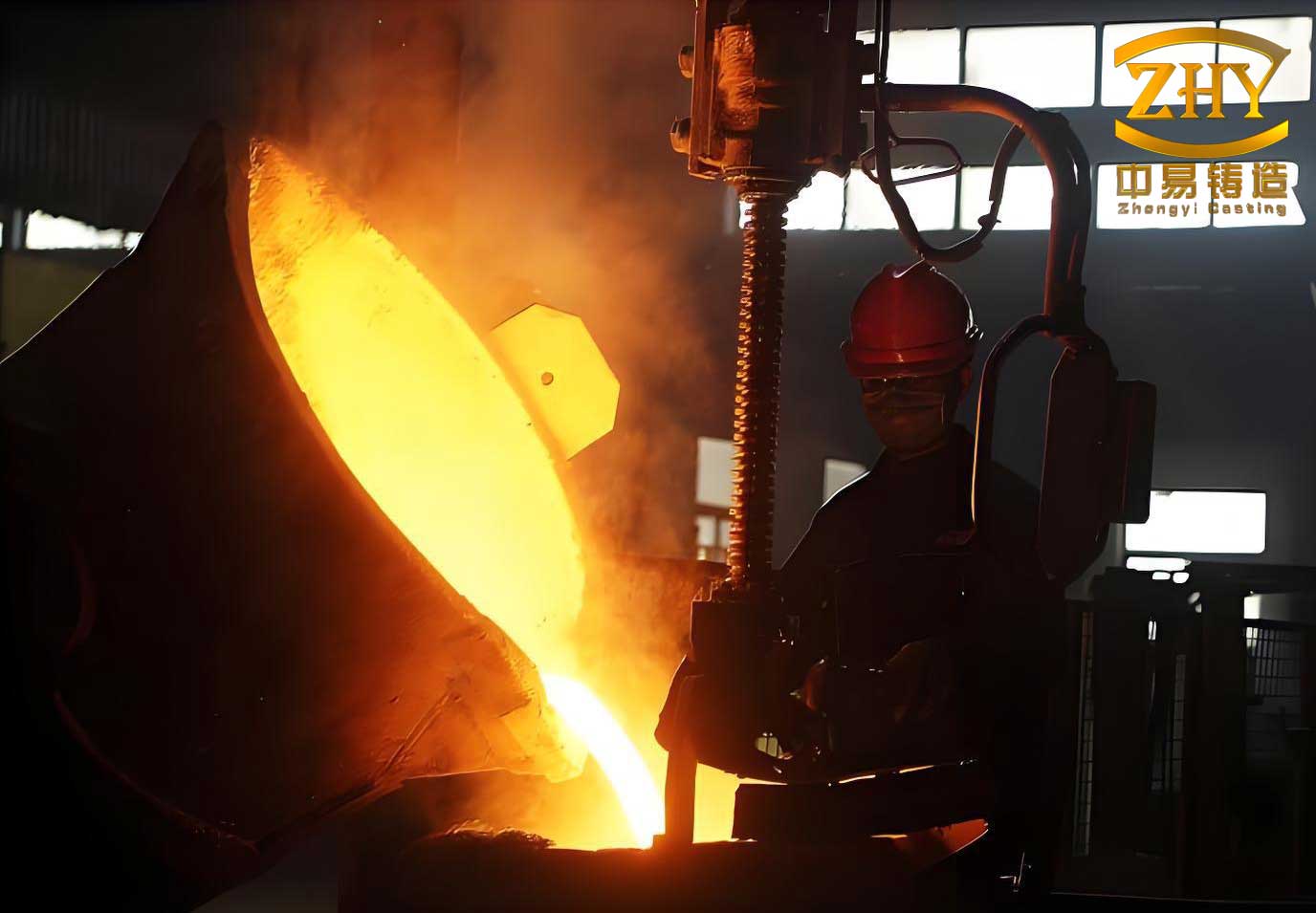
Casting was performed under standard foundry conditions for high manganese steel casting. The heat treatment for both grades involved a solution annealing (water quenching) process at approximately 1050°C to dissolve carbides into the austenitic matrix and achieve the required ductility. Post-heat treatment, samples were taken from the castings for comprehensive mechanical testing and metallographic analysis. The results, presented in Table 2, clearly illustrate the impact of microalloying.
| Property / Structure | Grade A (Standard) | Grade B (V+RE) | Improvement |
|---|---|---|---|
| Tensile Strength, $\sigma_b$ (MPa) | 780 | 860 | +10.3% |
| Yield Strength, $\sigma_{0.2}$ (MPa) | 410 | 480 | +17.1% |
| Elongation, $\delta$ (%) | 35 | 38 | +8.6% |
| Impact Toughness, $a_K$ (J/cm²) | 180 | 210 | +16.7% |
| Average Austenite Grain Size (ASTM) | 2 | 4 | Refined by 2 grades |
| Carbide Morphology & Distribution | Discontinuous network at boundaries | Finely dispersed, isolated particles | Significantly improved |
The data confirms the theoretical predictions. The microalloyed high manganese steel casting (Grade B) exhibits a simultaneous improvement in strength and toughness—a combination often difficult to achieve. The increase in yield strength is particularly notable and can be attributed primarily to grain refinement (Hall-Petch) and dispersion strengthening from VC precipitates. The Orowan mechanism describes the strengthening contribution of non-shearable particles:
$$ \tau = \frac{Gb}{L} $$
where $\tau$ is the increased shear stress, $G$ is the shear modulus, $b$ is the Burgers vector, and $L$ is the inter-particle spacing. The finer and more numerous the VC precipitates, the smaller the value of $L$, leading to a higher $\tau$. Metallographic examination revealed a dramatically refined austenitic grain structure in Grade B, with carbides appearing as fine, discrete particles rather than the continuous brittle network observed in Grade A. This refined and cleaner microstructure is the direct result of the vanadium and rare earth additions and forms the basis for the enhanced wear performance.
The ultimate validation of any material modification for wear parts comes from field performance. We conducted a comparative field trial under severe operating conditions. The test site involved excavating hard, poorly fragmented copper ore. A 4m³ capacity excavator was fitted with one set of standard teeth (Grade A) and one set of microalloyed teeth (Grade B) on opposite sides of the bucket, ensuring identical working conditions for both materials. The test ran until the teeth were considered worn out. Wear was quantified by measuring both weight loss and the recession of the tooth tip length. The field trial data is consolidated in Table 3.
| Parameter | Grade A (Standard) | Grade B (V+RE) | Performance Ratio (B/A) |
|---|---|---|---|
| Total Ore Excavated (tonnes) | 122,500 | 163,800 | 1.337 |
| Initial Tip Length (mm) | 250 | 250 | 1.00 |
| Final Tip Length (mm) | 98 | 125 | – |
| Length Worn (mm) | 152 | 125 | 0.822 |
| Initial Weight per Set (kg) | 175 | 175 | 1.00 |
| Weight Loss per Set (kg) | 48.5 | 41.2 | 0.849 |
| Ore Mined per mm Wear (tonnes/mm) | 806 | 1,310 | 1.625 |
| Ore Mined per kg Wear (tonnes/kg) | 2,526 | 3,976 | 1.574 |
The results are unequivocal. The microalloyed high manganese steel casting (Grade B) excavated 33.7% more ore before requiring replacement. More importantly, the wear rate metrics show a dramatic improvement. Grade B mined 62.5% more ore per millimeter of length worn and 57.4% more ore per kilogram of metal lost. This directly translates to a significant extension in service life for the bucket teeth. To understand this improvement, we analyzed the worn teeth. The work-hardening capability is paramount for high manganese steel in gouging abrasion. Cross-sectional hardness profiles from the worn surface inward were measured. The surface hardness of the worn Grade B teeth reached approximately 550 HB, compared to about 480 HB for Grade A. The hardened layer was also more consistent. The superior work-hardening response can be linked to the refined microstructure. A finer grain structure provides more grain boundaries, which act as barriers to dislocation motion, leading to a higher rate of dislocation pile-up and faster work-hardening, often described empirically by:
$$ H = H_0 + k\varepsilon^n $$
where $H$ is the hardness, $H_0$ is the initial hardness, $\varepsilon$ is the strain, and $k$ and $n$ are material constants. The refined grain structure and precipitate dispersion in the microalloyed high manganese steel casting effectively increase the value of $k$, leading to a greater hardness increase for a given strain ($\varepsilon$) from impact.
The technical superiority must be evaluated against economic reality. The addition of ferrovanadium and rare earth mischmetal increases the raw material cost of the high manganese steel casting. However, the dramatically extended service life results in substantial net savings. A detailed cost-benefit analysis is presented below. Assuming a market price for bucket teeth of $1,800 per tonne, the cost of vanadium and RE additions is approximately $XX per tonne. The relative wear life improvement is at least 1.57x (from Table 3, tonnes mined per kg wear).
The net saving per tonne of microalloyed teeth used can be expressed as:
$$ S = (P \cdot (R-1)) – C_{add} $$
Where:
$S$ = Net saving per tonne of casting ($/tonne)
$P$ = Price of standard teeth ($/tonne)
$R$ = Relative wear life (Grade B / Grade A)
$C_{add}$ = Additional alloying cost ($/tonne)
Substituting conservative values: $P = 1800$, $R = 1.57$, $C_{add} = XX$:
$$ S = (1800 \cdot (1.57 – 1)) – XX \approx 1026 – XX $$
Even after deducting the alloying cost, the net saving per tonne of microalloyed high manganese steel casting used is significant, approximately on the order of several hundred dollars. For a medium-sized mine consuming around 50 tonnes of bucket teeth annually, this translates to yearly savings in the tens of thousands of dollars, providing a compelling economic incentive for adoption.
In conclusion, the microalloying of traditional high manganese steel casting with vanadium and rare earth elements represents a highly effective and commercially viable strategy for enhancing the performance of critical wear components like excavator bucket teeth. The additions of V and RE work synergistically to refine the as-cast austenitic grain structure, homogenize and spheroidize carbide distributions, and purify the grain boundaries. This refined microstructure directly translates to improved bulk mechanical properties, including higher strength and toughness, and critically, a significantly enhanced work-hardening capacity under impact. Field trials under severe gouging abrasion conditions confirmed a greater than 57% improvement in wear life metrics. The associated reduction in component consumption yields substantial economic savings, far outweighing the marginal increase in material cost. The production process for this enhanced high manganese steel casting is robust and can be implemented in standard foundry operations with careful control of composition and heat treatment. Therefore, the adoption of vanadium and rare earth microalloying offers a clear path to increased durability, operational efficiency, and cost-effectiveness in mining and heavy excavation, underscoring the continued potential for innovation within this classic family of engineering materials.