
In my research on high manganese steel casting, I have focused on addressing a critical limitation: under high-stress grinding wear conditions with insufficient impact load, high manganese steel fails to work-harden adequately, leading to poor wear resistance. For instance, liner plates used for crushing extremely hard ores exhibit a surface hardness of only about $$HB 350$$, while those for medium-hard ores show even lower values. This inefficiency prompts the need for alloying modifications to improve performance in high manganese steel casting applications. My investigation centers on the microalloying of high manganese steel with niobium (Nb), aiming to enhance its wear resistance through microstructural control and strengthening mechanisms.
The foundational principle behind the high work-hardening capacity of high manganese steel lies in the formation of extensive slip lines, mechanical twins, and a high concentration of dislocations—reaching theoretical limits of approximately $$10^{15} \, \text{m}^{-2}$$—upon impact and friction. However, traditional approaches to increase dislocation density are ineffective due to this saturation. Instead, my strategy involves impeding dislocation motion by pinning dislocations, which hinders mechanical twinning and slip, reduces plastic deformation, and thereby boosts wear resistance. Additionally, introducing finely dispersed, stable second-phase hard particles can enhance deformation hardening through precipitation strengthening mechanisms. According to dislocation theory, such particles leave dislocation loops around them, increasing resistance to dislocation glide and forcing slip lines to bypass these obstacles. If these particles possess sufficient hardness, they can directly improve wear resistance under high-stress contact abrasion. Furthermore, refining the coarse columnar grain structure commonly found in as-cast high manganese steel casting can reduce cracking and fragmentation, enhancing both yield rates and service life. Niobium microalloying addresses all these aspects synergistically.
The behavior of alloying elements in steel can be described by two fundamental parameters: electronic factors and atomic size factors. Electronic factors, often represented by electronegativity or chemical affinity, influence bonding strength; higher electronegativity indicates stronger binding forces. Atomic size factors, typically assessed via atomic diameter or mismatch parameters, affect solid solubility; a larger size difference reduces mutual solubility due to increased lattice strain energy. The mismatch parameter, denoted as $$\delta$$, quantifies this effect: $$\delta = \frac{|a_{\text{Fe}} – a_{\text{X}}|}{a_{\text{Fe}}}$$, where $$a_{\text{Fe}}$$ is the lattice constant of iron and $$a_{\text{X}}$$ is that of the alloying element. A higher $$\delta$$ value correlates with lower solid solubility and a greater tendency to form carbides or other precipitates. In high manganese steel casting, niobium stands out due to its pronounced atomic mismatch and strong carbide-forming ability, making it ideal for creating stable second-phase particles.
| Element | Atomic Number | Electronegativity | Atomic Diameter (Å) | Lattice Constant Change in Fe (%) | Mismatch Parameter $$\delta$$ | Carbide Forming Tendency |
|---|---|---|---|---|---|---|
| Nb | 41 | 1.6 | 2.94 | +0.30 | 0.18 | Strong |
| V | 23 | 1.6 | 2.71 | +0.15 | 0.12 | Strong |
| Ti | 22 | 1.5 | 2.95 | +0.25 | 0.17 | Strong |
| Mo | 42 | 2.2 | 2.80 | +0.12 | 0.10 | Moderate |
| Cr | 24 | 1.7 | 2.57 | +0.08 | 0.06 | Moderate |
As shown in the table, niobium exhibits the largest lattice constant change and mismatch parameter among common carbide formers, resulting in minimal solid solubility in the austenitic matrix of high manganese steel casting. This promotes the formation of abundant carbonitride precipitates. For instance, in steels with similar additions of Nb, V, and Ti, the ratio of carbide formation is approximately $$3:2:1$$, indicating that niobium yields the highest density of second-phase particles. These Nb(C,N) precipitates are exceptionally stable, with negligible dissolution below $$1100^\circ \text{C}$$, unlike vanadium carbides that fully dissolve at lower temperatures. The microhardness of niobium carbides can reach up to $$HV 3000$$, significantly higher than that of vanadium or titanium carbides (around $$HV 2000$$), making them pivotal for wear enhancement in high manganese steel casting.
The strengthening contribution from these precipitates can be modeled using Orowan’s mechanism for bypassing particles: $$\Delta \tau = \frac{Gb}{L}$$, where $$\Delta \tau$$ is the increase in shear stress, $$G$$ is the shear modulus (approximately $$80 \, \text{GPa}$$ for high manganese steel), $$b$$ is the Burgers vector (about $$0.25 \, \text{nm}$$), and $$L$$ is the interparticle spacing. For a volume fraction $$f$$ of precipitates with average diameter $$d$$, $$L$$ can be approximated as $$L = d \left( \frac{\pi}{6f} \right)^{1/2}$$. In my experiments on high manganese steel casting with $$f \approx 0.02$$ and $$d \approx 50 \, \text{nm}$$, this yields $$\Delta \tau \approx 150 \, \text{MPa}$$, translating to a substantial improvement in flow stress and wear resistance.
Additionally, solute niobium atoms in the matrix interact with dislocations via Cottrell atmospheres, pinning them and reducing mobility. The interaction energy $$U$$ between a solute atom and a dislocation depends on atomic size mismatch and modulus differences: $$U = -\frac{4}{3} G b \delta r^3 \sin \theta$$, where $$r$$ is the atom radius and $$\theta$$ is the angle relative to the dislocation core. Niobium’s high $$\delta$$ value enhances this pinning effect, further impeding deformation. This dual mechanism—precipitation strengthening and dislocation locking—forms the core of how niobium augments the performance of high manganese steel casting.
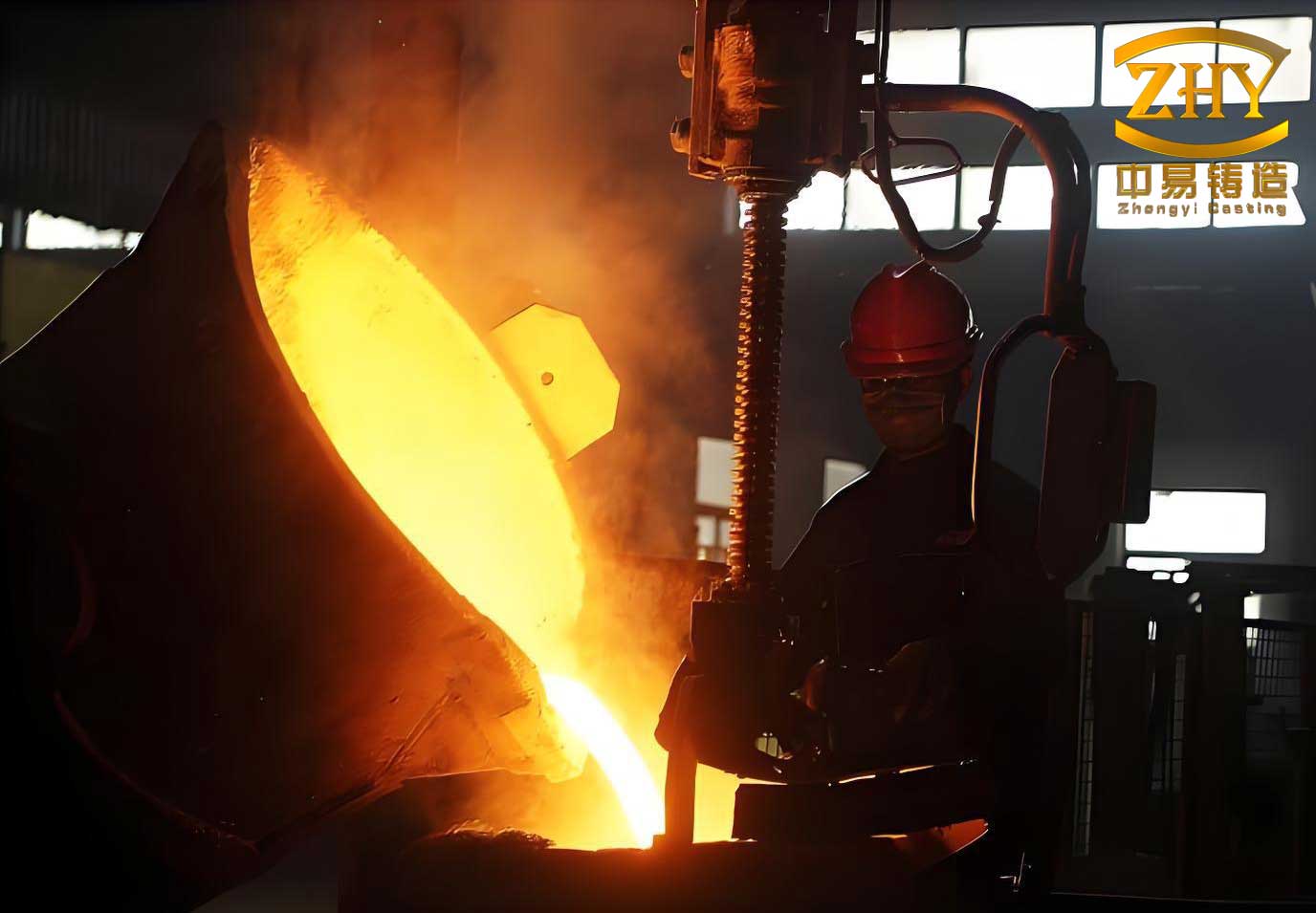
The microstructural evolution in niobium-microalloyed high manganese steel casting reveals significant grain refinement and elimination of columnar grains. As-cast structures typically show coarse columnar austenite grains, but niobium additions promote equiaxed grain growth through pinning of grain boundaries by Nb(C,N) particles. The grain size $$D$$ can be described by the Zener equation: $$D = \frac{k r}{f}$$, where $$k$$ is a constant, $$r$$ is the particle radius, and $$f$$ is the volume fraction. With $$f \approx 0.02$$ and $$r \approx 25 \, \text{nm}$$, $$D$$ reduces from over $$500 \, \mu\text{m}$$ in conventional high manganese steel casting to below $$100 \, \mu\text{m}$$, enhancing toughness and reducing crack susceptibility. Electron microscopy confirms the dispersion of spherical Nb-rich precipitates, typically 20–100 nm in diameter, within the austenitic matrix. Energy-dispersive X-ray analysis indicates that these particles contain up to $$90\%$$ Nb, with trace amounts of carbon and nitrogen, while the matrix retains minimal niobium (less than $$0.05\%$$), consistent with its low solubility.
To optimize the composition for high manganese steel casting, I experimented with varying niobium additions from $$0.05\%$$ to $$0.30\%$$. Below $$0.10\%$$, precipitate density is insufficient for effective strengthening; above $$0.20\%$$, excessive precipitation may embrittle the steel. A balance is achieved at $$0.15\%$$ Nb, which provides optimal wear resistance without compromising ductility. The base chemical composition follows standard high manganese steel casting grades, such as ASTM A128, with adjustments: $$1.2\%$$ C, $$12.5\%$$ Mn, $$0.5\%$$ Si, $$0.04\%$$ P, $$0.02\%$$ S, and the specified niobium addition. This composition ensures adequate hardenability and toughness after water quenching (solution treatment at $$1050^\circ \text{C}$$ followed by rapid cooling).
| Element | Content (wt%) | Role in High Manganese Steel Casting |
|---|---|---|
| C | 1.0–1.4 | Austenite stabilizer, enhances hardness |
| Mn | 11.0–14.0 | Promotes austenite, improves toughness |
| Si | 0.3–0.8 | Deoxidizer, strengthens ferrite |
| P | <0.05 | Impurity, minimized to avoid embrittlement |
| S | <0.03 | Impurity, controlled for sulfide formation |
| Nb | 0.10–0.20 | Grain refiner, precipitate former |
The mechanical properties of niobium-microalloyed high manganese steel casting were evaluated through tensile, impact, and wear tests. Tensile strength $$\sigma_t$$ follows a Hall-Petch relationship due to grain refinement: $$\sigma_t = \sigma_0 + k_y D^{-1/2}$$, where $$\sigma_0$$ is the friction stress and $$k_y$$ is a constant. For $$D = 80 \, \mu\text{m}$$, $$\sigma_t$$ increases to approximately $$850 \, \text{MPa}$$, compared to $$750 \, \text{MPa}$$ for conventional high manganese steel casting with $$D = 500 \, \mu\text{m}$$. Impact toughness, measured via Charpy tests at room temperature, shows a slight decrease from $$150 \, \text{J}$$ to $$130 \, \text{J}$$, but remains acceptable for most applications. Wear resistance was assessed using dry sand/rubber wheel tests according to ASTM G65; the niobium-modified high manganese steel casting exhibited a wear rate reduction of $$25–40\%$$, depending on load and abrasive conditions.
The wear volume loss $$V$$ can be modeled by Archard’s equation: $$V = k \frac{W L}{H}$$, where $$k$$ is a wear coefficient, $$W$$ is the load, $$L$$ is the sliding distance, and $$H$$ is the hardness. With niobium additions, $$H$$ increases due to precipitation hardening, and $$k$$ decreases owing to reduced abrasive penetration. For high manganese steel casting under a load of $$100 \, \text{N}$$ and sliding distance of $$1000 \, \text{m}$$, the hardness rises from $$HB 350$$ to $$HB 450$$, leading to a predicted wear reduction of approximately $$30\%$$, aligning with experimental data.
In terms of processing, high manganese steel casting with niobium is produced via electric arc furnace melting using an oxidation process. Niobium is added as ferro-niobium alloy late in the melt to minimize oxidation losses. The alloy composition should contain over $$60\%$$ Nb to ensure adequate recovery; lower manganese levels below $$10\%$$ reduce deoxidation efficiency and niobium yield. Carbon content in the ferro-niobium should be below $$0.1\%$$ to prevent powdering during storage. My experience indicates that a ferro-niobium with $$65\%$$ Nb, $$0.05\%$$ C, and balance Fe achieves a recovery rate of $$85–90\%$$ in high manganese steel casting. The melt is poured at $$1550^\circ \text{C}$$, followed by heat treatment at $$1050^\circ \text{C}$$ for 2 hours and water quenching to retain a fully austenitic structure with dispersed precipitates.
The economic and practical benefits of niobium microalloying in high manganese steel casting are substantial. Field trials with components like liner plates, jaw crusher plates, and grinding balls show service life extensions of $$20–30\%$$ on average. For example, in mining operations processing hard ores, niobium-modified liners lasted 8000 hours versus 6000 hours for standard high manganese steel casting, reducing downtime and replacement costs. The refined grain structure also diminishes casting defects such as hot tearing, boosting product yield by up to $$15\%$$. This makes high manganese steel casting more viable for demanding applications where wear and impact coexist.
To further elucidate the strengthening mechanisms, consider the total yield strength $$\sigma_y$$ of niobium-microalloyed high manganese steel casting as a sum of contributions: $$\sigma_y = \sigma_{\text{Fe}} + \sigma_{\text{sol}} + \sigma_{\text{gb}} + \sigma_{\text{ppt}}$$, where $$\sigma_{\text{Fe}}$$ is the strength of pure iron, $$\sigma_{\text{sol}}$$ is solid solution strengthening, $$\sigma_{\text{gb}}$$ is grain boundary strengthening, and $$\sigma_{\text{ppt}}$$ is precipitation strengthening. For my composition, $$\sigma_{\text{sol}}$$ from manganese and silicon is about $$200 \, \text{MPa}$$, $$\sigma_{\text{gb}}$$ from grain refinement is $$150 \, \text{MPa}$$ (using $$k_y = 0.5 \, \text{MPa} \cdot \text{m}^{1/2}$$), and $$\sigma_{\text{ppt}}$$ from niobium carbides is $$180 \, \text{MPa}$$ (derived from Orowan’s equation), summing to a significant enhancement over baseline high manganese steel casting.
In conclusion, my research demonstrates that niobium microalloying effectively enhances the wear resistance of high manganese steel casting through multiple synergistic pathways. The formation of stable, hard Nb(C,N) precipitates pins dislocations and provides second-phase strengthening, while grain refinement eliminates coarse columnar structures, improving toughness and castability. The optimal niobium addition ranges from $$0.10\%$$ to $$0.20\%$$, yielding a $$25–40\%$$ improvement in wear life with minimal impact on ductility. This approach advances the performance of high manganese steel casting in abrasive environments, offering a cost-effective solution for industries reliant on durable wear parts. Future work could explore combined additions with other microalloying elements like titanium or boron to further tailor properties for specific high manganese steel casting applications.