
In my extensive research into foundry technologies, I have dedicated significant effort to addressing the persistent challenges in high manganese steel casting. This specialized steel, characterized by a manganese content of around 13%, is indispensable for components subjected to severe impact and abrasive wear, such as those in mining, railway, and heavy machinery. However, the very properties that make high manganese steel valuable also complicate its casting process, particularly when using conventional sand binders. My work focuses on developing an advanced molding sand system that enhances both the efficiency and quality of high manganese steel casting.
The core issue in high manganese steel casting stems from the chemical interaction between the molten steel and the molding sand. During pouring, the high manganese content leads to the formation of manganese oxide (MnO), a basic oxide. When traditional silica sand (composed mainly of acidic SiO₂) is used, a detrimental chemical reaction occurs: $$ \text{MnO} + \text{SiO}_2 \rightarrow \text{MnO} \cdot \text{SiO}_2 $$ This reaction product is a low-melting-point compound that readily infiltrates sand gaps, causing severe chemical burn-on and making subsequent cleaning arduous. To mitigate this, foundries often turn to non-siliceous sands like magnesia olivine sand (mainly Mg₂SiO₄). While this solves the chemical compatibility issue, it introduces new problems when bonded with conventional sodium silicate (water glass). The alkaline nature of the sand-binder system results in low strength, poor surface finish, and exceptionally difficult knockout, hindering productivity in high manganese steel casting.
My proposed solution involves fundamentally modifying the inorganic sodium silicate binder by integrating an organic component. The hypothesis was that a hybrid binder could synergize the environmental benefits and cost-effectiveness of inorganic binders with the superior collapsibility and surface quality imparted by organic resins. Specifically, I aimed to incorporate alkaline phenolic resin into the sodium silicate matrix, creating a novel modified ester-cured binder tailored for high manganese steel casting applications.
The experimental journey began with selecting and characterizing the raw materials. I used a commercial sodium silicate with a modulus of 2.3 and a solids content of 48%. The organic modifier was an alkaline phenolic resin with a density of 1.24 g/cm³. Other key additives included an active base (to facilitate dissolution), boron compounds, specific crosslinking agents, and triacetin as the ester curing agent. The core modification process involved a carefully controlled thermal procedure: dissolving a predetermined amount of alkaline phenolic resin into the sodium silicate using the active base, heating the mixture to 95–105 °C for 30 minutes, cooling it below 40 °C, and finally incorporating a selected crosslinking agent under agitation.
To evaluate the performance of this modified binder in the context of high manganese steel casting, I standardized a testing protocol. Sand mixtures were prepared using 1000g of standard silica sand (for baseline comparison, though magnesia olivine sand was used in later production trials). The ester curing agent (triacetin) was added first at 0.3 wt% of the sand, followed by mixing. Then, the modified sodium silicate binder was added at 2.5 wt% and mixed further. The prepared sand was used to fabricate standard “8”-shaped specimens for tensile strength measurement and cylindrical specimens for residual strength testing. The residual strength, critical for assessing collapsibility in high manganese steel casting, was determined by baking cylindrical samples at 1000 °C for 30 minutes and then measuring their compressive strength.
The first critical parameter investigated was the amount of active base required to solubilize the phenolic resin within the sodium silicate. As expected, the two components are not naturally miscible. The relationship between active base addition and resin solubility proved fundamental and can be summarized by the following empirical correlation derived from my data:
$$ S = S_{max} \left(1 – e^{-k \cdot C}\right) $$
Where \( S \) is the solubility of phenolic resin (%), \( S_{max} \) is the maximum achievable solubility (approximately 30%), \( C \) is the concentration of active base (%), and \( k \) is a rate constant. The experimental data clearly showed that solubility increased sharply with active base up to about 10%, after which it plateaued. This informed the optimal dosage for subsequent experiments, ensuring sufficient resin integration without excessive alkali content that could weaken the bond.
| Active Base Addition (%) | Phenolic Resin Solubility (%) | Observations on Mixture Stability |
|---|---|---|
| 0 | 0 | Complete phase separation |
| 5 | 15 | Partial dissolution, cloudy mixture |
| 10 | 29 | Clear, homogeneous solution |
| 15 | 31 | Clear, homogeneous solution |
| 20 | 32 | Clear, homogeneous solution |
Next, I explored the pivotal role of crosslinking agents. Merely dissolving resin in silicate does not guarantee synergistic curing. The crosslinker’s function is to create covalent bridges between the inorganic silicate network and the organic phenolic resin during ester-induced hardening. I tested several water-based silane coupling agents. The performance was assessed based on bench life (usable time of the sand mixture) and strength development at intervals critical for high manganese steel casting operations like mold handling and pouring.
| Crosslinking Agent Type | Addition Level (% of binder system) | Sand Bench Life (min) | 2-h Tensile Strength (MPa) | 4-h Tensile Strength (MPa) | 24-h Tensile Strength (MPa) |
|---|---|---|---|---|---|
| None | 0 | 40 | 0.27 | 0.59 | 0.89 |
| Type A (Water-based silane) | 0.2 | 40 | 0.36 | 0.81 | 1.33 |
| Type B (Commercial agent) | 0.2 | 40 | 0.29 | 0.65 | 1.03 |
| Type C (Resin-specific silane) | 0.2 | 35 | 0.32 | 0.68 | 0.95 |
Type A crosslinking agent yielded the best overall strength profile without compromising bench life, making it the preferred choice. Further optimization of its dosage revealed a logarithmic relationship between crosslinker content and strength gain, which can be modeled as: $$ \sigma_t = \sigma_0 + \alpha \ln(1 + \beta \cdot X) $$ Here, \( \sigma_t \) is the tensile strength at time \( t \), \( \sigma_0 \) is the base strength without crosslinker, \( \alpha \) and \( \beta \) are material constants, and \( X \) is the crosslinker concentration. The gains diminished above 0.25%, establishing the optimal range of 0.2–0.25% for high manganese steel casting applications.
The most transformative aspect of this research was quantifying the impact of alkaline phenolic resin content on the system’s properties. The resin serves multiple functions: it improves mold surface finish, provides a reducing atmosphere during metal pouring to minimize oxidation and burn-on, and critically, dramatically reduces residual strength. The data below illustrates this profound effect, which directly addresses a major bottleneck in high manganese steel casting – knockout and cleaning.
| Alkaline Phenolic Resin in Binder (%) | 24-h Tensile Strength (MPa) | Residual Compressive Strength after 1000°C (MPa) | Estimated Surface Finish Quality (Relative Scale 1-10) |
|---|---|---|---|
| 0 (Plain Sodium Silicate) | 0.85 | 2.8 | 4 |
| 10 | 1.05 | 1.2 | 6 |
| 20 | 1.33 | 0.45 | 8 |
| 30 | 1.40 | 0.25 | 9 |
| 40 | 1.38 | 0.22 | 9 |
The mechanism behind the collapsed strength reduction can be partially described by considering the volumetric ratio of organic to inorganic phases and their thermal decomposition. Upon heating during the high manganese steel casting process, the organic resin phase pyrolyzes, creating porosity and weakening the sintered silicate bridge. The residual strength \( \sigma_r \) can be expressed as a function of the resin volume fraction \( \phi \): $$ \sigma_r = \sigma_{r0} \exp(-\gamma \phi) $$ where \( \sigma_{r0} \) is the residual strength of pure sodium silicate sand and \( \gamma \) is a constant related to the decomposition characteristics. This exponential decay model fits the observed data well, explaining why even modest resin additions (20-30%) lead to residual strengths below 0.5 MPa, a threshold that signifies easy knockout for high manganese steel castings.
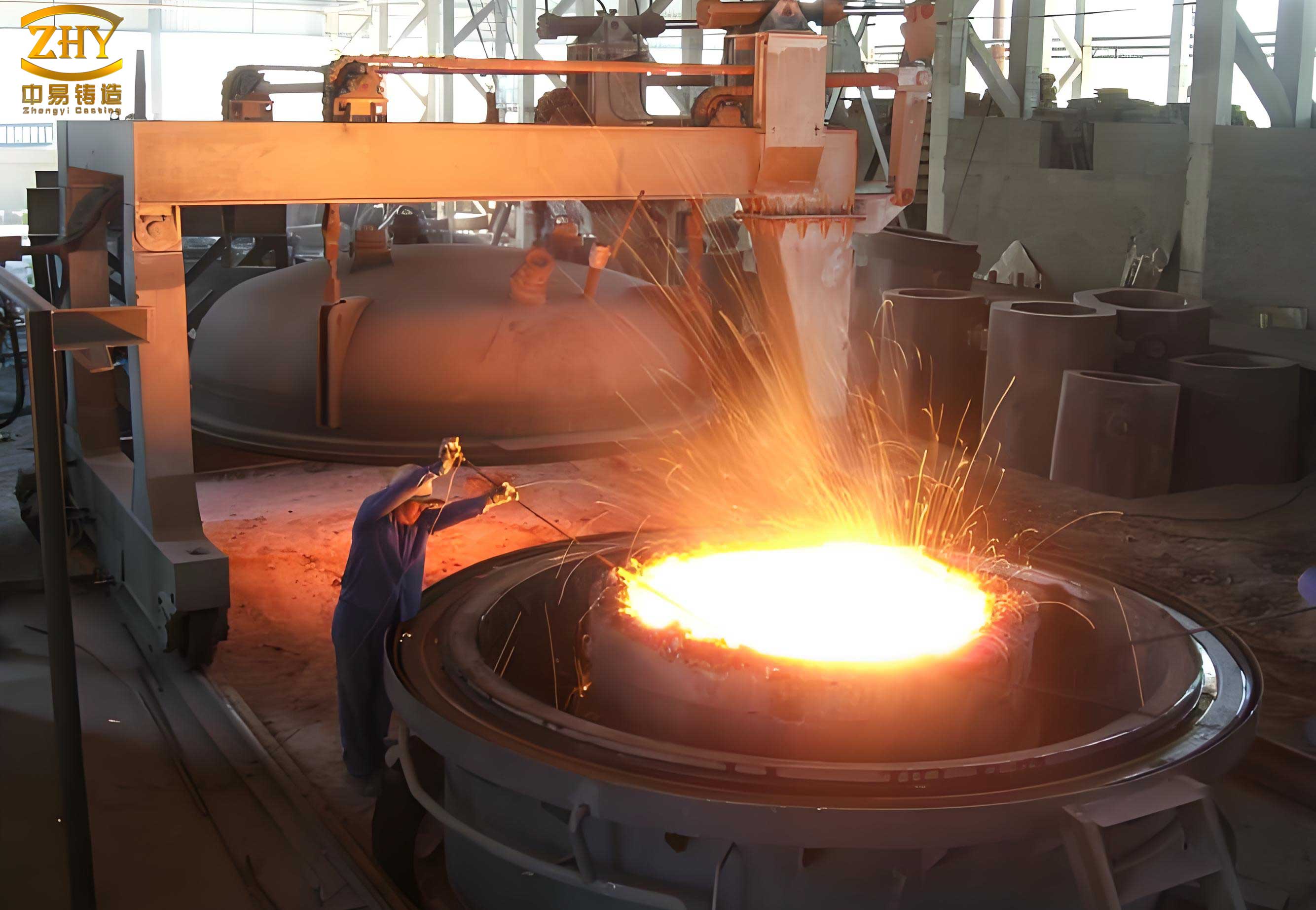
The true validation of any foundry material innovation lies in its performance on the production floor. This modified ester-cured sodium silicate sand was subjected to rigorous trials at a specialized foundry producing large-scale high manganese steel castings, such as railway crossings. The sand was mixed continuously using an automated system and used to create molds and cores for complex high manganese steel casting geometries. The improvements were immediately apparent. The molds exhibited excellent green strength, allowing for swift pattern withdrawal and robust handling during coating, assembly, and transportation to the pouring line. The castings produced showed a markedly superior surface finish, with minimal veining or burn-on defects. Most significantly, the knockout process, historically a labor-intensive and time-consuming stage in high manganese steel casting, was revolutionized. The molds disintegrated readily upon vibration, and the sand lumps broke apart easily, drastically reducing cleaning time and energy consumption. This practical success underscores the system’s viability for industrial high manganese steel casting.
In conclusion, my research demonstrates that the strategic modification of sodium silicate with alkaline phenolic resin, facilitated by an active base and a tailored crosslinking agent, creates a superior molding sand system for high manganese steel casting. This hybrid binder overcomes the traditional trade-offs between inorganic and organic systems. It delivers the high initial strength and environmental safety of water glass while incorporating the excellent collapsibility and enhanced surface definition of resin binders. The key relationships governing resin solubility, crosslinking efficiency, and strength development have been quantified through empirical models. The dramatic reduction in residual strength, modeled by an exponential decay function of resin content, is a breakthrough that directly alleviates one of the most persistent challenges in high manganese steel casting. This technology paves the way for more efficient, cost-effective, and high-quality production of durable high manganese steel components, meeting the growing demands of heavy industry. Future work will focus on further optimizing the formulation for specific casting geometries and exploring the use of different ester hardeners to fine-tune the curing kinetics for various high manganese steel casting applications.