
The manufacturing of high-performance high manganese steel castings, particularly large and complex components like railway crossings, presents significant foundry challenges. These castings must exhibit exceptional wear resistance, high toughness, and superior fatigue strength to withstand severe impact and cyclic loading in service. Achieving the required internal soundness and dimensional accuracy is paramount. For years, our production relied on traditional molding methods, which often led to issues such as dimensional inaccuracies from mold wall movement and persistent surface defects like gas holes, adversely affecting the quality and yield of our high manganese steel casting components.
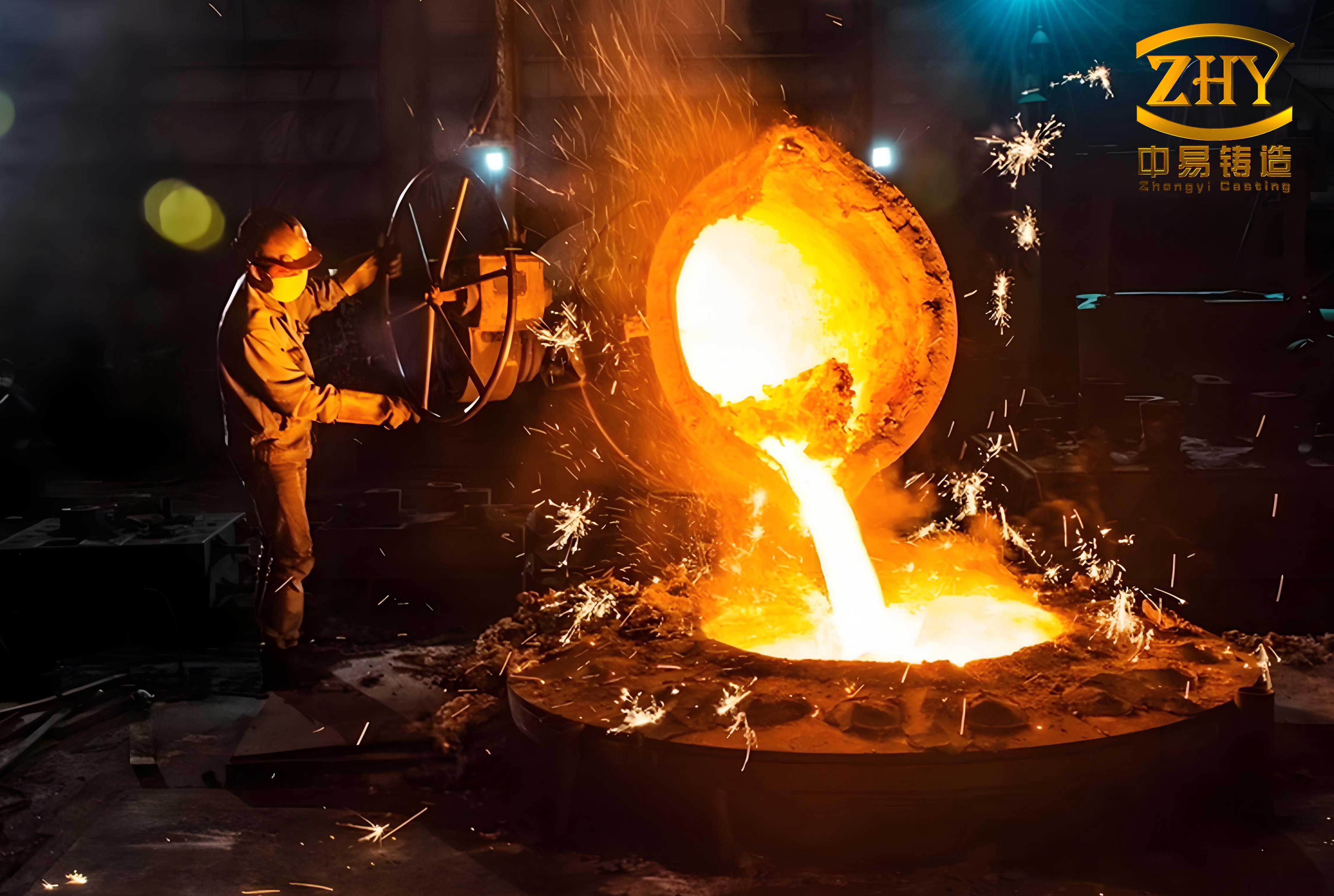
Seeking a technological advancement, we introduced the Vacuum Sealed Molding Process, commonly known as the V-Process. This method involves placing a thin plastic film over a pattern, applying vacuum to draw the film tightly onto the pattern details, filling the flask with unbonded sand, covering with another film, and applying vacuum to the entire mold cavity to harden it. The promise of this technology for high manganese steel casting lay in its potential for excellent dimensional reproducibility, superior surface finish, and improved sand collapsibility compared to conventional silicate-bonded sands.
However, transitioning to the V-Process for such demanding applications was not merely an equipment change; it required a comprehensive redevelopment of the entire production protocol. We conducted extensive trials to establish a complete set of process parameters—from sand preparation and molding to pouring and shakeout—specifically tailored for producing heavy-section high manganese steel casting products. A representative example is our process for a large railroad frog, with a casting weight of approximately 2.3 tons and dimensions of 4.5m in length. The gating system was designed with two ingates at the heel end, connected to two insulating feeder heads. The cope contained a massive hanging core, and chills were strategically placed along the rail tread surface to promote directional solidification.
Technical Advantages and Observed Benefits
The implementation of the V-Process for high manganese steel casting yielded marked improvements over our previous method. We formulated our facing sand using 100% new olivine sand with a sodium silicate addition of approximately 3.0-3.5%, while the backing sand consisted entirely of reclaimed sand with a lower binder addition of around 2.5%. The molds were typically broken after 48 to 72 hours.
The benefits were substantial and multifaceted, as summarized in the comparison below:
| Aspect | Previous Process | V-Process | Improvement / Outcome |
|---|---|---|---|
| Casting Quality & Yield | Surface defects (gas holes), dimensional scatter, lower yield. | Smooth surface, eliminated gas holes, precise dimensions. | Qualified casting rate increased significantly. Quality reached advanced international levels. |
| Production Efficiency & Ergonomics | Labor-intensive shakeout, poor working conditions. | Easier shakeout, reduced physical labor. | Moderate efficiency gain, substantial improvement in working environment. |
| Material Consumption | Higher sodium silicate usage. | Optimized binder addition. | Sodium silicate consumption reduced by nearly 50%. |
| Dimensional Accuracy | “Mold wall movement” causing size variation. | Rigid mold maintained by vacuum pressure. | Eliminated dimensional sinking, greatly improved precision. |
Critical Technical Challenges and Solutions in V-Process for High Manganese Steel Casting
Despite the overall success, the development phase revealed several critical technical hurdles specific to using domestic raw materials for high manganese steel casting production. Addressing these was key to stable production.
1. Mold Strength and Surface Stability
A fundamental requirement for the V-Process mold is adequate strength and surface stability to withstand handling and the metallostatic pressure of molten high manganese steel. The target for our trial was a compressive strength greater than 0.7 MPa and a surface stability value over 90% after a specific hardening period. The combined hardening mechanism in the V-Process can be represented by the following relationship for final mold strength ($\sigma_m$):
$$
\sigma_m = \sigma_c + \sigma_d
$$
Where $\sigma_c$ is the strength from chemical hardening of the silicate binder and $\sigma_d$ is the strength from rapid dehydration hardening under vacuum. This dual mechanism theoretically allows for higher strength at lower binder levels compared to conventional CO₂ hardening.
However, with domestic olivine sand, we encountered difficulties achieving the target strength even with a 3.5% sodium silicate addition. The strength was critically low, and surface friability was high, leading to risks of erosion and inclusions in the high manganese steel casting. The core issue was traced to the physical properties of the sand, particularly its bulk density. We established an empirical relationship showing that satisfactory strength for high manganese steel casting molds required sand with a bulk density ($\rho_b$) and grain surface characteristics meeting a minimum threshold:
$$
\rho_b > 1.6 \, \text{g/cm}^3 \quad \text{and} \quad A_f < 0.5\%
$$
where $A_f$ represents the percentage of fine, dusty particles. The domestic sand often had a lower bulk density (~1.4 g/cm³) due to mineral quality and higher friability, directly impacting the effectiveness of the thin silicate film. This highlighted the V-Process’s sensitivity to raw material consistency—a significant challenge given the variability in domestic mining and processing standards.
2. Sand Collapsibility and Knock-Out Properties
Excellent collapsibility is the cornerstone of the V-Process advantage, especially for high manganese steel casting, which is prone to hot tearing if constrained during cooling. Collapsibility ($C$) is inversely related to the residual strength of the sand after pouring and is primarily a function of binder content ($B$) and the time-temperature history after casting, which we characterize as the shakeout delay time ($t_s$) and corresponding sand temperature ($T_s$).
$$
C \propto \frac{1}{f(B, t_s, T_s)}
$$
Our experiments quantified this relationship. As shown in the data below, for a given binder content, collapsibility improved dramatically with longer shakeout times (and lower sand temperatures).
| Binder Addition | Shakeout Time (hrs) | Approx. Sand Temp. (°C) | Core Knock-out Yield | Collapsibility Rating |
|---|---|---|---|---|
| 3.5% | 24 | >200 | < 50% | Poor |
| 3.5% | 48 | ~150 | > 80% | Good |
| 3.0% | 48 | ~150 | > 90% | Excellent |
The underlying mechanism involves the thermal embrittlement and cracking of the dehydrated silicate film upon cooling. The trade-off is clear: shorter shakeout times improve production flow but drastically reduce collapsibility, increasing the risk of casting damage and difficult cleanup. Finding the optimal balance between minimum mold strength for handling and maximum collapsibility for high manganese steel casting integrity was a central technical challenge.
3. Sand Reclamation System Performance
Effective dry reclamation of V-Process sand is essential for economic and environmental sustainability. The goal is to remove the brittle, dehydrated silicate coating from the grain surface to produce consistent reclaimed sand with low residual binder ($RB$). The performance of a reclamation system can be modeled by its removal efficiency ($\eta_r$):
$$
\eta_r = 1 – \frac{RB_{\text{output}}}{RB_{\text{input}}}
$$
We faced significant issues, particularly in winter, where reclaimed sand quality deteriorated: residual binder levels were high, and moist fines agglomerated, adhering to equipment surfaces and causing handling problems. The root causes were twofold and formed a vicious cycle:
1. High shakeout sand temperature ($T_s$): Early shakeout meant sand entered the reclamation system at elevated temperatures, causing moisture evaporation within the sand mass. This steam condensed on the abundant fine particles (from sand attrition), creating damp, sticky fines.
2. Inadequate fines removal: The dust collection system was not optimized for the volume and nature of these moist fines, leading to recirculation and buildup.
The solution pathway required addressing the input condition to the reclamation loop. This meant that to achieve good reclamation for high manganese steel casting production, we had to extend the shakeout time to lower $T_s$, despite the production throughput penalty. Alternatively, a sand cooling unit installed after shakeout would be a necessary system modification for high-volume production.
4. Sand Mixing Uniformity
With sodium silicate additions reduced to 3.0-3.5%, achieving a perfectly uniform coating on each sand grain became critically important for consistent mold strength. Non-uniformity leads to weak spots in the mold, risking failure during pouring of the high manganese steel. We evaluated the mixing efficiency ($U$) of two mixer types by measuring the coefficient of variation in the immediate compressive strength of multiple samples taken from a single batch:
$$
U = 1 – \frac{\sigma_{\text{strength}}}{\mu_{\text{strength}}}
$$
Where $\sigma_{\text{strength}}$ is the standard deviation and $\mu_{\text{strength}}$ is the mean strength of the samples. A batch mixer (like a roller-type) provided significantly more uniform mixing ($U > 0.95$) compared to a continuous mixer with a simple feed mechanism ($U < 0.80$). The primary cause in the continuous system was inconsistent feed rate from the sand hopper, exacerbated by vibrations from pneumatic discharge aids. The short mixing screw without reverse-flight sections further contributed to inadequate homogenization of the low-viscosity silicate binder. This experience underscored that standard continuous mixers often require significant modification or that batch mixers are preferable for the precise demands of V-Process sand preparation for critical high manganese steel casting applications.
| Mixer Type | Mixing Principle | Uniformity (U) | Avg. Strength (MPa) | Suitability for V-Process |
|---|---|---|---|---|
| Continuous (Screw) | Conveyance with limited shear | 0.75 – 0.85 | 0.65 | Poor (requires major feed & design mods) |
| Batch (Roller/Turbulent) | High-intensity shearing & kneading | > 0.95 | 0.80 | Good |
Consolidated Process Parameters and Conclusions
Based on our development work, the following table summarizes the key established and learned parameters for producing large, complex high manganese steel casting using the V-Process with domestic olivine sand:
| Process Stage | Parameter | Target Value / Condition | Key Consideration |
|---|---|---|---|
| Raw Material | Olivine Sand Bulk Density | > 1.6 g/cm³ | Critical for achieving mold strength with low binder. |
| Sand Preparation | Facing Sand Binder Addition | 3.0 – 3.5% | Use 100% new sand. |
| Sand Preparation | Backing Sand Binder Addition | ~2.5% | Use 100% reclaimed sand. |
| Molding | Vacuum Level & Film Stretch | Stable & sufficient for pattern detail | Ensures dimensional accuracy. |
| Solidification & Cooling | Shakeout Delay Time | 48 – 72 hours | Balances collapsibility and production flow. |
| Shakeout | Target Sand Temperature | < 150°C | Essential for good collapsibility and reclamation. |
| Sand Reclamation | Fines Removal Efficiency | > 95% of -200 mesh material | Requires well-designed, managed dust system. |
| Mixing | Binder Distribution Uniformity | C.o.V. of strength < 5% | High-shear batch mixing is preferred. |
In conclusion, the successful adoption of the V-Process for manufacturing high manganese steel casting, specifically large railroad frogs, demonstrates a viable path to superior product quality. The benefits in surface finish, dimensional precision, and yield are substantial and align with advanced international standards for high manganese steel casting production. However, this success is contingent upon meticulously addressing several intertwined technical challenges. The process exhibits high sensitivity to raw material quality, particularly sand density and fines content. The critical interrelationship between shakeout timing, sand collapsibility, and the performance of the sand reclamation system must be carefully managed. Furthermore, achieving the necessary consistency in sand mixing requires equipment capable of providing high uniformity at low binder addition rates. For foundries considering this transition for high manganese steel casting or similar demanding applications, a holistic approach encompassing material specification, process parameter optimization, and equipment adaptation is essential to fully realize the potential of the V-Process.