
In my extensive experience with industrial equipment, the bucket teeth used in excavators and power shovels are critical components subjected to severe abrasive wear, high bending forces, and intense impact loads. The prevalent use of high manganese steel casting for these parts is due to its exceptional work-hardening capability and toughness. However, early fracture of bucket teeth remains a persistent issue, leading to production downtime, increased costs, and potential equipment failures. This article delves into a comprehensive analysis of the root causes of such fractures and outlines refined methodologies across melting, casting, and heat treatment processes to significantly improve the durability of high manganese steel casting. The insights shared here stem from practical investigations and aim to provide a holistic approach to quality enhancement.
The intrinsic properties of any high manganese steel casting are fundamentally dictated by its chemical composition. Key elements such as carbon and manganese establish the austenitic matrix, while impurities like phosphorus and sulfur can detrimentally affect integrity. My analysis of fractured bucket teeth consistently revealed that deviations in standard composition, particularly excessive carbon and phosphorus, were primary contributors to premature failure.
Carbon is paramount in achieving the desired austenitic structure in high manganese steel casting. Its concentration directly influences hardness, strength, and wear resistance. However, an overly high carbon content leads to the formation of coarse, networked carbides within the as-cast structure. These carbides, primarily of the (Fe, Mn)$_3$C type, embrittle the grain boundaries and act as stress concentrators. During subsequent heat treatment, if not fully dissolved, they leave behind microscopic voids that serve as initiation sites for cracks. The relationship between carbon content and carbide volume fraction can be approximated by leveraging the Fe-C-Mn phase diagram. For a typical high manganese steel casting with ~12% Mn, the maximum solubility of carbon in austenite at the solution treatment temperature follows a trend that can be modeled. The equilibrium volume fraction of carbide $V_c$ prior to solution treatment can be estimated as a function of the actual carbon content $C_a$ and the solubility limit $C_s$ at a given temperature:
$$ V_c \propto (C_a – C_s) $$
Where $C_s$ decreases with increasing manganese content for a given temperature. For bucket teeth facing high impact, the carbon content should be tailored. I recommend a range of 0.9% to 1.1% for optimal toughness, whereas for pure abrasion resistance, 1.15% to 1.35% is suitable. Exceeding these limits, as found in failed castings with carbon levels of 1.30% to 1.48%, invariably leads to networked carbides as seen in metallographic analysis, severely compromising fatigue life.
Phosphorus is another critical element in high manganese steel casting. It has low solubility in austenite and tends to segregate at grain boundaries, forming brittle phosphide eutectics. While finely dispersed phosphides can marginally aid wear resistance, coarse, continuous networks drastically reduce the cohesive strength of grain boundaries. In early-failure cases, phosphorus levels reached 0.08% to 0.10%, far above the recommended limit of below 0.05%. The combined effect of high carbon and high phosphorus is synergistic in promoting carbide precipitation and increasing the difficulty of achieving a fully austenitic structure after heat treatment. The detrimental effect of phosphorus on impact toughness $K$ can be qualitatively described by an empirical relation:
$$ K \approx K_0 – \alpha \cdot P_{wt\%} $$
where $K_0$ is the base toughness and $\alpha$ is a positive constant. Therefore, stringent control over both carbon and phosphorus is non-negotiable for producing reliable high manganese steel casting.
| Element | Optimal Range for Impact Service (wt%) | Optimal Range for Abrasion Service (wt%) | Maximum Allowable Limit (wt%) | Primary Detrimental Effect when Excessive |
|---|---|---|---|---|
| C | 0.9 – 1.1 | 1.15 – 1.35 | 1.35 | Coarse networked carbides, brittleness |
| Mn | 11.0 – 14.0 | 11.0 – 14.0 | 14.0 | — |
| Si | 0.3 – 0.8 | 0.3 – 0.8 | 1.0 | Reduces toughness |
| P | < 0.05 | < 0.05 | 0.07 | Grain boundary phosphide eutectics |
| S | < 0.03 | < 0.03 | 0.04 | Hot shortness, sulfide inclusions |
The journey of a high-quality high manganese steel casting begins in the foundry. The as-cast grain structure of high manganese steel is irreversible through heat treatment; thus, achieving a fine, equiaxed grain structure during solidification is paramount. This requires meticulous control over pouring parameters and innovative casting techniques.
Pouring temperature is a critical lever. Lower superheat promotes a higher nucleation rate, resulting in finer grains. In practice, maintaining a pouring temperature between 1420°C and 1450°C is ideal. Without continuous temperature monitoring, a practical method involves measuring the solidification skin time on a spoon sample; a凝固 film time of 25 to 30 seconds often correlates with the desired temperature range. The thermal dynamics during solidification can be conceptualized using Fourier’s law of heat conduction. The rate of heat extraction $\dot{Q}$ from the casting influences the cooling rate $dT/dt$:
$$ \dot{Q} = -k \cdot A \cdot \frac{dT}{dx} $$
where $k$ is the thermal conductivity of the mold material, $A$ is the area, and $dT/dx$ is the temperature gradient. A lower pouring temperature reduces the initial thermal energy, increasing $dT/dx$ and promoting faster solidification.
To further enhance heat extraction and control solidification mode, the use of metal molds (chills) and internal chills is highly effective for high manganese steel casting. Metal molds provide rapid chilling, suppressing columnar grain growth and promoting a fine equiaxed structure. For complex shapes like bucket teeth with varying sections, a combination of external chills and strategically placed internal chills ensures near-simultaneous solidification, minimizing thermal stresses. For instance, in a bucket tooth with a massive 93mm x 73mm cross-section, inserting a cylindrical internal chill (e.g., 20mm diameter x 180mm long) can transform the central region from a zone of coarse grains to one of fine equiaxed crystals. This approach mitigates the anisotropic mechanical properties often seen in heavy-section high manganese steel casting. Conversely, for thinner sections, sand inserts within the metal mold can moderate cooling, balancing the solidification rates across the entire casting. The goal is to minimize the temperature difference $\Delta T$ between thick and thin sections at any time during solidification:
$$ \Delta T = T_{thick} – T_{thin} $$
By employing chills, $\Delta T$ is reduced, thereby lowering thermal stress $\sigma_{thermal}$ which is proportional to the product of the material’s Young’s modulus $E$, coefficient of thermal expansion $\alpha$, and $\Delta T$:
$$ \sigma_{thermal} \propto E \cdot \alpha \cdot \Delta T $$
High manganese steel has a relatively low thermal conductivity and high expansion coefficient, making it particularly prone to hot tearing if $\sigma_{thermal}$ becomes excessive.
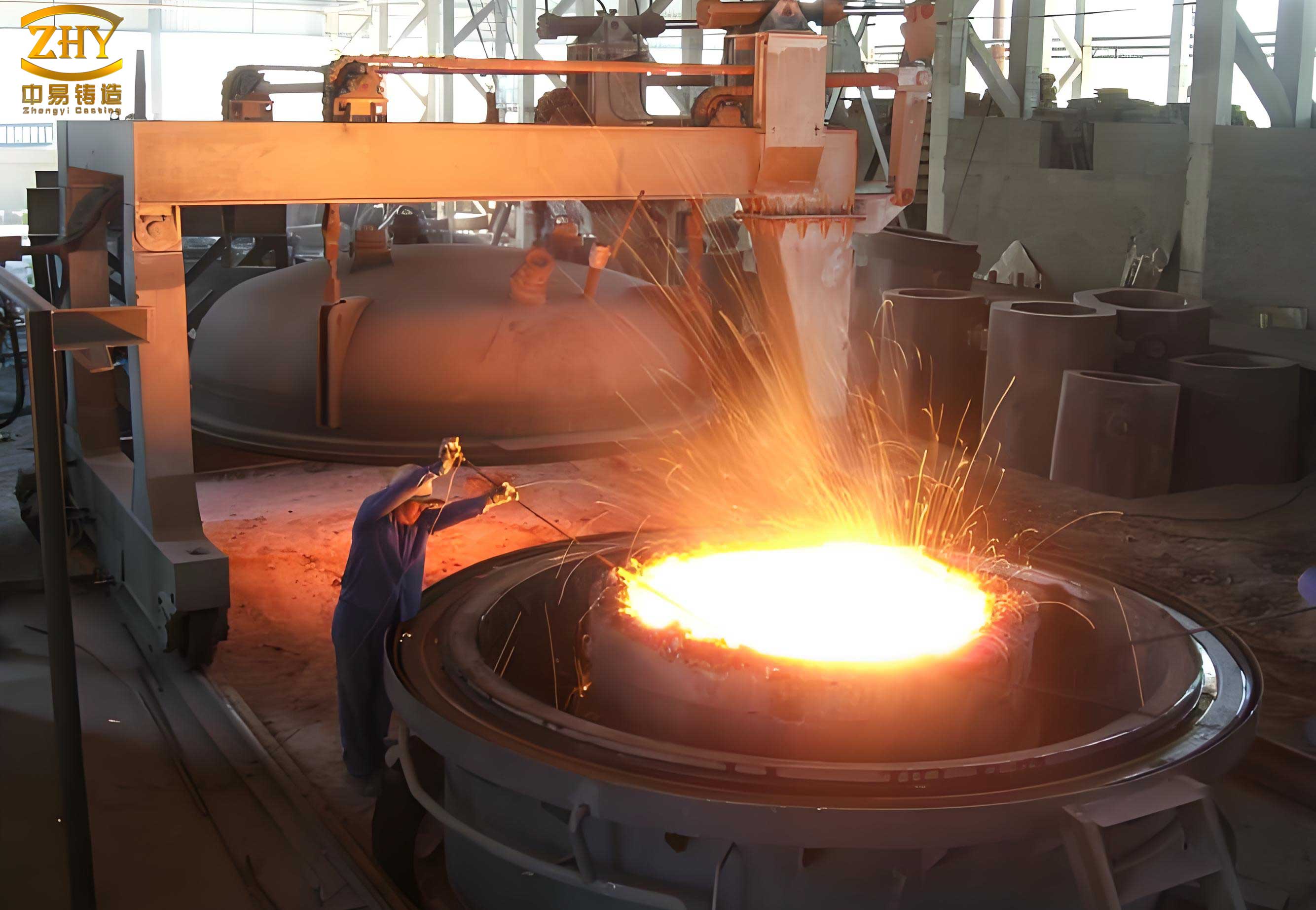
Riser design for high manganese steel casting is generally minimal due to the alloy’s good fluidity and solidification characteristics. However, for soundness, small necked-down or break-off risers are used. A crucial post-casting practice is the removal of these risers. For large castings, risers are often removed after solution heat treatment using oxy-fuel cutting. To prevent the introduction of thermal cracks from this localized heating, the casting is partially immersed in circulating cooling water (maintained below 45°C) during the cutting operation. This simple yet effective measure prevents the tempering or re-precipitation of carbides in the heat-affected zone, preserving the integrity of the high manganese steel casting.
The final and most transformative step in manufacturing high-performance high manganese steel casting is the heat treatment, specifically the water quenching or water toughening process. This process aims to dissolve all carbides into the austenitic matrix and retain this supersaturated solid solution at room temperature by rapid quenching.
The heating stage must be carefully orchestrated to avoid cracking and ensure complete carbide dissolution. High manganese steel has poor thermal conductivity, making it susceptible to thermal shock during heating. Therefore, a controlled heating rate is essential, particularly through the lower temperature range (room temperature to 600°C) where plasticity is low. Based on casting thickness, I have established the following heating rate guidelines:
| Casting Wall Thickness (mm) | Recommended Heating Rate (°C/h) | Rationale |
|---|---|---|
| < 30 | 70 – 80 | Thinner sections can tolerate faster heating with lower thermal stress. |
| 30 – 60 | 50 – 60 | Moderate thickness requires a balanced rate to prevent distortion. |
| > 60 | 30 – 50 | Heavy sections generate significant internal stress; slow heating is critical. |
Above 600°C, the steel gains ductility, and a uniform heating rate of 120-150°C/h can be applied up to the solution temperature.
The solution temperature and holding time are determined by the need to dissolve carbides without causing excessive grain growth or surface decarburization. The temperature must be above the Acm line on the relevant phase diagram. For a high manganese steel casting with a carbon content of 0.9-1.1%, the optimal range is 1050°C to 1100°C. The holding time $t_h$ is a function of the initial carbide size and distribution, and can be related to diffusion kinetics. The dissolution of a spherical carbide particle can be modeled by an equation derived from Fick’s laws:
$$ r_t^2 = r_0^2 – \frac{2D(C_s – C_0)}{\rho} t $$
where $r_t$ is the particle radius at time $t$, $r_0$ is the initial radius, $D$ is the diffusion coefficient of carbon in austenite, $C_s$ is the surface carbon concentration (at equilibrium with austenite), $C_0$ is the carbon concentration in the matrix far from the particle, and $\rho$ is related to the carbide density. Sufficient time must be allowed for $r_t$ to approach zero for the largest carbides present. Inadequate heating (“under-heating”) leaves undissolved carbides at grain boundaries, while excessive heating (“over-heating”) coarsens the austenite grains, both degrading the properties of the high manganese steel casting.
The water toughening (quenching) operation is the climax of the process. Upon reaching the solution temperature, the high manganese steel casting must be transferred from the furnace to the quenching bath as rapidly as possible—typically within 20 to 30 seconds. This minimizes the time for any carbide re-precipitation during cooling through the critical temperature range. The quenching water must be agitated and maintained at a low temperature. The initial water temperature should be below 30°C, and the temperature rise during quenching should not exceed 60°C. Rapid quenching ensures the carbon remains in supersaturated solid solution, yielding a fully austenitic microstructure with high toughness. The critical cooling rate $V_c$ to avoid carbide precipitation can be estimated from Continuous Cooling Transformation (CCT) diagrams for the specific high manganese steel casting composition. The process must achieve a cooling rate greater than $V_c$ from the solution temperature down to about 500°C.
Based on these principles, a robust, multi-stage heat treatment cycle has been developed and proven for bucket teeth. The curve involves step-wise heating with holds at critical temperatures (e.g., 350°C, 600°C) to equalize temperature and relieve stresses, followed by a slow ramp to the solution temperature, a sufficient soak, and immediate quenching. This meticulous cycle has eliminated issues of quench cracking, surface decarburization, and retained carbides in production high manganese steel casting.
To quantify the improvements achieved through these integrated process controls, a series of comparative studies were conducted. Metallographic examination of optimized high manganese steel casting reveals a uniform, single-phase austenitic structure free of continuous grain boundary networks. Mechanical testing shows a significant enhancement in impact toughness, often exceeding 150 J at room temperature for properly processed castings, compared to less than 50 J for those with defective microstructures. The work-hardening capacity, crucial for wear resistance in service, is also maximized. Field performance data collected over several years demonstrates a marked increase in the service life of bucket teeth, with reductions in catastrophic failures by over 70% in harsh mining environments. The synergy between refined chemistry, controlled solidification, and precise heat treatment creates a high manganese steel casting that is both tough and abrasion-resistant, capable of withstanding the demanding conditions of excavation.
The path to reliable high manganese steel casting for bucket teeth is multifaceted. It requires unwavering attention to chemical composition, with strict limits on carbon and phosphorus. It demands sophisticated casting practices that leverage controlled cooling through chills to refine as-cast grain structure. Finally, it hinges on a meticulously designed and executed heat treatment cycle that transforms the microstructure into a homogeneous, tough austenite. Each of these stages—melting, pouring, and heat treating—is interlinked; a lapse in one can negate the efforts in the others. By implementing the strategies and controls detailed here, foundries can consistently produce high-integrity high manganese steel casting that delivers extended service life, operational safety, and cost-effectiveness. The continuous pursuit of excellence in producing high manganese steel casting remains a cornerstone of advancing heavy machinery component reliability.