
The production of heavy-section high manganese steel casting presents unique challenges distinct from those encountered with standard geometries. Components like large crusher mantles, liners, and concaves, with critical sections exceeding 100 mm, are prone to casting defects such as shrinkage porosity, hot tearing, and the deleterious precipitation of carbides in the core. These issues severely compromise the service performance and reliability of these critical wear parts. Through extensive experimentation and process refinement, we have developed a holistic approach encompassing material re-alloying, advanced steelmaking, optimized foundry practices, and precise heat treatment to consistently produce superior quality heavy high manganese steel casting. This article details these integrated strategies.
The foundation of performance lies in the chemical composition. While standard ASTM A128 grades serve many purposes, heavy-section castings demanding exceptional impact toughness and resistance to carbide formation require a tailored, re-alloyed chemistry. The primary design philosophy is to achieve a fully austenitic matrix after heat treatment, even in slow-cooling core regions, while enhancing yield strength and work-hardening capability.
Carbon and Manganese: These are the fundamental elements. Carbon provides solid solution strengthening but reduces toughness at higher levels. Manganese stabilizes austenite. For heavy sections, the Mn/C ratio is critical to suppress carbide precipitation. We target a ratio of 10-11, leading to the following ranges:
$$ w(\text{C}) = 1.0\% – 1.2\% $$
$$ w(\text{Mn}) = 12.0\% – 13.0\% $$
$$ \text{Mn/C Ratio} = \frac{w(\text{Mn})}{w(\text{C})} \approx 10 – 11 $$
Silicon, Phosphorus, and Sulfur: Silicon is kept at a lower range (0.3%-0.5%) for deoxidation without significantly impairing toughness. Phosphorus and sulfur are strictly controlled as they segregate and form brittle phases (e.g., phosphides), drastically increasing hot tearing susceptibility and reducing impact energy, especially in thick sections.
$$ w(\text{P}) \leq 0.05\%, \quad w(\text{S}) \leq 0.03\% $$
Re-alloying with Chromium and Molybdenum: This is a key strategy for heavy high manganese steel casting. Chromium increases yield strength, initial hardness, and improves work-hardening. However, it promotes carbide formation. Molybdenum is added to counteract this; it retards carbide precipitation during cooling, enhances through-hardenability, and improves toughness. The synergistic effect is crucial for thick sections.
Rare Earth (RE) Treatment: The addition of Rare Earth elements (e.g., Cerium) acts as a powerful modifier. RE elements refine the as-cast grain structure, purify the melt by forming high-melting-point compounds with S and O, and modify the morphology and distribution of carbides and non-metallic inclusions. This results in improved castability, reduced hot tearing tendency, and enhanced impact toughness, particularly at lower temperatures.
The target composition for our heavy-section ZG120Mn13Cr2-type high manganese steel casting is summarized below:
| Element | Target Composition (wt.%) | Function & Rationale |
|---|---|---|
| C | 1.05 – 1.20 | Solid solution strengthening; controlled for Mn/C ratio. |
| Mn | 12.0 – 13.0 | Austenite stabilizer; key for Mn/C ratio. |
| Si | 0.3 – 0.5 | Deoxidizer; kept low to preserve toughness. |
| Cr | 1.5 – 2.0 | Increases yield strength & work-hardening. |
| Mo | 0.3 – 0.7 | Suppresses carbide formation, improves hardenability & toughness. |
| P | ≤ 0.05 | Minimized to prevent embrittlement. |
| S | ≤ 0.03 | Minimized to reduce inclusions. |
| RE | 0.02 – 0.03 | Grain refiner, melt purifier, improves toughness. |
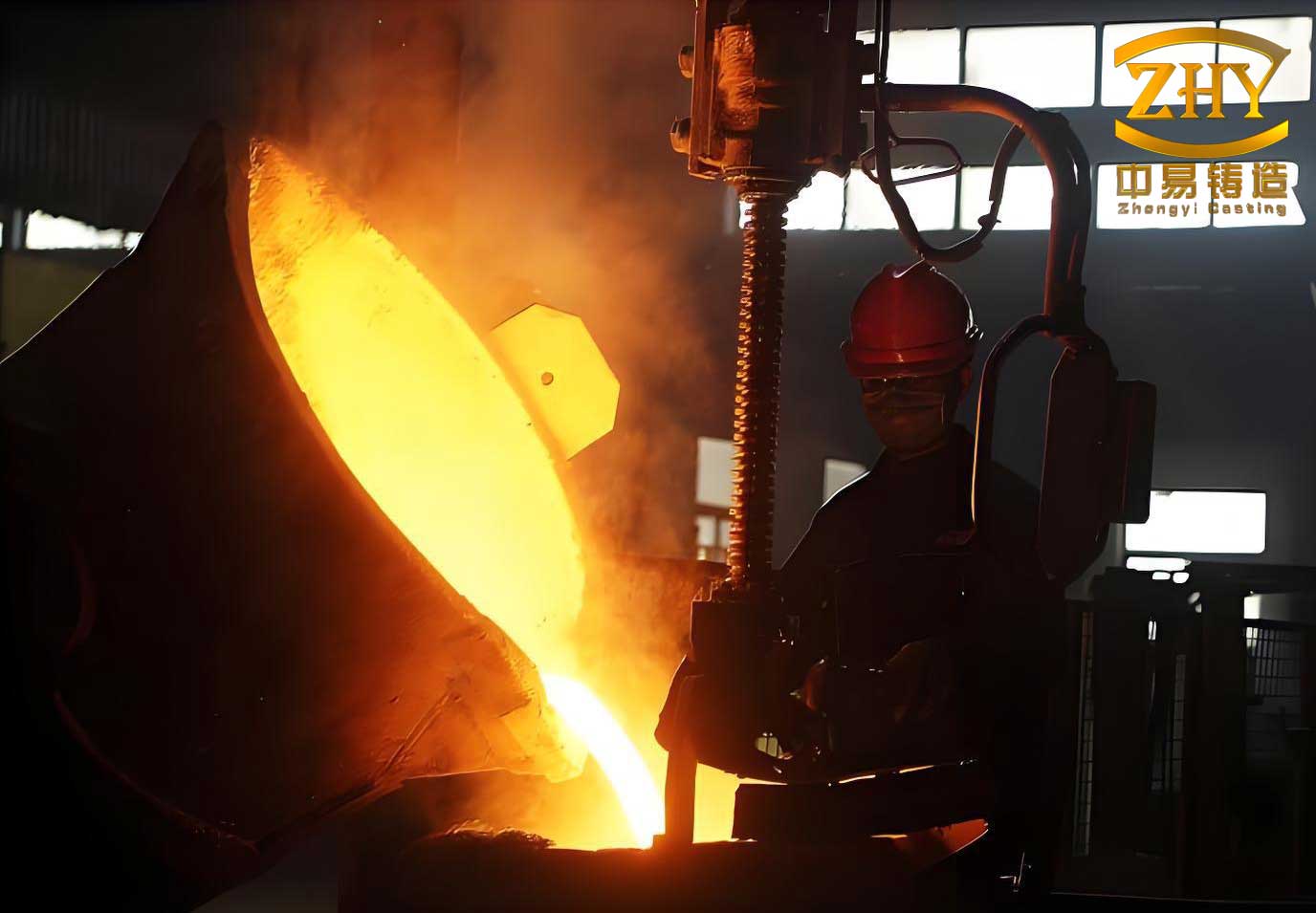
Advanced steelmaking is non-negotiable for heavy high manganese steel casting. Traditional melting furnaces often fail to achieve the necessary low levels of gaseous impurities and non-metallic inclusions. We employ a duplex process: primary melting in an Electric Arc Furnace (EAF) followed by secondary refining in a Ladle Furnace (LF) with argon stirring.
Argon stirring achieves several critical goals: homogenization of temperature and chemistry, removal of dissolved hydrogen and nitrogen, and flotation of oxide and sulfide inclusions. This results in a cleaner, more uniform melt. The practical benefits are profound:
$$ [O]_{final}, [H]_{final}, [N]_{final} \ll [O]_{tap}, [H]_{tap}, [N]_{tap} $$
$$ \text{Inclusion Count} \downarrow, \text{Inclusion Size} \downarrow $$
This refined metallurgical quality directly translates to a reduction in casting defects like gas porosity and inclusion-initiated cracks. Furthermore, improved fluidity allows for lower pouring temperatures, promoting finer grain structures. For our production, this process consistently enables phosphorus levels below 0.04% and sulfur below 0.015%, forming a robust foundation for defect-free heavy high manganese steel casting.
The铸造工艺 of high manganese steel is characterized by high fluidity but significant solidification shrinkage and thermal contraction, leading to hot tearing and shrinkage porosity risks in heavy sections. Numerical simulation (e.g., MAGMAsoft) is indispensable for predicting and eliminating these defects before production.
Key optimized铸造工艺 principles include:
- Mold & Core Design: Use of highly collapsible molding sands and cores to minimize mechanical resistance during contraction, reducing hot tear potential.
- Gating System: Employing an open, gating system with multiple, dispersed ingates at thinner sections to ensure rapid, tranquil filling and minimize thermal gradients.
- Feeding & Chilling: Strategic use of necked-down risers (feeder heads) combined with external chills at thermal centers. Chills accelerate local solidification, refining the grain structure and directing solidification towards the risers, effectively eliminating shrinkage cavities.
The efficacy of this approach is demonstrated through simulation. An initial design for a large crusher mantle showed significant centerline shrinkage. After optimization by repositioning risers and incorporating chills, the simulation confirmed the virtual elimination of major shrinkage defects, a prediction validated by actual castings.
Heat treatment, specifically water toughening (solution annealing and quenching), is what unlocks the legendary properties of high manganese steel casting. For heavy sections, precise control over every parameter is vital to dissolve carbides fully and prevent their re-precipitation.
1. Solution Temperature: For re-alloyed grades containing Cr and Mo, the solution temperature must be increased to dissolve the more stable carbides.
$$ T_{solution} = 1080^\circ\text{C} – 1100^\circ\text{C} $$
2. Holding Time: This is a function of the heaviest section thickness to ensure complete carbide dissolution and austenite homogenization.
$$ t_{hold} (\text{hours}) \approx \frac{\text{Maximum Section Thickness (mm)}}{25} $$
3. Quenching: Rapid cooling is essential. The transfer time from furnace to quench tank must be minimal (< 1 min), and the quenching water must be agitated and maintained below 50°C to ensure a cooling rate sufficient to bypass carbide precipitation.
$$ \frac{dT}{dt}_{quench} \text{ must be } > \text{ Critical Cooling Rate for Carbide Formation} $$
4. Tempering (Stress Relieving): A critical, often-overlooked step for heavy high manganese steel casting. After water toughening, machining, and weld repair, residual stresses remain. A low-temperature temper below the carbide precipitation range (250°C) effectively relieves these stresses without compromising the austenitic structure, resulting in a measurable increase in impact toughness.
| Material Condition | Yield Strength (MPa) | Tensile Strength (MPa) | Elongation (%) | Impact Energy (J) |
|---|---|---|---|---|
| Water-Toughened | ~ 450 | ~ 940 | ~ 45 | ~ 145 |
| Water-Toughened & Tempered | ~ 445 | ~ 915 | ~ 46 | ~ 210 |
The table above illustrates the benefit: tempering increases impact energy by over 40% while maintaining other mechanical properties, significantly enhancing the damage tolerance of the heavy high manganese steel casting.
In summary, the consistent production of high-integrity heavy-section high manganese steel casting is not reliant on a single silver bullet but on the integrated application of multiple advanced technologies. It begins with intelligent re-alloying chemistry designed for hardenability and toughness. This is enabled by ladle refining to achieve exceptional melt purity and homogeneity. The casting process must be rigorously optimized via simulation to manage solidification and contraction. Finally, a precisely controlled heat treatment cycle, culminating in a stress-relieving temper, is essential to deliver a fully austenitic, high-toughness component ready for the most demanding impact-abrasion service. This comprehensive methodology has proven essential for manufacturing large crusher components that meet the stringent performance requirements of modern mining and aggregate processing industries.