
In my extensive experience within the manganese steel casting foundry industry, the pervasive issue of crack formation in high manganese steel castings represents a significant challenge, often accounting for a substantial portion of rejection rates. This article synthesizes years of practical observation and technical analysis to delve deeply into the multifaceted causes of cracking and present a systematic framework for its prevention. The goal is to provide a detailed, actionable guide that leverages both theoretical principles and foundry-floor wisdom.
The inherent properties of high manganese steel, while excellent for wear resistance under impact loading, also predispose it to thermal cracking. The primary driver is its substantial volumetric change during solidification and cooling. The linear shrinkage value for high manganese steel is significantly greater than that of plain carbon steels, a factor that directly escalates the risk of hot tearing. This can be conceptually represented by the fundamental shrinkage formula:
$$ \epsilon_{sh} = \alpha \cdot (T_{pour} – T_{room}) $$
Where \( \epsilon_{sh} \) is the total linear shrinkage strain, \( \alpha \) is the effective linear thermal contraction coefficient for the alloy through its cooling range, \( T_{pour} \) is the pouring temperature, and \( T_{room} \) is ambient temperature. For a typical manganese steel casting foundry alloy, \( \alpha \) is in the range of 2.4% to 3.0% over the full cooling cycle, a value that must be meticulously accommodated in pattern design.
Compounding this issue is the low thermal conductivity (\( k \)) of high manganese steel. Its conductivity is approximately one-quarter to one-sixth that of carbon steel. This low \( k \) value creates steep thermal gradients within the casting during both heating and cooling phases, generating significant thermal stresses. The resultant stress (\( \sigma_{th} \)) in a constrained section can be approximated by:
$$ \sigma_{th} = E \cdot \alpha \cdot \Delta T $$
Here, \( E \) is Young’s modulus, \( \alpha \) is the coefficient of thermal expansion, and \( \Delta T \) is the temperature difference between the core and surface of a casting section. When \( \sigma_{th} \) exceeds the high-temperature strength of the material at the coherent solid network stage, hot cracks initiate.
The solidification morphology further sets the stage for crack susceptibility. In a manganese steel casting foundry, we observe that high manganese steel readily forms coarse columnar grains and dendritic structures in the as-cast state. A network of brittle carbides, primarily (Fe,Mn)3C, precipitates along these grain boundaries, drastically reducing the intergranular strength and ductility during the final stages of solidification. This creates an internal condition ripe for crack propagation. The critical time for crack initiation is during the formation of the initial solid shell, particularly at thermal hotspots where stress concentration is highest.
| Property | High Manganese Steel | Low Carbon Steel (Comparison) | Impact on Cracking |
|---|---|---|---|
| Linear Shrinkage (%) | 2.4 – 3.0 | 1.8 – 2.2 | Higher strain must be accommodated. |
| Thermal Conductivity (W/m·K) ~ at 500°C | ~15 | ~45-50 | Promotes high thermal gradients and stress. |
| High-Temperature Strength (MPa) ~ at 1200°C | Low (Coherent Solid) | Comparatively Higher | Lower resistance to stress during solidification. |
| Typical As-Cast Grain Structure | Coarse Columnar/Dendritic | Finer Equiaxed | Provides easy path for crack propagation along boundaries. |
From the perspective of a manganese steel casting foundry, the casting process itself introduces numerous variables that can exacerbate these inherent tendencies. The design of the gating and feeding system is paramount. A poorly designed system that creates hot spots or imposes mechanical restraint during contraction is a direct invitation for cracks. For instance, multiple ingates that converge can create a localized region of high thermal stress. The function of a riser is not only to feed shrinkage but also to act as a “hot link” that allows for more controlled contraction. The efficiency of a riser can be related to its modulus:
$$ M_{riser} = \frac{V_{riser}}{A_{riser}} $$
Where \( V \) is volume and \( A \) is surface area. For effective feeding and to minimize cracking in adjacent regions, \( M_{riser} \) must be greater than the modulus of the casting section it is intended to feed. The strategic use of chills is equally critical in a manganese steel casting foundry. Chills extract heat rapidly, promoting directional solidification towards the feeder. However, improper application—such as using warped chills or having excessive gaps between them—can create uneven cooling and severe stress concentrations, leading to cracks precisely at these junctions.
The chemical composition is the foundational variable that every manganese steel casting foundry must control with extreme precision. Carbon and phosphorus are the two most influential elements regarding crack sensitivity. Higher carbon content leads to a greater volume fraction of eutectic carbides in the inter-dendritic and grain boundary regions in the as-cast condition. Phosphorus, even in small amounts, segregates strongly to the solidifying front and forms brittle phosphide networks at grain boundaries. The combined embrittling effect can be conceptualized. A simplified model for the susceptibility (S) might consider these factors additively:
$$ S \propto [C]^2 + k_P \cdot [P] $$
Where [C] and [P] are weight percentages, and \( k_P \) is a large proportionality constant highlighting phosphorus’s severe impact. This underscores why specifications for manganese steel casting foundry products mandate very low phosphorus limits, often below 0.06% or even 0.04%.
| Element | Target Range (wt.%) | Maximum Limit for Critical Castings | Primary Effect Related to Cracking |
|---|---|---|---|
| Carbon (C) | 1.05 – 1.25 | 1.20 | Higher C increases carbide volume, reducing high-temperature ductility. |
| Manganese (Mn) | 11.0 – 14.0 | 14.0 | Stabilizes austenite; very high Mn can promote segregation. |
| Silicon (Si) | 0.30 – 0.80 | 0.60 | Deoxidizer; high Si can increase hardness and reduce toughness. |
| Phosphorus (P) | As low as possible | 0.04 – 0.06 | Severe grain boundary embrittlement via phosphide formation. |
| Sulfur (S) | < 0.04 | 0.025 | Forms sulfides; can act as stress raisers. |
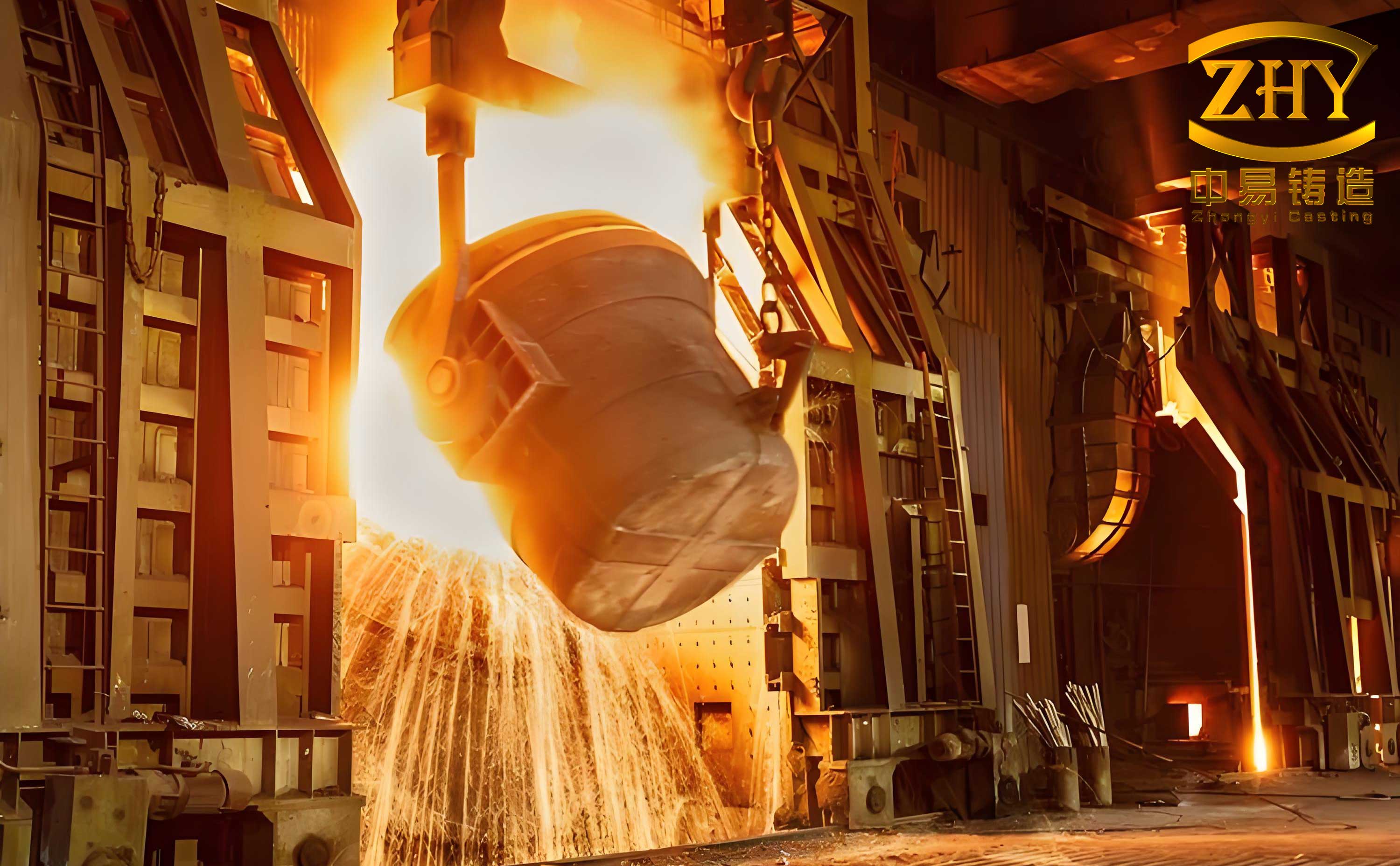
Melting and pouring practices in a manganese steel casting foundry are just as critical as chemistry. The state of the melt, particularly its oxygen potential, influences cleanliness and grain boundary strength. A highly oxidized melt, indicated by high levels of FeO and MnO in the slag, leads to oxide inclusions within the casting. These inclusions act as potent initiators for cracks under stress. Therefore, maintaining a reducing slag with (FeO+MnO) content typically below 1.2% is a standard practice. Pouring temperature is another lever we control meticulously. While fluidity is necessary, excessive superheat coarsens the as-cast grain structure, widening the columnar zone and amplifying segregation. The relationship between grain size (d) and pouring superheat (\(\Delta T_{super}\)) is generally direct. A lower pouring temperature, coupled with rapid filling to avoid mistruns, is the ideal strategy to refine structure and reduce stress.
The post-casting phase, encompassing shakeout and heat treatment, is where many cracks can either be avoided or catastrophically induced. In our manganese steel casting foundry, we never extract red-hot castings from the mold. The shock of exposure to ambient air can quench the surface, creating massive thermal stress. The castings must cool slowly within the mold to below approximately 200°C before shakeout. The heat treatment—water quenching from solutionizing temperature—is designed to dissolve carbides and achieve the tough austenitic microstructure. However, the heating cycle to reach the solutionizing temperature (typically 1050-1100°C) is fraught with danger for complex castings. The heating rate, especially through the lower temperature range where the material has lower strength and thermal conductivity is still poor, must be carefully regulated. A safe heating profile can be defined piecewise:
For \( T < 650^\circ C \): \( \frac{dT}{dt} \leq 50^\circ C/hour \)
For \( 650^\circ C \leq T \leq T_{solution} \): \( \frac{dT}{dt} \leq 100^\circ C/hour \)
Furthermore, a prolonged soak (or “equalization”) period of 1-2 hours is mandatory once the furnace reaches a temperature close to the casting’s initial temperature to minimize thermal shock upon charging.
During service, cracks often originate from pre-existing discontinuities that escaped detection. Subsurface shrinkage porosity or micro-shrinkage acts as a stress concentrator under cyclic impact loading. The Paris-Erdogan law governing fatigue crack growth (\( da/dN \)) is relevant here, even in a non-classical high-cycle fatigue sense for impact wear:
$$ \frac{da}{dN} = C (\Delta K)^m $$
Where \( a \) is crack length, \( N \) is the number of cycles (or impacts), \( C \) and \( m \) are material constants, and \( \Delta K \) is the stress intensity factor range. A casting defect provides the initial crack length \( a_0 \), from which propagation begins. Therefore, the foundry’s goal is to eliminate these initiation sites through sound feeding and solidification control.
| Process Stage | Key Action | Technical Rationale & Practical Tip |
|---|---|---|
| Design & Pattern | Avoid sharp corners; use generous fillet radii (R > 0.2 x section thickness). Transition sections smoothly (e.g., use “T” instead of “+” junctions). | Reduces stress concentration factors. Fillet radius significantly lowers the theoretical stress concentration factor \( K_t \). |
| Molding & Coremaking | Use high-reef (good collapsibility) molding sand. Ensure core prints do not create hard constraints. | Allows the mold to yield during casting contraction, reducing tensile stress on the solidifying skin. |
| Gating & Risering | Prefer tangential or stepped gating to avoid direct impingement. Use side risers or knock-off risers instead of top risers when possible. Apply chills systematically to control solidification direction. | Minimizes localized superheating. Eliminates thermal shock from torch-cutting top risers. Chills must be flat, clean, and properly spaced (gap < 2mm). |
| Melting & Pouring | Maintain reducing slag (FeO+MnO < 1.2%). Pour at the lowest temperature ensuring complete filling (often 1420-1460°C). | Produces cleaner steel with fewer oxide stress raisers. Refines as-cast grain structure. |
| Cooling & Shakeout | Cool in mold to below 200°C. For very heavy sections, consider controlled furnace cooling. | Prevents thermal shock and allows stress relief through plastic deformation at elevated temperature. |
| Heat Treatment | Pre-heat furnace. Use slow heating rates (<50°C/h) to 650°C. Ensure proper solutionizing and rapid, uniform quench. | Prevents thermal stress cracking during heating. Achieves full carbide dissolution and the desired austenitic toughness. |
Implementing these measures requires a holistic, controlled approach across the entire manganese steel casting foundry workflow. It is not merely about adjusting one parameter but about creating a synergistic system where design, process engineering, metallurgy, and operational discipline align. For example, the choice of riser type connects directly to the finishing operations; a knock-off side riser is preferable as it avoids the thermal and mechanical stress of flame cutting, a common crack initiator. Similarly, the foundry layout must facilitate the careful handling of hot castings to prevent mechanical damage that can reveal subsurface imperfections or create new stress points.
From a quality assurance standpoint, non-destructive testing (NDT) methods like dye penetrant testing or ultrasonic testing are essential for identifying surface and near-surface defects that could become service-life cracks. However, the most cost-effective strategy is preventive process control. Statistical process control (SPC) charts for key variables such as pouring temperature, chemical analysis results (especially P and C), and heat treatment cycle times are invaluable tools for any modern manganese steel casting foundry. By monitoring these, trends toward a riskier process window can be detected and corrected before defective castings are produced.
In conclusion, the battle against cracking in high manganese steel castings is won through a deep understanding of the material’s physics and a relentless commitment to process optimization at every stage. The manganese steel casting foundry that masters the interplay between high shrinkage, low conductivity, microstructural sensitivity, and mechanical restraint will consistently produce sound, reliable castings. The principles outlined here—rooted in fundamental engineering formulae and systematized in practical tables—form a robust framework. By treating the casting system as an integrated whole, from molten metal to finished heat-treated component, and by embedding rigorous controls and continuous improvement, the incidence of cracks can be reduced from a dominant failure mode to a rare exception, ensuring the superior performance that high manganese steel is renowned for in the most demanding impact and abrasion applications.