
The pursuit of cost-effective, high-performance components consistently drives innovation within the manganese steel casting foundry sector. A prime example is the production of counterbalance weights for compressors, critical components designed to counteract rotational imbalance in motors. Traditionally manufactured from hot-forged brass, these parts presented a significant material cost burden. Our engineering team successfully transitioned this production to an investment casting process utilizing high manganese steel, achieving a remarkable 40-50% reduction in production cost while meeting stringent dimensional, surface finish, and non-magnetic requirements. This article details the comprehensive process parameters, metallurgical considerations, and innovative solutions developed in our manganese steel casting foundry to produce these complex, thin-walled, deep-hole components reliably and economically.
The component in question is a relatively simple, smooth-arc-shaped part with the primary complexity residing in two stepped holes at each end. These features define it as a deep-hole, thin-wall casting, with a minimum wall thickness of 1.25 mm and a total hole depth of 17.0 mm. The specifications demand a surface roughness of Ra 1.6 µm, dimensional tolerances within ±0.2 mm, and critically, a near-complete absence of magnetism (residual magnetism < 5×10⁻⁴ T, relative permeability ≤ 1.05). Investment casting, or precision lost-wax casting, is the ideal near-net-shape process for such requirements, capable of achieving CT4-CT6 dimensional tolerance and excellent surface finish. The non-magnetic property hinges on obtaining a stable austenitic microstructure at room temperature, a hallmark of appropriately heat-treated high manganese steel. Thus, the project synthesized the capabilities of a precision manganese steel casting foundry with the unique material science of austenitic manganese steel.
Metallurgical Foundation: Optimizing Chemistry for Castability and Performance
The selection and optimization of chemical composition are the first critical steps in any manganese steel casting foundry operation. For a non-magnetic application, the primary goal is to secure a fully austenitic structure that remains stable under service conditions (which, for a counterbalance, does not involve significant impact or abrasion). In the Fe-Mn-C system, both manganese and carbon are potent austenite stabilizers. While a minimum of approximately 16 wt% Mn is required to suppress the austenite-to-martensite transformation (Ms point) below room temperature in lower-carbon alloys, carbon significantly enhances austenite stability. This allows for a strategic reduction in the more expensive manganese content. However, increasing carbon also raises hardness and strength, potentially complicating post-casting trimming and grinding operations. Therefore, a balanced composition is essential.
Our optimized chemistry for the counterbalance is presented in Table 1. This formulation ensures sufficient austenite stability for non-magnetic properties while maintaining good foundry characteristics such as fluidity and minimizing hot tearing susceptibility. The low silicon content helps control carbide formation during solidification and cooling.
| Element | Weight Percentage (wt%) | Primary Role |
|---|---|---|
| C | 0.5 – 1.0 | Austenite stabilizer, increases hardness and strength. |
| Mn | 13.0 – 18.0 | Primary austenite stabilizer, lowers Ms point dramatically. |
| Si | 0.2 – 0.9 | Deoxidizer, improves fluidity; high levels promote carbide formation. |
| P | ≤ 0.09 | Impurity; kept low to avoid embrittlement. |
| S | ≤ 0.08 | Impurity; kept low to avoid hot shortness. |
| Fe | Balance | Base element. |
The stability of austenite can be approximated using empirical formulas that estimate the martensite start temperature (Ms). One such formula for high Mn steels is:
$$ M_s(°C) = 545 – 30(\%C) – 17(\%Mn) – 17(\%Ni) – 21(\%Mo) $$
For our nominal composition (e.g., 0.8%C, 15%Mn), the calculation yields an Ms point significantly below 0°C, confirming the feasibility of retaining austenite upon quenching. The key for the manganese steel casting foundry is to ensure this structure is achieved and maintained through proper heat treatment, preventing the formation of embrittling carbides at grain boundaries.
Precision Pattern and Shell Engineering
The journey of the counterbalance in our manganese steel casting foundry begins with the creation of a precise wax pattern assembly. The wax pattern must faithfully replicate the final part, including the challenging deep holes. We use a specialized injection-molding wax (P201 type). Critical parameters are tightly controlled: injection temperature at 80°C, pressure at 3 MPa, and injection times of 20-24 seconds depending on the pattern element. Environmental control in the wax room is paramount; temperature is maintained at 24 ± 2°C and humidity between 40-70% to prevent pattern distortion or surface imperfections.
The gating and feeding system is designed with multiple objectives: to facilitate shell building, ensure proper metal filling, provide effective feeding for shrinkage, and allow for efficient dewaxing and cleaning. A tree assembly of 40 patterns is standard for production efficiency. The system features three long, sturdy vertical runners that act as both structural supports during shell building and as feeding risers. Strategic reinforcement ribs are added at the base of the runner and between the pour cup and the main runner to prevent shell cracking and to provide handling points during the pouring operation. The orientation of the patterns on the tree is crucial; they are angled to assist in the escape of molten wax during autoclave dewaxing and to allow slag to float away from the casting cavity during metal pour. The design philosophy here embodies the precision required in a modern manganese steel casting foundry.
The shell-building process transforms the wax assembly into a robust, refractory mold. We employ a multi-layer ceramic shell system, as detailed in Table 2. The process starts with a prime coat that directly contacts the molten metal. For this, we use a slurry of colloidal silica binder (830 grade) and fine 320-mesh white alumina flour. The slurry’s viscosity, measured in a Zahn cup (#4 or #5), is meticulously controlled between 42-45 seconds. A wetting agent (0.6%) and defoamer (0.2%) are added to ensure complete coverage of the intricate wax pattern, especially the deep recesses. The first two layers are stuccoed with fine 70-80 mesh white alumina sand to produce a smooth surface finish.
| Layer | Slurry Composition | Liquid/Powder Ratio | Viscosity (Zahn #4, s) | Stucco Material | Drying Time (h) |
|---|---|---|---|---|---|
| 1 & 2 (Face Coat) | Colloidal Silica + White Alumina Flour | 3.6 : 1 | 42 – 45 | 70/80 Mesh White Alumina | 4 – 6 |
| 3 (Back-up) | Colloidal Silica + Mullite Flour | ~3.6 : 1 | 22 – 25 | 70/80 Mesh Mullite | 8 |
| 4 & 5 (Back-up) | Colloidal Silica + Mullite Flour | ~3.6 : 1 | 13 – 19 | 70/80 Mesh Mullite | 8 – 14 |
| Seal Coat | Colloidal Silica + Mullite Flour | ~3.6 : 1 | 16 – 19 | — | 14 |
Subsequent backup layers use a more economical colloidal silica and mullite flour system, stuccoed with mullite sand. The viscosity is progressively lowered for these layers to ensure adequate penetration and bonding without excessive build-up. A final seal coat without stucco is applied to densify the shell’s exterior. Each layer requires complete drying under controlled conditions; inadequate drying, particularly within the deep core areas, is a primary cause of defects like shell spalling, gas bubbles, or misruns. We optimize drying by ensuring adequate spacing between trees, using forced air circulation, and adhering to strict drying schedules. The shell’s final properties—green strength, fired strength, and permeability—are a direct result of this layered engineering, a core competency of any successful manganese steel casting foundry.
The drying process for a ceramic layer can be modeled as a diffusion-controlled mechanism. The rate of moisture loss is critical to avoid cracks. An approximation of the drying time for a given layer thickness can be related to the square of the thickness, following a relationship like:
$$ t_d \propto \frac{L^2}{D_{eff}} $$
where \( t_d \) is the drying time, \( L \) is the characteristic thickness of the slurry layer, and \( D_{eff} \) is the effective diffusivity of moisture through the porous coating. This underpins the need for longer drying times for thicker slurry applications or in poorly ventilated areas like deep cavities.
Melting, Dewaxing, and Pouring: Critical Thermal Operations
Prior to melting, the ceramic shell must undergo a high-temperature firing process to remove any residual wax, burn off organic binders from the prime coat, and sinter the ceramic into a strong, stable mold. This step proved to be one of the significant challenges initially encountered in our manganese steel casting foundry. Using a low-calorific-value producer gas, the furnace struggled to reach and maintain the required temperature profile. Incomplete firing, or “under-roasting,” resulted in shells with low strength and high gas content, leading to casting defects such as scabbing, gas porosity, and insufficient feeding.
The solution was a transition to a natural gas-fired furnace. The higher and more consistent heat input ensured the shells reached a minimum temperature of 1050°C and were held there for over 30 minutes. This guaranteed complete wax removal, proper sintering of the ceramic matrix, and a adequately preheated mold ready to receive the molten metal. The thermal energy required to heat a shell from ambient to firing temperature can be estimated by:
$$ Q_{shell} = m_{shell} \int_{T_{ambient}}^{T_{fire}} C_p(T) \, dT $$
where \( m_{shell} \) is the mass of the ceramic shell, \( C_p(T) \) is its temperature-dependent specific heat, and \( T_{fire} \) is the firing temperature (~1050°C). The higher efficiency of the natural gas burner reliably supplied this energy demand.
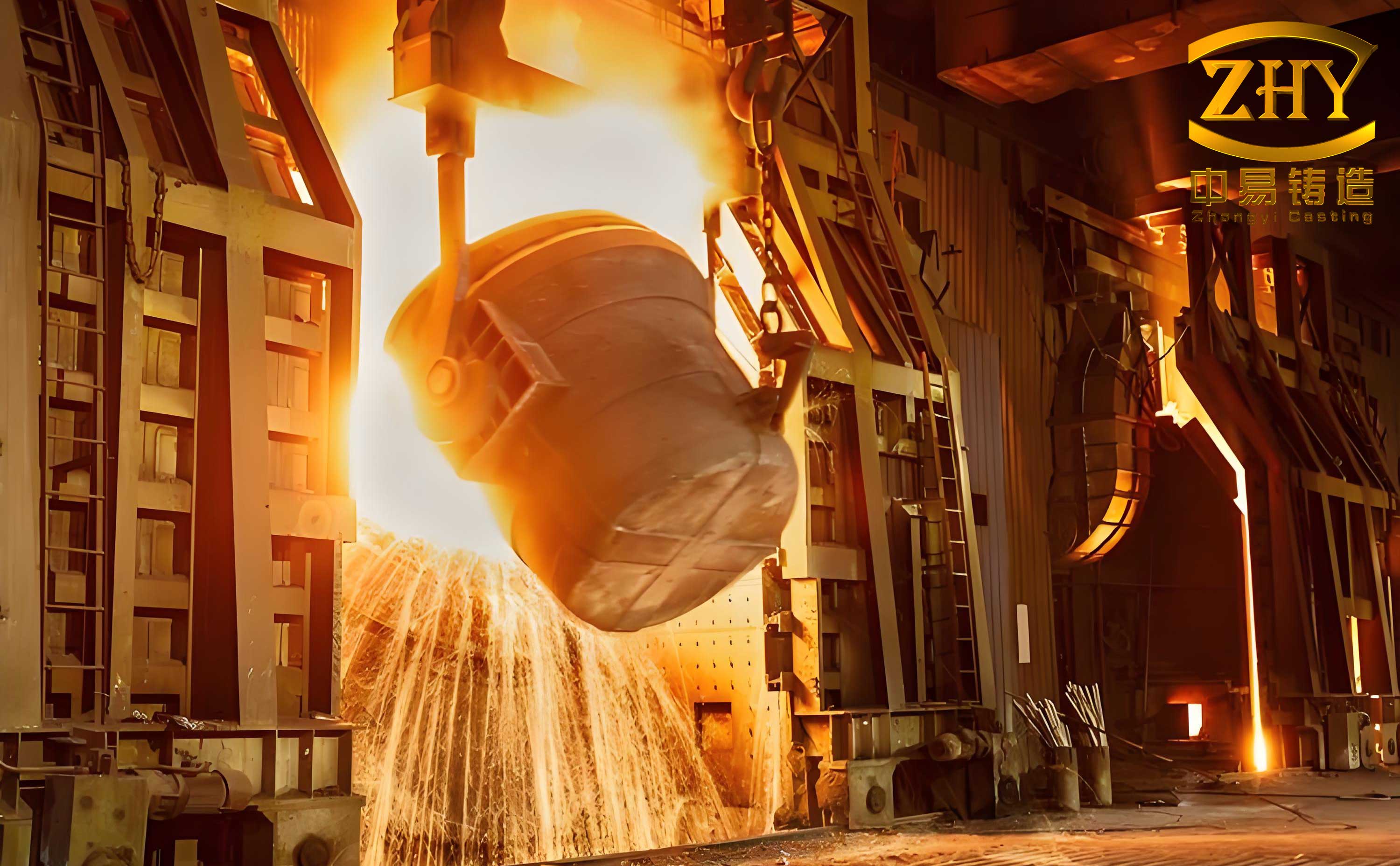
The melting of high manganese steel is conducted in a medium-frequency induction furnace. Induction melting is preferred in a manganese steel casting foundry for its excellent stirring action, which promotes homogeneity, and its relatively rapid melting, which helps minimize manganese loss through oxidation. The charge consists of carbon steel scrap, ferro-manganese (high and medium grades for adjustment), deoxidizers (aluminum wire, calcium-silicon-manganese), and a slag-forming flux. A typical charge calculation accounts for element recovery rates (e.g., Mn recovery is often 85-95%).
The molten metal is superheated to 1600-1620°C to ensure adequate fluidity and to keep carbides in solution before the casting solidifies. The pouring temperature is carefully controlled between 1560-1580°C. Pouring into a hot, properly fired shell is essential to prevent mistuns in the thin sections and to promote directional solidification towards the feeder heads (the vertical runners). The fluidity of molten steel is a complex function of temperature, composition, and surface tension. While not a simple linear relationship, the superheat (\( \Delta T = T_{pour} – T_{liquidus} \)) is a primary driver. For our manganese steel composition, the liquidus temperature is approximately 1400-1450°C, providing a superheat of 150-200°C, which is sufficient for filling the thin-walled features.
Heat Treatment: Overcoming the “Surface Magnetism” Challenge
As-cast high manganese steel contains a network of brittle carbides, primarily at grain boundaries, which make it hard and unsuitable for service. The standard treatment is water toughening (solution annealing followed by rapid quenching), which dissolves the carbides into the austenite matrix and retains that single-phase structure at room temperature. The conventional process involves heating to 1050-1100°C, holding for sufficient time (typically 1-2 hours per inch of section thickness), and then quenching rapidly in water.
Applying this standard process to the counterbalances initially yielded austenitic, non-magnetic castings. However, a subsequent problem emerged: after the water quench, a heavy oxide scale formed on the casting surface. To remove this scale, shot blasting was employed. The high-velocity impact of the steel shot on the austenitic surface induced severe localized plastic deformation. High manganese austenite is renowned for its work-hardening capability, which under extreme deformation can trigger a strain-induced transformation to martensite (ε-martensite or α’-martensite). This surface layer of martensite is ferromagnetic, resulting in a “floating magnetism” phenomenon that violated the product’s non-magnetic specification.
This presented a critical problem for our manganese steel casting foundry: the very process used to clean the part re-introduced the disqualifying property. The solution required a fundamental rethinking of the heat treatment process. We implemented a modified heat treatment system comprising two key innovations:
- Atmosphere-Controlled Furnace: We replaced the conventional air-atmosphere furnace with a mesh-belt continuous furnace capable of introducing a protective atmosphere. We use a dissociated ammonia (75% H2, 25% N2) atmosphere, which is strongly reducing, preventing the formation of surface oxide scales during both heating and cooling.
- Indirect Water Quench: The furnace is designed with a cooling zone that uses water-jacketed cooling channels. The castings are cooled rapidly by conduction and radiation to the cooled walls and atmosphere, not by direct immersion in water. This provides a sufficiently fast quench for the thin-section castings to prevent carbide precipitation while avoiding the thermal shock and oxidation of a water bath.
The modified thermal cycle is as follows: Heat to 1100°C with a hold time of approximately 40 minutes (sufficient for the thin sections), then rapidly cool within the protective atmosphere to below 500°C. The resulting castings emerge with a bright, metallic surface, completely free of oxide scale. This eliminates the need for shot blasting entirely, thereby removing the source of deformation-induced martensite and solving the floating magnetism issue.
The prevention of martensite formation is governed by the stability of the austenite, which can be assessed by its stacking fault energy (SFE) and Md30 temperature (the temperature at which 50% martensite forms after 30% true strain). For high Mn steels, the SFE is relatively high, promoting dislocation glide over twinning or transformation. However, under severe impact, transformation can still occur. The modified process eliminates the high-impact cleaning step. The Ms temperature can be estimated more accurately for our specific composition. A common formula for high Mn steels is:
$$ M_s(K) = 764 – 302(\%C) – 33.5(\%Mn) – 16.3(\%Ni) + 8.6(\%Cr) $$
Converting to Celsius and using our nominal composition confirms Ms is well below room temperature. The continuous cooling transformation (CCT) diagram for this steel shows that to avoid carbide precipitation, cooling from solution temperature must be faster than a critical rate, \( V_c \). For thin-section castings, the indirect forced convection cooling in our furnace exceeds \( V_c \), ensuring a carbide-free austenitic structure. The successful implementation of this tailored heat treatment is a testament to the problem-solving capabilities required in a specialized manganese steel casting foundry.
Conclusion and Economic Impact
Through the systematic optimization of chemistry, precision wax and shell engineering, controlled melting and pouring, and an innovative protective-atmosphere heat treatment, we have established a robust and reliable process for manufacturing compressor counterbalances via investment casting of high manganese steel. The integration of these disciplines within our manganese steel casting foundry has resulted in a product that meets all dimensional, surface, and stringent non-magnetic specifications with a consistent first-pass yield exceeding 95%.
The economic advantage is profound. By substituting investment-cast high manganese steel for hot-forged brass, the total production cost was reduced by 40-50%. This saving stems from the lower raw material cost of steel versus copper alloys, the near-net-shape efficiency of investment casting minimizing machining waste, and the streamlined heat treatment that eliminated secondary cleaning operations. This case study exemplifies how advanced materials engineering and precision casting techniques can converge to deliver superior value, highlighting the critical role of the modern manganese steel casting foundry in driving innovation and cost-effectiveness in component manufacturing for demanding industrial applications.