
In the mining, metallurgy, and construction industries, jaw crushers are indispensable equipment for material fragmentation. The jaw plates, which undergo severe abrasive and impact wear during operation, are typically made from water-quenched high manganese steel. However, in cold regions, these components often suffer from brittle fracture, leading to significant economic losses. As a researcher involved in advanced material development at a specialized manganese steel casting foundry, I have undertaken an in-depth investigation into the enhancement of high manganese steel through boron alloying. This study focuses on the microstructure, mechanical properties, and wear resistance of alloyed high manganese steel jaw plates, with particular emphasis on low-temperature performance. The goal is to address the limitations of conventional high manganese steel and improve service life in harsh environments.
The foundation of this work lies in the expertise of a modern manganese steel casting foundry, where precise control over composition and heat treatment is critical. High manganese steel, primarily austenitic after solution treatment, relies on work-hardening under impact to achieve wear resistance. Yet, its low-temperature brittleness remains a challenge. By introducing alloying elements such as boron (B), chromium (Cr), and rare earth (RE), we aimed to refine the microstructure and enhance mechanical properties. This article presents our findings from a comprehensive experimental program, incorporating extensive data analysis through tables and formulas to elucidate the underlying mechanisms.
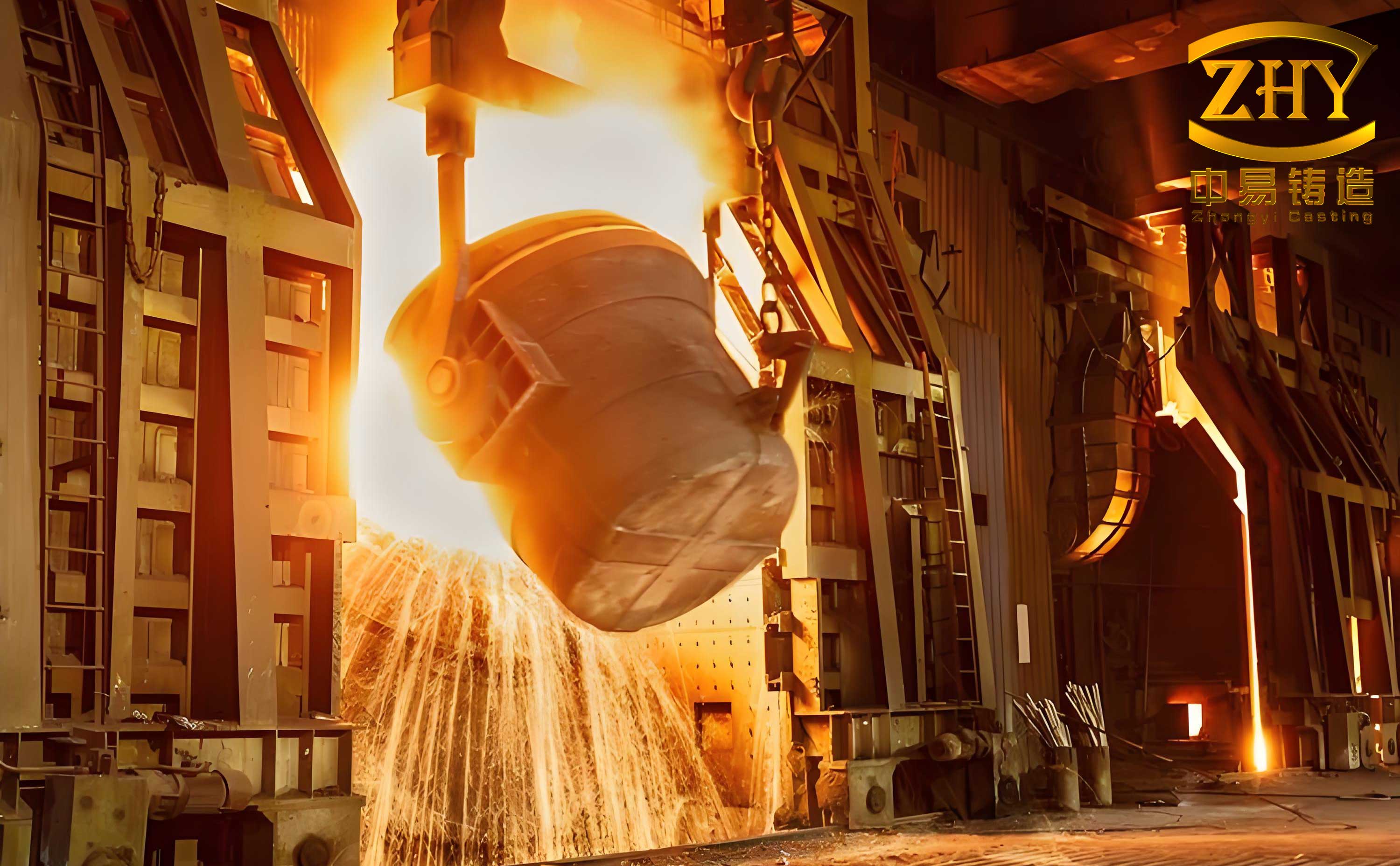
The production of jaw plates in a manganese steel casting foundry begins with meticulous melting and casting processes. For this study, the alloy was designed with specific chemical compositions to optimize performance. The base high manganese steel was modified with boron, chromium, and rare earth additions, as detailed in Table 1. The casting was performed using standard foundry practices, yielding jaw plates weighing approximately 900 kg each. The geometry of the jaw plate, crucial for stress distribution during crushing, was designed to minimize failure risks. Our manganese steel casting foundry ensured consistent quality through controlled pouring and solidification, which is essential for achieving uniform properties in large castings.
| Element | C | Si | Mn | Cr | S | P | RE | B |
|---|---|---|---|---|---|---|---|---|
| Content | 1.26 | 0.53 | 13.01 | 1.07 | 0.008 | 0.046 | 0.1 | 0.0044 |
The heat treatment process is a pivotal step in a manganese steel casting foundry, as it determines the final microstructure and properties. We investigated three different heat treatment regimes, as outlined in Table 2. Process 1 involved industrial-scale treatment following standard foundry protocols, while Processes 2 and 3 were conducted in a laboratory setting to explore variations in soaking temperatures and cooling rates. The objective was to assess how these parameters influence carbide dissolution and precipitation, which directly impact toughness and wear resistance. The general heat treatment curve can be described by a time-temperature function, where the soaking temperature $T_s$ and time $t_s$ are critical variables. For instance, the solution treatment aims to dissolve carbides into the austenitic matrix, which can be modeled as:
$$ C(t) = C_0 \cdot e^{-k t} $$
where $C(t)$ is the carbide concentration at time $t$, $C_0$ is the initial concentration, and $k$ is a rate constant dependent on temperature. In a manganese steel casting foundry, optimizing this process is key to balancing hardness and toughness.
| Process | Soaking Temperature (°C) | Soaking Time (h) | Cooling Method | Application |
|---|---|---|---|---|
| Process 1 | 1050 | 2 | Water Quench | Industrial (Foundry) |
| Process 2 | 1100 | 1.5 | Water Quench | Laboratory |
| Process 3 | 1150 | 1 | Water Quench | Laboratory |
Microstructural analysis revealed that the boron-alloyed high manganese steel consisted primarily of austenite and alloy carbides after water quenching. Using optical and transmission electron microscopy, we observed that Process 3 resulted in a higher volume fraction of fine carbides distributed both intra-granularly and along grain boundaries, compared to Processes 1 and 2. This can be attributed to the enhanced diffusion at higher soaking temperatures, promoting carbide precipitation. The presence of carbides is crucial for wear resistance, as they act as hard phases that impede abrasive wear. In a manganese steel casting foundry, controlling carbide morphology is essential, and the addition of boron facilitates the formation of stable borocarbides, which refine the grain structure. The grain size $d$ can be related to the boron content $[B]$ through an empirical equation:
$$ d = \alpha \cdot [B]^{-\beta} $$
where $\alpha$ and $\beta$ are material constants. This refinement contributes to improved toughness and hardness, as verified by our mechanical tests.
The mechanical properties of the alloyed steel were evaluated at both room and low temperatures. Table 3 summarizes the room-temperature impact toughness and hardness for the three heat treatment processes. Impact toughness, measured using Charpy U-notch specimens, is a critical indicator of fracture resistance under dynamic loading. Process 3 yielded the highest impact energy, underscoring the benefit of optimized heat treatment. Hardness was assessed using a Rockwell scale, with values consistent across processes but slightly higher for Process 3 due to finer carbide dispersion. These properties are vital for jaw plates in a manganese steel casting foundry, where components must withstand high-impact stresses without failure.
| Property | Process 1 | Process 2 | Process 3 |
|---|---|---|---|
| Impact Toughness $a_k$ (J/cm²) | 152.1 | 147.7 | 175.6 |
| Hardness (HB) | 215 | 212 | 221 |
Low-temperature performance was a focal point of this study, given the prevalence of brittle fractures in cold climates. We conducted impact tests at temperatures ranging from 20°C to -60°C on specimens treated with Process 1, which mimics industrial conditions in a manganese steel casting foundry. The results, presented in Table 4, show a significant decrease in impact toughness with reducing temperature. For instance, at -20°C, the toughness dropped to approximately 51.3% of the room-temperature value. This behavior is characteristic of materials undergoing a ductile-to-brittle transition (DBTT), which we analyzed in detail. The temperature dependence of impact energy $a_k$ can be modeled using an Arrhenius-type relation:
$$ a_k(T) = a_0 \cdot e^{-\frac{Q}{RT}} $$
where $a_0$ is a pre-exponential factor, $Q$ is the activation energy for brittle fracture, $R$ is the gas constant, and $T$ is the absolute temperature. This equation helps quantify the sensitivity of toughness to temperature changes, which is crucial for designing components in a manganese steel casting foundry for Arctic applications.
| Temperature (°C) | Impact Toughness $a_k$ (J/cm²) | Percentage of Room-Temperature Value (%) |
|---|---|---|
| 20 | 152.8 | 100 |
| 0 | 103.4 | 67.7 |
| -20 | 78.4 | 51.3 |
| -40 | 42.1 | 27.6 |
| -60 | 29.9 | 19.6 |
The ductile-to-brittle transition temperature (DBTT) was determined to be approximately -20°C based on macroscopic fracture analysis. At this temperature, the fracture surface exhibited about 50% brittle cleavage and 50% ductile dimples, aligning with the FATT50 criterion. Below -20°C, the fracture mode shifted predominantly to brittle intergranular failure, as observed in scanning electron microscopy images. This transition is critical for a manganese steel casting foundry, as it defines the lower service limit for jaw plates in cold environments. The DBTT can be influenced by alloy composition and microstructure; for our boron-alloyed steel, the addition of chromium and rare earth elements helped suppress grain boundary embrittlement, thereby lowering the DBTT compared to conventional high manganese steel.
Wear resistance is the ultimate measure of performance for jaw plates. In field trials, the boron-alloyed high manganese steel jaw plates produced in our manganese steel casting foundry demonstrated a service life increase of 2.3 times over conventional high manganese steel plates. Specifically, the alloyed plates crushed approximately 70,000 tons of nickel ore over 100 days of continuous operation, whereas the conventional plates lasted only 30 days, processing about 21,000 tons. This improvement stems from the synergistic effects of boron, chromium, and rare earth additions. Chromium forms hard, stable carbides (e.g., Cr₇C₃) that enhance abrasion resistance, while boron refines the microstructure and promotes work-hardening. The wear rate $W$ can be expressed as a function of hardness $H$ and carbide volume fraction $V_c$:
$$ W = \frac{K}{H \cdot V_c} $$
where $K$ is a constant dependent on operating conditions. By increasing $H$ and $V_c$ through alloying, we achieved a lower wear rate, extending component life. This underscores the importance of tailored alloy design in a manganese steel casting foundry to meet specific wear challenges.
To further elucidate the role of alloy elements, we performed thermodynamic calculations using Calphad methods to predict phase equilibria. The addition of boron reduces the austenite grain boundary energy, inhibiting carbide coarsening. Similarly, rare earth elements scavenge impurities like sulfur and phosphorus, which are known to embrittle grain boundaries. The effectiveness of impurity removal can be quantified by the segregation coefficient $S$, defined as:
$$ S = \frac{C_{gb}}{C_{bulk}} $$
where $C_{gb}$ is the impurity concentration at grain boundaries and $C_{bulk}$ is the bulk concentration. Lower $S$ values indicate better purification, contributing to improved toughness. In a manganese steel casting foundry, controlling these microalloying additions is essential for consistent quality.
The heat treatment optimization also plays a pivotal role. Process 3, with a higher soaking temperature, resulted in better carbide dissolution and subsequent reprecipitation of fine carbides upon cooling. This microstructure offers a favorable balance between strength and ductility. The yield strength $\sigma_y$ of the alloyed steel can be estimated using the Hall-Petch relationship and dispersion strengthening contributions:
$$ \sigma_y = \sigma_0 + k_y d^{-1/2} + \sigma_{disp} $$
where $\sigma_0$ is the lattice friction stress, $k_y$ is the strengthening coefficient, $d$ is the grain diameter, and $\sigma_{disp}$ is the strengthening due to dispersed carbides. For our boron-alloyed steel, the fine grain size and carbide dispersion led to enhanced yield strength without compromising toughness, a key advantage for jaw plates subjected to impact loads.
In terms of low-temperature applications, the DBTT of -20°C is a significant finding. This suggests that the alloyed steel can be safely used in temperate cold regions without risk of brittle fracture. However, for extreme cold below -40°C, additional modifications such as nickel additions might be considered. The impact energy transition can be modeled using a sigmoidal function, often employed in fracture mechanics:
$$ a_k(T) = \frac{A}{1 + e^{-B(T – T_0)}} + C $$
where $A$, $B$, $C$, and $T_0$ are fitting parameters, and $T_0$ represents the DBTT. Our data fit this model well, providing a predictive tool for engineers in a manganese steel casting foundry to tailor compositions for specific climate conditions.
The economic implications of this research are substantial. By extending jaw plate life by 2.3 times, downtime and replacement costs are significantly reduced, leading to higher productivity in mining operations. A manganese steel casting foundry can leverage these findings to offer premium alloyed components with documented performance benefits. Moreover, the environmental impact is positive due to reduced material consumption and waste.
Future work will focus on scaling up the production process in a manganese steel casting foundry setting, with attention to reproducibility and cost-effectiveness. We plan to explore other alloying elements like titanium and vanadium to further enhance properties. Additionally, advanced characterization techniques such as in-situ neutron diffraction could provide deeper insights into deformation mechanisms under low-temperature conditions.
In conclusion, this study demonstrates the efficacy of boron alloying in high manganese steel for jaw plate applications. Through meticulous control of composition and heat treatment in a manganese steel casting foundry, we achieved a microstructure with refined grains and dispersed carbides, resulting in superior mechanical properties and wear resistance. The ductile-to-brittle transition temperature was lowered to -20°C, mitigating low-temperature brittleness concerns. The field performance confirmed a 2.3-fold increase in service life, validating the laboratory findings. These results highlight the potential of alloyed high manganese steel to revolutionize wear-resistant components in harsh industrial environments, offering both technical and economic advantages. As the demand for durable materials grows, innovations from manganese steel casting foundries will continue to drive progress in the field.
To summarize key relationships, we present the following formulas that encapsulate the core findings:
1. Carbide dissolution kinetics: $$ C(t) = C_0 \cdot e^{-k t} $$
2. Grain size refinement with boron: $$ d = \alpha \cdot [B]^{-\beta} $$
3. Temperature-dependent impact toughness: $$ a_k(T) = a_0 \cdot e^{-\frac{Q}{RT}} $$
4. Wear rate model: $$ W = \frac{K}{H \cdot V_c} $$
5. Yield strength contribution: $$ \sigma_y = \sigma_0 + k_y d^{-1/2} + \sigma_{disp} $$
6. Ductile-to-brittle transition modeling: $$ a_k(T) = \frac{A}{1 + e^{-B(T – T_0)}} + C $$
These equations, coupled with the tabulated data, provide a comprehensive framework for optimizing high manganese steel in a manganese steel casting foundry. By integrating theoretical models with practical foundry experience, we can develop next-generation materials that meet the evolving challenges of the mining and construction sectors.