
In the specialized domain of manganese steel casting foundry operations, the production of components that are largely non-machined presents a unique set of challenges. The inherent properties of austenitic manganese steel—its exceptional work-hardening capability and toughness—are ultimately dependent on achieving precise dimensional accuracy and superior surface finish directly from the mold. At our manganese steel casting foundry, we have developed and refined a holistic process philosophy that integrates every stage, from pattern making to final inspection, to ensure these critical requirements are consistently met. This article details our first-person perspective and accumulated practices in manufacturing high-integrity manganese steel castings.
The cornerstone of dimensional control in any manganese steel casting foundry lies in the pattern shop. We predominantly employ pattern plates for high-volume production runs, typically exceeding several hundred pieces. The advantages are multifold: enhanced productivity, reduced unit cost, and most importantly, superior dimensional consistency and pattern surface finish. A critical practice is to always orient the pattern’s working face downward in the mold. This positioning not only safeguards pattern detail but also contributes to a cleaner, more defined casting surface. The fundamental calculation for pattern dimensions starts with the contraction allowance. For austenitic manganese steel, our foundry uniformly applies a linear shrinkage factor of:
$$ \text{Pattern Dimension} = \text{Finished Casting Dimension} \times (1 + 0.023) $$
This 2.3% allowance is a baseline, but intelligent application is key. For installation holes, we systematically apply a positive tolerance (“+” tolerance) on the pattern, meaning the hole cores are made larger to account for shrinkage, ensuring the final as-cast hole meets minimum size requirements. The center-to-center distance between holes, however, is held unchanged, with shrinkage applied to the overall length. For example, on a shovel tooth casting with two holes, the centerline remains fixed, but each hole diameter is increased by 3 mm on the pattern. For larger components like mill liner plates, hole enlargements may range from 2 to 5 mm. Furthermore, fillets are meticulously incorporated at features like square-head bolt seats to prevent stress concentration and casting cracks, which is a vital consideration for the service life of a manganese steel casting.
Our standard hole tolerance scheme applied at the pattern stage is summarized below:
| Hole Type | Diameter < 50 mm | Diameter ≥ 50 mm |
|---|---|---|
| Installation Hole | +2.0 mm / +1.0 mm (Tolerance) | +2.5 mm / +1.5 mm (Tolerance) |
| Non-Installation Hole | -1.0 mm / -2.0 mm (Tolerance) | -1.5 mm / -2.5 mm (Tolerance) |
Pattern inspection is rigorous. Beyond verifying dimensions and surface finish against drawings and工艺 specifications, we employ specific checks for critical features. For castings like cheek plates that come in matching pairs (male/female), the patterns are physically mated to ensure uniform contact without high spots. For极高精度 parts, reliance is placed on precise calculation supplemented by master setting templates. For components like track shoes, tolerance application is strategic: convex features are given a negative (“-“) tolerance, while concave features receive a positive (“+”) tolerance to facilitate assembly, a nuance critical for the proper functioning of manganese steel casting foundry products like undercarriage components.
The molding process is where surface quality is fundamentally captured. Our approach is tailored to casting geometry and section thickness:
| Casting Section Thickness | Feeding & Cooling Strategy | Gating Approach |
|---|---|---|
| ≤ 40 mm | Generally no risers. Use of chills and shaped chill inserts (chill thickness ≈ casting wall thickness). Accelerated cooling. | Preference for core gating systems. |
| > 40 mm (Medium/Small) | Use of knock-off or易割 risers for parts like hammers, teeth. | Conventional gating or core gating. |
| Vertical Pouring (Cylinders, Concaves) | Top open risers. | Conventional gating. |
| Large, Complex Shapes | Combination of blind and open risers. Mold coats applied on heavy sections. | Carefully designed gating for minimal turbulence. |
For cores, we standardize on zircon sand for its excellent refractoriness and superior finish, which also promotes easy knockout. A pivotal practice for surface integrity and preventing cracking is the hot removal of risers. Open and blind risers are cut off while the casting is still within a temperature range of $$ 600\ ^{\circ}\text{C} \text{ to } 800\ ^{\circ}\text{C} $$. For non-risered castings, we heavily favor core gating systems. This design disperses heat input, promotes directional solidification, and most importantly, after shakeout, the gates simply break off with a hammer blow, eliminating cutting and associated stress risers. The typical cross-section of our core gates is a standardized trapezoidal shape, designed for easy break-off. For critical castings with deep cores, core setting jigs are manufactured to guarantee accurate core placement and, consequently, correct internal dimensions like hole spacing. Dedicated, product-focused molding teams operating in fixed areas within the manganese steel casting foundry foster skill specialization and a deep understanding of product requirements, further cementing quality.
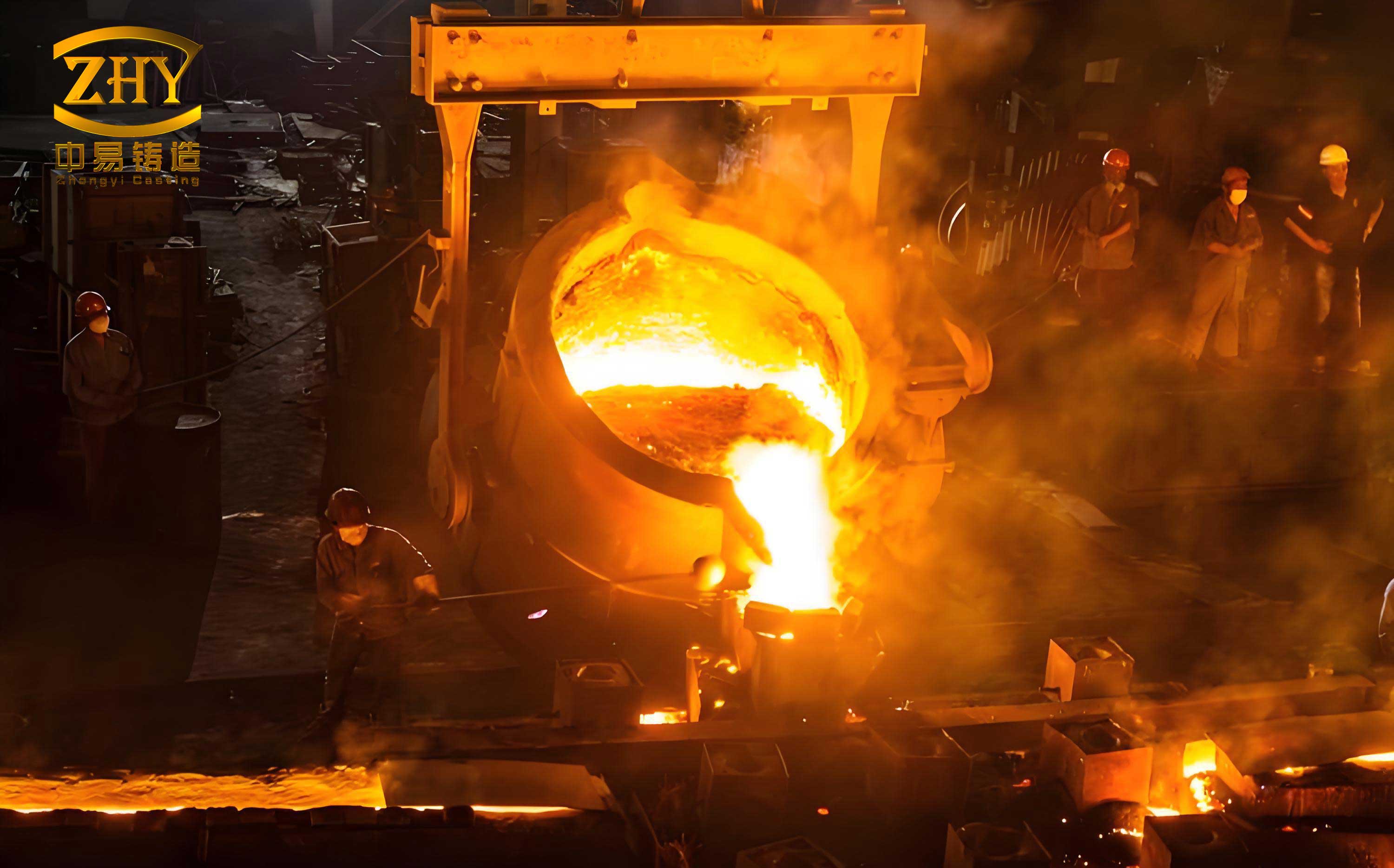
Melting and pouring constitute the heart of metallurgical control in a manganese steel casting foundry. Our furnace practice mandates rapid and thorough slag removal, followed by a refining period of no less than 15 minutes. A properly refined slag should appear white and powdery upon cooling. Temperature control is paramount. The tap temperature is strictly maintained between:
$$ 1500\ ^{\circ}\text{C} \text{ to } 1520\ ^{\circ}\text{C} $$
This is verified by disposable thermocouple, with two consecutive readings required to confirm the temperature is within the target window. After tapping, the steel is allowed to settle in the ladle for a minimum of 5 minutes to facilitate inclusion floatation. Pouring control is monitored via the “skin formation time” in the pouring cup, which is targeted between 6 to 8 seconds, with an ideal condition being a “no-skin” pour to minimize reoxidation.
Post-casting operations are carefully sequenced to prevent thermal cracking and ensure clean surfaces. Shakeout times are prescribed based on casting weight and geometry. After knockout, castings are buried in dry sand to slow cool to ambient temperature. Cleaning is predominantly done via shot blasting for small to medium parts like jaw plates and liners. Riser necks are removed using a hydraulic press for knock-off types. For castings requiring hot cutting, the temperature is controlled around $$ 200\ ^{\circ}\text{C} $$, after which they are covered in dry sand. The critical水韧处理 (water toughening or solution heat treatment) is performed only after all gates and risers are fully removed. The cycle involves heating to $$ 1050\ ^{\circ}\text{C} \pm 10\ ^{\circ}\text{C} $$, holding for sufficient austenitization (typically 1 hour per inch of section), followed by rapid quenching in agitated water. Furnace loading is strategic: heavier sections are placed near the burners/firewall, while thinner sections are placed near the door to minimize thermal gradients and distortion.
After quenching, residual fins and riser pads are removed via oxygen-acetylene torches, and surfaces are ground smooth. Any distortion or deviation in critical dimensions (like the opening width of a crusher jaw) is corrected using hydraulic presses for straightening before proceeding.
The final pillar of our system is rigorous成品检验 (finished product inspection). Every casting undergoes a full dimensional check against drawing requirements. For high-precision components or those with complex contours, custom inspection gauges and templates are employed. For critical assembly items like track links, a final prove-out is conducted: a sample batch of 3 to 5 pieces is assembled into a chain or mechanism and test-rotated to verify fit, function, and interchangeability. Only after passing this practical test is the production batch released. This commitment to functional validation, coupled with ongoing statistical sampling, underpins the reliability expected from a professional manganese steel casting foundry.
In essence, achieving consistent dimensional accuracy and surface quality in non-machined manganese steel castings is not the result of any single action but the product of a meticulously controlled and integrated process. From pattern engineering with intelligent tolerance application, through controlled molding and gating, strict metallurgical practices, disciplined thermal management, and finally, a comprehensive inspection regime, each step is interlinked. It is this systemic approach, deeply embedded in the culture of our manganese steel casting foundry, that transforms the challenging specifications for high-wear components into reliable, high-performance castings ready for the most demanding applications. The continuous refinement of these practices, including advanced melt treatments like argon stirring for gas and inclusion reduction, remains a focus for further enhancing the intrinsic quality of our manganese steel casting foundry products.