
In the manganese steel casting foundry industry, the production of critical components like railway frogs from high manganese steel is paramount due to their demanding service conditions. These castings endure repetitive pressure, impact, and vibrational loads, making internal integrity essential for safety and performance. As an engineer involved in vacuum molding (V-process) casting, I have extensively studied the challenges associated with riser removal, particularly the defects arising from traditional flame cutting methods. This article presents a comprehensive improvement in the riser removal process for high manganese steel castings, focusing on a novel breaker core design and modified feeding channels to enable hammer removal, thereby enhancing quality, reducing costs, and meeting environmental standards in manganese steel casting foundry operations.
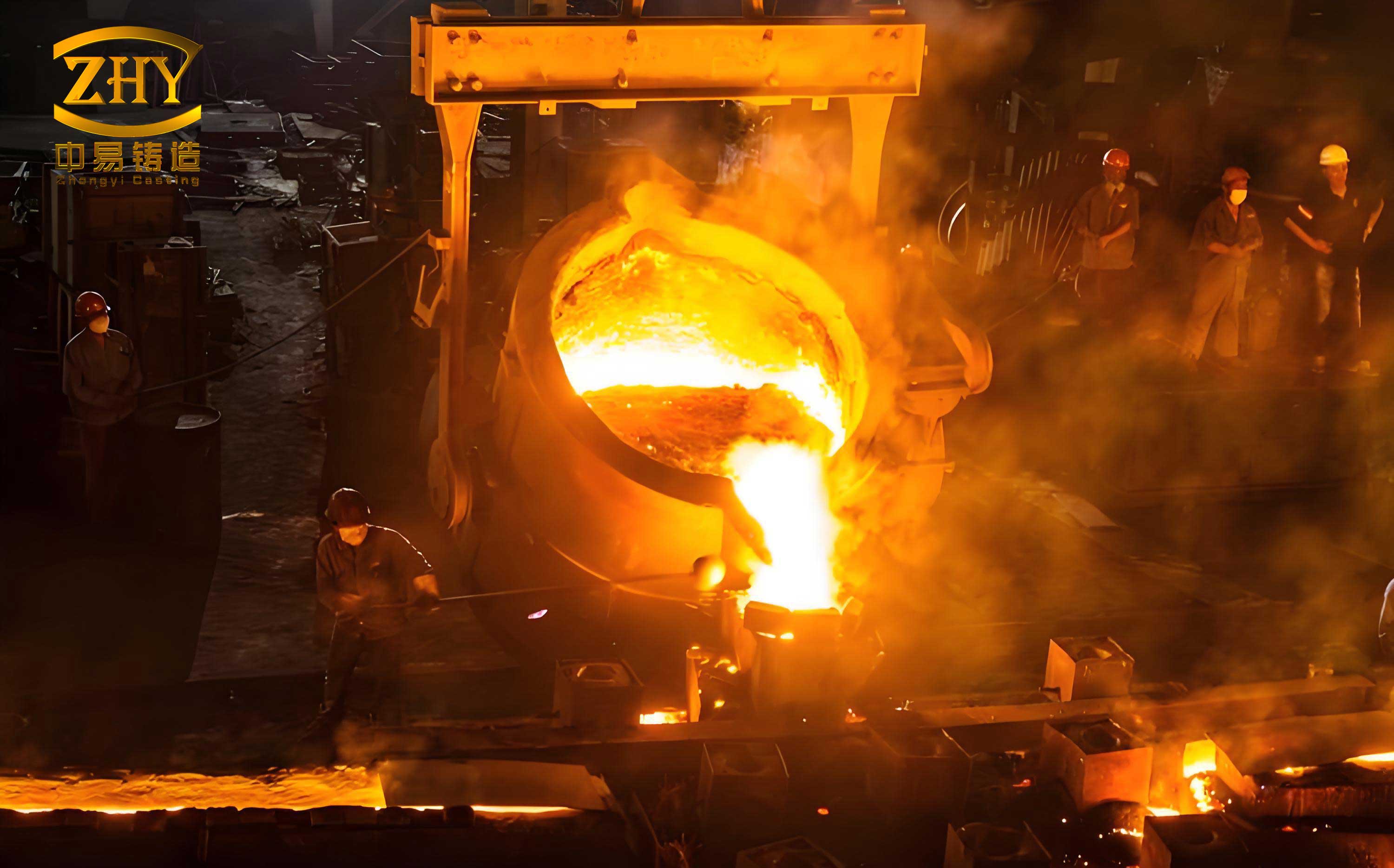
The V-process, widely used in manganese steel casting foundry for its ability to produce smooth surfaces and minimal distortion, involves creating a mold using vacuum pressure without binders. However, this method leads to rapid cooling, which complicates the feeding system during solidification. Risers are employed to compensate for shrinkage, but their removal via acetylene flame cutting after approximately 9 hours of pouring often induces defects such as shrinkage porosity, microcracks, and rail wall cracks. These issues stem from localized heating, thermal stresses, and premature solidification of feeding channels, compromising the casting’s structural integrity. In this context, optimizing the riser removal process is crucial for advancing manganese steel casting foundry practices, ensuring that components like frogs meet stringent railway standards.
To analyze the root causes, let’s delve into the metallurgical and thermodynamic aspects of high manganese steel solidification. High manganese steel, typically containing 11-14% manganese and 1-1.4% carbon, exhibits austenitic structure with high toughness and work-hardening properties. During solidification, shrinkage occurs due to the phase change from liquid to solid, requiring effective feeding from risers. The original process used wooden patterns to form feeding channels with a taper of 1:20, but in the V-process, the absence of binders causes these channels to cool faster than the risers. This creates a bottleneck where the feeding channel solidifies prematurely, blocking riser feed metal and leading to defects. The modulus method, a key principle in foundry engineering, helps evaluate this phenomenon. Modulus (M) is defined as the volume-to-cooling surface area ratio:
$$ M = \frac{V}{A} $$
For optimal feeding, the riser modulus should exceed that of the casting, but in the original design, the feeding channel modulus was lower than both, expressed as:
$$ M_{\text{riser}} > M_{\text{channel}} < M_{\text{casting}} $$
This inequality indicates inefficient feeding, resulting in shrinkage porosity and microcracks at riser roots. Additionally, thermal stresses during flame cutting can be quantified using the formula for thermal stress in a solid:
$$ \sigma = \alpha E \Delta T $$
where $\alpha$ is the coefficient of thermal expansion (approximately $2.3 \times 10^{-5} \, \text{K}^{-1}$ for high manganese steel), $E$ is Young’s modulus (around 200 GPa), and $\Delta T$ is the temperature gradient induced by acetylene heating. High $\Delta T$ values, often exceeding 500°C locally, generate stresses that exceed the material’s yield strength, initiating cracks. To address these issues, a systematic improvement was developed, targeting both the riser attachment and removal mechanisms.
The core of the improvement lies in the design of a breaker core, which creates a controlled weak section for hammer removal. After testing various materials and structures, a breaker core made from chromite sand mixed with 2% resin was selected. Chromite sand offers high refractoriness and thermal stability, while the resin provides adequate bonding strength to withstand pouring but fractures under impact. The geometry was optimized to ensure minimal interference with feeding while facilitating clean breakage. The design parameters are detailed in Table 1, comparing the original and improved configurations.
| Parameter | Original Design | Improved Design |
|---|---|---|
| Breaker Core Material | None (wooden pattern for channel) | Chromite sand + 2% resin mixture |
| Feeding Channel Type | Sand-formed channel, taper 1:20 | Insulating sleeve integrated with exothermic riser |
| Channel Dimensions | Diameter 110 mm, length 150 mm | Reduced diameter and length, optimized via modulus |
| Riser Height After Removal | Variable, often with residual projections | Consistently 10 mm after hammering |
| Modulus Relationship | M_riser > M_channel < M_casting | M_riser > M_channel > M_casting |
| Removal Method | Acetylene flame cutting | Pneumatic hammer (e.g., QC200 model) |
Concurrently, the feeding channel was redesigned to eliminate the bottleneck. An insulating sleeve, made from ceramic-fiber materials, replaced the sand-formed channel. This sleeve is integrated with an exothermic riser, reducing the channel’s radius and length to increase its modulus. The new configuration ensures that the modulus hierarchy supports effective feeding:
$$ M_{\text{riser}} > M_{\text{channel}} > M_{\text{casting}} $$
This is achieved by optimizing the sleeve dimensions using modulus calculations. For a cylindrical channel, modulus is given by:
$$ M_{\text{channel}} = \frac{\pi r^2 L}{2\pi r L + 2\pi r^2} = \frac{rL}{2(L + r)} $$
where $r$ is the radius and $L$ is the length. By reducing $L$ and adjusting $r$, $M_{\text{channel}}$ is increased to surpass $M_{\text{casting}}$, which is typically derived from the casting’s geometry. For a complex shape like a frog, $M_{\text{casting}}$ can be approximated by segmenting the casting into simple shapes and averaging their moduli. This redesign enhances feeding efficiency, reduces shrinkage defects, and allows the riser to be removed by hammering after solidification.
The hammer removal process involves using a pneumatic hammer, such as the QC200 model, applied 9 hours post-pouring when the casting has cooled sufficiently but retains some ductility. The breaker core fractures cleanly, leaving a smooth surface without thermal damage. To validate the improvement, extensive production trials were conducted on 60-12VGA high manganese steel frogs, a common product in manganese steel casting foundry. The results were analyzed through visual inspection, metallography, and performance testing.
A key metric is the riser feeding efficiency, defined as the volume of metal fed into the casting divided by the initial riser volume. In the original process, feeding was limited by the channel bottleneck, resulting in low efficiency. The improved process showed a dramatic increase. The liquid level drop in the riser, indicative of fed volume, was measured before and after improvement. Data from multiple trials are summarized in Table 2.
| Trial Set | Original Process: Level Drop (mm) | Improved Process: Level Drop (mm) | Efficiency Gain (%) |
|---|---|---|---|
| 1 | 20 | 120 | 500 |
| 2 | 25 | 135 | 440 |
| 3 | 30 | 150 | 400 |
| Average | 25 | 135 | 440 |
The feeding efficiency $\eta$ can be calculated as:
$$ \eta = \frac{V_{\text{fed}}}{V_{\text{riser}}} \times 100\% = \frac{A_{\text{riser}} \times \Delta h}{V_{\text{riser}}} \times 100\% $$
where $A_{\text{riser}}$ is the riser cross-sectional area, $\Delta h$ is the level drop, and $V_{\text{riser}}$ is the initial riser volume. For a cylindrical riser of diameter 150 mm and height 200 mm, with $\Delta h = 135$ mm, $\eta$ exceeds 50%, compared to about 10% previously. This enhancement directly correlates with improved internal density, as confirmed by ultrasonic testing and slice analysis.
To quantitatively assess internal quality, cross-sections of castings from both processes were examined for defects. The defect density was measured using image analysis software, and results are presented in Table 3. Defects include shrinkage porosity, microcracks, and inclusion clusters, which are critical in manganese steel casting foundry for fatigue resistance.
| Defect Type | Original Process: Defect Density (per cm²) | Improved Process: Defect Density (per cm²) | Reduction Factor |
|---|---|---|---|
| Shrinkage Porosity | 0.15 | 0.01 | 15 |
| Microcracks (>10 µm) | 0.10 | 0.005 | 20 |
| Rail Wall Cracks | 0.05 | 0 | ∞ (eliminated) |
| Overall Defect Index | 0.30 | 0.015 | 20 |
The defect index is a weighted sum of defect densities, reflecting overall quality. The improvement shows a 20-fold reduction, highlighting the effectiveness of the new process. Moreover, the elimination of flame cutting removes thermal stress sources, preventing rail wall cracks entirely. This is crucial for the longevity of manganese steel casting foundry products, as cracks can propagate under cyclic loading, leading to catastrophic failure.
The economic and environmental benefits are substantial. In a typical manganese steel casting foundry, flame cutting consumes acetylene and oxygen, generates smoke and dust, and requires post-cleaning. Hammer removal eliminates these issues, reducing operating costs and environmental impact. A cost analysis model was developed to quantify savings. Let $C_{\text{gas}}$ be the cost of gases per casting, $C_{\text{labour}}$ the labour cost for cutting, $C_{\text{riser metal}}$ the cost of excess riser metal, and $C_{\text{breaker core}}$ the cost of the new core. The net savings per casting, $S$, is given by:
$$ S = C_{\text{gas}} + C_{\text{labour}} + C_{\text{riser metal}} – C_{\text{breaker core}} $$
Based on data from a medium-sized manganese steel casting foundry producing 1000 frogs annually, the values are: $C_{\text{gas}} = \$20$, $C_{\text{labour}} = \$15$, $C_{\text{riser metal}} = \$50$ (due to reduced riser size from higher efficiency), and $C_{\text{breaker core}} = \$10$. Thus, $S = \$75$ per casting, leading to annual savings of \$75,000. Additionally, the reduced defect rate lowers rework and scrap costs, further enhancing profitability. Environmental metrics, such as carbon footprint reduction, can be estimated using emissions factors for acetylene combustion. The elimination of flame cutting reduces CO₂ emissions by approximately 5 kg per casting, contributing to sustainable practices in manganese steel casting foundry.
The improved process also aligns with advanced foundry principles, such as simulation-driven design. Using solidification simulation software, the temperature distribution and feeding behavior were modeled. The governing equation for heat transfer during solidification is the Fourier equation:
$$ \frac{\partial T}{\partial t} = \alpha \nabla^2 T + \frac{L}{c_p} \frac{\partial f_s}{\partial t} $$
where $T$ is temperature, $t$ is time, $\alpha$ is thermal diffusivity, $L$ is latent heat, $c_p$ is specific heat, and $f_s$ is solid fraction. Simulations confirmed that the insulating sleeve maintains higher temperatures in the feeding channel, delaying solidification and improving feeding. The results were validated experimentally, demonstrating good agreement with predicted defect locations. This integration of simulation and practical experimentation is a hallmark of modern manganese steel casting foundry operations.
Furthermore, the mechanical properties of the castings were evaluated to ensure the improvement does not compromise performance. Tensile tests, hardness measurements, and impact tests were conducted on samples from both processes. Data are summarized in Table 4, showing that the improved process enhances properties due to better internal integrity.
| Property | Original Process | Improved Process | Standard Requirement |
|---|---|---|---|
| Tensile Strength (MPa) | 450-470 | 480-510 | >450 |
| Elongation (%) | 10-12 | 14-16 | >10 |
| Hardness (HB) | 180-200 | 190-210 | 180-220 |
| Impact Energy (J) | 40-50 | 55-65 | >40 |
The improvement in elongation and impact energy is particularly significant for high manganese steel, which relies on ductility for work-hardening. These enhancements stem from reduced defect concentrations, as defects act as stress raisers that degrade mechanical properties. This underscores the importance of refined riser removal in manganese steel casting foundry for achieving optimal material performance.
In terms of scalability, the improved process has been adapted for various high manganese steel casting geometries beyond frogs, such as crusher liners and trackwork components. The breaker core design can be customized using modulus calculations for different shapes. For a general casting, the required breaker core thickness $t_b$ can be derived from fracture mechanics principles to ensure clean breakage:
$$ t_b = \frac{K_{IC}}{\sigma_y} \sqrt{\pi a} $$
where $K_{IC}$ is the fracture toughness of the breaker core material (approximately 2 MPa√m for chromite-resin composite), $\sigma_y$ is the yield strength under impact (around 50 MPa), and $a$ is the flaw size (assumed as 0.1 mm). This gives $t_b \approx 5$ mm, which aligns with practical designs. Such engineering analyses facilitate widespread adoption in manganese steel casting foundry settings.
Looking ahead, future developments could involve automated hammering systems and advanced breaker core materials, such as biodegradable composites, to further reduce environmental impact. Continuous monitoring via IoT sensors in the manganese steel casting foundry could optimize hammering timing based on real-time temperature data, ensuring consistent quality. These innovations will drive the manganese steel casting foundry industry toward greater efficiency and sustainability.
In conclusion, the improvement in riser removal process for high manganese steel castings, centered on breaker cores and modified feeding channels, has demonstrated substantial benefits in quality, cost, and environmental performance. By replacing flame cutting with hammer removal, defects are minimized, feeding efficiency is maximized, and operational costs are lowered. This advancement exemplifies how targeted engineering solutions can transform traditional practices in manganese steel casting foundry, ensuring that critical components meet the evolving demands of industries like railway transportation. The integration of theoretical modeling, empirical testing, and economic analysis provides a robust framework for ongoing optimization in manganese steel casting foundry operations worldwide.