
In my extensive experience within the manganese steel casting foundry sector, addressing crack formation in high manganese steel castings remains a paramount challenge. These castings are critical for applications requiring exceptional wear resistance under high-impact loads, such as in mining and heavy machinery. However, the inherent properties of high manganese steel, including its high free linear contraction and low thermal conductivity, predispose it to thermal cracking during solidification and cooling. This article delves into a first-person perspective on the root causes of these cracks and outlines a holistic, technology-driven approach to prevention, integrating advanced熔炼 protocols, meticulous工艺 design, and precise thermal management. Throughout this discussion, the term “manganese steel casting foundry” will be frequently referenced to anchor our context in industrial practice.
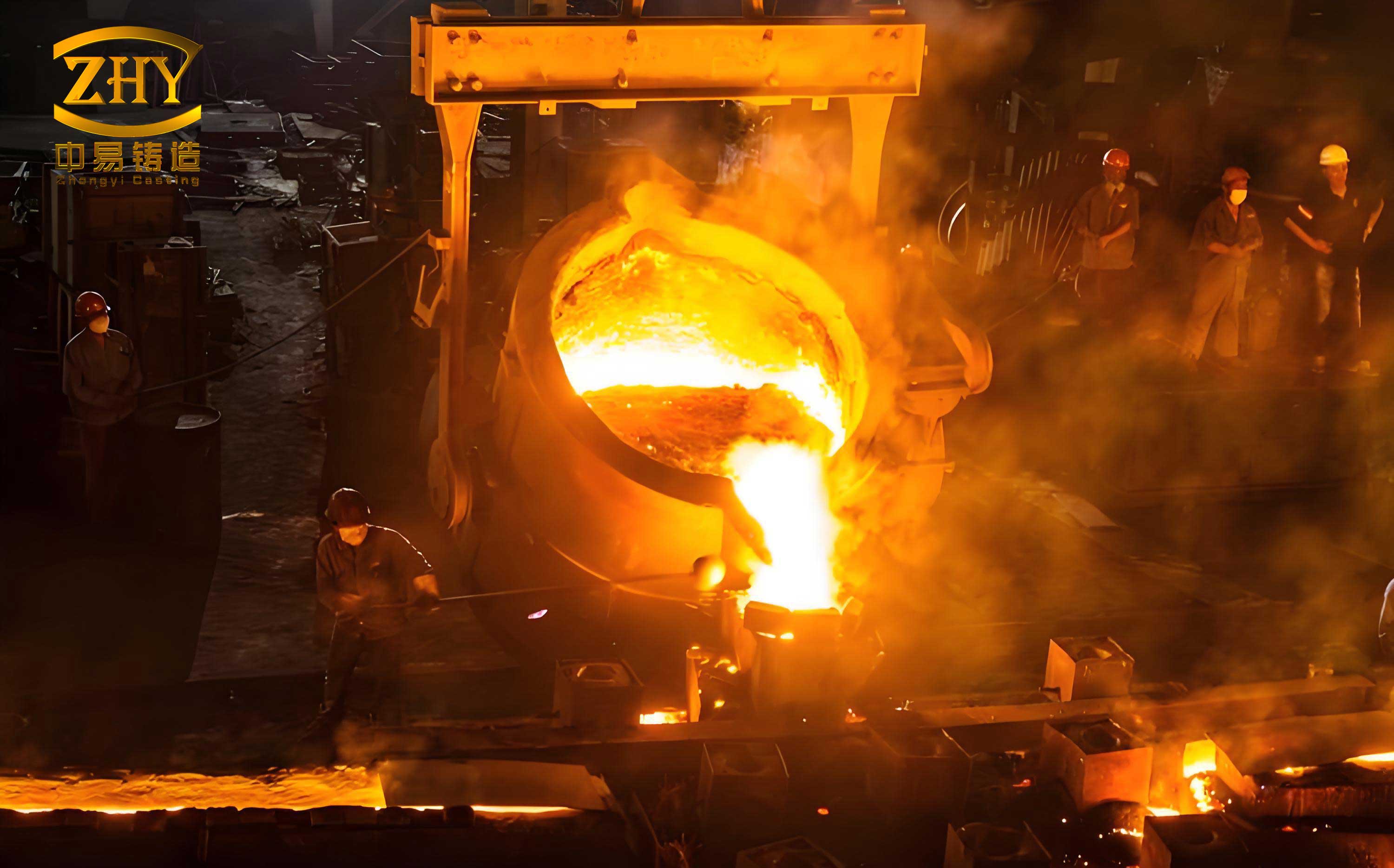
The foundation of quality in any manganese steel casting foundry begins with the熔炼 process. We rigorously control熔炼 temperature, holding it between 1480°C and 1500°C. This range is optimal as it reduces viscosity, enhancing fluidity and facilitating the flotation and removal of non-metallic inclusions. Lower temperatures increase viscosity, impeding inclusion removal and leading to defects. Furthermore, a sufficient holding time of 5 to 8 minutes allows for effective镇静, ensuring a homogeneous melt. The thermal dynamics can be partially described by the relationship for fluid flow and inclusion buoyancy. The upward velocity of an inclusion, \( v \), can be approximated by Stokes’ law for small spheres: $$ v = \frac{2}{9} \frac{(\rho_m – \rho_i) g r^2}{\eta} $$ where \( \rho_m \) is the density of the molten steel, \( \rho_i \) is the inclusion density, \( g \) is gravitational acceleration, \( r \) is the inclusion radius, and \( \eta \) is the dynamic viscosity of the steel. Higher temperature reduces \( \eta \), thereby increasing \( v \) and improving inclusion removal efficiency.
Deoxidation is another critical pillar. In our manganese steel casting foundry, inadequate deoxidation leads to elevated MnO and FeO content in the steel, severely degrading mechanical properties. For instance, the presence of just 0.010% to 0.013% MnO can reduce wear resistance by up to 50%. We employ a multi-stage deoxidation process: initial扩散 deoxidation using carbon or silicon-carbon powder, followed by the addition of ferrotitanium approximately 15 minutes before tapping for deeper deoxidation, and final deoxidation with aluminum just before tapping. The target residual aluminum content is 0.03% to 0.06%. The effectiveness is judged by the slag composition; we aim for FeO content ≤ 0.5% and (FeO + MnO) ≤ 1.2%. The thermodynamic driving force for deoxidation can be expressed using the equilibrium constant. For aluminum deoxidation: $$ [Al]^2 \cdot [O]^3 = K_{Al-O} $$ where \( K_{Al-O} \) is the equilibrium constant at the melt temperature. Maintaining a low oxygen potential is crucial.
To further refine the microstructure, we implement modification treatment using rare earth (RE) alloys. Adding 0.2% to 0.3% RE alloy when the ladle is one-third full effectively modifies inclusion morphology, reducing their size and improving distribution. This refinement enhances the toughness of the grain boundaries, a key factor in crack resistance. The modification effect can be related to the interfacial energy between inclusions and the matrix. The change in inclusion size distribution often follows a log-normal function after treatment.
Human factors and production management are equally vital. We foster an environment conducive to low-temperature pouring by preheating ladles and stopper rods to above 800°C, using flame torches to keep the stopper seat area hot during holding, optimizing crane operations for smooth and fast movement, and aligning molding boxes to streamline浇注. These measures minimize temperature losses and thermal shocks during transfer.
The propensity for crack formation, primarily thermal cracks, is intrinsically linked to the material’s physical properties. The free linear contraction of high manganese steel is exceptionally high, ranging from 2.4% to 3.0%, compared to about 2.0% for carbon steels. This imposes significant tensile stresses during solidification. Compounding this is the low thermal conductivity, \( k \), which is approximately one-quarter to one-sixth that of carbon steel. This leads to steep temperature gradients and high thermal stresses. The thermal stress, \( \sigma_{th} \), in a constrained cooling body can be estimated by: $$ \sigma_{th} = E \cdot \alpha \cdot \Delta T \cdot f(\text{geometry}) $$ where \( E \) is Young’s modulus, \( \alpha \) is the coefficient of thermal expansion, and \( \Delta T \) is the temperature difference across the section. For high manganese steel, both \( \alpha \) and \( \Delta T \) tend to be significant, leading to high \( \sigma_{th} \).
| Property | High Manganese Steel (Typical) | Comparison with Carbon Steel | Impact on Cracking |
|---|---|---|---|
| Free Linear Contraction | 2.4% – 3.0% | ~20-50% higher | Directly increases tensile strain during solidification |
| Thermal Conductivity (k) | ~12 – 15 W/(m·K) at 1000°C | ~1/4 to 1/6 of carbon steel | Promotes large ΔT and thermal stress |
| Young’s Modulus (E) | ~200 GPa at room temperature | Similar | Moderates stress for a given strain |
| Coefficient of Thermal Expansion (α) | ~18 × 10⁻⁶ /K | Slightly higher | Increases thermal strain |
During solidification, the as-cast microstructure often exhibits coarse grains and columnar crystals, with brittle carbides (e.g., (Fe,Mn)₃C) precipitating at grain boundaries. This embrittles the material, providing an internal condition for crack initiation. Cracks typically nucleate at stress concentrators such as section changes, sharp corners, hot spots, or areas with slow cooling. Internal cracks are frequently associated with shrinkage porosity and cavities. The pressure within a shrinkage cavity, \( P_{cav} \), if isolated, can be related to the local solidification time and feeding difficulty. Micro-cracks revealed after machining often originate from surface defects like gas or slag holes, where stress concentration under load initiates failure.
In service, pre-existing casting defects act as stress risers under cyclic impact loading, leading to fatigue crack initiation and propagation. Furthermore, improper heat treatment can cause carbide precipitation at grain boundaries, or high phosphorus content can lead to phosphide eutectics, both severely reducing boundary strength and accelerating crack growth. The fatigue crack growth rate, \( da/dN \), can be described by Paris’ law: $$ \frac{da}{dN} = C (\Delta K)^m $$ where \( \Delta K \) is the stress intensity factor range, and \( C \) and \( m \) are material constants. Defects increase the initial crack size \( a \), leading to a higher \( \Delta K \) and faster failure.
Prevention strategies in a modern manganese steel casting foundry must be multi-faceted. First, casting design should avoid drastic section changes, use generous fillet radii, and transition from problematic shapes like “cross” sections to “T” sections. Second,铸造工艺 design must prioritize mold collapsibility. Rigid mold constraints or improperly placed reinforcing ribs in flask design can hinder contraction and induce cracking. The浇注 system should be designed to minimize contraction restraint; multiple ingates can cause hot spots and cracking at their junctions. It is often advisable to place a riser at the ingate junction to provide feeding.
| Aspect | Key Measures | Technical Rationale | Typical Parameters/Standards |
|---|---|---|---|
| 熔炼 Control | Temperature: 1480-1500°C; Multi-stage deoxidation; RE modification | Reduces inclusions, improves fluidity, refines microstructure | Slag (FeO+MnO) ≤ 1.2%; RE addition: 0.2-0.3% |
| Casting Design | Avoid sharp transitions, use large radii, optimize section geometry | Reduces stress concentration factors | Fillet radius ≥ 0.3 × wall thickness |
| Riser & Chill Design | Prefer side/knock-off risers; judicious use of chills; proper chill spacing | Controls solidification sequence, prevents shrinkage and hot tears | Chill spacing ≤ 1.5 × chill width for uniform cooling |
| Chemical Composition | Control C and P levels; ensure good deoxidation | High C and P promote grain boundary embrittlement | C: 1.0-1.3% (context dependent); P < 0.04% |
| 浇注 & Cooling | Low浇注 temperature; slow cooling in mold; controlled knockout temperature | Reduces thermal stress and grain coarsening | 浇注 temp: ~1420-1450°C; Knockout: ~200°C |
| Heat Treatment | Slow heating through 650°C; adequate soaking; rapid water quench above 1050°C | Prevents heating cracks, dissolves carbides, achieves austenitic structure | Heating rate < 50°C/h for complex castings; solution treat at 1050-1100°C |
The strategic use of risers and chills is paramount. In our manganese steel casting foundry, we avoid standard top risers that require gas torch cutting, as the local heating can induce cracks. Instead, side risers or knock-off risers are employed. Riser design ensures adequate feeding to eliminate shrinkage porosity, a common companion to internal cracks. Chills, used in conjunction with risers, direct solidification and can shift the location of potential defects. However, misapplied chills—such as those warped or spaced too far apart—create localized cooling disparities that generate stresses and cracks. The efficacy of a chill can be analyzed through its chilling power, often related to its volume, material (e.g., iron, copper), and contact area. The heat extraction rate \( Q \) can be modeled as: $$ Q = h_c A (T_{cast} – T_{chill}) $$ where \( h_c \) is the interfacial heat transfer coefficient, \( A \) is the contact area, and \( T \) are temperatures.
Chemical composition, particularly carbon and phosphorus, is critically controlled. Higher carbon content increases hardness but reduces ductility and dramatically raises cracking susceptibility. The relationship between carbon content and crack sensitivity is often non-linear. Phosphorus, even in small amounts, forms brittle phosphides at grain boundaries. We maintain stringent limits, typically P < 0.04%. The熔炼 slag control mentioned earlier is directly tied to minimizing FeO and MnO, which if high, lead to oxide inclusions at boundaries, embrittling the steel.
浇注 temperature and knockout temperature are vital process controls. Excessively high浇注 temperature increases total contraction stress and promotes coarse grain growth, weakening the steel. We target浇注 temperatures around 1420-1450°C, depending on casting geometry. Equally important is allowing the casting to cool slowly within the mold to below 200°C before knockout to avoid thermal shock from rapid air cooling.
Heat treatment, specifically the water toughening process (solution treatment followed by rapid quenching), is essential for developing the austenitic microstructure with high toughness. However, the heating phase is prone to inducing cracks if not carefully managed. Castings must be loaded into a furnace at a temperature close to their own to minimize thermal shock. A prolonged均温 period of 1-1.5 hours is standard. The heating rate through the lower temperature range (below 650°C) is critical; for complex castings, we limit it to 50°C per hour. The thermal stress during heating can be approximated by the same formula \( \sigma_{th} = E \alpha \Delta T \), where \( \Delta T \) now represents the temperature difference between the surface and core of the casting during heating. Exceeding a critical stress level during this phase can cause fracture. After solution treatment at 1050-1100°C, rapid water quenching is performed to retain carbon in solid solution and prevent carbide precipitation at grain boundaries.
To synthesize these principles, let’s consider a quantitative example for thermal stress estimation. Assume a plate-shaped high manganese steel casting with a thickness \( L \), experiencing a linear temperature difference \( \Delta T \) between surface and center. The maximum thermal stress during cooling or heating can be approximated for an elastic body as: $$ \sigma_{max} \approx \frac{E \alpha \Delta T}{1 – \nu} $$ where \( \nu \) is Poisson’s ratio (~0.3). If \( E = 200 \, GPa \), \( \alpha = 18 \times 10^{-6} \, /K \), and \( \Delta T = 300 \, K \), then \( \sigma_{max} \approx \frac{200 \times 10^9 \times 18 \times 10^{-6} \times 300}{1 – 0.3} \approx 1.54 \times 10^9 \, Pa = 1540 \, MPa \). This far exceeds the high-temperature yield strength of the material, indicating why plastic deformation and cracking occur. This simplified calculation underscores the necessity of minimizing \( \Delta T \) through controlled cooling and heating rates—a core operational tenet in any advanced manganese steel casting foundry.
In conclusion, producing crack-free high manganese steel castings demands an integrated approach spanning the entire production chain in a manganese steel casting foundry. It begins with precise熔炼 control and deoxidation, extends through intelligent casting and工艺 design that accommodates the material’s high contraction and low conductivity, involves careful control of chemistry and pouring practices, and culminates in a meticulously executed heat treatment cycle. Each step interlinks; a failure in one can precipitate cracking. By adhering to these principles, leveraging computational tools for solidification modeling, and continuously training personnel, a manganese steel casting foundry can significantly reduce scrap rates, enhance product reliability, and meet the stringent demands of heavy-industry applications. The journey towards zero-defect casting is continuous, driven by deep process understanding and a commitment to excellence in every pour.