
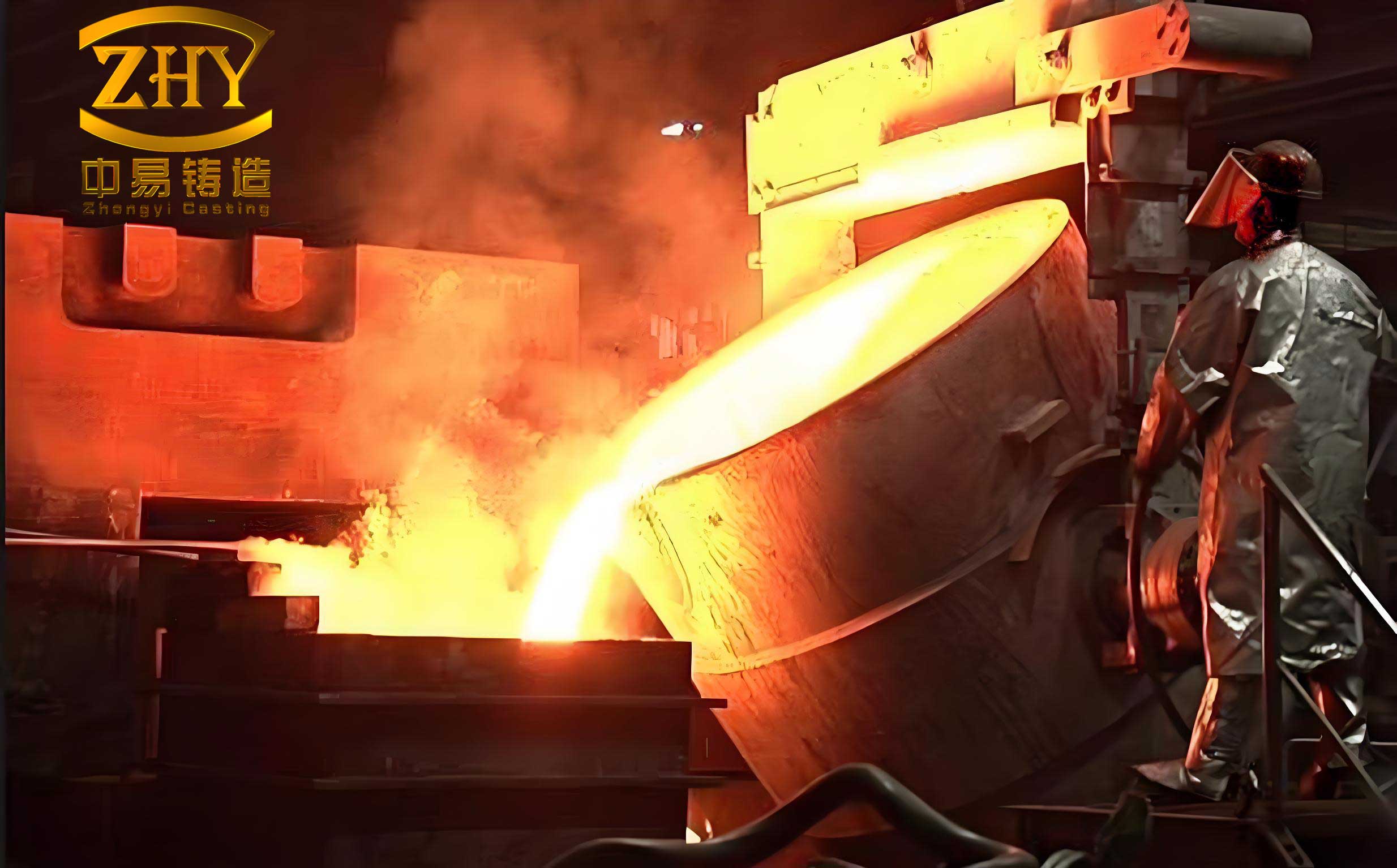
The pursuit of reliable, defect-free castings in the realm of manganese steel casting foundry operations is a constant technical challenge. High manganese steel, renowned for its exceptional work-hardening capability and toughness under severe impact, is indispensable for critical wear components like crusher jaws, railway crossings, and mining shovel parts such as the front jockey wheel. However, its very composition, which grants these superior in-service properties, also makes it notoriously difficult to cast. The high levels of carbon and manganese, coupled with a low thermal conductivity, result in significant solidification shrinkage and a high susceptibility to hot tearing when contraction is restrained. In a complex casting like a front jockey wheel, with its intricate internal cavities and varying wall thicknesses, designing a robust gating and feeding system is paramount. The cost of failure is high; defects like shrinkage porosity and cracks, often impossible to rectify due to the material’s hardening nature, lead directly to scrap. This narrative details my systematic approach, leveraging simulation technology, to analyze, diagnose, and optimize the casting process for a high manganese steel front jockey wheel within our manganese steel casting foundry.
The core of the problem lies in the material’s inherent characteristics. The standard Hadfield manganese steel has a nominal composition as shown in the table below, leading to a fully austenitic microstructure at room temperature.
| Element | C | Mn | Si | P | S |
|---|---|---|---|---|---|
| Content (wt.%) | 1.0 – 1.4 | 11.0 – 14.0 | 0.3 – 0.8 | ≤ 0.07 | ≤ 0.05 |
This chemistry results in a relatively long solidification interval and poor thermal conductivity, approximately 15 W/m·K in the casting temperature range. The thermal and mechanical properties central to our simulation were derived using computational materials science software (JMatPro®). For the mold and core, we used a furan resin sand, whose properties were sourced from an industry-standard database (MAGMA®). The key simulation parameters are summarized as follows:
| Parameter | Value / Model |
|---|---|
| Pouring Temperature | 1419 °C |
| Mold Material | Furan Resin Sand |
| Stress Model | Elasto-Plastic |
| Mold/Core Rigidity | Assumed Rigid (Non-Yielding) |
| Filling | Instantaneous Pour Assumption |
The geometry of the front jockey wheel itself presents the primary challenge for any manganese steel casting foundry. The component features a large central axle hole surrounded by a thick rim. Radiating from the central hub are several internal arms or chambers, creating sections with drastic changes in cross-section and sharp internal corners. These geometric features act as natural stress concentrators and create isolated hot spots during solidification, making them prime locations for shrinkage defects and hot tears.
Our foundry had two existing process routes for this component. The first, designated DR (Double Risers), employed two open risers on the top of the central axle hole, with no insulating sleeves. The second, SR (Single Riser), used a single, larger open riser on the axle hole fitted with a 30mm insulating pad. Both designs utilized nine blind risers around the wheel’s outer rim and a bottom-gating system. The initial task was to evaluate these two competing methods through rigorous simulation using ProCAST® software. The critical step in such analysis is the application of scientifically validated defect prediction criteria.
For shrinkage porosity, we employed two complementary methods. The first is the direct calculation of the Shrinkage Porosity Percentage, where a critical value of 2% is typically used to indicate a high probability of macro-shrinkage. The second, and often more sensitive, method is the Niyama criterion. This criterion is based on the local thermal conditions at the end of solidification and is expressed as:
$$G / \sqrt{\dot{T}} \le NY_{\text{critical}}$$
where \(G\) is the temperature gradient (°C/m), \(\dot{T}\) is the cooling rate (°C/s), and \(NY_{\text{critical}}\) is a threshold value. For steel castings, a value of \(NY_{\text{critical}} = 7.75\,^{\circ}\text{C}^{1/2}\text{s}^{1/2}\text{cm}^{-1}\) is widely accepted. Regions where the calculated \(G/\sqrt{\dot{T}}\) falls below this threshold are predicted to be susceptible to microporosity.
For hot tearing, a more complex thermo-mechanical analysis is required. We used a Hot Tearing Sensitivity index based on the accumulated viscoplastic strain during the vulnerable period when the mushy zone contains a critical fraction of liquid films. This model, often rooted in the Rappaz-Drezet-Gremaud (RDG) criterion, calculates the strain rate in the inter-dendritic regions and compares it to a critical feeding rate. The simplified expression for the susceptibility involves the integral of the strain rate over the solidification time in the susceptible range:
$$S_{\text{hot tear}} = \int_{t_{\text{coherence}}}^{t_{\text{solidus}}} \dot{\varepsilon}_{\text{vp}} \, dt$$
A higher value of \(S_{\text{hot tear}}\) indicates a greater propensity for crack initiation.
The simulation results for the two initial processes were revealing. The DR process showed significant shrinkage risk in the axle hub region predicted by both porosity percentage and the Niyama criterion. Furthermore, the hot tearing model indicated high susceptibility at the sharp internal corners of the chambers and around the riser contact areas. The SR process showed marked improvement: shrinkage in the axle hub was eliminated, and rim shrinkage was reduced. However, the hot tearing tendency at the internal corners remained a serious concern. A direct comparison is summarized below:
| Process | Shrinkage in Axle Hub | Shrinkage in Rim | Hot Tearing at Internal Corners | Overall Defect Risk |
|---|---|---|---|---|
| DR (Double Risers) | High (Multiple zones) | Moderate | High | Very High |
| SR (Single Riser) | Low | Low-Moderate | High | Moderate-High |
Clearly, the SR process was the superior baseline, but it was not yet a robust solution for a production manganese steel casting foundry. The rim still showed areas of potential microporosity, and the persistent hot tear warning at stress concentrators was unacceptable. This led to the first optimization cycle, resulting in process M1. The strategy was two-fold: first, to improve directional solidification toward the rim risers, and second, to modify the cooling pattern. We removed all original external chills. Instead, we introduced a continuous ring chill on the drag (bottom) side of the wheel rim, specifically on the side opposite the gating, to promote more uniform cooling from that face. Simultaneously, we increased the volume of the nine blind risers around the rim to enhance their feeding capacity.
The M1 simulation yielded positive results for shrinkage. The enhanced risers successfully eliminated the Niyama warnings in the wheel rim, drawing the shrinkage into the riser bodies themselves. However, the hot tearing analysis presented a new insight. By improving feeding to the rim, we inadvertently prolonged the solidification time in the central hub and internal arms. This extended the period where these areas, particularly at sharp corners, were vulnerable to strain accumulation. The hot tearing susceptibility in these regions remained high, and in some areas, even intensified compared to the SR process. The optimization had solved one problem but highlighted another more acutely.
This prompted the second optimization, M2. We reasoned that the central open riser in SR and M1 might be over-sized, acting as a massive heat source that kept the hub area hot for too long. For M2, we reduced the volume of the single central riser. Crucially, to compensate for the reduced thermal mass and maintain its feeding efficiency longer, we replaced the 30mm insulating pad with a much thicker 65mm insulating brick sleeve. This change aimed to achieve a delicate balance: provide sufficient feed metal to the hub while allowing it to cool and gain strength earlier, thus reducing the time window for hot tear formation.
The ProCAST simulation for the M2 process was the most promising. The shrinkage performance matched that of M1—no significant porosity in the rim or hub. The breakthrough was in the hot tearing prediction. The reduced riser size and improved insulation altered the thermal profile. The central hub and internal arms solidified more quickly relative to the riser, shortening the critical vulnerability period. The accumulated strain values at the internal corners decreased significantly. While not entirely eliminated—a near-impossible feat for such geometry with a rigid sand core—the hot tearing propensity was minimized to its lowest level across all processes studied. The evolution and results of the optimization are captured in the following table:
| Process | Key Modifications from SR | Shrinkage Result | Hot Tearing Result |
|---|---|---|---|
| SR (Baseline) | N/A | Low in hub, Moderate in rim | High at internal corners & hub |
| M1 | 1. Ring chill on drag side rim. 2. Increased blind riser volume. |
**Eliminated** in rim. Low in hub. | High at internal corners & hub. |
| M2 | 1. All M1 modifications. 2. **Reduced** central riser volume. 3. **Thick** insulating brick (65mm). |
**Eliminated** in rim. Low in hub. | **Minimized** at internal corners & hub. |
The simulation study provides a clear, physics-based pathway for process improvement in the manganese steel casting foundry. It underscores that solving foundry defects often requires a systems approach, as changes to address shrinkage can directly impact the stress conditions that cause hot tears. The journey from DR to M2 illustrates several key principles for casting high manganese steel components: (1) Efficient but not excessive risering is crucial; an over-sized riser can exacerbate hot tearing. (2) Strategic use of chills can control solidification sequence, but their placement must be carefully evaluated. (3) Insulation is a powerful tool to extend feeding without severely delaying overall cooling.
However, simulation also clearly defines the remaining challenges and the limits of purely process-based solutions. The primary risk area is the geometric stress concentrators—the sharp internal corners. While M2 minimizes the thermal condition that leads to tearing, the fundamental stress concentration remains. Therefore, the final recommendations extend beyond process parameters. First, where design allows, implementing larger fillet radii at all internal corners is the most effective mechanical solution to reduce stress concentration factors. Second, reviewing core sand technology is essential. The assumption of a rigid, non-yielding furan sand core is conservative and likely reflects reality, but exploring cores with better collapsibility (e.g., using organic breakdown agents or alternative binder systems like sodium silicate) can directly reduce the mechanical restraint that drives hot tearing. Third, further simulation fidelity could be gained by incorporating more accurate high-temperature mechanical properties for the mold and core materials.
In conclusion, the integration of advanced numerical simulation has been transformative for optimizing this challenging manganese steel casting foundry component. It allowed for the rapid virtual testing of multiple concepts, saving enormous time and cost compared to physical trials. The systematic approach—baseline evaluation, targeted optimization of feeding and cooling, and coupled analysis of shrinkage and stress—led to a scientifically substantiated process, M2. This process is predicted to produce a sound casting, free from shrinkage defects, with a significantly reduced and managed risk of hot tearing at known critical locations. This work exemplifies the modern foundry engineering methodology, where computational tools provide deep insight, guiding us to manufacture high-integrity manganese steel castings with greater confidence and reliability.