
In our manganese steel casting foundry, we have dedicated years to mastering the art and science of producing high-performance components for demanding industries. The manganese steel casting foundry environment is where innovation meets practical application, ensuring that every piece meets rigorous standards. As an expert from a leading manganese steel casting foundry, I will share insights into the processes, challenges, and advancements that define our work. This article delves into the intricacies of heat treatment, mechanical properties, and operational efficiencies, all centered around the core theme of manganese steel casting foundry practices.
The importance of manganese steel castings cannot be overstated. In our manganese steel casting foundry, we produce parts like crusher jaws, rail crossings, and excavator buckets, which are essential in mining, construction, and transportation. These components derive their superior wear resistance and toughness from the unique microstructure achieved through precise heat treatment. At our manganese steel casting foundry, we emphasize that the as-cast state often contains detrimental carbides, making heat treatment a critical step. The goal is to dissolve these carbides into a homogeneous austenitic matrix, which enhances durability. Throughout this discussion, the term manganese steel casting foundry will recur to highlight our specialized focus.
Heat treatment in a manganese steel casting foundry involves heating the castings to high temperatures, followed by rapid quenching. Based on our experience, the optimal temperature range is between 1050°C and 1100°C. We use a two-stage heating process to ensure uniform temperature distribution and complete carbide dissolution. The first stage involves holding at 650°C for stress relief, followed by a ramp to 1050°C for austenitization. The total heating time can be modeled using the following formula for heat transfer: $$ Q = m \cdot c \cdot \Delta T $$ where \( Q \) is the heat input, \( m \) is the mass of the casting, \( c \) is the specific heat capacity, and \( \Delta T \) is the temperature change. In our manganese steel casting foundry, we adjust parameters based on casting thickness, as shown in Table 1.
| Casting Thickness (mm) | Hold Time at 650°C (hours) | Hold Time at 1050°C (hours) | Total Cycle Time (hours) |
|---|---|---|---|
| 10-50 | 2 | 4 | 6 |
| 50-100 | 3 | 6 | 9 |
| 100-200 | 4 | 8 | 12 |
After heating, quenching is performed immediately in water at temperatures below 30°C. Our manganese steel casting foundry uses large quenching tanks to maintain low water temperatures, as exceeding 40°C can reduce quenching efficiency. The quenching rate is critical to suppress carbide precipitation. We calculate the cooling rate using: $$ \frac{dT}{dt} = -k (T – T_{\text{water}}) $$ where \( k \) is the heat transfer coefficient. This ensures that the austenitic structure is retained, imparting high toughness. The success of this process in our manganese steel casting foundry is evident from the mechanical properties achieved, summarized in Table 2.
| Property | Value Range | Unit |
|---|---|---|
| Hardness (HB) | 200-250 | HB |
| Tensile Strength | 800-1000 | MPa |
| Elongation | 40-50 | % |
| Impact Toughness | 150-200 | J/cm² |
The microstructural evolution during heat treatment is a key focus in our manganese steel casting foundry. As-cast structures often show coarse austenite grains with networked carbides, which we analyze using metallography. After treatment, the ideal microstructure is fully austenitic, free of carbides. We quantify carbide dissolution using the Avrami equation: $$ X = 1 – \exp(-k t^n) $$ where \( X \) is the fraction of carbides dissolved, \( k \) is a rate constant, \( t \) is time, and \( n \) is an exponent. This helps optimize holding times. Our manganese steel casting foundry continuously refines these parameters to enhance quality.
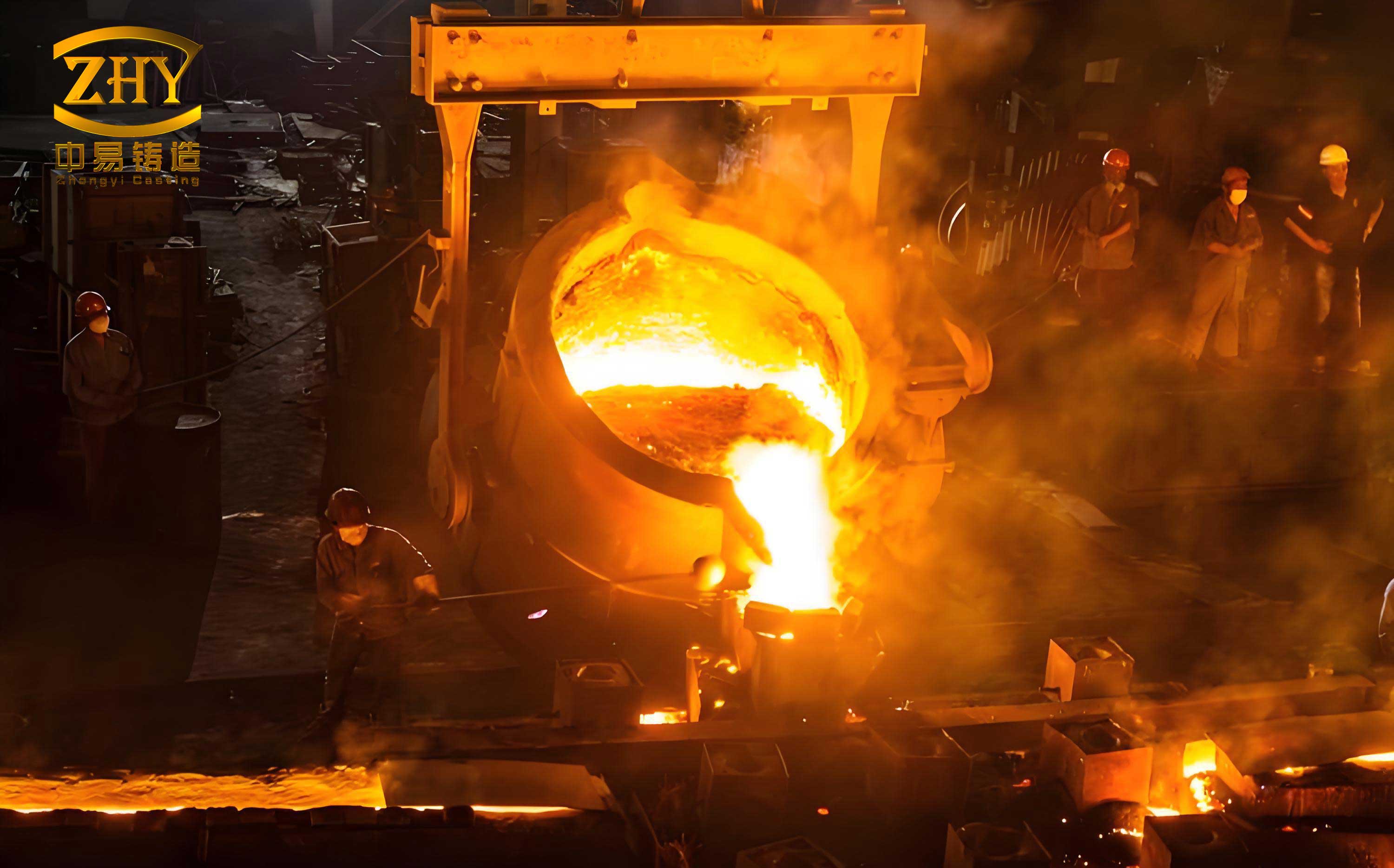
Operational improvements in a manganese steel casting foundry extend beyond heat treatment. We have implemented advanced furnace designs that boost productivity and thermal efficiency. For instance, our new forging furnaces reduce coal consumption by 30% compared to traditional models. The thermal efficiency \( \eta \) is calculated as: $$ \eta = \frac{Q_{\text{useful}}}{Q_{\text{input}}} \times 100\% $$ where \( Q_{\text{useful}} \) is the heat absorbed by castings, and \( Q_{\text{input}} \) is the heat from coal. In our manganese steel casting foundry, we achieve efficiencies above 50%, as detailed in Table 3. These furnaces also improve working conditions, with no smoke or dust, allowing general workers to operate them easily. This aligns with our manganese steel casting foundry’s commitment to environmental sustainability and worker safety.
| Furnace Type | Coal Consumption (kg/day) | Thermal Efficiency (%) | Workers Required | Productivity Relative to Old Furnaces |
|---|---|---|---|---|
| Traditional Forging Furnace | 500 | 30 | 1 skilled worker (grade 4-5) | 1x |
| New Forging Furnace | 350 | 55 | 1 general worker | 2.5x |
Applications of manganese steel castings are vast, and our manganese steel casting foundry supplies to sectors like cement equipment, where parts such as mill liners and grinding balls endure extreme abrasion. The wear resistance is quantified by the Archard wear equation: $$ V = K \frac{W L}{H} $$ where \( V \) is wear volume, \( K \) is a wear coefficient, \( W \) is load, \( L \) is sliding distance, and \( H \) is hardness. Our castings exhibit low \( K \) values due to optimal heat treatment. In every project, the manganese steel casting foundry ensures that components meet specific operational demands, leveraging our expertise in alloy design and processing.
Quality control in our manganese steel casting foundry involves rigorous testing. We perform chemical analysis to ensure composition within specified limits, typically: Carbon 1.0-1.4%, Manganese 11-14%, Silicon 0.3-0.8%, Sulfur <0.05%, Phosphorus <0.10%. The carbon equivalent \( CE \) is calculated to predict weldability: $$ CE = C + \frac{Mn}{6} + \frac{Si}{24} $$ For our castings, \( CE \) ranges from 2.5 to 3.0, indicating good castability but requiring careful heat treatment. Non-destructive testing like ultrasonic inspection is routine in our manganese steel casting foundry to detect internal defects.
Innovation in our manganese steel casting foundry also focuses on energy efficiency. We model heat losses using Fourier’s law: $$ q = -k \nabla T $$ where \( q \) is heat flux, \( k \) is thermal conductivity, and \( \nabla T \) is temperature gradient. By insulating furnaces better, we reduce losses by 20%. This contributes to lower operating costs and a smaller carbon footprint, reinforcing the manganese steel casting foundry’s role in sustainable manufacturing. Additionally, we recycle scrap metal within our processes, minimizing waste.
The future of manganese steel casting foundry operations lies in automation and data analytics. We are integrating IoT sensors to monitor furnace temperatures in real-time, using predictive algorithms to optimize cycles. The data is analyzed with machine learning models, such as: $$ y = \beta_0 + \beta_1 x_1 + \cdots + \beta_n x_n $$ where \( y \) could be hardness outcome, and \( x_i \) are process variables. This proactive approach in our manganese steel casting foundry reduces trial-and-error, ensuring consistent quality. As we scale, the manganese steel casting foundry will continue to be a hub of technological advancement.
Training and skill development are integral to our manganese steel casting foundry. We empower workers with knowledge of metallurgy and safety protocols, enabling them to handle complex operations. The simplicity of our new furnaces means that even junior staff can achieve high productivity, as noted earlier. This human-centric approach distinguishes our manganese steel casting foundry from others, fostering a culture of continuous improvement.
In conclusion, the manganese steel casting foundry is a dynamic environment where precision heat treatment, advanced furnace technology, and rigorous quality control converge to produce superior components. From heat treatment formulas to operational tables, every aspect is optimized for performance. Our manganese steel casting foundry exemplifies how traditional industries can evolve through innovation. As we move forward, the lessons learned here will guide the broader foundry sector, ensuring that manganese steel castings remain indispensable in heavy industry. The journey of a manganese steel casting foundry is one of constant refinement, and we are proud to lead the way.
To further illustrate the impact, consider the economic benefits: our manganese steel casting foundry has seen a 40% increase in output per furnace due to these improvements. The return on investment for upgrading furnaces can be calculated using: $$ ROI = \frac{\text{Net Profit}}{\text{Cost of Investment}} \times 100\% $$ In our case, ROI exceeds 100% within two years. This underscores the viability of investing in modern foundry technologies. As a trusted manganese steel casting foundry, we share these insights to benefit the industry at large, promoting best practices and collaborative growth.