
In the realm of manganese steel casting foundry operations, the repair and maintenance of high-manganese steel components present a significant technical challenge. As someone deeply involved in a manganese steel casting foundry, I have encountered numerous instances where welding repairs were necessary, and the outcomes were often less than satisfactory. Through extensive trial and error, our manganese steel casting foundry has developed a set of relatively successful welding repair techniques, which I will elaborate on here. The inherent properties of high-manganese steel, such as its low thermal conductivity and high propensity for work hardening, make it prone to localized stress concentrations and cracking during welding. Thus, mastering the repair process is crucial for ensuring the longevity and performance of these castings.
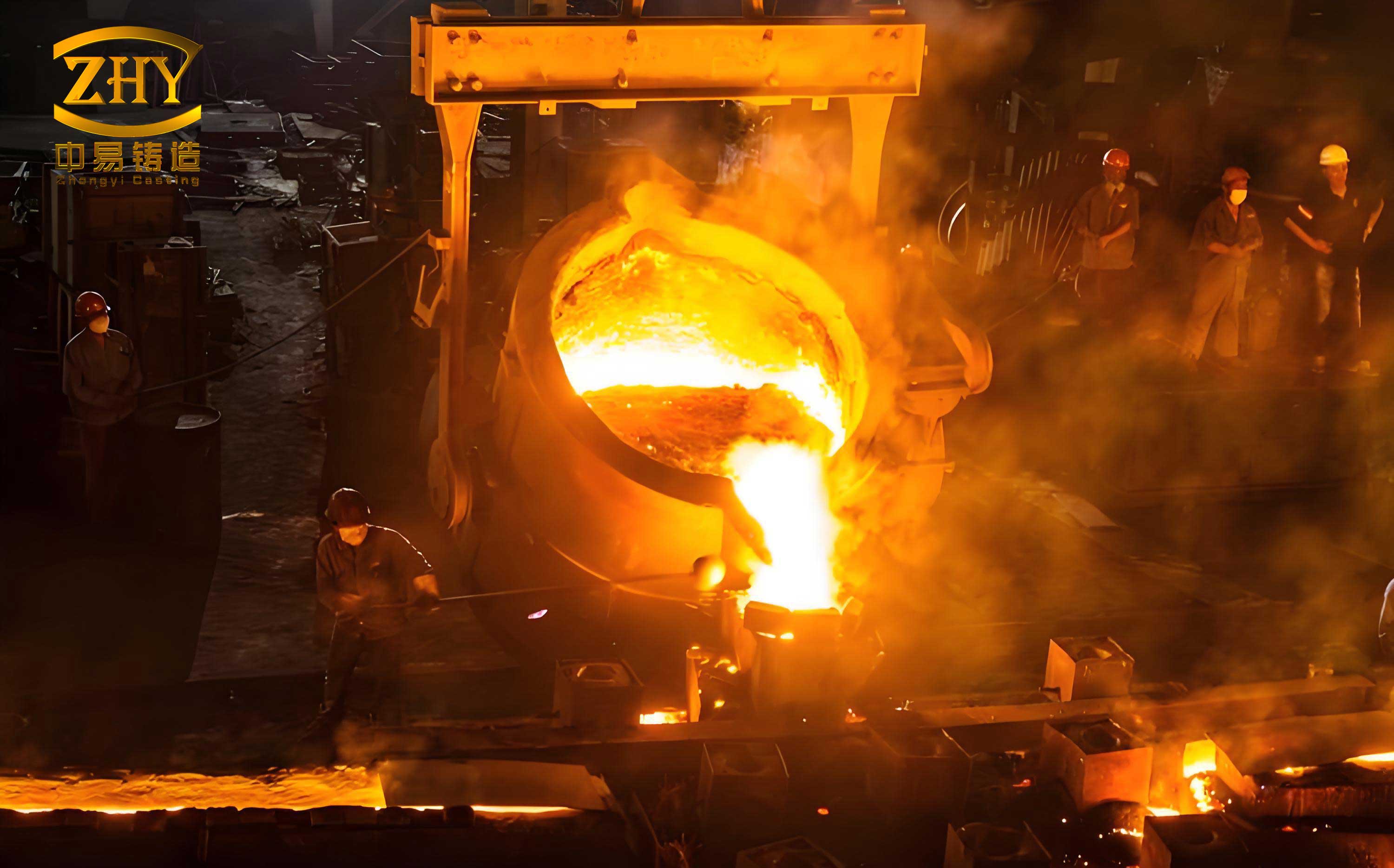
Our experience in the manganese steel casting foundry indicates that defects in high-manganese steel castings typically manifest in several forms. Understanding these defects is the first step toward effective repair. The primary defect types we have observed include surface cracks, edge defects, inclusions such as sand holes, complete edge cracks, and localized subsurface cracks. Each defect requires a tailored approach to preparation and welding. In a manganese steel casting foundry, it is imperative to recognize that improper handling during repair can exacerbate these defects, leading to catastrophic failure in service.
Before welding, the defective area must be meticulously prepared by grinding to create a suitable groove or bevel. This process is critical in a manganese steel casting foundry to ensure that all damaged metal is removed, exposing fresh, sound material. The shape and dimensions of the groove depend on the defect type. For instance, partial cracks and edge defects are best prepared with a V-shaped groove, while complete cracks necessitate a more extensive U-shaped groove to facilitate proper weld penetration and stress distribution. A key lesson from our manganese steel casting foundry is that using oxygen cutting to prepare these grooves is strictly prohibited. Due to the low thermal conductivity of high-manganese steel, oxygen cutting can induce new micro-cracks and obscure the visibility of existing cracks, compromising the repair integrity. The grinding process must be thorough, and all contaminants around the groove must be cleaned to prevent inclusions.
The following table summarizes the common defect types and recommended groove preparations in a manganese steel casting foundry:
| Defect Type | Description | Recommended Groove Shape | Key Considerations |
|---|---|---|---|
| Surface Crack | A shallow crack on the casting surface | V-groove | Grind until crack is fully removed; avoid overheating. |
| Edge Defect | Imperfections along the casting edge | V-groove with wider angle | Ensure complete removal of defective material. |
| Inclusion (Sand Hole) | Internal voids or sand inclusions | U-groove or enlarged V-groove | Clean thoroughly to eliminate all foreign particles. |
| Complete Edge Crack | A crack extending through the edge | U-groove | Provide sufficient space for weld deposition and stress relief. |
| Localized Subsurface Crack | Cracks below the surface | V-groove or custom shape | Grind deeply to expose the crack tip; avoid residual stresses. |
In our manganese steel casting foundry, we emphasize that welding repairs should be performed after the casting has undergone quenching (austenitization and water toughening). Preheating or localized preheating before welding is generally avoided. This is because heating can lead to the precipitation of carbides along grain boundaries, increasing surface hardness and reducing ductility, which in turn can initiate new cracks. The thermal behavior of high-manganese steel can be described using the heat conduction equation: $$q = -k \nabla T$$ where \(q\) is the heat flux, \(k\) is the thermal conductivity (which is low for manganese steel), and \(\nabla T\) is the temperature gradient. This low \(k\) value exacerbates temperature gradients, leading to high thermal stresses: $$\sigma_{thermal} = E \alpha \Delta T$$ where \(\sigma_{thermal}\) is the thermal stress, \(E\) is Young’s modulus, \(\alpha\) is the coefficient of thermal expansion, and \(\Delta T\) is the temperature difference. Minimizing these stresses is paramount in a manganese steel casting foundry.
During welding, several precautions must be taken. After completing each weld bead, while it is still hot, the casting should be lightly peened with a hammer. This practice helps to diffuse concentrated stresses and reduce carbide precipitation, thereby enhancing the density and integrity of the weld metal. Additionally, to improve wear resistance and toughness, the weld bead can be rapidly quenched with water immediately after welding while it is still red-hot. This rapid cooling helps to maintain the austenitic structure and increase hardness. However, it is crucial to allow each bead to cool completely before proceeding to the next bead to avoid cumulative heat input and stress buildup. The welding sequence is also vital; for V-grooves, a staggered or stepwise sequence is recommended, while for U-grooves, simultaneous welding from both sides by two operators can balance stresses. In our manganese steel casting foundry, we have found that the welding path should follow a pattern that minimizes distortion, such as a zigzag or oscillatory motion.
The success of welding in a manganese steel casting foundry heavily relies on the selection of appropriate filler materials and welding parameters. The electrode core and flux composition are designed to match the base metal properties and mitigate cracking. Based on our practices, the typical compositions are as follows:
| Component | Electrode Core Composition (wt%) | Flux Composition (wt%) |
|---|---|---|
| Carbon (C) | 0.8-1.2 | – |
| Manganese (Mn) | 12-14 | – |
| Silicon (Si) | 0.3-0.8 | Added as ferrosilicon |
| Chromium (Cr) | 1.5-2.5 | – |
| Sulfur (S) | ≤0.03 | – |
| Phosphorus (P) | ≤0.05 | – |
| Fluorspar (CaF₂) | – | 20-30 |
| Marble (CaCO₃) | – | 20-30 |
| Quartz (SiO₂) | – | 10-15 |
| Low-carbon Ferromanganese | – | 15-20 |
| Titanium-Aluminum (Ti-Al) | – | 5-10 |
| Water Glass (Na₂SiO₃) | – | 15-20 (as binder) |
The flux is typically prepared by mixing the dry components with water glass as a binder. In our manganese steel casting foundry, we use a formulation where water glass constitutes about 15-20% of the total flux weight. This flux helps to stabilize the arc, provide slag coverage, and add alloying elements to the weld metal. The welding parameters are equally critical. Direct current (DC) is preferred, with alternating current (AC) being acceptable at lower settings. The current should be adjusted based on electrode diameter to ensure adequate penetration without excessive heat input. For example, a 4 mm diameter electrode might require 120-160 amps, while a 5 mm electrode could need 160-200 amps. These parameters help control the heat-affected zone (HAZ) and minimize distortion in the manganese steel casting foundry.
Temperature control during welding is a delicate balance. In our manganese steel casting foundry, we use gas torches to maintain the casting temperature around 200-300°C during the welding process. This interpass temperature is crucial to prevent rapid cooling and cracking. After each layer is welded, the slag and spatter must be thoroughly removed to avoid defects in subsequent layers. The entire welding procedure can be modeled using a thermal cycle analysis. The temperature evolution over time \(T(t)\) during welding can be approximated by: $$T(t) = T_0 + \frac{Q}{{\rho c_p \sqrt{4 \pi \alpha t}}} e^{-\frac{x^2}{4 \alpha t}}$$ where \(T_0\) is the initial temperature, \(Q\) is the heat input, \(\rho\) is density, \(c_p\) is specific heat, \(\alpha\) is thermal diffusivity, \(x\) is distance from the weld centerline, and \(t\) is time. Optimizing \(Q\) through current and speed settings is essential in a manganese steel casting foundry.
Post-weld heat treatment is often necessary to relieve residual stresses and restore properties. After welding, the casting is placed in a furnace for stress relief annealing. The typical annealing curve involves heating to 500-600°C, holding for 1-2 hours per inch of thickness, and then slowly cooling. This process helps to homogenize the microstructure and reduce stresses without causing excessive carbide precipitation. The effectiveness of the repair can be evaluated through non-destructive testing (NDT) methods such as ultrasonic testing or magnetic particle inspection. In our manganese steel casting foundry, we have observed that properly repaired castings exhibit uniform hardness and dense microstructure, with hardness values typically in the range of 200-250 HB, ensuring good wear resistance and toughness.
For buildup or overlay welding to restore thickness, a different strategy is employed. The welding sequence should be planned to minimize dilution and distortion. Often, a zigzag or weaving pattern is used, as illustrated in welding diagrams. The deposition rate \(R_d\) can be calculated as: $$R_d = \frac{{\pi d^2 v_w \rho}}{{4}}$$ where \(d\) is the electrode diameter, \(v_w\) is the welding speed, and \(\rho\) is the density of the weld metal. Controlling \(R_d\) ensures efficient material addition without overheating. In winter conditions, ambient temperature management is vital in a manganese steel casting foundry. We recommend using adequate shelter or heating to maintain a stable environment above 10°C, as low temperatures can increase the risk of brittle fracture.
An innovative practice from our manganese steel casting foundry involves the use of protective coatings to facilitate spatter removal. A solution composed of water glass, water, and chalk powder is applied to the casting surface before welding. When spatter lands on this coating, the water glass melts, forming a barrier that prevents adhesion. After welding, the spatter can be easily brushed off or removed with sandblasting, saving significant labor. This technique is particularly useful for complex geometries common in manganese steel casting foundry products.
To summarize the welding parameters used in our manganese steel casting foundry, the following table provides a concise overview:
| Parameter | Specification | Remarks |
|---|---|---|
| Welding Current | DC, 120-200 A (depending on electrode) | AC can be used at lower currents. |
| Electrode Diameter | 3.2 mm, 4 mm, 5 mm | Larger diameters for higher deposition. |
| Interpass Temperature | 200-300°C | Maintained with gas torch heating. |
| Peening | After each bead, while hot | Light hammering to relieve stress. |
| Quenching | Water quench while bead is red-hot | Enhances hardness and wear resistance. |
| Post-weld Annealing | 500-600°C, 1-2 h/inch, slow cool | Stress relief and microstructure stabilization. |
| Ambient Temperature | >10°C | Use heaters in cold conditions. |
In conclusion, the welding repair of high-manganese steel castings demands a meticulous approach that considers material properties, defect characteristics, and process controls. Through systematic practices developed in our manganese steel casting foundry, we have achieved reliable repairs that restore casting integrity and performance. Key elements include proper groove preparation without oxygen cutting, avoidance of preheating, controlled welding sequences, peening, quenching, and appropriate post-weld heat treatment. The use of tailored electrodes and fluxes, along with careful parameter selection, ensures minimal defects and optimal mechanical properties. As a manganese steel casting foundry, we continue to refine these techniques, leveraging thermal and stress analysis models to further improve outcomes. The integration of protective coatings for spatter removal exemplifies the innovative solutions that enhance efficiency in a manganese steel casting foundry. Ultimately, mastering these welding repair methods is essential for extending the service life of high-manganese steel components in demanding applications.