
In my extensive experience working within a manganese steel casting foundry, I have consistently observed that cracking defects represent one of the most significant and costly challenges in the production of high-manganese steel wear parts. These components are critical for applications involving high-impact loads, such as in mining, crushing, and material handling equipment. The financial impact is substantial; cracking-related rejections can account for approximately half of all casting scrap, leading to considerable economic losses for any manganese steel casting foundry. This article delves into a comprehensive, first-person analysis of the mechanisms behind crack formation, the multifactorial influences during solidification and service, and presents a detailed framework of preventative strategies derived from practical foundry operations.
The predominant type of flaw encountered is hot tearing or hot cracking. This phenomenon is intrinsically linked to the exceptional physical and metallurgical characteristics of high-manganese steel, notably its austenitic structure with 11-14% Mn and 1.0-1.4% C. The fundamental driver is the alloy’s substantial free linear shrinkage, which is significantly greater than that of plain carbon steels. The linear shrinkage strain, $\epsilon_s$, can be conceptually represented as a function of the thermal contraction coefficient and the temperature drop through the solidification range:
$$ \epsilon_s \approx \int_{T_s}^{T_l} \alpha(T) \, dT $$
where $\alpha(T)$ is the coefficient of thermal expansion (which is itself temperature-dependent and relatively high for this steel), $T_l$ is the liquidus temperature, and $T_s$ is the solidus temperature. When this inherent contraction is hindered—by rigid mold cores, non-yielding sand, or the casting’s own geometry—tensile stresses develop within the partially solidified, mushy zone. If these stresses exceed the fragile strength of the material at that stage, a hot tear initiates. Compounding this is the low thermal conductivity of high-manganese steel, typically only about 1/4 to 1/3 that of carbon steel. This poor heat dissipation leads to steep thermal gradients during both heating and cooling, generating significant thermal stresses. The combined stress state from shrinkage restraint and thermal gradients creates a perfect storm for crack initiation. The thermal stress, $\sigma_{th}$, can be approximated by:
$$ \sigma_{th} = E \cdot \alpha \cdot \Delta T \cdot f(\text{constraint}) $$
where $E$ is the Young’s modulus, $\alpha$ is the average coefficient of thermal expansion, $\Delta T$ is the temperature difference across a section, and the function accounts for the degree of mechanical constraint provided by the mold and the casting design.
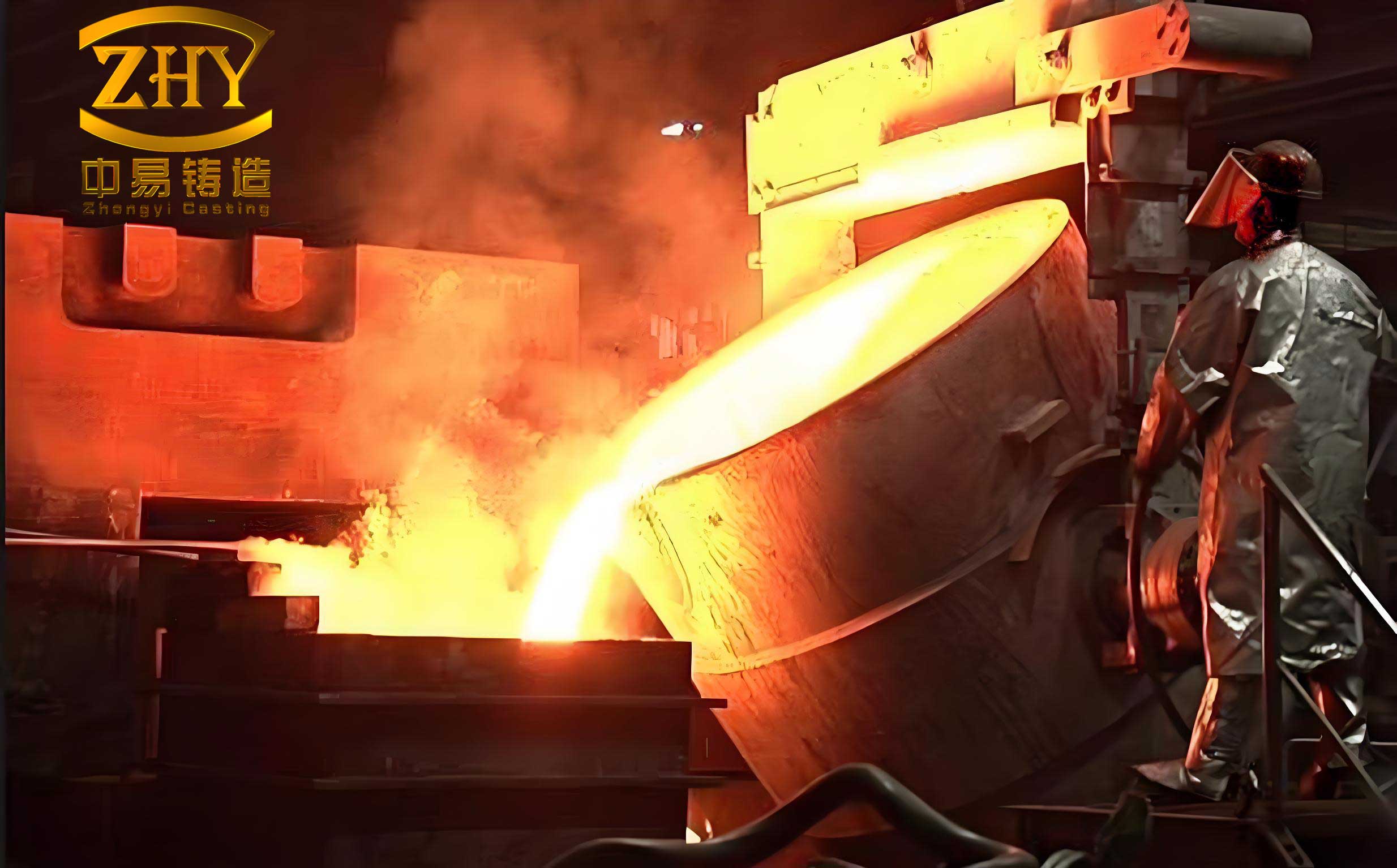
The solidification microstructure of high-manganese steel provides the internal condition for crack propagation. The alloy exhibits a strong tendency to form coarse columnar grains and dendritic structures in the as-cast state. More critically, brittle carbides, primarily of the (Fe,Mn)3C type, precipitate preferentially along these grain boundaries. This continuous or semi-continuous network severely embrittles the casting at elevated temperatures, dramatically lowering its resistance to crack initiation and growth during solidification. The crack formation process is dynamic. Initial fissures often appear at stress concentration points like hot spots when a thin solid shell first forms. As the shell thickens, the crack may propagate inward. Sometimes, these incipient tears are backfilled by residual liquid metal, effectively “healing” them. However, if the feeding is insufficient or the tear reopens during subsequent contraction, a permanent defect is established. Internal cracks (hot tears) are invariably associated with shrinkage porosity and macro-shrinkage cavities, as these regions are the last to solidify and are under triaxial tension, making them highly susceptible to tearing between dendrite arms.
From a practical standpoint in the manganese steel casting foundry, cracks manifest in specific locations: sections with abrupt changes in wall thickness, insufficient fillet radii at junctions, and areas of slow cooling. Furthermore, surface defects like gas holes, slag inclusions, or sand burns act as potent stress raisers. During machining or even upon shakeout, these can evolve into visible surface cracks. The role of foundry practice cannot be overstated; improper gating design that creates hot spots or restricts contraction, or the use of distorted chills, directly contributes to these failures.
The journey of a casting does not end at shakeout. Cracks can also develop or propagate during heat treatment and in service. The standard heat treatment for high-manganese steel involves solution annealing at 1050-1100°C followed by rapid water quenching to retain carbon in solid solution and achieve the desired austenitic microstructure with high toughness. Incorrect practices here are detrimental. If the heating rate is too fast, especially through the lower temperature range (below 600°C), the thermal stresses induced can exceed the material’s strength and cause quench cracking. Similarly, if the casting is quenched from a temperature that is too low or held at a critical temperature range for too long, secondary carbides can precipitate along grain boundaries, re-embrittling the material. In service, under repetitive high-impact loading, any pre-existing subsurface defect—a shrinkage cavity, a micro-shrinkage zone, or an area with carbide networks—acts as a fatigue crack nucleation site. The crack then propagates under cyclic loading until it reaches the surface, leading to catastrophic failure. The presence of phosphorus, which forms a low-melting-point phosphide eutectic at grain boundaries, is particularly harmful as it drastically reduces hot ductility and accelerates fatigue crack growth.
Addressing these challenges requires a holistic, multi-pronged approach at every stage of the manufacturing process in a manganese steel casting foundry. The following table summarizes the key influencing factors and their mechanisms related to cracking.
| Factor Category | Specific Element | Mechanism of Influence on Cracking | Typical Manifestation |
|---|---|---|---|
| Material Properties | High Linear Shrinkage | Generates high tensile strain during solidification if restrained. | Hot tears at junctions and hot spots. |
| Low Thermal Conductivity | Causes large thermal gradients and high thermal stresses. | Quench cracks, stress concentration. | |
| Carbide Precipitation | Embrittles grain boundaries in as-cast and improperly heat-treated states. | Reduced strength, easy crack initiation. | |
| Design & Geometry | Abrupt Section Changes | Creates stress concentration and differential cooling rates. | Cracks at fillets or thin-to-thick transitions. |
| Poor Fillet Radii | Increases local stress significantly. | Cracks originating from sharp corners. | |
| Foundry Process | Rigid Mold/Core System | Impedes free contraction of the casting. | Hot tears along restraining surfaces. |
| Improper Gating/Risering | Causes thermal gradients, hinders feeding, creates hot spots. | Shrinkage-related internal cracks, tears near gates. | |
| Incorrect Chill Use | Creates unbalanced solidification and localized stresses. | Cracks between chills or at chill edges. | |
| Metallurgy & Chemistry | High Carbon & Phosphorus | Promotes excessive carbides and brittle phosphide networks at grain boundaries. | General embrittlement, severe hot tearing susceptibility. |
| Poor Melt Deoxidation | Leads to non-metallic inclusions (oxides) that act as crack initiators. | Cracks associated with inclusion clusters. | |
| Heat Treatment | Rapid Heating/Improper Quench | Induces excessive thermal stress or allows harmful carbide precipitation. | Quench cracks, reduced impact toughness in service. |
| Premature Shakeout | Exposes red-hot casting to air causing non-uniform rapid cooling. | Cooling cracks, increased residual stress. |
To effectively prevent cracking, the strategy must be integrated from design through to post-heat treatment handling. The cornerstone is sound casting design. Collaboration between the designer and the foundry engineer is paramount to avoid problematic features. Where possible, “T” sections should be preferred over “+” cross-sections to reduce hot spots. Wall thickness transitions must be gradual, and generous fillet radii must be specified. The gating and risering system design is a critical art in the manganese steel casting foundry. The goal is to achieve directional solidification towards the risers while minimizing temperature gradients and contraction hindrance. Multiple ingates, if not carefully placed, can act as rigid constraints. It is often necessary to place a riser at the ingate location to compensate for the localized superheat and shrinkage. The use of side risers or knock-off risers is strongly recommended over top risers to avoid the thermal shock and stress concentration associated with torch cutting. Chills are powerful tools for controlling solidification but must be used judiciously. They must be flat, properly spaced, and of adequate size to avoid creating new stress raisers or zones of conflicting contraction. The relationship between riser size, chill placement, and casting geometry can be optimized using modulus calculations, where the modulus $M$ is the volume-to-cooling-surface-area ratio ($M = V/A$). The riser modulus should exceed that of the section it feeds to ensure it remains liquid longest.
Metallurgical control is non-negotiable. Chemical composition, particularly carbon and phosphorus, must be tightly controlled. While carbon is necessary for hardness, excessive carbon increases the volume of brittle carbides. The carbon content should be kept at the lower end of the specification for castings prone to cracking. Phosphorus is a notorious tramp element; its content must be minimized, ideally below 0.04%, as it severely reduces ductility and promotes hot tearing. The following relationship illustrates the combined detrimental effect:
$$ \text{Embrittlement Tendency} \propto [\%C]^2 + k \cdot [\%P] $$
where $k$ is a large constant multiplier highlighting phosphorus’s severe impact. Melting practice is equally important. A fully reducing slag with low oxidation potential is essential to prevent the formation of manganese silicate and other oxide inclusions that weaken grain boundaries. The slag basicity and composition should be controlled to minimize the content of FeO and MnO. Pouring temperature is a key process variable; a lower temperature within the fluidity range reduces total contraction and grain size. The grain size, $d$, often follows a relationship with pouring superheat, $\Delta T_{pour}$:
$$ d \approx d_0 + c \cdot \Delta T_{pour} $$
where $d_0$ and $c$ are material constants. A finer grain size inherently improves strength and ductility, reducing cracking propensity. Therefore, the practice of “low temperature, rapid pouring” is advocated.
Heat treatment is the final critical step that can either mitigate or induce cracks. The heating cycle must be gradual to allow thick and thin sections to equalize in temperature. For complex castings, a heating rate not exceeding 50°C per hour up to 600°C is a safe rule. The casting should be charged into a furnace at a temperature not vastly different from its own to avoid thermal shock. After solutionizing, quenching must be immediate and vigorous to achieve full austenitization. Equally crucial is the practice of allowing the casting to cool slowly in the mold after pouring. Shakeout should not occur until the casting has cooled below 400-450°C to avoid introducing massive thermal stresses. The following table provides a consolidated checklist of preventative measures for a manganese steel casting foundry.
| Process Stage | Preventative Action | Technical Rationale & Target |
|---|---|---|
| Casting Design | Avoid sharp corners, use generous fillets (R min = 0.3 x wall thickness). Transition walls gradually. Prefer open, simple geometries. | Minimize stress concentration factors (Kt). Promote uniform cooling. |
| Pattern & Mold Making | Use molding sands with excellent collapsibility (e.g., organic binders). Ensure cores are hollow or crushable. Design rigid yet open sand boxes; keep box bars away from casting/risers. | Maximize mold yield to reduce contraction restraint. Prevent mechanical hindrance. |
| Gating & Risering Design | Design for directional solidification. Use side/knock-off risers. Place risers at thermal centers and gate junctions. Calculate moduli (M_riser > 1.2 x M_casting). Use insulating sleeves on risers. | Ensure adequate feed metal to compensate for shrinkage. Eliminate internal voids that become crack nuclei. |
| Chill Application | Use flat, clean chills. Space chills closely to avoid “hot spots” between them. Match chill size to section modulus. | Control solidification sequence, eliminate isolated hot spots, promote directional cooling. |
| Melting & Chemistry Control | Maintain low P (<0.04%). Optimize C content for application (often ~1.1%). Ensure good deoxidation (Al addition). Control slag (Σ(FeO+MnO) < 1.0%). | Minimize grain boundary embrittling phases. Produce clean, inclusion-free steel. |
| Pouring Practice | Use the lowest practical pouring temperature that ensures complete filling. Pour rapidly once started. | Reduce total contraction strain and grain coarsening. |
| Cooling & Shakeout | Allow castings to cool in mold to below 450°C. Avoid exposing red-hot castings to air drafts. | Minimize thermal stresses induced by rapid, uneven cooling in air. |
| Heat Treatment | Charge cold castings into a cold or warm furnace (<300°C). Heat slowly (30-50°C/hr to 600°C). Hold for adequate solutionizing time at 1050-1100°C. Quench immediately and uniformly into agitated water. | Avoid thermal shock heating. Dissolve all carbides. Achieve fully austenitic, tough microstructure. Avoid carbide reprecipitation. |
| Quality Inspection | Implement non-destructive testing (NDT) like dye penetrant or ultrasonic testing on critical areas and high-risk geometries. | Detect sub-surface defects early before they propagate in service. |
In service, the performance of a casting is a direct testament to the quality of the manufacturing process in the manganese steel casting foundry. A well-made casting, free from significant internal defects and with a sound microstructure, will work-harden uniformly under impact, developing a hard, wear-resistant surface while retaining a tough, crack-resistant core. Conversely, a casting with hidden shrinkage, carbide networks, or high residual stress will often fail prematurely through crack propagation from these flaws. The fatigue life, $N_f$, can be empirically related to the initial defect size, $a_i$, following a Paris Law type relationship for crack growth:
$$ \frac{da}{dN} = C (\Delta K)^m $$
where $a$ is crack length, $N$ is cycles, $\Delta K$ is the stress intensity factor range, and $C$ and $m$ are material constants. A larger initial defect $a_i$ drastically reduces the total cycles to failure. This underscores the paramount importance of sound founding practices to minimize $a_i$.
Furthermore, the economics of a manganese steel casting foundry are heavily influenced by yield and scrap rates. Implementing the preventative measures outlined here, while potentially adding minor cost or complexity to individual steps, results in a net positive outcome through dramatically reduced scrap, fewer customer complaints, and enhanced reputation for reliability. It transforms the production process from a reactive, problem-fighting operation to a proactive, quality-engineering one.
In conclusion, the battle against cracking in high-manganese steel castings is won through a deep understanding of the material’s behavior and meticulous control over every stage of production. From the drawing board to the quenching tank, each decision plays a role. A holistic approach encompassing intelligent design, precise process engineering, stringent metallurgical control, and disciplined heat treatment is not just beneficial—it is essential. As someone deeply involved in the craft, I can affirm that when these principles are rigorously applied, the incidence of cracking can be controlled to minimal levels, enabling the production of durable, high-performance castings that reliably withstand the most demanding service conditions. The synergy between empirical foundry knowledge and fundamental metallurgical principles is the key to success in any modern manganese steel casting foundry.