
As a seasoned practitioner in the manganese steel casting foundry industry, I have dedicated years to refining the processes that yield high-performance wear-resistant components. The unique properties of high manganese steel, particularly its ability to work-harden under impact, make it indispensable for applications like mining equipment, crusher liners, and railway crossings. However, achieving optimal performance requires meticulous control over every stage—from melting and casting to heat treatment. In this comprehensive discussion, I will delve into the critical aspects that define success in a manganese steel casting foundry, drawing from hands-on experience and empirical studies. My goal is to share insights that can enhance durability, reduce wear, and elevate the standards of our industry.
The foundation of any manganese steel casting foundry lies in the casting process itself. Proper gating and risering systems are paramount to ensure soundness and density in the final product. For instance, in the production of roller sleeves for crushers, the method of riser placement profoundly affects internal integrity. When multiple risers are used due to design constraints, shrinkage porosity often occurs at the roots, compromising the component’s lifespan. Conversely, a single concentrated riser, coupled with strategic orientation, can eliminate such defects, leading to a denser casting and extending service life by up to 50%. This underscores the importance of adopting a holistic approach in the manganese steel casting foundry to minimize voids and enhance cohesion.
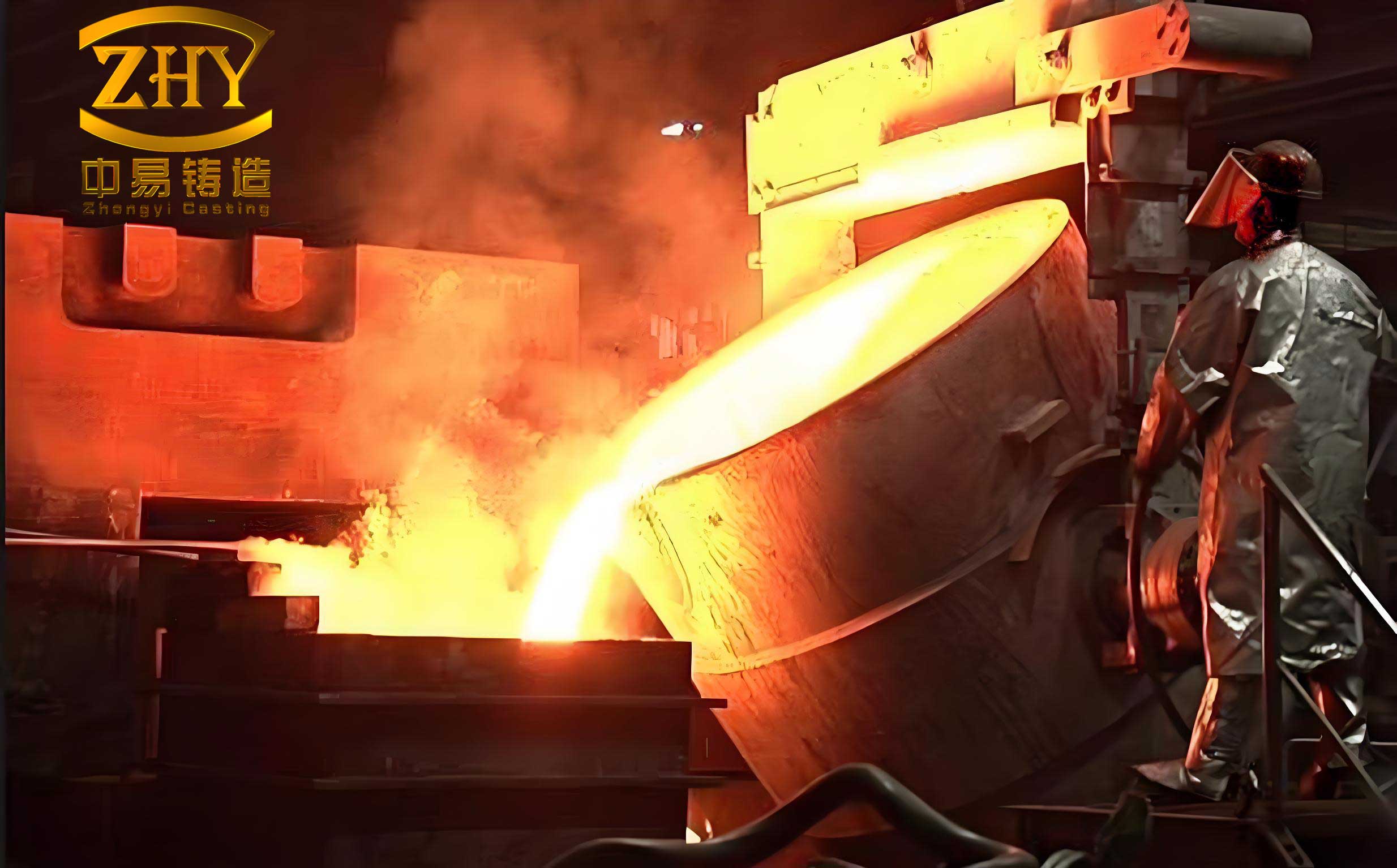
To systematize these principles, I recommend the following guidelines based on wall thickness, which are essential for any manganese steel casting foundry:
| Wall Thickness (mm) | Recommended Process | Key Measures |
|---|---|---|
| ≤ 50 | Riser with washable core or neck breaker | Use external chills to accelerate cooling and improve density. |
| 50–100 | Directional solidification scheme | Employ external chills selectively to promote uniform solidification. |
| > 100 | Concentrated riser system | Avoid washable cores; use hot cutting or underwater cutting for riser removal. |
Moreover, for batch production of simple-shaped parts, metal molds or sand-lined metal molds can significantly enhance surface finish and dimensional accuracy. The mantra of “three lows” should be adhered to: low pouring temperature (typically below 1500°C), low mold preheat temperature, and low tap temperature from the furnace to prevent overheating. These practices are fundamental to maintaining the integrity of casts in a manganese steel casting foundry.
Another pivotal factor is the control of austenitic grain size. While some in the manganese steel casting foundry community argue that grain size has negligible impact on wear resistance, I contend this view is myopic. Fine, equiaxed grains with clear boundaries contribute to superior work-hardening capability and toughness. The relationship between grain size and mechanical properties can be expressed through the Hall-Petch equation: $$ \sigma_y = \sigma_0 + k_y \cdot d^{-1/2} $$ where $\sigma_y$ is the yield strength, $\sigma_0$ is the lattice friction stress, $k_y$ is the strengthening coefficient, and $d$ is the average grain diameter. In high manganese steel, finer grains ($d < 100 \mu m$) impede dislocation motion and grain boundary sliding, thereby enhancing hardness under abrasion. However, under severe impact, grains may fragment dynamically, masking the initial size effect. Thus, for most service conditions involving combined impact and abrasive wear, aiming for fine grains is prudent.
To achieve refined as-cast structures, a manganese steel casting foundry must implement全程 control: regulating pouring temperature, employing micro-alloying additions (e.g., titanium, vanadium), and accelerating mold cooling. For example, adding 0.1% Ti can inhibit grain growth by forming TiC precipitates that pin boundaries. The cooling rate $R$ influences grain size according to: $$ d = A \cdot R^{-n} $$ where $A$ and $n$ are material constants. Faster cooling, achieved through chills or thin-walled molds, yields finer grains. Below is a summary of measures to refine grain structure in a manganese steel casting foundry:
| Control Parameter | Target Range | Effect on Grain Size |
|---|---|---|
| Pouring Temperature | 1420–1480°C | Lower temperature reduces dendrite arm spacing and grain coarsening. |
| Micro-alloying (Ti, V) | 0.05–0.15 wt% | Forms fine carbides that act as nucleation sites and pin boundaries. |
| Mold Cooling Rate | > 10°C/s for surface layers | Promotes rapid solidification, yielding equiaxed fine grains. |
| Inoculation Practice | Use of ferrosilicon or rare earths | Increases nucleation potency, refining overall microstructure. |
The morphology and distribution of carbides are equally critical in a manganese steel casting foundry. While a fully austenitic matrix is ideal, carbide precipitation is inevitable. The key is to control its form: fine, dispersed particles within grains enhance wear resistance by acting as hard phases that support work-hardening, whereas continuous films or networks along grain boundaries embrittle the steel. This aligns with the theory of second-phase particles influencing加工 hardening. The increase in hardness $\Delta H$ due to carbides can be modeled as: $$ \Delta H = B \cdot f^{m} \cdot r^{-p} $$ where $f$ is the volume fraction of carbides, $r$ is their average radius, and $B, m, p$ are constants. For optimal performance, carbides should be spherical or granular with $r < 1 \mu m$ and distributed uniformly.
In practice, heat treatment (water toughening) is employed to dissolve eutectic carbides. However, excessive time or temperature can lead to re-precipitation or even phosphorus eutectic formation, degrading properties. The dissolution kinetics follow an Arrhenius-type relation: $$ t_d = C \cdot \exp\left(\frac{Q}{RT}\right) $$ where $t_d$ is the dissolution time, $Q$ is the activation energy, $R$ is the gas constant, $T$ is the absolute temperature, and $C$ is a pre-factor. For a typical manganese steel casting foundry, I recommend austenitizing at 1050–1100°C for 1–3 hours depending on section thickness, followed by rapid quenching in water. Below is a comparison of carbide states and their impact:
| Carbide Morphology | Typical Size | Location | Effect on Wear Resistance |
|---|---|---|---|
| Fine needle-like | 0.5–2 µm | Intragranular | Positive: acts as hardening sites, improves abrasion resistance. |
| Granular/spheroidal | < 1 µm | Intragranular | Positive: enhances toughness and work-hardening capacity. |
| Film/network | Continuous layers | Grain boundaries | Negative: induces brittleness, reduces impact fatigue life. |
| Coarse lamellar | > 5 µm | Interdendritic | Severely detrimental: promotes crack initiation and spalling. |
A persistent challenge in the manganese steel casting foundry is surface decarburization during heat treatment. Decarburization depletes carbon from the surface layer, forming a soft ferritic zone that drastically reduces wear resistance. The depth of decarburization $\delta$ depends on time $t$, temperature $T$, and atmosphere oxidizability. It can be approximated by: $$ \delta = \alpha \cdot \sqrt{t} \cdot \exp\left(-\frac{E_a}{2RT}\right) $$ where $\alpha$ is a constant and $E_a$ is the activation energy for carbon diffusion. To illustrate, experimental data from our manganese steel casting foundry shows decarburization depths for various holding times:
| Sample Diameter (mm) | Initial Carbon (%) | Holding Time (h) | Temperature (°C) | Decarb Depth (mm) |
|---|---|---|---|---|
| Φ20 | 1.20 | 2 | 1050 | 0.8 |
| Φ30 | 1.25 | 3 | 1080 | 1.2 |
| Φ50 | 1.15 | 4 | 1100 | 1.6 |
| Φ80 | 1.30 | 5 | 1120 | 2.0 |
To mitigate decarburization, a manganese steel casting foundry can adopt several strategies. First, segregate castings by wall thickness in the furnace: thick sections in hotter zones near burners, thin sections in cooler areas. Second, optimize thermal cycles: for medium walls (40–80 mm), austenitize at 1050–1080°C for no more than 2 hours; for heavy sections, limit to 1100°C for 3 hours. A short-term temperature spike to 1150°C just before quenching can redress carbide re-precipitation without excessive decarb. Third, use protective atmospheres (e.g., nitrogen or endothermic gas) or coat castings with anti-oxidant washes prior to charging. In trials at our manganese steel casting foundry, a silica-based slurry reduced decarb depth by ~30%.
Looking beyond traditional methods, the integration of computational modeling can revolutionize a manganese steel casting foundry. Simulation of solidification using finite element analysis helps predict shrinkage porosity and hot spots, allowing for proactive riser design. The energy balance during solidification is given by: $$ \rho C_p \frac{\partial T}{\partial t} = \nabla \cdot (k \nabla T) + L \frac{\partial f_s}{\partial t} $$ where $\rho$ is density, $C_p$ is specific heat, $k$ is thermal conductivity, $L$ is latent heat, and $f_s$ is solid fraction. By optimizing gating and cooling, we can achieve more uniform microstructures. Furthermore, statistical process control (SPC) tools can monitor key variables like carbon equivalent and pouring temperature, ensuring consistency across batches in a manganese steel casting foundry.
Micro-alloying deserves special attention. Elements like boron (0.002–0.005%) enhance hardenability and grain refinement, while rare earths (e.g., cerium) modify inclusions and improve carbide dispersion. The effect on impact toughness $K_{CV}$ can be empirical: $$ K_{CV} = K_0 + \beta_1[Mn] + \beta_2[Ti] – \beta_3[P] $$ where $K_0$ is a base value, $\beta_i$ are coefficients, and brackets denote weight percentages. By balancing composition, a manganese steel casting foundry can tailor properties for specific applications, such as jaw plates for crushers or liners for grinding mills.
In terms of heat treatment innovation, fluidized bed furnaces offer rapid heating and precise atmosphere control, reducing decarburization risks. The quenching medium also matters: agitated water at 20–40°C ensures fast heat extraction without steam pocket formation. Post-quench inspection using non-destructive techniques like ultrasonic testing or magnetic permeability measurements can detect subsurface flaws, though caution is needed—magnetic response alone shouldn’t condemn a part, as it may reflect surface conditions rather than bulk carbide dissolution.
Sustainability is becoming crucial for modern manganese steel casting foundries. Recycling scrap steel, optimizing energy use in melting (e.g., via electric arc furnaces with regenerative burners), and minimizing slag waste contribute to greener operations. The carbon footprint $F$ of producing one ton of high manganese steel castings can be estimated: $$ F = E_m \cdot I_e + E_t \cdot I_t + M \cdot I_m $$ where $E_m$ is melting energy, $I_e$ is emission intensity of electricity, $E_t$ is thermal energy for heat treatment, $I_t$ is emission factor for fuel, $M$ is material input, and $I_m$ is embodied emissions of raw materials. By adopting best practices, a manganese steel casting foundry can reduce $F$ by 15–20%.
To encapsulate my recommendations for a manganese steel casting foundry, I propose a comprehensive checklist:
| Aspect | Best Practice | Expected Benefit |
|---|---|---|
| Melting | Control superheat ≤ 50°C above liquidus; use basic slag to reduce phosphorus. | Cleaner steel, fewer non-metallic inclusions. |
| Casting Design | Simulate solidification; use chills and risers based on modulus method. | Sound castings with minimal shrinkage. |
| Grain Refinement | Add 0.1% Ti or 0.05% V; pour at lower end of range. | Fine austenite grains (ASTM 4–6). |
| Carbide Control | Austenitize at 1070°C ± 20°C; quench within 30 seconds of withdrawal. | Dissolved carbides, no continuous networks. |
| Decarb Prevention | Apply ceramic coating; use neutral atmosphere during heating. | Surface carbon loss < 0.1 mm. |
| Quality Assurance | Monitor hardness profile (HB 200–230 as-cast); conduct periodic microstructure checks. | Consistent performance, longer service life. |
In conclusion, excellence in a manganese steel casting foundry hinges on a synergistic approach that blends empirical wisdom with scientific principles. By focusing on density through optimized risering, refining grains via controlled solidification, dispersing carbides appropriately, and combating decarburization, we can produce castings that withstand extreme abrasive and impact conditions. The journey involves continuous learning and adaptation, but the rewards—enhanced durability, customer satisfaction, and operational efficiency—are immense. As the industry evolves, embracing technologies like additive manufacturing for molds or AI-driven process control will further elevate the capabilities of the manganese steel casting foundry. Let us commit to advancing these practices, ensuring that every component we produce embodies the resilience and quality that define high manganese steel.
Finally, I encourage fellow foundry engineers to share data and collaborate on research. The complex interplay of factors in manganese steel casting foundry operations means that collective insights can accelerate progress. Whether through industry conferences or technical publications, exchanging experiences on topics like eutectic modification or non-destructive evaluation will benefit all. Together, we can set new benchmarks for wear resistance and reliability, solidifying the role of the manganese steel casting foundry as a cornerstone of heavy industry.