
In my extensive experience within the manganese steel casting foundry industry, the production of ball mill liners represents a critical application where material science and precise manufacturing converge. The unique properties of high manganese steel, particularly its work-hardening capability and impact resistance, make it indispensable for such wear-resistant components. This article delves into the comprehensive technological framework I employ to produce high-quality ball mill liners, emphasizing the integration of innovative foundry practices that define a modern manganese steel casting foundry. From alloy design to final heat treatment, every step is optimized to enhance dimensional accuracy, surface quality, and internal integrity of castings, ensuring they meet stringent industrial demands.
The foundation of any successful manganese steel casting foundry lies in a deep understanding of the alloy’s composition. For ball mill liners, the standard material is ZGMn13-1, which adheres to specifications like GB5680-85. The chemical composition and mechanical properties are paramount, as they directly influence performance in abrasive and impact environments. Below is a detailed table summarizing the key parameters that guide our production in the manganese steel casting foundry.
| Chemical Element | Weight Percentage (w%) | Mechanical Property | Value |
|---|---|---|---|
| Carbon (C) | 1.1 – 1.5 | Tensile Strength (σb) | ≥637 MPa |
| Manganese (Mn) | 11.0 – 14.0 | Elongation (δ) | ≥20% |
| Silicon (Si) | 0.3 – 1.8 | Impact Toughness (ak) | ≥15 J·cm-2 |
| Phosphorus (P) | ≤0.09 | Hardness (HB) | ≤229 HB |
| Sulfur (S) | ≤0.05 | Mn/C Ratio | ≥9.0 |
In the manganese steel casting foundry, maintaining a high Mn/C ratio (above 9.5) is crucial to prevent carbide precipitation and ensure austenitic stability. This is achieved through careful control during melting, which I will elaborate on later. The mechanical properties, such as hardness and toughness, are validated through rigorous testing to guarantee that castings withstand operational stresses. The manganese steel casting foundry environment must balance these compositional targets with practical casting considerations to avoid defects like hot tearing or shrinkage porosity.
The casting process begins with meticulous pattern and mold design. In our manganese steel casting foundry, we utilize metal pattern plates combined with standard flasks to achieve high dimensional accuracy and surface finish. This approach minimizes machining allowances, typically set at 3-5 mm, thereby reducing material waste and post-processing time. For core-making, we employ magnesite-based refractory materials to withstand the high temperatures and chemical interactions inherent in manganese steel casting. The design principles include a negative tolerance for external dimensions and a positive tolerance for internal features, ensuring precise fit in ball mill assemblies. The free linear shrinkage rate is controlled between 2.2% and 3.2%, calculated based on the thermal expansion characteristics of high manganese steel. The riser design accounts for a solidification shrinkage of 6%, and we implement easily removable gating systems to facilitate cleaning. A key innovation in our manganese steel casting foundry is the use of forsterite-based alkaline coatings, which provide excellent resistance to metal penetration and improve surface quality by reducing slag adherence. The gating system is designed as an open type to ensure smooth metal flow and minimize turbulence, which can introduce inclusions. The cross-sectional areas are proportioned as follows: $$ \Sigma F_{\text{inner}} : \Sigma F_{\text{runner}} : \Sigma F_{\text{sprue}} = 1 : (1 \text{ to } 1.1) : (1 \text{ to } 1.4) $$ where $$ \Sigma F_{\text{sprue}} = \frac{\pi d^2}{4} $$ with a sprue diameter of 45 mm, giving $$ \Sigma F_{\text{sprue}} = \frac{\pi (45)^2}{4} \approx 15.9 \text{ cm}^2 $$. This mathematical optimization ensures balanced filling and reduces the risk of defects, a hallmark of advanced manganese steel casting foundry operations.
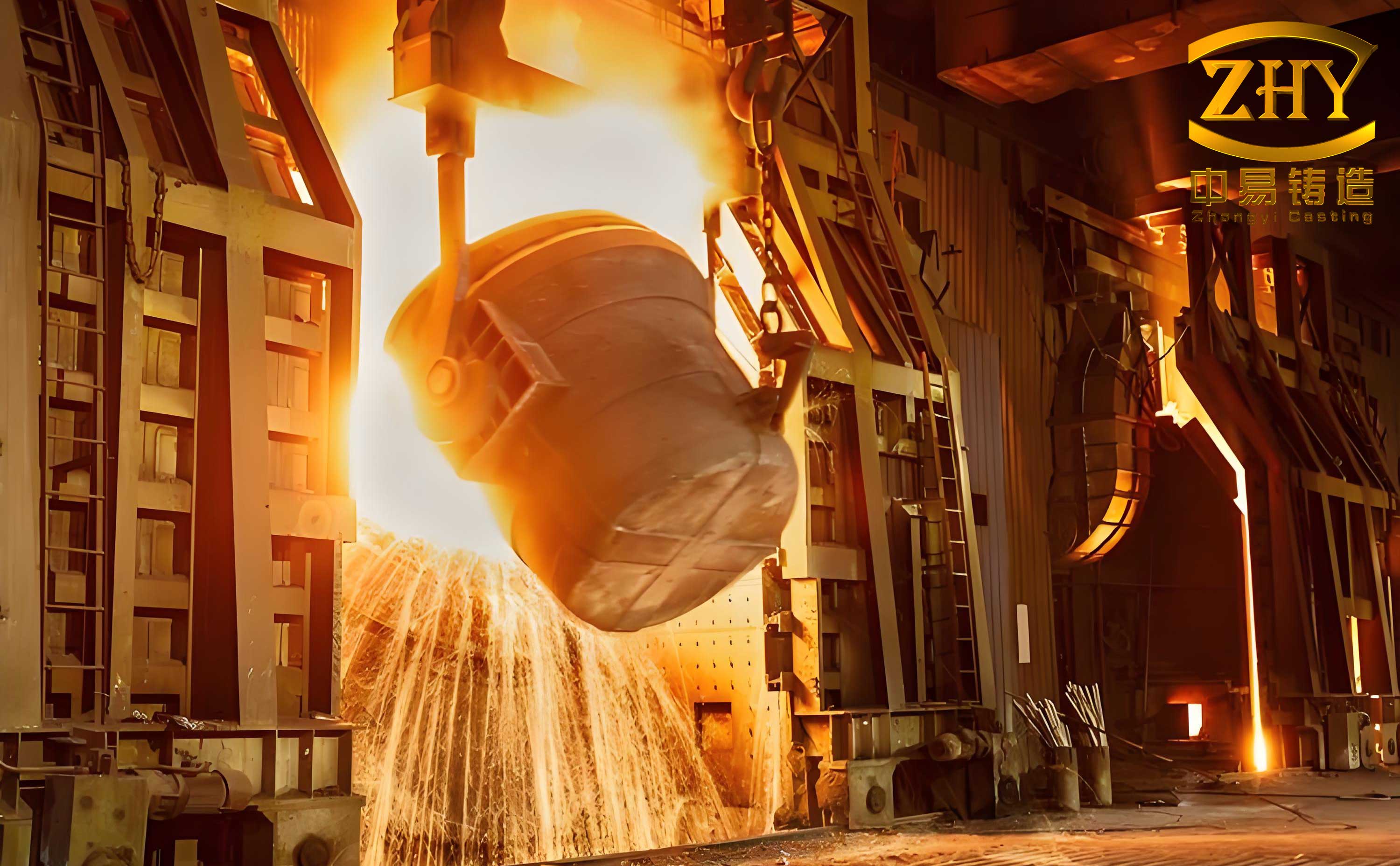
Melting and pouring are critical phases in the manganese steel casting foundry, where冶金 quality is established. We use a GW-1-500J medium-frequency induction furnace, which offers precise temperature control and efficient stirring. To protect the molten metal from oxidation and gas absorption, we implement a slag cover system. Initially, limestone (CaO) is placed at the furnace bottom, amounting to about 1% of the metal charge weight. As melting proceeds, a slag layer forms, continuously covering the steel surface. This slag, composed of limestone and fluorite (CaF2) in a mass ratio of 4-5:1, acts as a barrier against atmospheric contamination and helps float out inclusions. The addition of fluorite lowers the slag melting point and adjusts viscosity, making it easier to remove during slagging. The deoxidation sequence is meticulously planned to enhance冶金 quality. First, pre-deoxidation is performed using high-carbon ferromanganese (FeMn75C7.5) at a temperature range of 1610–1640°C. The addition amount is approximately 1% of the steel weight, with a yield of 90%. This step reduces iron oxide content through carbon oxidation: $$ \text{C} + \text{FeO} \rightarrow \text{Fe} + \text{CO} \uparrow $$. Subsequently, ferromanganese for alloying is added in preheated batches (50–100 mm pieces at over 750°C) to achieve the target manganese content, with a yield of 95% when added after pre-deoxidation. This order improves overall yield by 5%, optimizing cost-efficiency in the manganese steel casting foundry. Finally, terminal deoxidation is carried out with aluminum, added at 0.1–0.2% of the steel weight to ensure a residual aluminum content above 0.08%. This promotes the formation of high-melting-point Al-P compounds within grains, mitigating the detrimental effects of phosphorus segregation. The pouring temperature is tightly controlled between 1340°C and 1380°C, based on the liquidus temperature of 1400°C for ZGMn13-1. To determine the holding time after tapping, we monitor the slag skim solidification time, as summarized in the table below—a standard practice in our manganese steel casting foundry to prevent reoxidation and inclusion entrapment.
| Slag Skim Solidification Time (s) | Recommended Holding Time Before Pouring (min) |
|---|---|
| <11 | 0 |
| 12–14 | 2–3 |
| 15–18 | 3–8 |
| 18–22 | 8–14 |
| 23–25 | 14–18 |
| 25–30 | 18–22 |
Post-casting operations in the manganese steel casting foundry focus on careful cooling and cleaning to prevent defects. After pouring, molds are loosened approximately 30 minutes later, based on a calculated rate of 1 minute per 5 mm of section thickness, to allow for safe contraction without inducing stresses. Shakeout is performed when the casting temperature exceeds 400°C, and castings are kept away from drafts to avoid thermal shock. Gating systems are removed using oxy-acetylene torches while the castings are still above 400°C, preventing the re-precipitation of carbides that can occur if done after heat treatment. Flash and burrs are ground off using abrasive tools, and any thick sections are cut with grinders. This meticulous approach ensures that the inherent low thermal conductivity (about one-third that of carbon steel) and high thermal expansion coefficient (roughly double that of carbon steel) of high manganese steel do not lead to cracking, a common challenge in manganese steel casting foundry workflows.
Heat treatment, specifically water toughening, is the transformative step that imparts the desired austenitic microstructure and toughness to high manganese steel castings. In our manganese steel casting foundry, we employ two methods: conventional water toughening and direct water toughening. The conventional process involves controlled heating and quenching. For thick-section castings like ball mill liners (with thickness δ > 75 mm), the heating rate must be carefully managed to avoid thermal stresses. The temperature profile follows: from room temperature to 600°C, the heating rate is maintained at 30–50°C/h, described by the differential equation: $$ \frac{dT}{dt} = k $$ where k is the rate constant. Above 600°C, the rate increases to 100–150°C/h until the soaking temperature of 1050–1080°C is reached. The holding time t at this temperature ensures complete dissolution of carbides into the austenitic matrix, governed by Fick’s law of diffusion: $$ C(x,t) = C_0 \left(1 – \text{erf}\left(\frac{x}{2\sqrt{Dt}}\right)\right) $$ where C is carbon concentration, D is the diffusion coefficient, and x is distance. After soaking for 4 hours, castings are rapidly quenched in water at 10–30°C, with the transfer time from furnace to water kept under 3 minutes to prevent temperature drop below 950°C. The quenching process leads to a supersaturated austenitic structure that provides high toughness and work-hardening ability. For urgent productions, our manganese steel casting foundry utilizes direct water toughening, where castings are shaken out at 1050–1080°C and immediately quenched, combining heat treatment and sand removal in one step. This method is efficient but requires precise temperature monitoring to avoid excessive grain growth or residual stresses. Both techniques are validated for producing ball mill liners, as well as other components like crusher hammers and jaw plates, showcasing the versatility of our manganese steel casting foundry.
The冶金 aspects of high manganese steel are further refined through thermodynamic modeling in the manganese steel casting foundry. For instance, the deoxidation equilibrium can be expressed using the following relation for aluminum deoxidation: $$ [\text{Al}] + \frac{3}{2} [\text{O}] \rightleftharpoons \text{Al}_2\text{O}_3(s) $$ with the equilibrium constant $$ K_{\text{Al-O}} = \frac{a_{\text{Al}_2\text{O}_3}}{[\%\text{Al}] [\%\text{O}]^{3/2}} $$. By controlling activities through slag composition, we minimize oxygen content to below 50 ppm, enhancing cleanliness. Additionally, the Mn/C ratio is critical for suppressing carbide formation, as per the empirical formula: $$ \text{Mn/C} = \frac{[\text{Mn}]}{[\text{C}]} \geq 9.5 $$. This ratio influences the driving force for carbide precipitation, which can be modeled using the Gibbs free energy change: $$ \Delta G = \Delta H – T\Delta S $$ where a negative ΔG favors dissolution. In practice, our manganese steel casting foundry adjusts melting parameters to maintain this balance, ensuring optimal performance in service.
Quality control in the manganese steel casting foundry extends to non-destructive testing and microstructure evaluation. We routinely examine castings for carbide networks using metallographic techniques, ensuring they meet grade standards (e.g., carbide level ≤ 3 according to industry norms). Hardness testing post-heat treatment confirms values between 197–228 HB, aligning with specifications. The absence of cracks and porosity is verified through penetrant testing, which is essential for safety-critical applications. Moreover, the manganese steel casting foundry implements statistical process control to monitor variables like pouring temperature and alloy composition, using control charts to maintain consistency. For example, we track the standard deviation of carbon content: $$ \sigma_C = \sqrt{\frac{1}{N-1} \sum_{i=1}^N (C_i – \bar{C})^2} $$ aiming for σC < 0.05% to ensure batch homogeneity. Such rigorous protocols define a world-class manganese steel casting foundry, capable of delivering reliable wear-resistant components.
In conclusion, the production of high manganese steel ball mill liners embodies the integration of advanced foundry techniques that are central to a modern manganese steel casting foundry. By leveraging metal pattern tooling, alkaline coatings, optimized melting sequences, and precise heat treatments, we achieve superior dimensional accuracy, surface quality, and internal soundness. The conventional and direct water toughening methods both yield合格 castings, with the choice depending on production schedules and specific requirements. These processes not only enhance the performance of ball mill liners but also apply to other wear parts like hammers and breaker plates, demonstrating the adaptability of our manganese steel casting foundry. Future advancements may involve computational modeling for solidification prediction and automated pouring systems, further elevating the capabilities of the manganese steel casting foundry. Through continuous innovation and adherence to rigorous standards, the manganese steel casting foundry remains pivotal in supplying durable components for mining and industrial sectors worldwide.