
In my years of experience working in a manganese steel casting foundry, I have encountered numerous challenges and solutions related to producing high-integrity castings, particularly for components like mill door liners in ball mills. The unique properties of manganese steel, such as its high toughness and wear resistance, make it ideal for demanding applications, but its casting process requires meticulous attention to detail. This article delves into the comprehensive approach we adopt in a manganese steel casting foundry, from design to defect mitigation, emphasizing key aspects like gating system design,工艺参数, and common pitfalls. The goal is to share insights that can enhance efficiency and quality in any manganese steel casting foundry operation.
The foundation of success in a manganese steel casting foundry lies in the initial工艺设计. For a typical mill door liner casting, which weighs around 39 kg and is made of ZGMn13 steel (符合 ASTM A128 standards), we start by defining the casting process plan. The chemical composition must adhere to strict standards, often summarized in a table for clarity.
| Element | Content (%) | Standard Reference |
|---|---|---|
| Carbon (C) | 1.0 – 1.4 | ASTM A128 Grade B |
| Manganese (Mn) | 11.0 – 14.0 | |
| Silicon (Si) | 0.3 – 0.8 | |
| Phosphorus (P) | ≤ 0.07 | |
| Sulfur (S) | ≤ 0.05 |
In a manganese steel casting foundry, the selection of molding materials is critical. For this liner, we use water-glass quartz sand for the mold, hardened with carbon dioxide gas, while the core sand is based on limestone, coated and dried. This combination ensures adequate strength and collapsibility. Since we often handle单件生产, manual molding is employed, allowing for flexibility and precision. The gating position and parting line are determined to minimize turbulence and promote directional solidification, as illustrated in process diagrams. In our manganese steel casting foundry, we prioritize designs that reduce defects like shrinkage and porosity.
Designing the gating system is a cornerstone of our approach in the manganese steel casting foundry. For manganese steel castings, we aim for a smooth and uniform fill to avoid oxidation and gas entrapment. An open gating system is typically chosen, where the cross-sectional areas follow a specific ratio. The relationship can be expressed as:
$$A_{\text{sprue}} : A_{\text{runner}} : A_{\text{ingate}} = 1 : (1.1 \text{ to } 1.2) : (1.1 \text{ to } 1.3)$$
Here, \(A\) denotes the cross-sectional area. For instance, if the sprue diameter is set at 50 mm, we calculate:
$$A_{\text{sprue}} = \pi \times \left(\frac{50}{2}\right)^2 \approx 1963.5 \text{ mm}^2$$
Then, for one runner:
$$A_{\text{runner}} = (1.1 \text{ to } 1.2) \times A_{\text{sprue}} \approx 2159.9 \text{ to } 2356.2 \text{ mm}^2$$
And for four ingates:
$$A_{\text{ingate}} = (1.1 \text{ to } 1.3) \times A_{\text{sprue}} \approx 2159.9 \text{ to } 2552.6 \text{ mm}^2$$
Based on practical adjustments, we might finalize dimensions as: sprue diameter 50 mm, runner size 60 mm × 90 mm × 30 mm, and each ingate at 20 mm × 40 mm × 10 mm. Such calculations are routine in our manganese steel casting foundry to ensure optimal metal flow.
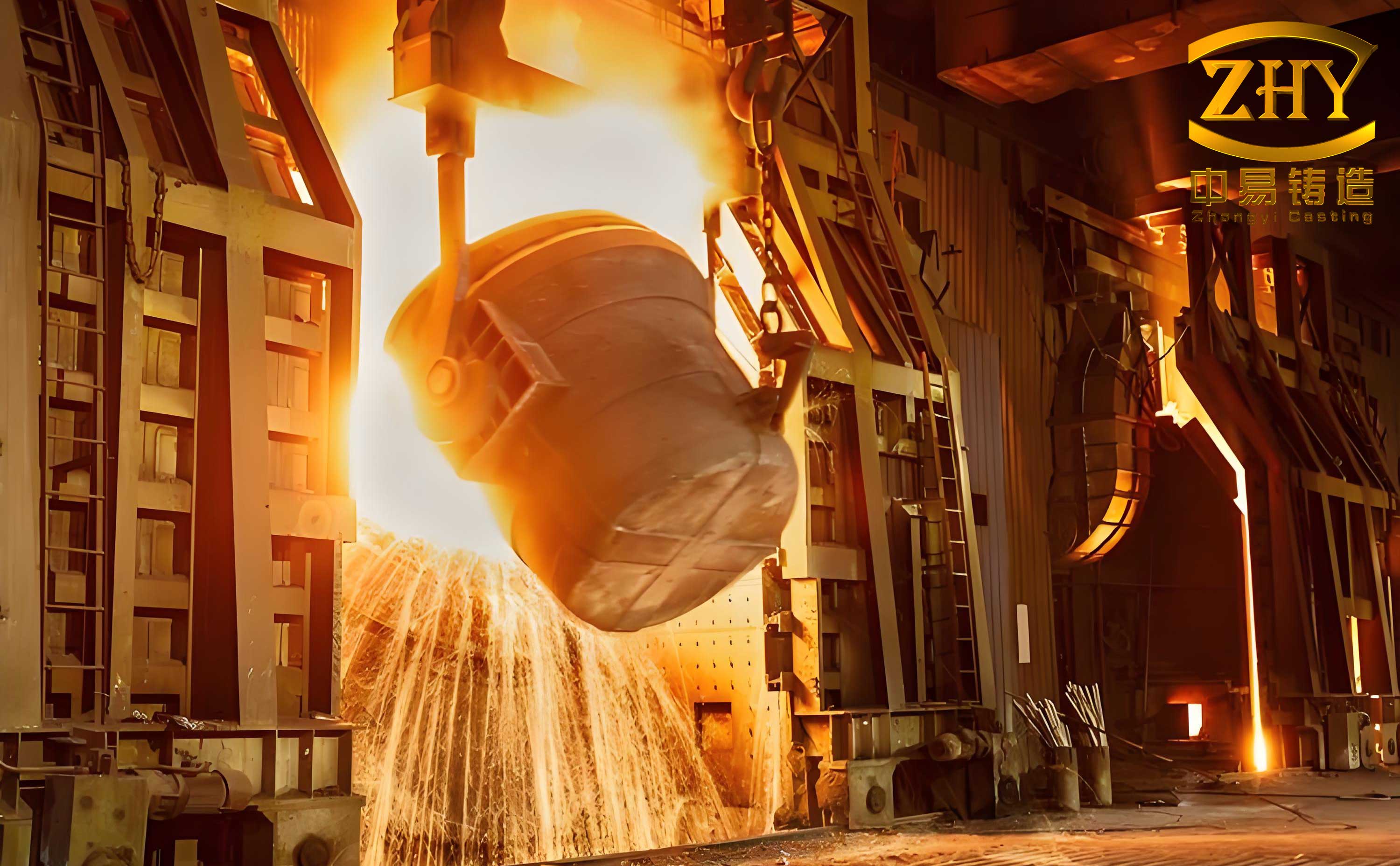
The image above showcases a typical setup in a manganese steel casting foundry, highlighting the intricate details of mold preparation and gating. It underscores the importance of visual aids in understanding the practical aspects of our work. In a manganese steel casting foundry, every element from pattern making to finishing plays a role in achieving the desired hardness of 170 to 220 HB after heat treatment.
Key casting parameters must be precisely controlled in any manganese steel casting foundry. The casting shrinkage rate is influenced by multiple factors, and we determine it using the formula:
$$S = \frac{L_{\text{pattern}} – L_{\text{casting}}}{L_{\text{casting}}} \times 100\%$$
where \(S\) is the shrinkage rate, \(L_{\text{pattern}}\) is the pattern dimension, and \(L_{\text{casting}}\) is the final casting dimension. For manganese steel liners, based on empirical data, we adopt a shrinkage rate of 2.4%. This value is critical for pattern design to ensure dimensional accuracy. Additionally, the draft angle is selected to facilitate pattern removal; we often use a tapered form that adds material, depending on the casting geometry. These parameters are summarized in the table below for common manganese steel casting foundry applications.
| Parameter | Typical Value | Remarks |
|---|---|---|
| Casting Shrinkage Rate | 2.4% | For liners up to 500 mm length |
| Draft Angle | 1° to 3° | Depending on wall thickness |
| Pouring Temperature | 1450°C to 1500°C | To ensure fluidity and reduce defects |
| Heat Treatment Hardness | 170-220 HB | After water toughening |
In our manganese steel casting foundry, the铸造工艺图 serves as a blueprint, integrating all these elements. It depicts the gating system, core placement, and venting channels without referencing specific image numbers, ensuring clarity for the foundry team. The focus is on creating a defect-free casting, which requires深入分析 of potential issues.
Defect analysis is integral to maintaining quality in a manganese steel casting foundry. Two common defects in manganese steel castings are gas porosity and sand sticking. Gas porosity often arises from multiple sources. Firstly, molding materials can contribute if the binder content is excessive or mixing is inadequate, reducing permeability and generating gases upon contact with molten metal. For example, with limestone core sand, the decomposition at high temperatures produces carbon dioxide:
$$\text{CaCO}_3 \rightarrow \text{CaO} + \text{CO}_2 \uparrow$$
This reaction liberates substantial \(\text{CO}_2\), which must be vented to avoid intrusion into the casting. Secondly, improper drying of molds or cores—such as insufficient CO₂ gassing or hot boxing—can trap moisture, leading to porosity. Thirdly, inadequate venting in molds impedes gas escape, while fast pouring rates exacerbate gas entrapment. Lastly, a poorly designed gating system can turbulence flow,卷入气体. To prevent these in our manganese steel casting foundry, we implement measures like optimizing gating for平稳 flow, ensuring thorough drying and venting, controlling material properties, and allowing melt镇静 time for gas floatation.
Sand sticking,另一个常见缺陷, occurs due to mechanical or chemical factors. Mechanically, low mold compactness or粗糙 surfaces allow metal penetration between sand grains, embedding them into the casting. Chemically, manganese steel forms alkaline manganese oxide (\(\text{MnO}\)), which reacts with silica in molding materials:
$$\text{MnO} + \text{SiO}_2 \rightarrow \text{MnO} \cdot \text{SiO}_2$$
This reaction promotes chemical burn-on. In our manganese steel casting foundry, we prevent this by using碱性造型材料 like olivine or chromite sands, finer sand grains for tighter packing, and high-quality coatings. Additionally,我们控制 pouring temperatures to minimize metal-mold interactions. The table below summarizes defect causes and solutions in a manganese steel casting foundry.
| Defect | Primary Causes | Prevention Methods |
|---|---|---|
| Gas Porosity | High gas generation from materials, inadequate drying, poor venting, turbulent gating | Use low-moisture sands, ensure proper drying and venting, design open gating systems, allow melt镇静 |
| Sand Sticking | Low mold hardness, coarse sand, chemical reactions between MnO and SiO₂ | Employ alkaline sands, increase compactness, apply refractory coatings, control pouring temperature |
Beyond these basics, a successful manganese steel casting foundry must consider advanced aspects like heat treatment and quality control. Manganese steel requires water toughening—heating to 1050°C followed by rapid quenching—to achieve its characteristic austenitic structure and high impact resistance. We monitor this process closely to ensure hardness meets specifications. Moreover, non-destructive testing methods, such as ultrasonic or magnetic particle inspection, are employed to detect internal flaws without damaging the castings. In our manganese steel casting foundry, we also emphasize sustainability by recycling sand and optimizing energy use during melting and heat treatment.
The economic aspect cannot be overlooked in a manganese steel casting foundry. By refining工艺设计, we reduce scrap rates and improve yield. For instance, calculating the optimal riser size using Chvorinov’s rule helps minimize shrinkage defects:
$$t_{\text{solidification}} = k \left( \frac{V}{A} \right)^2$$
where \(t\) is solidification time, \(k\) is a mold constant, \(V\) is volume, and \(A\) is surface area. This guides riser placement to feed the casting effectively. Additionally, we leverage simulation software to虚拟试铸, predicting flow patterns and temperature distributions before actual production. This proactive approach saves time and resources in our manganese steel casting foundry.
Material science plays a key role in enhancing manganese steel casting foundry outcomes. Research into alloy modifications, such as adding chromium or vanadium, can improve wear resistance further. We experiment with these in controlled batches to assess their impact on castability and性能. Furthermore, the interaction between molding materials and molten metal is studied through thermodynamic models, like using FactSage software to predict slag formation. This scientific rigor ensures that our manganese steel casting foundry stays at the forefront of technology.
In terms of daily operations, safety is paramount in a manganese steel casting foundry. We enforce protocols for handling molten metal, personal protective equipment, and ventilation to mitigate risks from fumes and heat. Training programs ensure that all personnel understand the nuances of manganese steel casting, from pattern making to finishing. This holistic approach fosters a culture of quality and safety, which is essential for long-term success in any manganese steel casting foundry.
Looking ahead, the future of manganese steel casting foundry practices involves automation and digitalization. Robotics for mold handling and pouring can enhance precision and reduce labor intensity. Internet of Things (IoT) sensors can monitor process parameters in real-time, enabling predictive maintenance and consistent quality. As we adopt these innovations, our manganese steel casting foundry aims to achieve higher efficiency and lower environmental impact. For example, integrating renewable energy sources for melting furnaces can reduce carbon footprint, aligning with global sustainability goals.
To conclude, the art and science of operating a manganese steel casting foundry require a blend of empirical knowledge and technical expertise. From designing gating systems to mitigating defects like porosity and sand sticking, every step influences the final product’s integrity. By sharing these insights, I hope to contribute to the broader community of foundry professionals. The journey in a manganese steel casting foundry is continuous, driven by innovation and a commitment to excellence. Whether producing mill liners or other components, the principles outlined here—emphasizing careful planning, parameter control, and defect prevention—are universally applicable. As we evolve, the manganese steel casting foundry will remain a vital hub for manufacturing durable and high-performance castings, meeting the demands of industries worldwide.