
In the specialized domain of the manganese steel casting foundry, the production of ZGMn13 components presents a unique set of challenges and opportunities. Having worked extensively with this remarkable material, I aim to provide a comprehensive exploration of the zero-riser, or riserless, casting methodology. This approach is not merely a cost-saving measure but a fundamental rethinking of solidification control tailored to the intrinsic properties of high manganese steel.
High manganese steel, specifically ZGMn13 with a nominal manganese content of 13 wt.%, is an austenitic alloy steel renowned for its exceptional combination of toughness and work-hardening capability. The metallurgical foundation of this material is what makes unconventional casting strategies like riserless pouring viable and advantageous.
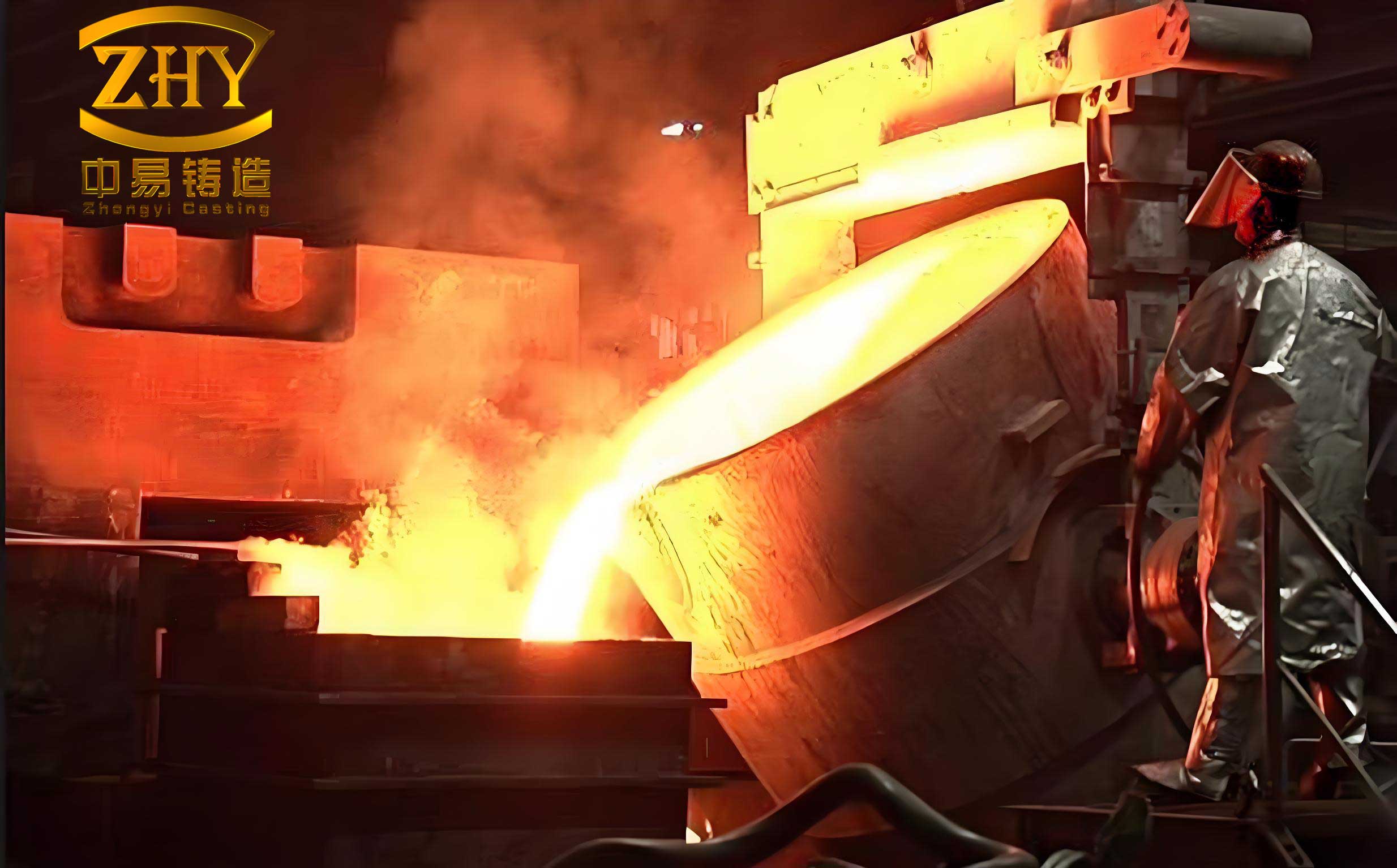
The defining characteristic of this alloy is its fully austenitic microstructure at room temperature after solution heat treatment (water quenching). In its as-cast or heat-treated state, the hardness is relatively modest, typically around 200 HB. However, upon subjection to intense impact or severe compressive deformation, the surface layer undergoes a dramatic transformation. The austenite undergoes strain-induced transformation to martensite and/or develops a high density of dislocations and twins, leading to significant surface hardening, with hardness values soaring to 450-550 HB. This phenomenon is described by the relationship between flow stress and strain:
$$ \sigma = K \epsilon^n $$
where $\sigma$ is the flow stress, $\epsilon$ is the true strain, $K$ is the strength coefficient, and $n$ is the work-hardening exponent, which is exceptionally high for high manganese steel. This outer hardened shell provides outstanding abrasion resistance, while the unaffected core retains its high toughness, making it ideal for components like crusher jaws, cone liners, and dredger pump casings produced in a manganese steel casting foundry.
The casting-related properties of ZGMn13 are pivotal to understanding the zero-riser approach, as summarized below:
| Property | Typical Value for ZGMn13 | Comparison vs. Carbon Steel | Implication for Casting |
|---|---|---|---|
| Liquidus Temperature | ~1350°C – 1400°C | Lower | Allows for lower pouring temperatures. |
| Solidification Range | Wide (~150-200°C) | Wider | Promotes pasty/mushy freezing, long feeding range. |
| Liquid Metal Fluidity | Excellent | Superior | Enfills thin sections even at low superheat. |
| Volumetric Solidification Contraction | High (~6.0%) | ~1.5x Higher | Traditionally requires large risers for feeding. |
| Linear Contraction | 2.4% – 3.0% | Higher | Increases risk of hot tearing; pattern allowances critical. |
| Thermal Conductivity | Low (~12 W/m·K at 20°C) | ~1/4 to 1/5 of CS | Slows heat extraction, promotes thermal gradients, increases stress. |
| As-Cast Strength | Low, Brittle | Lower | Susceptible to cracking during handling; requires careful knockout. |
The high volumetric shrinkage and low thermal conductivity traditionally necessitate the use of massive risers in a conventional manganese steel casting foundry setup, often accounting for 50% or more of the total poured weight. Removing these risers is problematic: pre-heat treatment cutting risks damage, while post-treatment cutting is complex and can induce cracks. The zero-riser philosophy seeks to eliminate this problem at its root by preventing the formation of major shrinkage cavities through precise control of the solidification process.
The Principle of Riserless Casting for High Manganese Steel
The feasibility of zero-riser casting for this alloy hinges on counterbalancing its high liquid contraction with its unique solidification behavior. The core principle is to achieve directional solidification towards the multiple gates, using the gating system itself as the primary feeding source, rather than relying on separate, bulky risers. This is enabled by a combination of low superheat pouring and a meticulously designed running system that promotes rapid heat extraction and controlled thermal gradients.
The theoretical basis lies in managing the solidification time and temperature gradient. The local solidification time $t_f$ for a section of modulus $M$ (Volume/Surface Area) can be approximated by Chvorinov’s rule, modified for the alloy’s properties:
$$ t_f = B \cdot M^n $$
where $B$ is the mold constant (heavily influenced by the mold material and alloy properties) and $n$ is an exponent typically close to 2. For zero-riser success, we aim for the entire casting to solidify in a near-simultaneous manner, but with a slight, controlled progression from the furthest points back to the gates. The gates, being the last to solidify due to continuous hot metal inflow, act as effective feeders.
The total volume deficit due to shrinkage $V_{shrink}$ must be compensated by liquid metal fed from the gating system before it solidifies:
$$ V_{shrink} = \beta \cdot V_{casting} \approx F_{feed} \cdot A_{gate} \cdot v_{feed} \cdot t_{feed} $$
where $\beta$ is the volumetric shrinkage fraction (~0.06), $V_{casting}$ is the casting volume, $F_{feed}$ is an efficiency factor, $A_{gate}$ is the effective cross-sectional area of the gates, $v_{feed}$ is the feeding flow velocity, and $t_{feed}$ is the available feeding time. The zero-riser strategy maximizes $A_{gate}$ and $t_{feed}$ while minimizing $\beta$ (via low superheat) to make this equation balance without a dedicated riser.
Key Technological Pillars of the Zero-Riser Process
Implementing this in a production manganese steel casting foundry requires an integrated system of process controls. The following sections detail the critical pillars.
1. Low Superheat Pouring: The Cornerstone
This is the single most critical parameter. The goal is to pour the metal at a temperature as close as possible to its liquidus temperature, significantly reducing the total liquid contraction. While standard carbon steels may require a superheat of 50-150°C, high manganese steel exhibits excellent fluidity even with minimal superheat. The target pouring temperature range is typically 1410°C to 1460°C, with an optimal point around 1430°C ± 10°C. This demands precise temperature control:
- Melting & Holding: Use of medium-frequency induction furnaces for precise temperature homogeneity and control. Final deoxidation and alloy adjustments are made carefully to avoid excessive temperature drops or rises.
- Temperature Measurement: Dual-mode verification is essential. A quick immersion thermocouple provides a digital readout, while the “ladle test” or “plate test” – observing the solidification skin formation time on a cold iron sample – serves as a reliable, on-the-floor cross-check. For ZGMn13, a solidification skin time of 20-30 seconds often correlates well with the target pouring temperature.
- Pouring Practice: The metal must be transferred quickly from furnace to ladle to pouring to minimize heat loss. Pre-heated ladles are mandatory. Sometimes, small additions of clean, pre-heated returns can be used to fine-tune the temperature in the ladle.
2. Gating System Design for Simultaneous Solidification & Feeding
The gating system is no longer just a delivery channel; it is the integrated feeder. The design objective is to establish minimal temperature differentials across the casting and ensure the gates remain liquid longest.
| Design Element | Principle & Rationale | Typical Design Parameter |
|---|---|---|
| Pouring Position | Orient the casting to place thicker sections lower and near gates, and large flat surfaces vertically to avoid mistruns. The working surface of a jaw plate, for example, should face downward. | Minimize thermal gradients in critical sections. |
| Gating Ratio | Use a pressurized system to promote rapid filling and minimize temperature loss. The sprue well acts as a initial heat reservoir. | $$ A_{sprue} : A_{runner} : A_{gate} \approx 1.0 : 1.2 : 1.5 $$ |
| Runner & Gate Configuration | Multiple, well-distributed gates are crucial. They feed the casting at numerous points, creating short feeding distances. Runner bars are made large in cross-section to act as thermal reservoirs. | Gate count: 4-8 for a medium-sized plate casting. Gate thickness = 0.3 to 0.4 x local casting wall thickness. |
| Ingate Connection | Gates are attached to non-critical areas and designed to be easily knocked off in the brittle as-cast state, minimizing finishing work post-heat treatment. | Tapered or necked design for easy fracture. |
3. Controlled Pouring Dynamics: The “Four-Stage” Technique
The pouring sequence is actively managed to optimize feeding. The classic “Start Fast, Middle Steady, Finish Slow, and Post-feed” method is employed:
- Start Fast: Initiate pouring at a high rate to quickly cover the bottom of the mold and the thin sections, preventing cold shuts or mistruns. This establishes the initial temperature field.
- Middle Steady: Once the metal has risen 25-50mm, reduce to a steady, uninterrupted pour. This maintains a consistent thermal gradient and minimizes turbulence.
- Finish Slow: As the mold fills to 90-95%, drastically slow the pouring rate. This allows the already-poured metal to begin solidifying from the top and sides while the gates remain active.
- Post-feed (Topping Up): After the mold is visibly full, pause for 10-30 seconds. Observe the liquid metal level in the pouring basin or sprue. Almost invariably, it will drop due to bulk liquid contraction. Deliberately top up the sprue 2 to 3 times at intervals. This is the direct, manual feeding action replacing the riser. The final top-up ensures the gates and runner are full of hot metal, ready to feed the final solidification stages.
The mass flow rate during these stages can be conceptually modeled. If $Q_{total}$ is the total casting mass, and $t_{pour}$ is the total pouring time, the average flow rate $\dot{m}_{avg} = Q_{total} / t_{pour}$. In practice:
$$ \dot{m}_{start} \approx 1.8 \cdot \dot{m}_{avg} $$
$$ \dot{m}_{steady} \approx 1.0 \cdot \dot{m}_{avg} $$
$$ \dot{m}_{finish} \approx 0.3 \cdot \dot{m}_{avg} $$
4. Mold and Core Engineering
The mold must work in concert with the process. Key considerations in the manganese steel casting foundry include:
- Mold Material: Chemically bonded silica sand (furan or alkaline phenolic) is standard, providing good collapsibility and surface finish. Zircon or chromite sand may be used for critical faces to improve chilling and surface density.
- Mold Hardness: High and uniform mold hardness (85-90 on the B-scale scale) is essential to resist metal pressure and prevent mold wall movement, which can distort the solidification pattern.
- Venting: Superior venting is non-negotiable. With multiple gates and rapid initial fill, displaced air must escape freely. Vent holes are placed at the highest points opposite ingates. Permeability of the mold sand must be rigorously controlled.
- Chills: External chills (iron or copper) are strategically placed on thick sections or hot spots to accelerate local cooling, promoting directional solidification towards the gates. Their use must be calculated to avoid creating steep thermal stresses that cause hot tears.
Practical Application and Case Analysis
Consider the production of a jaw crusher plate, a classic product of a manganese steel casting foundry. Specifications: Weight ~350 kg, Plan Dimensions ~1000mm x 750mm, Average Thickness ~50mm (with varying sections).
Traditional Method: Would likely use one or two large side risers, total poured weight ~700 kg, yield ~50%. Risers require arduous removal.
Zero-Riser Method Implementation:
- Pattern & Mold: The pattern is mounted with the tooth (working) face down on the drag. A large, tapered runner bar is placed along one or both long sides in the cope. Multiple ingates (6-8) branch from the runner into the non-working back of the jaw plate at regular intervals.
- Pouring Parameters: Target pouring temperature: 1430°C. Tap temperature from furnace: ≤1480°C to allow for ladle transfer cooling.
- Pouring Practice: The four-stage technique is executed meticulously. The post-feed topping is critical; the sprue is refilled twice after an initial pause, consuming an extra 15-20 kg of metal.
- Results: After shakeout and gate removal (by hammer strike in as-cast state), radiographic and ultrasonic testing reveals no major shrinkage porosity in the body. The microstructure shows refined, equiaxed austenitic grains with no columnar zones, as the low superheat and rapid heat extraction discourage directional grain growth.
The benefits are tangible:
$$ Yield_{new} = \frac{350}{350+20} \approx 94.6\% $$
$$ Yield_{improvement} = 94.6\% – 50\% = 44.6\% $$
This represents a dramatic reduction in melting energy, cleaning labor, and riser removal risk.
Challenges, Limitations, and Quality Control
While powerful, the zero-riser technique is not a universal solution for every manganese steel casting foundry. Its application has boundaries:
| Challenge | Description & Cause | Mitigation Strategy |
|---|---|---|
| Casting Size/Weight | The technique is most reliable for castings under ~1000 kg. Larger volumes have greater total liquid contraction, exceeding the feeding capacity of even enlarged gating systems. | For larger castings, use of small, efficient “knock-off” risers on isolated heavy sections combined with zero-riser principles for the main body. |
| Section Thickness Variation | Extreme variations (e.g., very thick hubs on thin plates) create uncontrollable thermal gradients, leading to shrinkage in the heavy section or hot tears at junctions. | Redesign to more uniform wall thickness. Apply intensive chilling on thick sections. Use of modest risers may be unavoidable. |
| Hot Tearing | Low thermal conductivity and high shrinkage strain concentrated at thermal “hot spots” or constraints can cause tearing in the brittle temperature range. | Improve mold collapsibility. Use of rounded fillets. Strategic placement of mold “soft spots” (e.g., cork inserts) to allow contraction. Careful design to avoid mechanical hindrance to contraction. |
| Surface Defects | Low pouring temperature can sometimes lead to “cold laps” or “flow marks” on large flat surfaces if filling is too slow initially. Sand burning/penetration can occur due to the metal’s high fluidity. | Ensure “Start Fast” is sufficiently vigorous. Use of high-quality, finely-grained facing sand with adequate refractory coatings (zircon-based washes). |
Quality control in a zero-riser manganese steel casting foundry must be stringent. Every batch requires verification of:
1. Chemical composition (Mn/C ratio >10 for austenite stability).
2. Pouring temperature records.
3. Non-destructive testing (NDT) on first-off castings: Radiography for internal soundness, Dye-Penetrant Inspection for surface defects.
4. Destructive testing on coupons: Microstructure analysis to confirm absence of continuous carbide networks and shrinkage.
Economic and Metallurgical Advantages
The adoption of zero-riser casting translates into significant competitive advantages for a manganese steel casting foundry:
Economic Impact:
– Yield Increase: Riser metal reduction from ~50% to <10% drastically improves material utilization.
– Energy Savings: Melting less metal per casting reduces electricity or fuel consumption proportionally.
– Labor Efficiency: Eliminates riser cutting and associated grinding, a labor-intensive and hazardous operation.
– Throughput Increase: More castings can be produced per furnace melt, and cleaning time is reduced.
The total cost saving $C_{save}$ per casting can be modeled as:
$$ C_{save} = (M_{riser} \cdot P_{metal}) + C_{cutting} + C_{grinding} + \Delta C_{energy} – C_{process-control} $$
where $M_{riser}$ is the mass of riser saved, $P_{metal}$ is the cost per kg of liquid metal, $C_{cutting/grinding}$ are the saved labor/consumable costs, $\Delta C_{energy}$ is the saved melting energy cost, and $C_{process-control}$ is the potentially increased cost of tighter process monitoring.
Metallurgical Quality Improvements:
– Finer Grain Structure: Low superheat pouring promotes heterogeneous nucleation, leading to a fine, equiaxed grain structure, which enhances both toughness and wear properties after work-hardening.
– Reduced Segregation: Faster solidification minimizes microsegregation of carbides.
– Lower Residual Stress: More uniform cooling reduces thermal stresses in the as-cast state, lowering the risk of cracking during subsequent handling and heat treatment.
Future Perspectives and Conclusion
The zero-riser technique represents a sophisticated application of solidification science tailored to the specific properties of high manganese steel. For a modern manganese steel casting foundry, it is a pathway to higher quality, sustainability, and profitability. Future advancements will likely integrate real-time process monitoring—such as thermal imaging of molds during pouring and solidification, and advanced simulation software to predict shrinkage and optimize gating designs for each new component geometry with greater accuracy.
Successful implementation demands a holistic view: it is not just omitting a riser, but orchestrating melting, molding, pouring, and process control into a coherent system. When executed with precision, it proves that understanding and working with a material’s inherent characteristics, rather than fighting them with oversized feeders, leads to superior engineering outcomes. The manganese steel casting foundry that masters this technique positions itself at the forefront of producing high-integrity, cost-effective wear-resistant components for the most demanding industrial applications.