
In my years of experience working in a manganese steel casting foundry, I have observed that cracking defects remain one of the most persistent and costly challenges. High manganese steel, renowned for its exceptional work-hardening capability and toughness under impact, is indispensable in applications like mining machinery, crusher parts, and railway components. However, the very properties that make it valuable—such as high linear shrinkage and low thermal conductivity—also predispose it to crack formation during casting and in service. This article delves into the mechanisms behind crack initiation and propagation, drawing from practical insights to outline comprehensive preventive strategies. The goal is to equip foundry professionals with knowledge to enhance quality and durability in manganese steel casting operations.
The genesis of cracks in manganese steel castings can be traced to interplay between intrinsic material characteristics and extrinsic process variables. From a foundational perspective, the high manganese steel alloy typically contains 10-14% manganese and 0.9-1.4% carbon, forming an austenitic structure that provides toughness. Yet, this structure is sensitive to processing conditions. In a manganese steel casting foundry, the production cycle—from melting and pouring to molding and heat treatment—must be meticulously controlled to mitigate crack risks. I will first explore the reasons for cracking during casting, then address failure mechanisms in service, and finally propose preventive measures backed by empirical evidence.
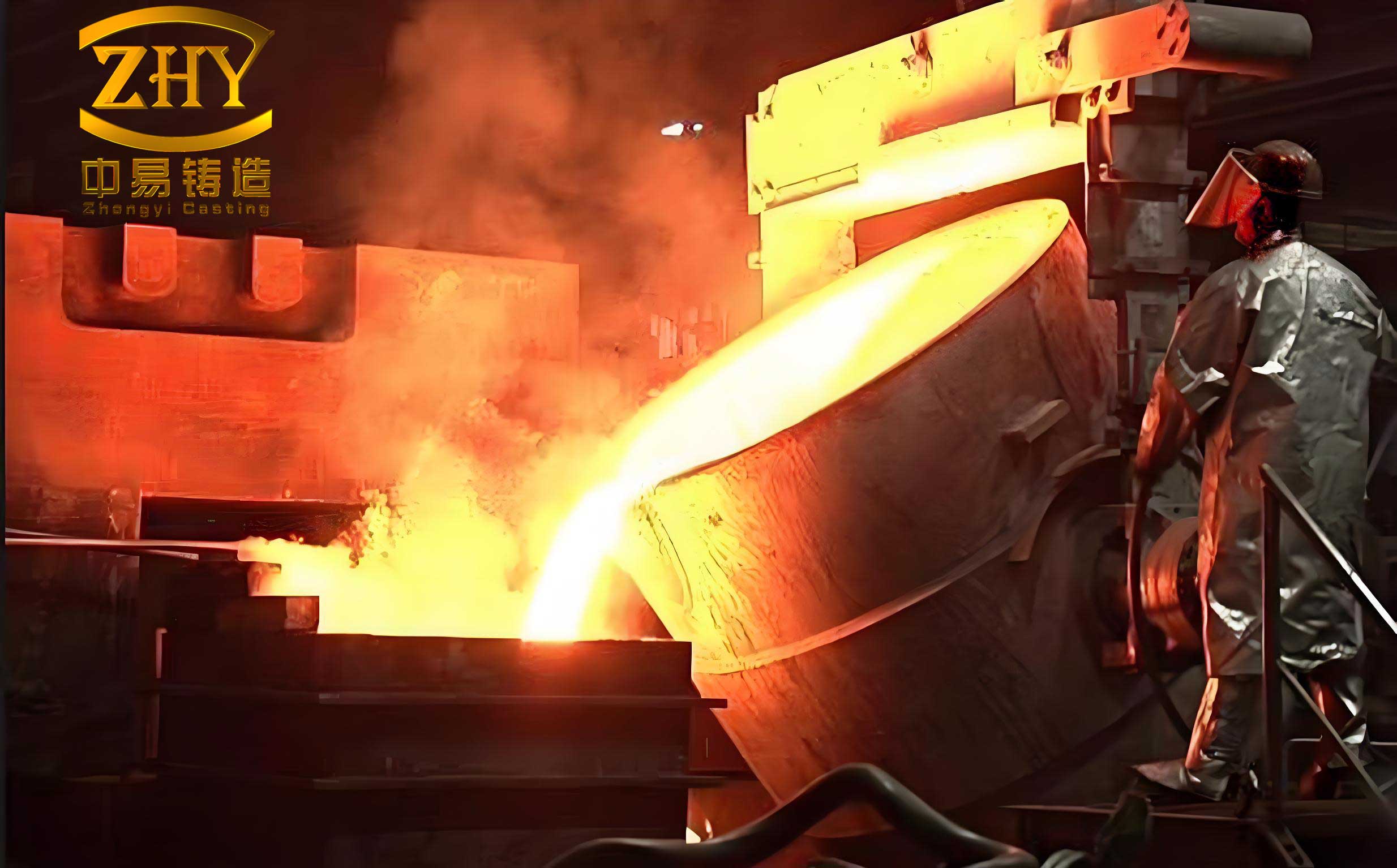
Analysis of Crack Formation During Casting
Cracks that emerge in the casting phase are primarily due to three intrinsic factors: high linear shrinkage, low thermal conductivity, and coarse microstructure. Let me break these down based on my observations in a manganese steel casting foundry.
First, the linear shrinkage of high manganese steel is approximately 2.4-3.0%, which is about double that of carbon steel. This significant contraction during solidification generates substantial tensile stresses if hindered by mold constraints. The stress (σ) can be approximated by Hooke’s law for thermal strain: $$ \sigma = E \cdot \alpha \cdot \Delta T $$ where E is Young’s modulus, α is the coefficient of thermal expansion, and ΔT is the temperature drop. For manganese steel, α is relatively high, contributing to stress buildup.
Second, the thermal conductivity (k) of manganese steel is low, roughly one-fourth to one-sixth that of carbon steel. This poor heat dissipation creates steep temperature gradients within the casting, leading to thermal stresses. The thermal stress can be modeled as: $$ \sigma_{thermal} = \frac{E \alpha \Delta T}{1 – \nu} $$ where ν is Poisson’s ratio. In practice, these stresses often exceed the material’s strength at elevated temperatures, causing hot tears or cold cracks.
Third, the as-cast microstructure tends to feature coarse columnar grains and interdendritic carbides. During solidification, carbon and other elements segregate to grain boundaries, forming brittle networks that reduce cohesion. This embrittlement, combined with shrinkage and thermal stresses, creates ideal conditions for crack initiation. Moreover, defects like shrinkage porosity, non-metallic inclusions, and phosphorus eutectics act as stress concentrators, further promoting crack nucleation.
To quantify these effects, I have compiled common defect sources in Table 1, which summarizes key factors in a manganese steel casting foundry environment.
| Factor | Typical Range/Manifestation | Impact on Cracking |
|---|---|---|
| Linear Shrinkage | 2.4-3.0% | High tensile stress if restrained |
| Thermal Conductivity | ~15 W/m·K (vs. 60 for carbon steel) | Large thermal gradients and stress |
| Carbon Content | 0.9-1.4% | Higher carbon increases carbide precipitation |
| Phosphorus Content | >0.05% detrimental | Forms brittle phosphides at grain boundaries |
| Pouring Temperature | 1430-1460°C ideal | Excessive temperature coarsens grains |
| Mold Restraint | High in quartz sand molds | Inhibits contraction, raising stress |
Crack Mechanisms in Service Under High Impact
Beyond the foundry, manganese steel castings in demanding applications like crusher jaws or mill liners can fail prematurely due to cracking. This is often a fatigue-driven process, where subsurface defects evolve into macrocracks under cyclic loading. In a manganese steel casting foundry, we must recognize that casting flaws become nucleation sites for service cracks.
The failure sequence involves three stages: crack nucleation, propagation, and final fracture. Nucleation typically occurs at microvoids left by dissolved carbides after heat treatment, or at inclusions and shrinkage cavities. Under impact, the surface work-hardens, developing high hardness (450-550 HB), but subsurface regions remain softer. The disparity in properties, coupled with stress concentrations from defects, initiates microcracks. These cracks grow via fatigue, eventually leading to spalling or catastrophic fracture.
Contact fatigue is another mode, where repeated high-stress cycles cause subsurface crack initiation below the Hertzian stress zone. The equation for maximum shear stress (τ_max) in contact fatigue is: $$ \tau_{max} = 0.3 p_0 $$ where p_0 is the maximum contact pressure. When this stress exceeds the material’s endurance limit, cracks nucleate and propagate to the surface, causing pitting and剥落. This underscores the importance of sound internal quality in manganese steel casting foundry outputs.
Preventive Measures: A Holistic Approach
Preventing cracks requires integrated strategies across design, metallurgy, and processing. In a manganese steel casting foundry, each step must be optimized to address the unique challenges of this alloy.
1. Design and Patternmaking
Castings should have uniform wall thicknesses and generous fillet radii to minimize stress concentrations. Avoiding sharp transitions and hot spots reduces thermal gradients. From my experience, collaborative design reviews between engineers and foundry technicians are crucial to ensure manufacturability.
2. Molding and Coremaking
Mold materials must offer good collapsibility to accommodate shrinkage. I recommend using limestone sand or resin-bonded sands over quartz sand, as they provide better yield. Coatings like magnesite or zircon refractory can prevent sand burn-on, which increases friction and stress. Additionally, proper venting and gating design are essential to avoid mold dilation and fin formation, which can act as stress risers.
3. Gating and Risering System
A well-designed gating system ensures rapid, turbulent-free filling. The cross-sectional area should be about 20% larger than for carbon steel castings to facilitate quick pouring. Multiple ingates should be arranged to minimize restraint; ideally, use a single ingate or carefully placed ones to avoid hindering contraction. Risers should be side- or neck-type to ease removal without inducing cracks during cutting. Chills can be employed to control solidification, but spacing must be optimized to prevent abrupt cooling differences. The relationship between chill spacing (F) and crack risk is empirical: if F is too large, intermediate regions cool slowly, promoting cracks.
4. Chemical Composition and Melting
Control of carbon and phosphorus is paramount. For high-impact parts, carbon should be kept at 0.9-1.0%, while for wear-resistant applications, up to 1.2% is acceptable. Phosphorus must be below 0.05%. During melting, a reducing slag with FeO+MnO ≤ 1.2% is vital to minimize oxide inclusions. Adding rare earth elements (e.g., 0.1-0.2% rare earth silicide) enhances deoxidation and grain refinement, significantly reducing crack susceptibility. The effect can be expressed as a refinement factor: $$ G = \frac{k}{d} $$ where G is grain size, k is a constant, and d is the density of nucleation sites increased by rare earths.
5. Pouring and Solidification Control
Low-temperature, high-speed pouring (1430-1460°C) is advocated to refine grains and reduce shrinkage stress. After pouring, controlled cooling is necessary; premature shakeout at high temperatures can induce thermal stresses. I advise using insulated boxes or slow cooling furnaces for complex castings. The temperature-time profile during cooling should avoid the brittle temperature range (around 700-900°C) where strength is low.
6. Heat Treatment
Water toughening (quenching from 1050-1100°C) is standard to dissolve carbides into austenite. However, heating rates must be gradual (50-80°C/h below 650°C) to prevent thermal shock. Soaking times should ensure uniform temperature, and quenching must be rapid to avoid carbide reprecipitation. The process can be summarized by the kinetic equation for carbide dissolution: $$ C(t) = C_0 e^{-kt} $$ where C(t) is carbide concentration, C_0 is initial concentration, k is a rate constant, and t is time at temperature.
7. In-Service Crack Prevention
To enhance service life, castings must be free from internal defects. Non-destructive testing (e.g., ultrasonic inspection) can detect subsurface flaws. Moreover, optimizing the microstructure through grain refinement and homogeneous carbide distribution improves fatigue resistance. In a manganese steel casting foundry, implementing statistical process control for key parameters like composition and pouring temperature can yield more consistent products.
Table 2 synthesizes preventive actions across the production chain in a manganese steel casting foundry.
| Process Stage | Preventive Action | Expected Outcome |
|---|---|---|
| Design | Avoid thickness variations; use fillets | Reduced stress concentration |
| Molding | Use collapsible sands; apply refractory coatings | Lower mold restraint; less friction |
| Gating | Large, smooth gating; strategic chill placement | Uniform cooling; minimized hot tears |
| Melting | Control C, P; add rare earths; reduce slag oxides | Refined grains; fewer inclusions |
| Pouring | Pour at 1430-1460°C; fast filling | Finer microstructure; less shrinkage |
| Heat Treatment | Slow heating; proper quenching | Carbide dissolution; tough austenite |
| Quality Control | NDT; process monitoring | Early defect detection; consistency |
Advanced Considerations and Formulas
To deepen understanding, let’s consider some quantitative aspects. The crack susceptibility during solidification can be assessed using the hot tearing index (HTI), which for manganese steel can be approximated as: $$ HTI = \frac{\Delta T_s}{S} $$ where ΔT_s is the solidification range and S is the strength at high temperature. A higher HTI indicates greater cracking risk. In practice, narrowing the solidification range through composition control (e.g., lower carbon) reduces HTI.
Another key aspect is the effect of grain size on toughness, per the Hall-Petch relation: $$ \sigma_y = \sigma_0 + \frac{k_y}{\sqrt{d}} $$ where σ_y is yield strength, σ_0 is friction stress, k_y is a constant, and d is grain diameter. Finer grains (smaller d) increase strength and toughness, mitigating crack propagation. This justifies grain refinement efforts in a manganese steel casting foundry.
Furthermore, the role of residual stresses post-heat treatment can be modeled using thermal elasticity. The residual stress (σ_res) after quenching depends on the cooling rate difference between surface and core: $$ \sigma_{res} = E \alpha (T_{core} – T_{surface}) $$ Slow cooling rates or interrupted quenching can minimize these stresses.
Conclusion
In summary, cracking in manganese steel castings is a multifaceted issue rooted in material properties and process-induced stresses. Through systematic analysis and control, foundries can significantly reduce crack incidence. Key takeaways include: adopting low-carbon compositions for high-impact parts, employing grain refiners like rare earths, optimizing gating and molding for minimal restraint, and enforcing strict heat treatment protocols. The integration of these measures, coupled with continuous monitoring, will enhance the reliability and longevity of manganese steel components. As a practitioner in a manganese steel casting foundry, I emphasize that prevention is always more cost-effective than remediation, and a proactive approach grounded in metallurgical principles is indispensable for success in this demanding field.
Ultimately, the journey toward crack-free castings involves constant learning and adaptation. By sharing insights and standardizing best practices, the manganese steel casting foundry industry can overcome these challenges, delivering superior products that withstand the rigors of heavy-duty applications. Let us continue to innovate and refine our processes, ensuring that every casting meets the highest standards of quality and performance.